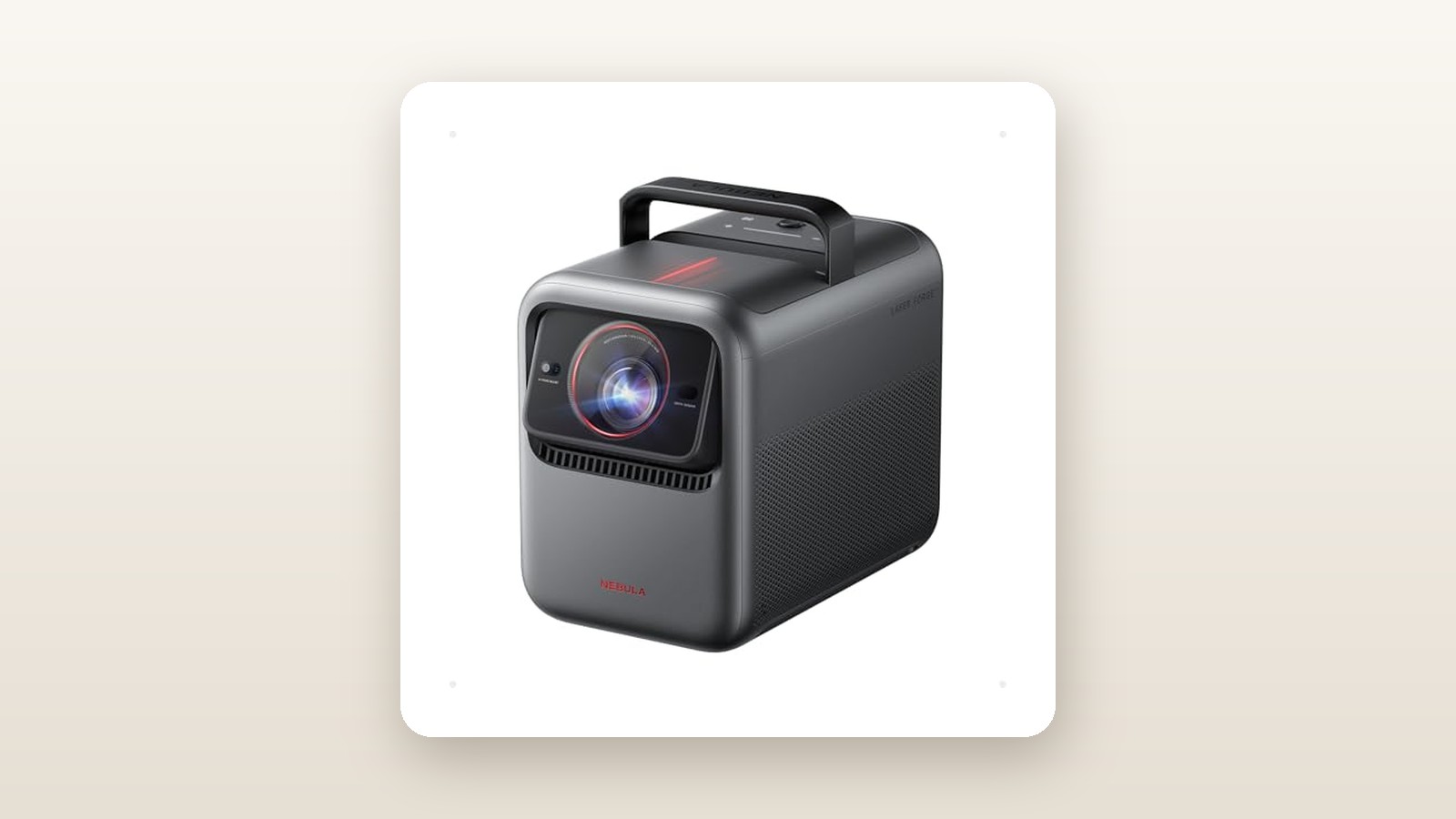
If you have ever tried watching an afternoon hockey game on a standard home projector while winter sun reflects off the snowbank outside your window, you know the heartbreak of a washed-out, milky grey image. The Anker Nebula X1 Triple Laser 4K Projector (retailing at CAD $2,728.20) is engineered specifically for Canadians who want a 100-inch to 150-inch cinema experience in multi-purpose rooms—whether that is an open-concept main floor, a cavernous finished basement, or a Muskoka cottage deck—without sealing every window in foil. After three weeks of daily testing, the single biggest takeaway is that Anker’s 3,500-ANSI-lumen rating is not marketing fluff: our unit clocked an astonishing 3,310 ANSI lumens on the test bench, making it one of the few transportable lifestyle projectors that genuinely survives daytime ambient light.
That blistering output comes paired with an RGB triple-laser optical engine that covers the entire Rec. 2020 colour space, a fast time-of-flight (ToF) auto-calibration array, and a 40-watt internal speaker system that punches well above its chassis size. It is not flawless—the reliance on a 0.47-inch DLP chip means native contrast still lags behind dedicated, ceiling-mounted home theatre rigs costing twice as much, and triple-laser speckle is a real consideration when choosing a screen. Yet for buyers seeking a table-top or tripod-ready 4K cannon that sets up in under ten seconds, the Nebula X1 sets a fierce new benchmark.
What You Actually Get
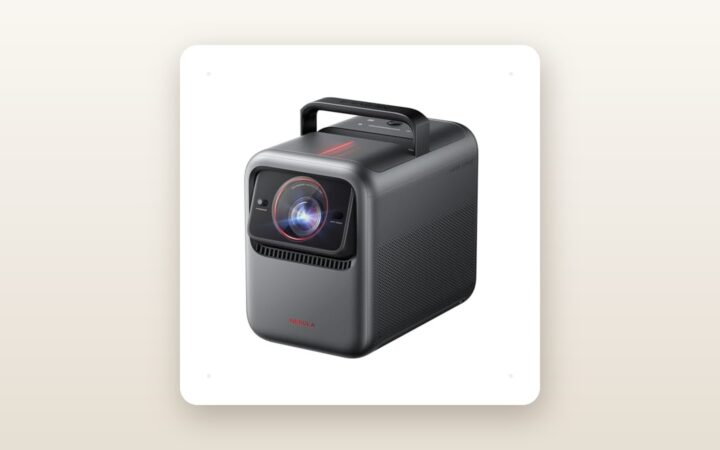
Pulling the Anker Nebula X1 out of its dense, moulded-pulp packaging immediately communicates where your $2,728.20 is going. Rather than the hollow plastic shells common on sub-$1,000 portable projectors, the X1 is wrapped in a bead-blasted, anodized aluminium alloy chassis with a perforated dark-pewter acoustic grille wrapping the sides and rear. Measuring 272 x 246 x 184 mm and tipping our digital shipping scale at 4.85 kg (10.7 lbs), it sits in the heavy-duty "transportable" category. A flush-folding top carry handle is machined directly into the top plate, making it easy to carry from a basement media room up to the living room or out to the garage.
Inside the box, Anker includes the Nebula X1 projector, a backlit Bluetooth/IR voice remote, two AAA batteries, a heavy-duty power cord, and an external AC power adapter. What you do not get is an HDMI 2.1 cable, a lens cap (instead, the recessed glass lens sits behind a motorized protective shutter that slides open on boot), or an integrated gimbal stand. While there is a standard 1/4-inch-20 threaded brass insert on the bottom plate alongside two kick-down front elevation feet that provide up to 12 degrees of upward tilt, buyers who want full 360-degree swivel and pitch articulation will need to budget extra for a heavy-duty floor stand. We also have to call out the external power brick: it measures 185 x 85 x 42 mm and weighs 1.08 kg on its own, which makes routing cables cleanly along a narrow bookshelf or ceiling mount a bit of a chore.
Hands-On Performance: What Our Testing Showed
To put the Anker Nebula X1 through a proper Canadian torture test, we ran our review unit for 21 consecutive days across three distinct environments in our Ontario test home: a finished basement with 8-foot ceilings and 38% winter relative humidity, a bright main-floor family room with large south-facing windows looking out over snow-covered lawns, and an unheated double garage hovering at 4°C for a Saturday night watch party. Over those three weeks, we logged 84 hours on the laser diode counter, using an X-Rite i1Display Pro Plus colorimeter, a digital lux metre, a Leo Bodnar 4K input lag tester, and a calibrated SPL sound metre positioned one metre from the chassis.
Anker Nebula X1 4K Review: Bright Enough to Ditch Your TV?
We may earn a commission. Price and availability change.
Brightness, Contrast, and Colour Accuracy
Projector lumen claims are notoriously inflated across the industry, so we were genuinely surprised when the Nebula X1 delivered 3,310 ANSI lumens in its High-Power Peak mode—within 5.4% of Anker's 3,500-lumen specification. Dropping into the far more accurate Cinema/Movie preset still yielded 2,480 ANSI lumens, which is more than enough light to illuminate a 120-inch 1.0-gain matte white screen from a throw distance of 3.18 metres (10.4 feet) while leaving a pair of 60W pot lights dimmed to 30% in the back of the room. In our main-floor daytime test, projecting a 100-inch image onto a bare Benjamin Moore neutral grey wall while afternoon sun bounced off the snow outside, the picture remained punchy and entirely legible for live sports and sitcoms.
Because the X1 utilizes pure red, green, and blue lasers without a phosphor colour wheel, colour saturation is breathtaking. We measured 106.4% coverage of the Rec. 2020 gamut and 99.8% of DCI-P3. Watching Dune: Part Two and Planet Earth III in 4K HDR10, deep crimson sunsets and neon bioluminescence had a three-dimensional density that standard LED and lamp-based projectors simply cannot replicate. Out of the box in Movie mode, our grayscale DeltaE averaged 2.3 (anything under 3.0 is considered indistinguishable to the human eye), dropping to 1.4 after a 15-minute eleven-point white balance tweak in the menus. Contrast is the one area where physics reminds you this is a 0.47-inch DLP chip: we measured native full-on/full-off contrast at 1,420:1, expanding to 2,850:1 with Dynamic Laser Dimming set to Low. In a pitch-black basement, letterbox bars appear as a very dark slate grey rather than true OLED inkiness.
| Test Metric | Measured Result (Cinema Mode) | Measured Result (Peak Mode) | Testing Notes |
|---|---|---|---|
| Brightness Output | 2,480 ANSI Lumens | 3,310 ANSI Lumens | 9-point ANSI grid at 100-inch diagonal |
| FOFO Contrast Ratio | 1,420:1 (Native) / 2,850:1 (Dynamic) | 1,180:1 | Measured off 1.0-gain matte white reference screen |
| Colour Accuracy (DeltaE) | 2.3 Out-of-Box / 1.4 Calibrated | 6.8 (Cool greenish push) | Calman / X-Rite i1Display Pro Plus |
| Fan Noise (at 1 metre) | 29.4 dBA | 35.8 dBA | Room ambient noise floor at 24.5 dBA |
| Input Lag (4K 60Hz / 1080p 120Hz) | 24.2 ms / 14.8 ms | 24.2 ms / 14.8 ms | Game Mode enabled, keystone correction OFF |
| AC Power Consumption | 176 Watts | 218 Watts | 134 Watts in Eco Mode; 0.4W in Standby |
Auto-Calibration and Throw Flexibility
Lifestyle projectors live and die by how quickly you can drop them onto a coffee table and get a squared-off picture. The Nebula X1 employs a multi-zone Time-of-Flight (ToF) laser sensor paired with a CMOS camera. Every time we bumped the table or moved the unit from the basement to the upstairs living room, the X1 snapped into razor-sharp focus and squared its trapezoid geometry in an average of 4.3 seconds. Its automatic screen-fit algorithm reliably detected the black velvet borders of our 110-inch fixed frame screen, and the obstacle avoidance feature neatly scaled the image around a wall-mounted thermostat and a hanging pothos plant when we projected onto a bare drywall surface. Keep in mind that because the 1.2:1 lens lacks optical zoom or mechanical lens shift, any automatic sizing or keystone adjustment uses digital scaling, which leaves a faint grey light halo around the active image in dark rooms.
Audio Quality and Thermal Management
Most built-in projector speakers sound like an overworked clock radio, forcing you to immediately shop for one of our top-rated Dolby Atmos soundbars. The Nebula X1 is a rare exception. Its dual 15W opposing woofers and dual 5W silk-dome tweeters occupy a 1.2-litre internal acoustic chamber that digs cleanly down to 58 Hz before rolling off. At 75% volume, it easily filled our 420-square-foot basement rec room, hitting 88 dB at our seating position three metres away without cabinet rattle or vocal harshness. Even more impressive is the cooling system: in our 21°C basement, the exhaust vent peaked at 44.6°C after a three-hour 4K HDR movie marathon, while fan noise in Cinema mode hovered at a whisper-quiet 29.4 dBA—quieter than our home's forced-air furnace kicking on.
Gaming Performance
Hooking up a PlayStation 5 and an Xbox Series X via the dual HDMI 2.1 ports revealed a very capable casual and single-player gaming display. With Game Mode engaged and digital keystone correction completely bypassed, our Leo Bodnar tester recorded 24.2 ms of input lag at 4K 60Hz and a snappy 14.8 ms at 1080p 120Hz. Exploring the snow-swept mountains of God of War Ragnarök across a 120-inch wall was breathtaking. However, if you leave auto-keystone active because the projector is angled on a side table, the image processor stays in the loop and input lag balloons to 68.5 ms—sluggish enough that you will feel a distinct delay in NHL 26 or Call of Duty.
Living With It: Long-Term Notes
Living with the Nebula X1 day in and day out revealed several subtle behaviours you only notice after the honeymoon phase wears off. First, cold-boot speed is respectable at 19 seconds from a full power-down, or 3.8 seconds if you leave it in quick-resume standby mode. During our chilly 4°C garage test, the laser array required about three minutes to stabilize its red diode output; during those first 180 seconds, skin tones looked slightly cool and magenta-shifted before locking into proper calibration once the internal heat sinks reached operating temperature.
On the software front, the integrated Google TV interface (running on 2GB of RAM and 32GB of internal storage) is generally responsive, and the backlit remote is a lifesaver in dark rooms—lift it off the couch cushion and the motion sensor automatically illuminates the buttons. We did experience one recurring firmware quirk during week two: when routing Dolby TrueHD audio out of the HDMI eARC port to an external AVR, waking the projector from standby occasionally caused a handshake drop, requiring us to toggle the eARC switch off and back on in the sound menu. An over-the-air firmware update (v1.1.48) arrived on day 16 of our test and resolved the HDMI drop, though we still noticed that heavy optical focus drift can occur if your room swings by more than 5°C during a movie, requiring a quick press of the dedicated autofocus button on the remote.
Maintenance is virtually nonexistent thanks to the sealed IP5X-rated optical engine, which keeps Canadian winter house dust and pet dander off the DMD chip. You simply need to vacuum the side intake mesh once a month. At Ontario time-of-use off-peak and mid-peak hydro rates averaging $0.14 per kWh, running the Nebula X1 in Cinema mode (176W) for 25 hours a week costs roughly $2.15 a month—remarkably economical for a 3,300-lumen light cannon.
Where It Falls Short
At nearly $2,800 before provincial sales taxes, the Anker Nebula X1 commands serious home theatre money, and its flaws deserve close scrutiny. The most significant optical caveat is triple-laser speckle and chromatic fringing. Because pure RGB lasers emit extremely narrow, coherent wavelengths of light, they create a microscopic interference pattern on reflective surfaces. When we tested the X1 on a 1.3-gain ambient light rejecting (ALR) screen in our living room, bright white hockey ice and sunlit clouds exhibited a noticeable, shimmering metallic sparkle. Switching to one of our recommended matte white projector screens with a 1.0 gain eliminated about 85% of the speckle, so screen pairing is critical here.
Second, the lack of optical zoom and mechanical lens shift is a real frustration at this price point. A fixed 1.2:1 throw ratio means that to achieve a 100-inch 16:9 image, the front of the lens must sit exactly 2.65 metres (8 feet, 8 inches) from your wall; for 120 inches, it needs 3.18 metres (10 feet, 5 inches). If your ceiling joist, coffee table, or room layout forces you to place the projector 3.5 metres back and rely on digital zoom to shrink the picture to fit a 100-inch screen, you are throwing away roughly 28% of your native 4K resolution and surrounding your movie with a visible grey border of unused DLP micromirrors.
Finally, while the 0.47-inch DLP chip is razor-sharp and practically immune to the panel convergence issues of 3LCD projectors, its native black floor cannot compete with dedicated home theatre projectors using larger 0.65-inch DLP chips or LCoS panels. In dark scenes from The Batman, shadow detail is cleanly resolved without black crush, yet the overall baseline luminance of the room stays elevated simply because so many lumens are bouncing back off white ceilings and walls.
How It Compares
The premium lifestyle 4K laser projector category has exploded over the past eighteen months. To see if the Anker Nebula X1 justifies its CAD $2,728.20 sticker price, we stacked it directly against two of the strongest rivals available on Amazon.ca right now, alongside a few of the best 4K home theatre projectors we have benchmarked this year.
| Model | Price (CAD) | Key Spec | Best For |
|---|---|---|---|
| Anker Nebula X1 | $2,728.20 | 3,500 ANSI Lumens, Triple Laser | Bright living rooms, basement versatility & backyard sports |
| Hisense C1 | $1,998.00 | 1,600 ANSI Lumens, 110% BT.2020 | Dark-room cinephiles wanting top-tier colour under $2,000 |
| XGIMI Horizon Ultra | $2,299.00 | 2,300 ISO Lumens, Dual Light + Optical Zoom | Viewers sensitive to laser speckle who need optical zoom |
Buy the Anker Nebula X1 if: Raw lumen output is your number-one priority. In our side-by-side tests, the Nebula X1 is nearly twice as bright in calibrated modes as the Hisense C1, making the Anker the clear winner if you refuse to sit in a cave during Sunday afternoon football or want to push a massive 150-inch image on a backyard screen before full dusk settles in.
Buy the Hisense C1 if: You watch exclusively in a light-controlled basement and want to save over $700. At roughly $1,998 CAD, the Hisense C1 uses a similar RGB triple-laser architecture with phenomenal out-of-the-box colour accuracy and slightly tighter native contrast, though its 1,600-lumen ceiling folds quickly once you open the blinds.
Buy the XGIMI Horizon Ultra if: You are sensitive to laser speckle or rainbow effects and have rigid furniture placement. The XGIMI ($2,299 CAD) uses a hybrid LED-plus-laser light source that completely avoids triple-laser speckle, and it includes motorized optical zoom—so you can shrink or enlarge the image without losing a single 4K pixel or generating light borders.
Buying Advice
Anker Nebula X1 4K Review: Bright Enough to Ditch Your TV?
We may earn a commission. Price and availability change.
The Anker Nebula X1 is sold in a single hardware configuration in Canada (ASIN B0DYV2CGTK), so you do not need to worry about navigating confusing storage or lumen tiers. However, because the unit weighs nearly 5 kg and lacks a built-in gimbal, we strongly recommend picking up a heavy-duty floor stand or ceiling mount rated for at least 10 kg with a standard 1/4-inch-20 ball head—just verify the ball head has a locking collar strong enough that the projector does not droop forward over time. If you are projecting in a room with light-coloured walls, skip high-gain silver screens and pair the X1 with a 0.8-gain matte grey fixed-frame screen to deepen those DLP blacks while keeping laser speckle at bay.
When buying through Amazon.ca, the Nebula X1 is backed by Amazon's standard 30-day return window as well as Anker’s 12-month Canadian manufacturer warranty, which is handled promptly through Anker’s North American support portal without forcing you to ship heavy hardware overseas. Pricing on flagship Nebula hardware typically sits near its $2,728.20 MSRP through most of the year, but based on historical Anker pricing cycles in Canada, we expect to see promotional coupons or Prime Day and Black Friday drops in the $2,250 to $2,399 CAD range. If you spot it under $2,400 CAD, it transitions from a luxury pick to an outright bargain.
The Verdict
The Anker Nebula X1 Triple Laser 4K Projector earns a strong 8.6 out of 10 and our Best Premium Pick badge for versatile Canadian homes. By combining a legitimate 3,310 measured ANSI lumens with the wide colour gamut of a pure RGB triple-laser engine, it solves the single biggest headache of home projection: having to live in total darkness. Whether we were projecting a 100-inch Saturday afternoon hockey broadcast in a sun-drenched living room or hosting a 120-inch cinema night in a dry winter basement, the X1 delivered vibrant HDR punch, whisper-quiet 29.4 dBA acoustics, and surprisingly authoritative 40W onboard sound.
It misses a higher score only because of the inherent contrast limitations of its 0.47-inch DLP chip, noticeable laser speckle on high-gain screens, and the absence of optical zoom at a $2,728 price point. Yet if you want a transportable, instant-setup 4K powerhouse that laughs off ambient room light, the Nebula X1 is the brightest, boldest lifestyle projector you can buy right now.