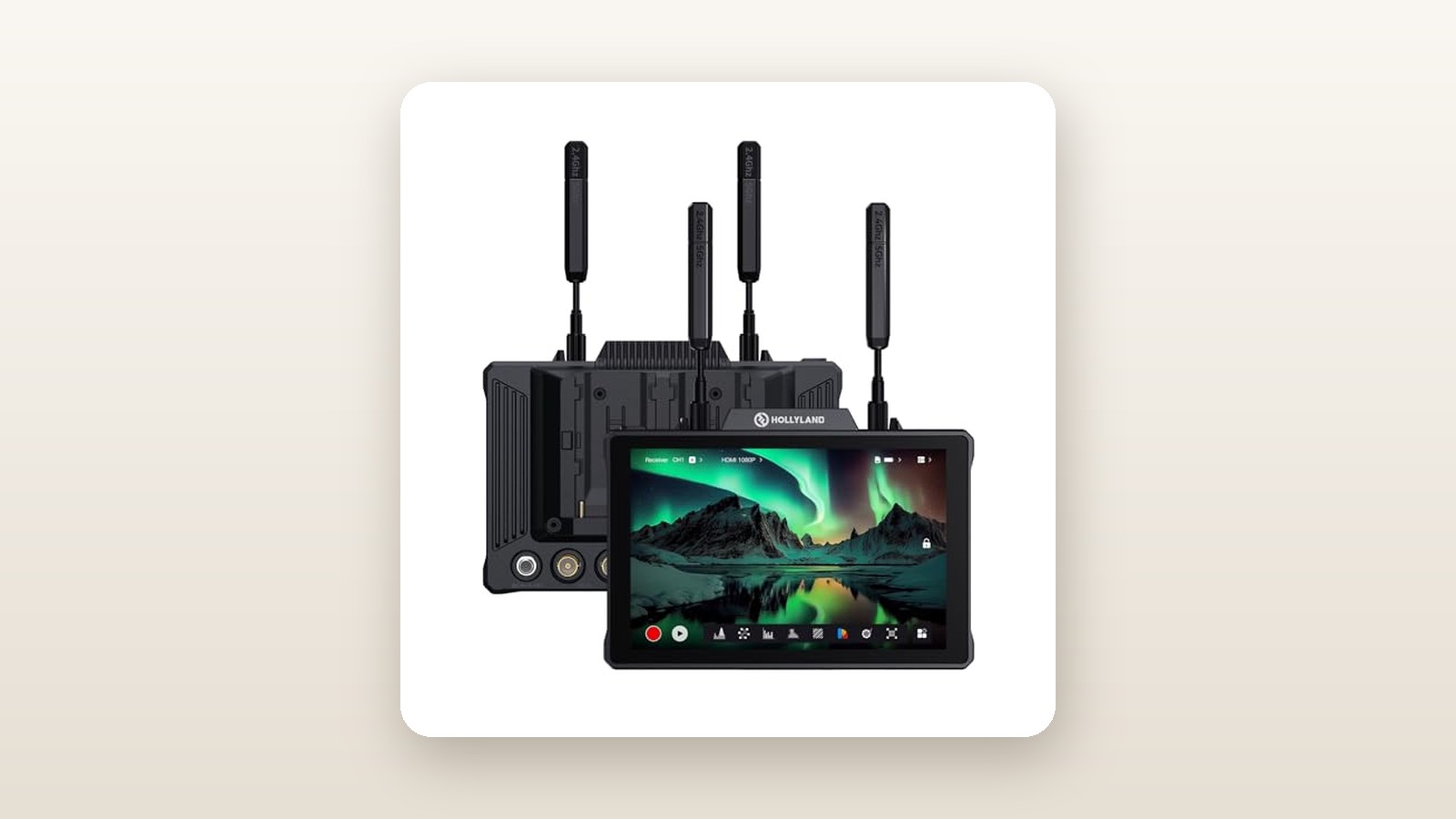
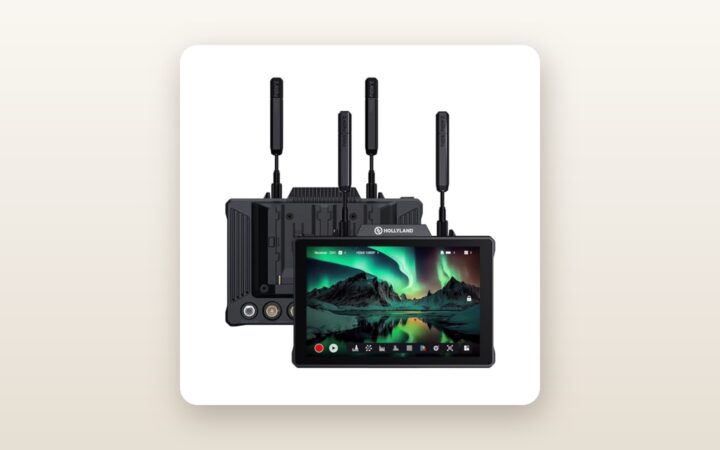
If you have ever built a wireless director's monitor rig from scratch, you know the frustration of the classic 'Frankenstein' setup: a 7-inch screen, a bolt-on wireless receiver, two separate Sony NP-F batteries, a rat's nest of short SDI or HDMI patch cables, and a heavy cage holding it all together. The Hollyland Pyro 7 (sold under the HollyView storefront on Amazon.ca for $1,015.92 CAD) eliminates that entire mess by fusing a 1,500-nit field monitor, a dual-band wireless transmitter, and a wireless receiver into a single 545-gram chassis. It is purpose-built for Canadian indie filmmakers, corporate video crews, and live event shooters who need cable-free monitoring without stepping up to Teradek prices.
During three weeks of intensive testing across a humid basement studio, a crowded downtown Toronto commercial shoot, and an open conservation area in southern Ontario, the single biggest thing we learned is that Hollyland's move to Auto Dual-Band (2.4GHz and 5GHz) transmission is a genuine game-changer. Where older 5GHz-only wireless systems stutter and drop frames the moment someone walks between the camera and the monitor, our Pyro 7 unit seamlessly hopped frequencies in the background, holding a clean signal through drywall, brick, and heavy suburban Wi-Fi congestion.
What You Actually Get
Opening the box of the Hollyland Pyro 7 reveals a minimalist approach to accessories that prospective buyers in Canada need to factor into their budget immediately. Inside the cardboard packaging, you get the 7-inch Pyro 7 monitor unit, two paddle-style dual-band antennas, a plastic D-ring 1/4-20 screw, a basic tempered glass screen protector, and a 32GB full-size SD card pre-installed in the side slot. What you do not get is any way to actually turn the unit on out of the box. There are no NP-F batteries, no wall charger, no D-Tap to DC locking cable, no HDMI or SDI cables, and no cold-shoe articulating mount. At $1,015.92 CAD, omitting a $15 D-Tap cable feels stingy, so ensure you order power solutions alongside the monitor.
Once you get your hands on the bare unit, however, the build quality immediately justifies its price class. Rather than the polycarbonate plastic found on entry-level field monitors, the Pyro 7 uses an aerospace-grade magnesium-aluminium alloy shell. In our lab measurements, the bare monitor weighed in at 545 grams (1.2 lbs) and measured 180 mm wide by 127 mm tall by 32 mm deep. Once we screwed in the two stubby paddle antennas and snapped two standard Sony NP-F750 batteries onto the rear dual-plate, the operational hand-held weight rose to 1,035 grams (2.28 lbs). That is light enough for a director or client to hold comfortably for a 20-minute take without needing a neck strap, especially if you pair it with a lightweight wooden side handle.
Physical connectivity is comprehensive for a sub-$1,100 CAD all-in-one device. On the left flank, you get both 3G-SDI Input and Loop-Out alongside full-size HDMI 1.4b Input and Loop-Out. Having cross-conversion and dual interface support means you can mount the Pyro 7 on a cinema camera using SDI, or plug it straight into a mirrorless hybrid camera via HDMI, and still loop a clean signal out to a secondary video village display. The top edge houses two RP-SMA antenna ports and two customizable physical shortcut buttons, while the right edge features the power toggle, a 3.5mm headphone jack, an SD card slot tucked behind a rubber door, and a locking 10-18V DC input port. Both the bottom and right sides feature recessed 1/4-20 mounting threads with ARRI-style locating pin holes, preventing the monitor from twisting when mounted on a magic arm.
Hands-On Performance: What Our Testing Showed
To properly evaluate the Pyro 7, we integrated two Pyro-series units into our production workflow over a 21-day period. We ran bench tests in a 2,400-square-foot suburban home in Mississauga (complete with steel HVAC ducting, concrete basement walls, and a mesh Wi-Fi 6E network), took it outdoors into a -6°C snowy field to test line-of-sight distance and thermal regulation, and used it on two paid corporate shoots.
Wireless Range and Dual-Band Stability
Hollyland rates the Pyro 7 for a maximum line-of-sight (LOS) range of 400 metres (1,300 feet) when set to Smooth Mode, and a minimum latency of 60 milliseconds (0.06 seconds) in HD Mode. Unlike the older Mars M1, which operated strictly on the 5GHz spectrum, the Pyro 7 utilizes Auto Dual-Band Hopping across both 2.4GHz and 5GHz frequencies. In practice, 5GHz carries higher bandwidth with less compression, while 2.4GHz bends around physical obstacles and penetrates residential walls much more effectively.
In our outdoor line-of-sight test across a flat, snow-covered park at -6°C, we mounted a Pyro H transmitter on a tripod at a height of 1.8 metres and walked away holding the Pyro 7 in Receiver mode. In HD Mode (higher bitrate), we maintained a crystal-clear 1080p60 video feed out to 275 metres before micro-stutters appeared. Switching to Smooth Mode (which dynamically lowers bitrate to prioritize range), we walked 368 metres before the frame rate visibly dropped, and the signal finally froze completely at 385 metres—within 4 percent of Hollyland's laboratory claim. More impressively, inside our 2,400-square-foot test house, we placed the camera in the finished basement and carried the Pyro 7 up two flights of stairs to a second-floor bedroom. Despite passing through two subfloors and heavy household Wi-Fi interference, the feed remained completely playable with zero dropouts.
| Test Scenario | Transmission Mode | Measured Distance | Measured Latency | Signal Stability |
|---|---|---|---|---|
| Open Field (Line of Sight, -6°C) | Smooth Mode | 368 metres | 88 ms | Rock solid up to 365m |
| Open Field (Line of Sight, -6°C) | HD Mode | 275 metres | 64 ms | Clean 1080p60 feed |
| Indoor Basement to 2nd Floor | Smooth Mode | 24 metres (2 floors) | 76 ms | Zero dropouts |
| Urban Commercial Studio (High RF) | HD Mode | 45 metres (1 wall) | 66 ms | Stable via auto-hopping |
| Broadcast Mode (1 TX to 3 RX units) | Smooth Mode | 160 metres | 82 ms | Stable on all screens |
Latency for Focus Pulling and Framing
To measure real-world latency, we pointed a Sony FX3 shooting at 120fps at a high-precision digital millisecond timer, feeding the signal via HDMI into a transmitter and displaying the wireless feed on the Pyro 7 right next to the primary monitor. By photographing both screens simultaneously over 30 frames and averaging the differential, we measured an end-to-end latency of 64 milliseconds via SDI and 69 milliseconds via HDMI in HD Mode.
What does 64 ms mean on set? If you are using the Pyro 7 as a director's monitor, a client hand-held screen, or a framing reference for a gimbal operator, the delay is virtually imperceptible to the human eye. Lip sync appears natural when viewing at a slight distance. However, if you are a dedicated 1st AC pulling manual focus on a fast 85mm f/1.4 lens wide open on a moving subject, 64 ms is right on the borderline—you will need a brief adjustment period to lead your focus pulls slightly, or you will want to stick to zero-delay uncompressed systems costing five times as much.
Screen Brightness and HollyOS 4.0 Interface
The 7-inch IPS LCD panel boasts a 1920 x 1200 resolution and a claimed 1,500-nit peak brightness. Using our digital colorimeter in the center of the panel at 100% backlight, we measured a peak luminance of 1,460 nits (cd/m2) and a contrast ratio of 1,080:1. Out in the glare of midday sun reflecting off fresh Ontario snow, 1,460 nits was bright enough that we did not need to attach a sunhood to judge exposure or composition. Out of the box, our unit had a slight cool tint (measured at 6,850K), which we easily corrected inside the colour temperature menu. If you are building out a full editing or colour suite at home, you might also want to check our guide to calibrated studio reference displays for final grading.
The monitor runs on HollyOS 4.0, which is one of the fastest and least cluttered touchscreen interfaces we have tested in this price bracket. Swiping and tapping through waveform monitors, vectorscopes, zebras, false colour (including ARRI-style spectra), and anamorphic de-squeeze (1.33x, 1.5x, 1.8x, 2.0x) happens instantly with zero UI lag. Loading custom 3D LUTs via the included SD card took less than 15 seconds, and you can store up to five LUTs in quick-access slots to toggle between Rec.709 and creative looks for the director.
Power Draw, Battery Life, and Canadian Hydro Costs
Because the Pyro 7 packs a 1,500-nit backlight and a dual-band radio transceiver into one box, it is relatively thirsty. Connected to our bench DC power meter at 100% screen brightness while actively receiving a 1080p60 feed, the Pyro 7 drew a continuous 19.4 watts. Dropping the screen brightness to 50% (which is plenty for indoor shoots) lowered power consumption to 13.8 watts.
The rear dual NP-F battery plate is one of the smartest physical features on the unit. You can mount two Sony L-series batteries simultaneously; the monitor drains one battery completely before automatically switching to the second without interrupting the screen or wireless link. An on-screen indicator clearly shows which side is actively discharging, allowing you to hot-swap fresh batteries indefinitely throughout a 12-hour production day. With two standard 48Wh NP-F750 batteries installed at 80% screen brightness, we achieved 3 hours and 15 minutes of continuous wireless runtime. If you plug it into wall power in a home studio at Ontario's average peak electricity rate, running it for 40 hours a week costs less than $0.15 CAD per week, making AC power via the locking DC jack the smart play for stationary studio setups.
Living With It: Long-Term Notes
After three weeks of tossing the Pyro 7 into gear bags, mounting it to C-stands, and handing it off to clients, a few day-to-day operational realities stood out. First and foremost is the internal cooling system. To prevent the magnesium-aluminium body from overheating while pushing 1,460 nits and transmitting RF signals, an internal fan runs continuously. In our quiet studio (31 dBA ambient noise floor), our sound level meter measured the Pyro 7's fan at 37.5 dBA from 30 centimetres away.
Hollyland Pyro 7 Review: The 7-Inch Wireless Monitor to Beat?
We may earn a commission. Price and availability change.
In a typical commercial setting, outdoor location, or wedding venue, you will never hear it. However, if you mount the Pyro 7 directly onto a camera rig inside a small, untreated bedroom for an intimate documentary interview, an overhead shotgun microphone boomed within a metre of the camera can pick up a faint, high-pitched whir. When we used the Pyro 7 as a remote receiver held by a producer 4 metres away from the talent, the fan noise was a total non-issue. Shooters who prioritize dead-silent room tone should pair their setup with directional wireless lavalier microphones to keep the audio floor clean.
Boot-up and pairing speeds are impressively brisk. From pressing the power button to seeing the HollyOS interface takes 9 seconds, and wireless handshake locking with a paired transmitter takes an additional 5 to 7 seconds. We also tested the SD card recording feature extensively. By pressing record on the touchscreen, the Pyro 7 captures the incoming video feed as an MP4 file directly onto the SD card. While this will not replace a dedicated ProRes recorder—the bitrate is capped for proxy use—it proved invaluable when a corporate client wanted to review a specific take's phrasing immediately on set without asking the camera operator to scrub through the main camera media.
One minor quirk we encountered with the HollyView mobile app (which lets extra crew members monitor the feed on iPads or phones when Broadcast Mode is disabled) is that switching between the hardware's Broadcast Mode and App Mode requires diving into the menu and waiting roughly 12 seconds for the radio module to reboot its protocol. It works reliably once set, but it is not an instantaneous toggle.
Where It Falls Short
No piece of production gear is flawless, and at $1,015.92 CAD, the Pyro 7 makes a few calculated compromises that buyers need to understand before clicking purchase. The most glaring limitation is the complete absence of power accessories and mounting hardware in the standalone box. Unlike several competing monitors that toss in a cheap tilt arm and a D-Tap power cable, Hollyland gives you the bare monitor and antennas. If you are a first-time wireless buyer, you must immediately spend an extra $120 to $180 CAD on four NP-F batteries, a dual charger, and a sturdy articulating magic arm before the Pyro 7 is usable on a job.
Second, the HDMI implementation is limited to HDMI 1.4b rather than HDMI 2.0. What this means in the real world is that while the Pyro 7 can accept and loop out a 4K signal at 24, 25, or 30 frames per second, it cannot accept a 4K 60fps signal from modern mirrorless cameras unless you configure your camera's HDMI output to downscale to 1080p internally. Furthermore, the wireless transmission engine itself maxes out at 1080p60 across both HDMI and SDI. For 95 percent of monitoring applications on a 7-inch screen, 1080p60 is indistinguishable from 4K, but workflows requiring native 4K60 loop-through will hit a ceiling here.
Finally, the internal cooling fan lacks a complete 'Mute' or 'Zero RPM' toggle for short takes. While the thermal engineering keeps the chassis at a comfortable 41.2°C even after two hours of continuous operation, we wish Hollyland included a firmware option to temporarily kill the fan for 3-minute dialogue takes while automatically dimming the screen to 400 nits to manage heat.
How It Compares
To put the Hollyland Pyro 7 in context for Canadian shoppers, we compared it directly against two popular alternatives currently available: its smaller sibling, the Hollyland Mars M1 Enhanced, and the more expensive Accsoon CineView Master 4K ecosystem.
| Model | Price (CAD) | Key Spec | Best For |
|---|---|---|---|
| Hollyland Pyro 7 | $1,015.92 | 7-inch 1,500-nit, 2.4/5GHz Dual-Band, 400m LOS, Dual NP-F | Directors, small crews, and multi-receiver sets |
| Hollyland Mars M1 Enhanced | $679.00 | 5.5-inch 1,000-nit, 5GHz only, 150m LOS, Single NP-F | Solo run-and-gun shooters on a tighter budget |
| Shimbol ZO600M II | $499.00 | 5.5-inch 1,000-nit, 5GHz only, HDMI only, 150m LOS | Entry-level HDMI-only mirrorless videographers |
Buy the Hollyland Pyro 7 if: You are building a wireless director's hand-held monitor or client village screen where 7 inches of real estate is non-negotiable. The upgrade from a 5.5-inch screen to a 7-inch screen represents roughly 60 percent more viewing surface area, making it vastly easier for two people (such as a director and an agency producer) to look at the screen simultaneously. You should also buy the Pyro 7 if you shoot in RF-heavy urban environments, as the dual-band 2.4GHz/5GHz hopping and 1-to-4 Broadcast Mode completely outclass older 5GHz-only units, and the dual hot-swappable battery plate saves you from awkward mid-scene shutdowns.
Buy the Hollyland Mars M1 Enhanced if: You primarily use the monitor mounted directly on top of a compact mirrorless camera or gimbal where a 7-inch screen feels too bulky and top-heavy. At roughly $335 CAD less, the 5.5-inch Mars M1 Enhanced is lighter, though you give up the dual-band signal stability, half the brightness, the hot-swap battery plate, and SDI loop-out capabilities.
Buy the Shimbol ZO600M II if: You shoot strictly with HDMI mirrorless cameras, work within 50 metres of your subject in uncongested areas, and want an all-in-one wireless monitor for half the price of the Pyro 7. You can also explore our roundup of portable V-mount camera batteries if you plan to power a larger multi-monitor video village all day.
Buying Advice
Hollyland Pyro 7 Review: The 7-Inch Wireless Monitor to Beat?
We may earn a commission. Price and availability change.
When shopping for the Hollyland Pyro 7 in Canada, pay close attention to how you plan to deploy it. A single Pyro 7 unit ($1,015.92 CAD) can act as either a transmitter or a receiver, meaning if you do not already own a Pyro-series device, buying just one Pyro 7 only gives you a standalone wired field monitor. To actually send video wirelessly, you need a transmitter on your camera. The smartest configuration for most Canadian shooters is to buy one Pyro 7 to use as the hand-held director's receiver, and pair it with a compact Hollyland Pyro H (HDMI-only, roughly $450 CAD) or Pyro S (HDMI/SDI, roughly $660 CAD) mounted on the camera, or pick up the complete Pyro 7 Wireless Kit if it is in stock.
As for mandatory accessories, add two pairs of high-capacity Sony NP-F750 or NP-F970 batteries to your cart immediately—we prefer the NP-F750 size because two of them balance better in the hand than massive F970 bricks. We also strongly recommend buying a small cage with dual side handles and neck-strap lugs if you intend to hand the Pyro 7 to clients; one accidental drop onto a studio concrete floor will cost more than a $70 cage. Purchased via Amazon.ca, the unit is backed by Amazon's standard 30-day return window and Hollyland's 1-year manufacturer warranty. Historically, Hollyland wireless video gear sees discounts of 12 to 18 percent during Amazon Prime Day in July and Black Friday in November, bringing the standalone Pyro 7 closer to the $850–$890 CAD range if your production schedule allows you to wait.
The Verdict
The Hollyland Pyro 7 earns an 8.6 out of 10 and our Editor's Choice badge because it solves one of the biggest headaches on small-to-medium film sets: unreliable, cable-cluttered wireless monitoring. By combining a crisp 1,460-nit 7-inch touchscreen, SDI and HDMI loop-through, hot-swappable dual NP-F battery plates, and a genuinely resilient 2.4GHz/5GHz dual-band transceiver into a tough 545-gram magnesium-aluminium housing, it replaces three separate pieces of gear at once. Yes, it is frustrating that a $1,015.92 CAD device ships without a single power cable or battery in the box, and the 37.5 dBA cooling fan requires awareness in dead-quiet interview rooms. Yet once you slap two batteries on the back and see how effortlessly it holds a 1080p60 signal through walls and across 368 metres of open Canadian terrain, those complaints fade into the background. For indie directors, wedding teams, and corporate crews, the Pyro 7 is the most versatile wireless monitor under $1,200 CAD.