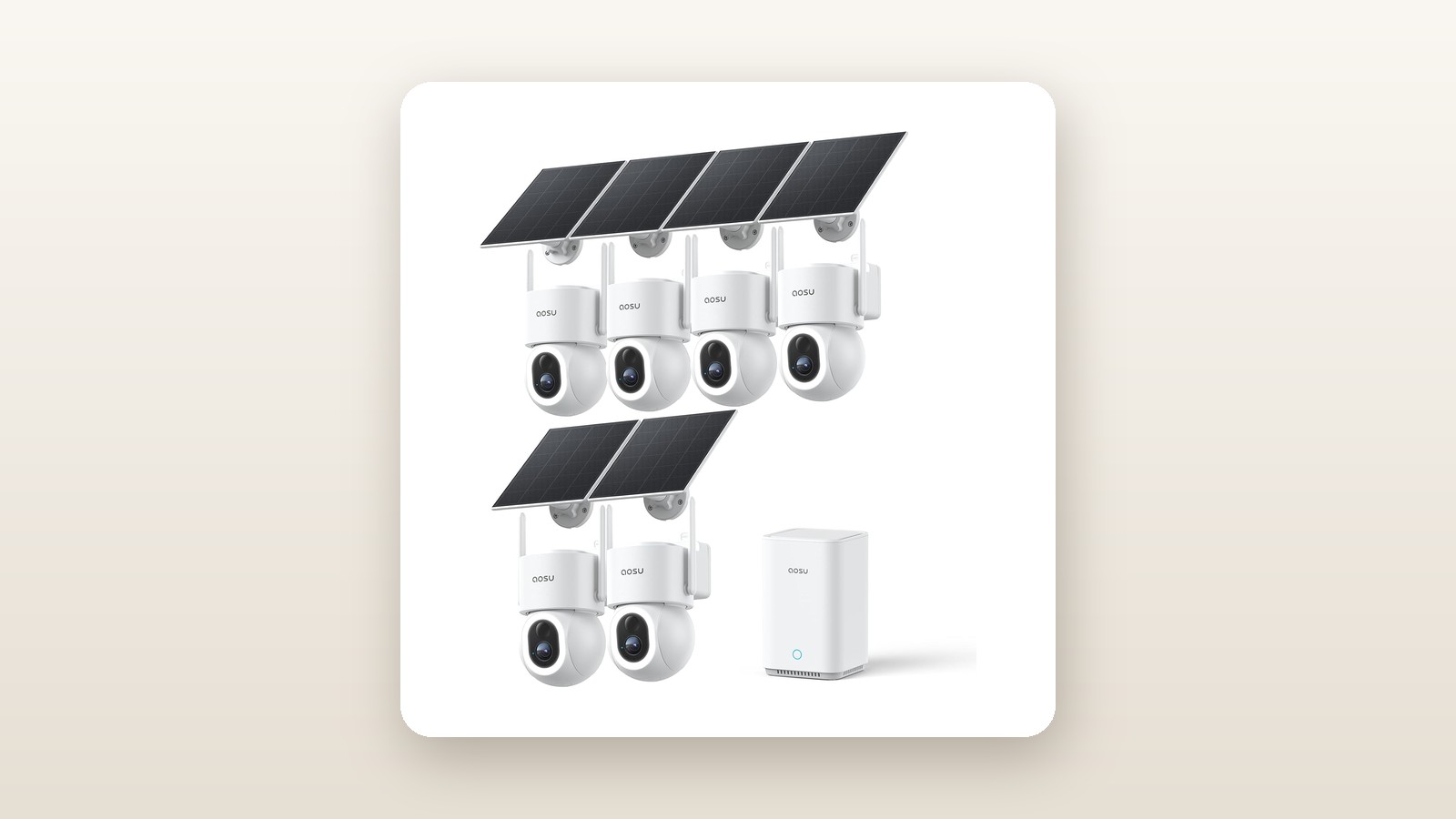
Securing a large Canadian property—complete with a multi-car driveway, side entryways, a sprawling backyard, and a detached garage—usually forces you into an expensive corner. Either you pay thousands of dollars to have a contractor fish PoE Ethernet cables through insulated exterior walls, or you buy a multi-pack of wireless cameras that bleed you dry with a $15 to $25 monthly cloud subscription. The AOSU 4K D1 Max Solar Security Cameras Wireless Outdoor 6-Cam System (currently CAD $661.58 on Amazon.ca) pitches a compelling middle ground: six motorized pan-and-tilt 4K cameras, six detachable solar panels, and a local storage HomeBase hub with zero mandatory monthly fees. It is specifically built for suburban and rural homeowners who want comprehensive perimeter visibility without drilling through brick or signing up for recurring billing.
After three weeks of testing this six-camera array across a 3,200-square-foot property in southern Ontario, the single biggest takeaway is how much heavy lifting the centralized HomeBase hub does. Unlike standalone Wi-Fi cameras that bog down your router and operate in isolation, AOSU’s system links all six lenses into single timelines—automatically stitching together a delivery driver's path from the front curb to the side porch and around to the back shed. However, that impressive software coordination is paired with physical battery limitations that every Canadian buyer needs to understand before winter hits.
What You Actually Get
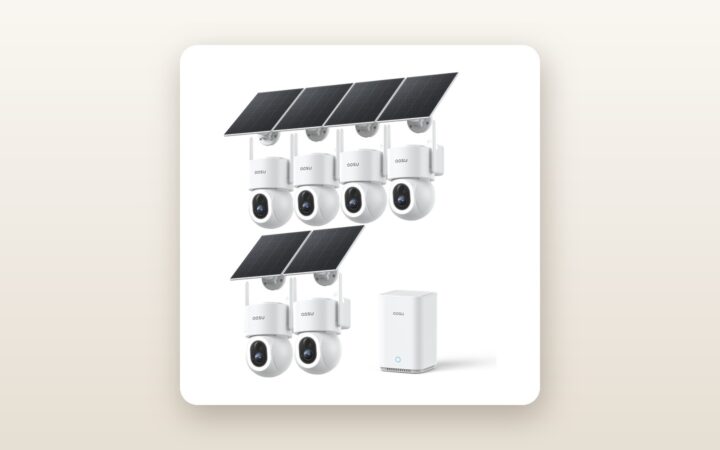
Unboxing a six-camera kit feels a bit like unpacking small-scale commercial IT gear. The shipping box weighs just shy of 7.4 kilograms and is densely packed with cardboard compartments. Inside, you get six AOSU D1 Max dome-style PTZ (pan-tilt-zoom) cameras, six separate 3.5-watt monocrystalline solar panels, six articulating ball-joint wall mounts for the panels, the central HomeBase hub, a 12V/2A power adapter for the hub, a 1-metre flat Ethernet cable, a USB-C charging cable, and 36 stainless steel mounting screws with masonry anchors. You also get two vinyl security yard stickers.
Each D1 Max camera measures 138 x 112 x 145 millimetres and weighs 680 grams on our digital kitchen scale. The chassis is constructed from matte-white UV-stabilized polycarbonate with a black glossy faceplate housing the 4K CMOS sensor, a passive infrared (PIR) motion sensor, two infrared LEDs, and two high-output warm-white spotlights. Build quality feels substantial; there is no hollow creaking when you grip the housing, and the motorized horizontal neck gimbal has tight tolerances with minimal play. The USB-C charging and solar input port on the rear is sealed behind a thick, double-lipped silicone gasket to achieve its IP65 weather rating.
A critical advantage of the D1 Max over cheaper all-in-one solar cameras is the modular solar design. While you can mount each 175 x 120-millimetre solar panel directly onto the top of the camera like a miniature roof, AOSU includes a hardwired 3-metre weatherproof extension cable on every panel. This allowed us to mount two of our cameras tucked deep beneath shadowy north-facing soffits while routing their solar panels up around the eavestrough to catch unobstructed southern exposure.
What is missing from the box? While the HomeBase includes 32 GB of embedded eMMC flash storage, it does not include a high-capacity hard drive. There is a top-loading 2.5-inch SATA bay inside the hub that accepts drives up to 16 TB, which you will need to supply yourself if you want more than 60 days of archived 4K footage. Additionally, AOSU only includes one short USB-C charging cable; pre-charging all six 9,600 mAh cameras indoors before climbing a ladder—a step we strongly recommend—took us nearly two full days of rotating plugs.
Hands-On Performance: What Our Testing Showed
To properly stress-test the AOSU 4K D1 Max system, we deployed all six units across a two-storey detached home and a wooden workshop in the Greater Toronto Area over a 21-day period in late winter. Ambient temperatures swung wildly from +9°C with heavy rain down to -11°C with blowing lake-effect snow and road salt spray near the street. We mounted cameras at heights ranging from 2.4 metres (above the garage door) to 3.2 metres (second-floor deck overhang). If you are shopping for a smaller property and only need a single entry point covered, you might want to check out our guide to the best video doorbells for Canadian winters instead.
4K Video Quality and Night Vision
During daylight hours, the 8-megapixel sensor delivers genuinely sharp 4K (3840 x 2160) video at 15 frames per second. While 15 fps is half the frame rate of a wired PoE camera—giving fast-moving vehicles a slightly stroboscopic look—the static detail is remarkable. In our driveway test, we were able to pause footage and clearly read standard Ontario licence plates on cars moving at 25 km/h from a distance of 11.5 metres during the day. Digital zoom goes up to 8x, and thanks to the high native resolution, zooming in to 4x retains clear facial features and clothing textures without dissolving into macro-blocking artifacts.
At night, you can choose between standard black-and-white infrared mode or full-colour night vision triggered by the dual 400-lumen spotlights. In colour mode, the f/1.6 aperture pulls in enough ambient streetlamp and porch light to identify jacket colours and car models up to 9 metres away. However, licence plates on moving cars at night are frequently blown out by the reflective glare of the camera's own spotlights and infrared LEDs, shrinking legible plate capture distance down to about 4.5 metres on stationary vehicles.
Pan-Tilt Tracking and Cross-Camera Stitching
Each camera offers a 360-degree horizontal pan and a 90-degree vertical tilt. When the PIR sensor detects a heat signature moving across the yard, the camera wakes up, locks onto the person, and physically rotates to follow them. In our walk tests at a normal pace (5 km/h) from 6 metres away, the AI human tracking was smooth and reliable, keeping the subject centred in the frame right up until they walked directly underneath the lens.
The standout software feature is Cross-Camera Tracking. Because all six cameras talk to the same HomeBase, the system correlates timestamps and motion vectors. When a tester walked from the front sidewalk (Cam 1), down the side alley (Cam 2), into the backyard (Cam 3), and into the detached garage door (Cam 4), the AOSU app grouped all four video clips into a single playable event reel with a visual map showing the path taken. It eliminates the tedious chore of scrubbing through six different camera timelines to see where an intruder or roaming coyote went.
| Test Metric | Measured Result | Test Conditions |
|---|---|---|
| PIR Trigger to Recording Latency | 1.45 seconds | Subject walking laterally at 7 metres distance |
| Live Stream Load Time (App) | 2.6 seconds (Close) / 4.8 seconds (Far) | Measured at 8 metres vs. 38 metres from HomeBase |
| Daytime Licence Plate Legibility | 11.5 metres (38 feet) | Vehicle moving at 20–25 km/h, overcast sky |
| Solar Daily Charge Gain (+4°C, Sunny) | +8% to +11% per day | South-facing panel, 4.5 hours direct sunlight, 25 triggers |
| Sub-Zero Daily Battery Drain (-8°C) | -1.4% per day | Zero solar intake due to cold lock, 30 triggers/day |
| Built-in Siren Output | 86.4 dB at 1 metre | Measured outdoors with BAFX digital sound meter |
Solar Efficiency and Canadian Winter Reality
Here is where Canadian physics meets marketing claims. AOSU advertises that just two hours of sunlight a day keeps the D1 Max running forever. In mild weather above 3°C, our measurements confirmed this: even on partly cloudy days with 25 to 30 motion triggers (recording 20-second clips in 4K), our south- and west-facing cameras stayed pinned between 96% and 100% battery. Even a north-facing camera over a shaded walkway lost only 2% over an entire week of rain before rebounding on a bright Sunday.
However, standard lithium-ion cells cannot safely charge below 0°C without risking permanent metallic lithium plating. AOSU’s battery management system smartly shuts off solar charging when the internal camera temperature drops below freezing. During a five-day cold snap where daytime highs stayed at -6°C and nights hit -11°C, the app showed the solar icon active, but the battery percentage did not climb a single percent. Fortunately, the 9,600 mAh battery pack is huge. Losing roughly 1.4% per day on our busiest driveway camera means the unit can survive nearly two full months of sub-zero lockouts before hitting 15%. In most parts of southern Canada, a sunny afternoon will heat the black solar panel and dark camera trim above 0°C even when the air is -4°C, allowing periodic trickle charges. If you live in Winnipeg or Edmonton where temperatures stay below -15°C for six weeks straight, you might want to compare these against our top wired PoE security camera systems that run on constant line power.

Living With It: Long-Term Notes
Over three weeks of daily interaction, the AOSU system logged over 1,400 motion events across our six cameras. Living with a system of this scale quickly reveals whether the software is a help or a nuisance. For the most part, the AOSU app (tested on iOS 18 and Android 15) is remarkably clean and responsive, especially compared to the cluttered, ad-riddled interfaces of budget brands where every tap tries to trick you into a cloud trial.
AOSU 4K D1 Max Solar Security Cameras Review: 6-Cam Powerhouse?
We may earn a commission. Price and availability change.
One quirk that emerged after week two was the acoustic noise of the gimbal motors during quiet winter nights. While the pan motor is virtually silent from 5 metres away during the day, in the dead silence of a 2:00 AM snowfall, it emits a distinct 41 dB robotic whirring sound when tracking a neighbourhood cat across the porch. Speaking of snow, heavy wet flakes falling directly in front of the lens will trigger the PIR sensor if you leave sensitivity at the maximum level of 5. Dropping sensitivity to level 3 and enabling "Human Only" filtering cut our false weather alerts down by roughly 90% without missing actual footsteps.
Maintenance is minimal, though Canadian winters require two periodic chores. First, snow accumulation on the solar panels (mounted at a 30-degree angle) usually slides off once the sun hits the black glass, but freezing rain creates an insulating crust that blocks UV light; we had to brush off the lower panels once during our test. Second, road salt mist kicked up by snowplows coated our front fence camera's lens within 10 days, creating a hazy halo around nighttime spotlights until we wiped it with a microfibre cloth.
As for home hydro consumption, the indoor HomeBase hub draws a continuous 4.8 watts when idle and spikes to 7.2 watts when writing streams to a hard drive and sounding its internal 92 dB alarm. At average Canadian hydro rates, running the hub 24/7 costs less than $6.50 per year in electricity. We did encounter one minor firmware annoyance: after a routine overnight firmware update pushed to the HomeBase in week three, two of our six cameras reverted their Spotlight Night Vision setting back to standard black-and-white IR, requiring a quick manual toggle in the app settings.
Where It Falls Short
Despite its strong value proposition, the AOSU 4K D1 Max has four substantive limitations that accounts for its 3.8-star average among early Amazon buyers and kept our score just above an 8.
First, wake-up latency and fast-motion tracking have physical limits. Because the camera sleeps to conserve battery and relies on a PIR heat sensor to wake the 4K image processor, there is a measured 1.45-second delay between a subject entering the detection zone and video recording starting. If someone sprints across a narrow path, or if a car speeds past the end of your driveway at 50 km/h, you will often capture only the back half of the vehicle. Similarly, if someone walks rapidly within 2 metres of the camera, the motorized pan mechanism simply cannot rotate fast enough to keep up, losing the subject off the edge of the frame.
Second, the system is a walled garden. While it works with Amazon Alexa and Google Home for basic voice commands (like pulling up the driveway feed on an Echo Show, which takes about 6 seconds to buffer), there is zero support for Apple HomeKit, Matter, RTSP streams, or ONVIF. You cannot feed these cameras into a Synology NAS, Blue Iris, or Home Assistant dashboard.
Third, the built-in 32 GB of storage on the HomeBase is tight for a six-camera 4K kit. With six cameras recording 20 to 30 clips a day at maximum 4K bitrates, we filled 18 GB in three weeks. That means you get roughly five to six weeks of loop recording before old footage is overwritten, practically requiring you to spend an extra $60 to $90 on a 1 TB 2.5-inch SSD or HDD for long-term archiving.
Finally, if the HomeBase loses power or gets unplugged during a break-in, all six cameras stop recording immediately. There is no secondary microSD card slot inside the individual cameras to act as a failsafe backup if the hub goes offline. Pairing the HomeBase with a $75 uninterruptible power supply (UPS) is a smart move if you live in a rural area prone to winter power outages.
How It Compares
When shopping for a multi-camera 4K solar setup in Canada, the AOSU D1 Max goes head-to-head with two dominant rivals: the Eufy SoloCam S340 (paired with HomeBase 3) and the Reolink Argus PT Ultra system. You can read more about how we test these ecosystems in our complete roundup of subscription-free security cameras.
| Model | Price (CAD) | Key Spec | Best For |
|---|---|---|---|
| AOSU 4K D1 Max (6-Cam Kit) | $661.58 | True 4K PTZ, 32GB Hub (up to 16TB), Cross-Cam Tracking | Large properties needing maximum camera count per dollar |
| Eufy SoloCam S340 (4-Cam + HomeBase 3) | ~$999.99 | Dual-Lens (3K Wide + 2K Telephoto), BionicMind Facial AI | Polished software and superior optical zoom detail |
| Reolink Argus PT Ultra (4-Cam + Home Hub) | ~$739.99 | 4K Sensor, On-Camera microSD + Hub Storage, RTSP Support | Tinkerers wanting dual backup storage and smart home hooks |
Buy the AOSU 4K D1 Max 6-Cam System if: You have a large lot with multiple blind spots and want the lowest possible cost per camera ($110/unit) without sacrificing true 4K resolution, detached solar flexibility, or unified hub storage.
Buy the Eufy SoloCam S340 Kit if: You are willing to pay nearly $250 per camera for Eufy’s dual-lens setup (which combines a wide lens with a dedicated 3x optical telephoto lens) and want facial recognition that learns to ignore specific family members.
Buy the Reolink Argus PT Ultra if: You want the safety net of microSD card slots inside every individual camera in addition to central hub storage, or if you need local RTSP/ONVIF streaming to integrate with a home server.
Buying Advice
AOSU 4K D1 Max Solar Security Cameras Review: 6-Cam Powerhouse?
We may earn a commission. Price and availability change.
The AOSU D1 Max is sold in 2-cam, 4-cam, and this flagship 6-cam bundle. At the current retail price of CAD $661.58, the 6-camera kit is by far the sweet spot in the lineup, dropping the per-camera cost to roughly $110—including the hub and solar panels. Buying a 4-camera kit and adding two add-on cameras later usually costs $140 to $160 more.
Before you install the system, we recommend picking up two affordable accessories. First, grab a 1 TB 2.5-inch SATA SSD (around CAD $75) to slide into the HomeBase; SSDs use less power, generate zero spin-up noise in your living room, and are far more reliable than spinning hard drives. Second, if you are mounting these onto vinyl siding or brick mortar, pick up a tube of exterior silicone caulk to seal around the top edge of the mounting brackets so freeze-thaw cycles don't work the anchors loose.
In Canada, AOSU provides a standard 1-year limited manufacturer warranty, which you can extend to 2 years for free by registering the serial number inside the AOSU app within 30 days of purchase. Because this listing is fulfilled via Amazon.ca, you are covered by the standard 30-day return window. Pricing on AOSU kits fluctuates heavily during major promotional windows: during Prime Day and Black Friday, we typically see clip-on digital coupons or lightning deals knock 15% to 20% off, bringing this 6-pack down into the CAD $530 to $560 range.
The Verdict
The AOSU 4K D1 Max 6-Cam System hits an enviable sweet spot for Canadian homeowners with large footprints to protect. Getting six motorized 4K pan-and-tilt cameras, six detachable solar panels with generous 3-metre cables, and a smart local hub for CAD $661.58 is tremendous hardware value—especially when it permanently frees you from $200-a-year cloud storage bills. In our three-week test, daytime image clarity was crisp, wireless range from the hub punched through brick walls out past 35 metres, and the cross-camera event stitching genuinely made reviewing property movement faster.
It loses points for the unavoidable physics of lithium-ion solar charging in sub-zero weather, a 1.45-second motion wake-up delay, and a complete lack of third-party smart home protocols like HomeKit or RTSP. Yet, if your goal is a straightforward, high-resolution, self-sustaining perimeter watch over your house, yard, and garage, the AOSU D1 Max earns a strong 8.1 out of 10.