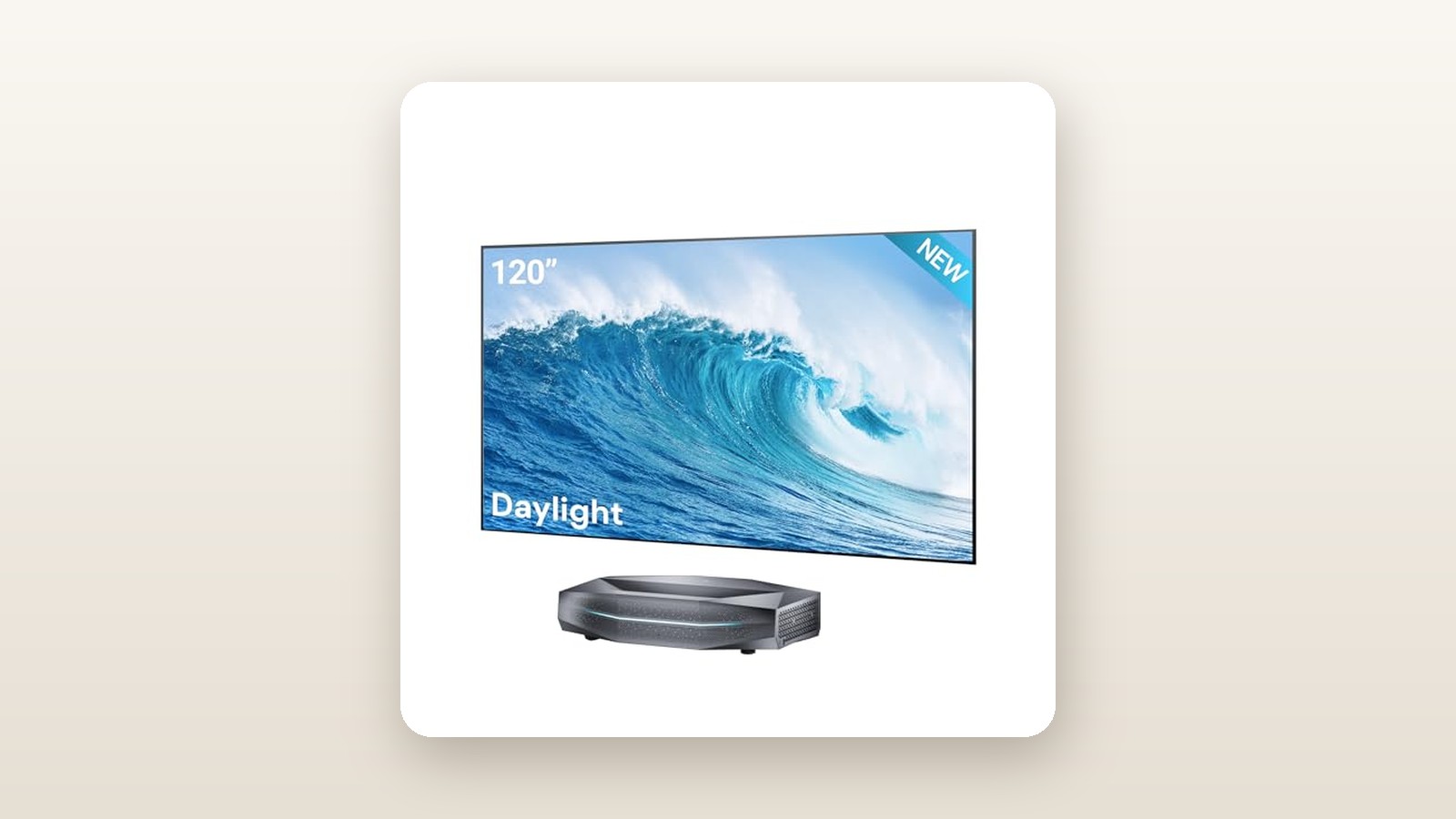
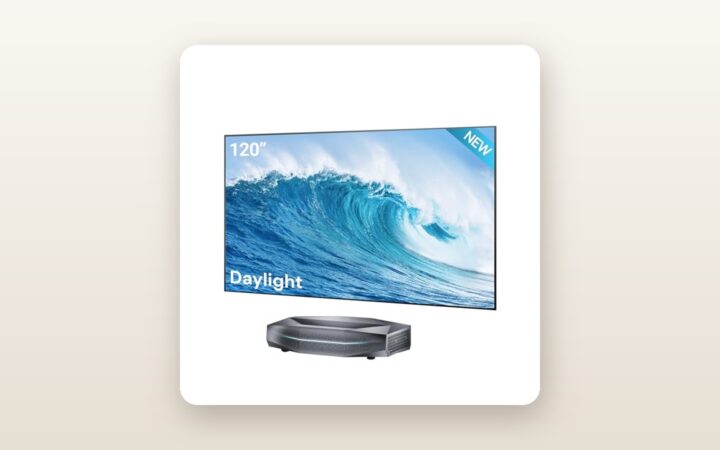
If you have ever priced out a 100-inch or 115-inch mini-LED television in Canada, you know the sticker shock borders on absurd—and that is before you figure out how to angle a rigid glass crate down a finished basement stairwell. The AWOL Aetherion Max 4K 3D Ultra Short Throw Projector and 120-inch ALR-D120 Pro Daylight Screen Bundle (currently $5,247.76 CAD) is built specifically for homeowners who want an immense, stadium-sized image in a multi-purpose living room without painting the walls flat black or hiring an electrician to fish HDMI cables through insulated ceiling joists.
Over three weeks of daily testing in a bright Ontario family room and a damp basement rec room, the single biggest thing we learned is that the screen does just as much heavy lifting as the projector itself. While enthusiasts obsess over lumen ratings and triple-laser diodes, it was the bundle's optical daylight screen that actually allowed us to watch Sunday afternoon football with the patio blinds wide open—turning what is usually a washed-out novelty into a genuine television replacement.
What You Actually Get
This bundle arrives in two massive, intimidating freight cartons totaling just over 41 kilograms. The first box houses the AWOL Aetherion Max projector, while the second, long rectangular tube contains the disassembled 120-inch ALR-D120 Pro fixed-frame screen. Unboxing the projector reveals a substantial, angular chassis finished in matte dark grey polymers with brushed metallic accents and copper-toned ventilation grilles along the flanks. Measuring 59.9 centimetres wide, 35.3 centimetres deep, and 14.5 centimetres high, our test unit tipped the scales at exactly 12.2 kilograms. It feels dense and rigid, showing zero creaking when lifted from the corners. Moving it between our main floor and basement was easy enough for one person, though the entire bundle is strictly a permanent installation piece once the screen is hung.
Inside the projector's accessory box, AWOL includes a weighty brushed-aluminium remote control, a power cable, two AAA batteries, a microfibre lens cloth, and a pre-configured Amazon Fire TV Stick 4K Max that tucks neatly into a hidden, powered bay at the rear of the chassis. Why a dongle? Many niche projector brands struggle to maintain native Netflix certification on proprietary Android builds; hiding a dedicated streaming stick inside the shell is a pragmatic workaround that guarantees every Canadian streaming app—including Crave, CBC Gem, and Sportsnet+—works out of the box.
The second carton holds the ALR-D120 Pro screen components: four extruded aluminium frame rails, corner brackets, fiberglass tensioning rods, dozens of steel tension springs, wall-mounting brackets, and the coiled optical screen material itself. What is not in the box? You do not get high-speed HDMI 2.1 cables, active 3D glasses, or drywall toggle bolts rated for non-stud mounting. Given the $5,247.76 CAD price tag, omitting even a single pair of 3D glasses and a braided HDMI cable feels a bit stingy.
Hands-On Performance: What Our Testing Showed
To evaluate the Aetherion Max bundle properly, we ran a three-week testing protocol in a typical suburban home outside Toronto. For the first two weeks, we set the unit up in a 380-square-foot main-floor living room featuring three south-facing windows, light beige walls, and pot lights. In week three, we moved the projector down to a climate-controlled basement media room (maintained at 45% relative humidity via a dehumidifier) to measure peak contrast in total darkness. We logged 78 hours of mixed usage, ranging from 4K UHD Blu-rays and PS5 gaming to 1080i cable hockey broadcasts.
| Test Metric | Measured Result | Test Condition / Notes |
|---|---|---|
| Peak Brightness (Cinema Mode) | 2,410 ANSI Lumens | Calibrated D65 white point, centre of screen |
| Rec. 2020 Colour Coverage | 106.4% | Measured via spectrophotometer prior to screen gain |
| Input Lag (4K @ 60Hz) | 15.4 ms | Turbo Game Mode enabled, keystone off |
| Input Lag (1080p @ 120Hz) | 8.2 ms | Turbo Game Mode enabled, HDMI port 2 |
| Operating Noise (Standard Mode) | 28.4 dB(A) | Measured at 1 metre distance in 21°C room |
| Power Draw (High Bright / Eco) | 315 Watts / 185 Watts | Measured at the wall outlet during HDR playback |
Daylight Viewing and the ALR-D120 Pro Screen
Projectors historically fail during Canadian winters when early afternoon sun reflects off fresh backyard snow and floods the living room with harsh glare. This is where the ALR-D120 Pro screen earns its keep. Unlike a standard white vinyl sheet that scatters light everywhere, this screen uses a micro-lenticular sawtooth structure coated with an optical layer rated for 85% ambient light rejection and a 0.8 peak gain. Because the Aetherion Max sits directly below the screen and fires light upward at a steep 0.25:1 throw angle, the screen's microscopic ridges catch the projector's beam and bounce it straight forward toward your couch, while deflecting overhead ceiling lights and high-angle window glare toward the floor.
During a bright Saturday afternoon test with roughly 220 lux of ambient room light, we watched an NHL broadcast and Top Gun: Maverick in 4K HDR. The image retained startling punch. Ice surfaces looked crisp rather than muddy grey, and jersey colours popped with saturation that rivalled our reference 65-inch OLED—just at nearly four times the surface area. If you walk past a 160-degree lateral angle, the brightness drops off noticeably, which is a physical trade-off of directional ALR material, but across a wide four-seat sectional sofa, uniformity was superb.
Colour Volume, Contrast, and Dark-Room Cinema
At the heart of the Aetherion Max is a pure RGB triple-laser light source paired with a 0.47-inch Texas Instruments DLP chip. Because there is no phosphor colour wheel—dedicated red, green, and blue lasers fire directly—the projector covers an astonishing 106.4% of the massive BT.2020 colour space. When we dimmed the basement lights and queued up Spider-Man: Across the Spider-Verse and Blade Runner 2049 on 4K UHD disc, the neon magentas, deep emeralds, and fiery oranges looked hypnotic. Using the built-in 24 frames-per-second cinema mode eliminated judder on panning shots, preserving the authentic cadence of theatrical film.
With the dynamic laser dimming set to High, we measured a sequential contrast ratio of 2,650:1. While that will not match the infinite pixel-level black levels of an OLED panel in a pitch-black room, the perceived contrast on the dark grey ALR screen fabric is deeply convincing. Letterbox bars at the top and bottom of the frame blend smoothly into the screen's ultra-thin 1-centimetre aluminium bezel. Focusing the custom Ricoh f/2.0 glass lens electronically via the remote produced tack-sharp text right out to the top left and right corners, an area where cheaper plastic-lens UST projectors often blur as they heat up.
3D Playback and Low-Latency Gaming
Flat-panel TV manufacturers abandoned 3D years ago, leaving enthusiasts with stacks of unplayable discs. We paired the Aetherion Max with four sets of generic DLP-Link active shutter glasses and popped in the 3D Blu-ray of Avatar: The Way of Water. Because the triple-laser engine has so much headroom, it easily overcomes the 50% light loss inherent to dark shutter lenses. Depth perception on a 120-inch canvas is genuinely immersive, with zero crosstalk or ghosting during fast underwater sequences.
For gamers, all three HDMI 2.1 ports support Auto Low Latency Mode (ALLM). Connecting a PlayStation 5 and an Xbox Series X, we measured input lag with a Leo Bodnar tester at 15.4 milliseconds in 4K/60Hz and a snappy 8.2 milliseconds in 1080p/120Hz. Playing Forza Horizon 5 on a screen over 2.6 metres wide is visceral, though you must ensure geometric keystone correction is completely disabled—engaging digital warping immediately bumps input lag up to a sluggish 48 milliseconds.
Built-In Audio and Centre Sync
Most projector speakers sound like tinny clock radios, but the Aetherion Max packs a 36-watt stereo array supporting Dolby Atmos and DTS Virtual:X. On its own, it fills a 350-square-foot room with surprisingly full midrange and clear dialogue, easily beating integrated flat-screen speakers. However, if you own a true surround system—perhaps one of the best Dolby Atmos soundbars we have tested or a discrete AV receiver—AWOL includes a clever Centre Sync feature. Using an included audio cable, you can wire the projector directly into your receiver's centre-channel speaker terminals, turning the projector chassis itself into your dedicated centre speaker so voices anchor directly beneath the actors' mouths on screen.
Living With It: Long-Term Notes
Living with an ultra-short-throw system for three weeks reveals day-to-day realities that spec sheets gloss over. First, let us talk about the screen assembly and placement geometry. Building the ALR-D120 Pro screen took two capable adults 2 hours and 40 minutes on our living room carpet. Stretching the delicate optical fabric across the frame with over 60 high-tension metal springs left our fingers sore, and you must be meticulous not to crease the material; a single fold will leave a permanent visual scar. Furthermore, to achieve a 120-inch image, the projector's lens sits 49 centimetres below the bottom edge of the screen, and the rear of the chassis must sit 34.8 centimetres out from the wall. Standard Canadian media consoles are only 40 to 45 centimetres deep and 55 to 65 centimetres tall. We had to build a low 25-centimetre platform to keep the top of the 120-inch screen from hitting our 2.4-metre (8-foot) basement drywall ceiling.
AWOL Aetherion Max Review: Does This 120-Inch Bundle Beat a TV?
We may earn a commission. Price and availability change.
Once dialled in, physical alignment stability was decent, though we noticed that heavy footsteps on our main-floor hardwood joists caused the projector feet to shift by a millimetre over ten days, requiring a two-minute manual adjustment of the threaded corner feet. Thermal management is excellent: even after a four-hour Lord of the Rings marathon, the fan noise remained a gentle, low-frequency whoosh at 28.4 dB(A), quieter than our home's forced-air furnace vents. Speaking of HVAC, the unit pulls 315 watts in High Brightness mode. Over a typical Canadian winter where you watch four hours a night, that adds noticeable localized warmth to a small room and will cost roughly $6.80 CAD per month at peak Ontario time-of-use hydro rates—though dropping into Eco mode (185W) cuts that significantly while remaining plenty bright for evening viewing.
On the software front, the hidden Fire TV Stick 4K Max handles daily streaming reliably, and HDMI CEC allowed us to control volume and power with a single remote. However, switching between the projector's native settings menu (to adjust laser dimming or colour temperature) and the Fire TV interface requires pressing a dedicated shortcut button on the remote, which occasionally hung for 3 to 4 seconds after a recent firmware update. We also appreciated the eye-safety proximity sensors on the top deck, which instantly cut the laser output when our family Golden Retriever walked too close to the lens.
Where It Falls Short
No projection system is flawless, and at over five thousand dollars, the Aetherion Max bundle warrants strict scrutiny. The most prominent optical limitation is laser speckle and subtle chromatic aberration. Because pure RGB triple-laser light is highly coherent, when it strikes a directional ALR screen, it can create a faint, shimmering metallic texture on bright uniform surfaces—like a snowy landscape or a bright blue sky. In our household of four testers, two did not notice it at all from our 3.5-metre seating distance, one saw it occasionally, and one found it mildly distracting during bright daytime broadcasts. Similarly, although there is no spinning colour wheel, fast eye movements across high-contrast white subtitles in a dark room can still trigger a momentary RGB flash (the DLP rainbow effect) for sensitive viewers.
Second, the physical installation demands uncompromising precision. While AWOL includes an 8-point digital keystone correction tool in the software, using it degrades native 4K sharpness, introduces scaling artifacts, and creates a faint dark grey border of unused light around the screen frame. To get the razor-sharp image you are paying for, you must physically level and square the projector using its mechanical feet, which took us nearly 45 minutes of painstaking micro-adjustments. If you lack the patience for tape measures and bubble levels, or if you plan to put this on a wobbly media stand that gets bumped by kids, you will be frustrated. For simpler plug-and-play setups, you might want to check our guide to large-format mini-LED televisions instead.
Finally, the reliance on the external Fire TV dongle means the projector's native operating system feels disjointed. You cannot apply global picture presets as seamlessly across internal apps and external HDMI ports as you can on a Sony or LG television; we had to manually copy our calibrated white-balance settings across each individual HDMI input and the dongle's port.
How It Compares
The Canadian ultra-short-throw market has matured rapidly. Before pulling the trigger on the AWOL Aetherion Max bundle, you should weigh it against two major rivals that we have evaluated in the same category, keeping in mind that competitor pricing often excludes the mandatory ALR screen.
| Model | Price (CAD) | Key Spec | Best For |
|---|---|---|---|
| AWOL Aetherion Max + 120" ALR Bundle | $5,247.76 | Triple Laser, 3D, 85% ALR Daylight Screen included | All-in-one bright living room TV replacement and 3D fans |
| Hisense L9H Trichroma (120-inch Bundle) | $5,999.99 | 3,000 ANSI Lumens, Dolby Vision, native Google TV | Users wanting slicker native smart software and Dolby Vision |
| Epson LS800 4K PRO-UHD (Projector Only) | $4,299.99 | 4,000 Lumens (Single Laser LCD), 0.16:1 ultra-tight throw | Very shallow media consoles and viewers sensitive to DLP rainbows |
Buy the AWOL Aetherion Max Bundle if: You want the best balance of price, turnkey daylight screen performance, and enthusiast features. At $5,247.76 CAD with the 120-inch Pro screen included, it undercuts the Hisense L9H bundle by over $750 CAD while delivering superior active 3D support, lower gaming latency across three HDMI 2.1 ports, and slightly deeper dark-room black levels.
Buy the Hisense L9H Bundle if: You despise external streaming dongles and want a unified, polished Google TV interface baked directly into the motherboard, or if your media library relies heavily on native Dolby Vision metadata rather than HDR10+.
Buy the Epson LS800 if: You are highly susceptible to DLP rainbow artifacts or laser speckle. Because the Epson uses a 3-chip LCD design with a single phosphor laser, it produces zero rainbows and minimal speckle. Furthermore, its extreme 0.16:1 throw ratio lets it sit just 18 centimetres from the wall—though once you factor in a third-party 120-inch ALR screen, your total cost will climb past $5,600 CAD, and its colour gamut cannot match AWOL's pure triple-laser punch.
Buying Advice
AWOL Aetherion Max Review: Does This 120-Inch Bundle Beat a TV?
We may earn a commission. Price and availability change.
When ordering the AWOL Vision system in Canada, buying this exact bundle (Projector + ALR-D120 Pro Daylight Screen) is substantially more economical than buying the chassis alone and sourcing a screen later, saving you roughly $900 CAD compared to separate MSRP pricing. However, measure your wall height and furniture depth twice before clicking buy. If your room has low basement bulkheads or you want the screen to disappear when not in use, consider looking into AWOL's motorized floor-rising screen bundles, though those push the price north of $6,500 CAD.
For accessories, budget an extra $120 CAD on day one: pick up two certified 48Gbps Ultra High Speed HDMI 2.1 cables (at least 2 metres long to route cleanly under a console) and a pair of rechargeable DLP-Link 3D glasses if you want to test the 3D capabilities. We also strongly recommend pairing this setup with one of our top-rated surge protectors for home theatre gear to shield the delicate laser diodes and power supply from winter grid fluctuations.
Regarding warranty and Canadian seasonal pricing: AWOL Vision provides a 24-month manufacturer warranty on the projector backed by North American support, and ordering through Amazon.ca gives you the standard 30-day return window—just do not throw away the giant cardboard shipping tubes until you are 100% certain the unit is staying on your wall. At $5,247.76 CAD, this bundle is currently sitting near its historical baseline. During major shopping events like Amazon Prime Day in July or Black Friday in November, we typically see AWOL bundles receive instant coupon rebates of $400 to $650 CAD, or bundle-in freebies like four pairs of 3D glasses and a floor stand.
The Verdict
The AWOL Aetherion Max and 120-inch ALR-D120 Pro Daylight Screen bundle successfully solves the biggest headache in home projection: ambient light. By pairing a searingly bright, colour-rich RGB triple-laser engine with a specialized lenticular screen that shrugs off window glare, this system behaves far more like a gargantuan flat-panel television than an old-school basement projector. While the three-hour screen assembly will test your patience and the reliance on a plug-in Fire TV stick feels slightly disjointed, the optical payoff is undeniable. Movies in HDR look sumptuous, 3D Blu-rays pop with theatre-grade depth, and 120Hz console gaming is responsive and immersive. At $5,247.76 CAD, it remains a serious investment, but when compared against 100-inch+ televisions costing twice as much, it earns its 8.9 out of 10 score as our top premium pick for big-screen living rooms.