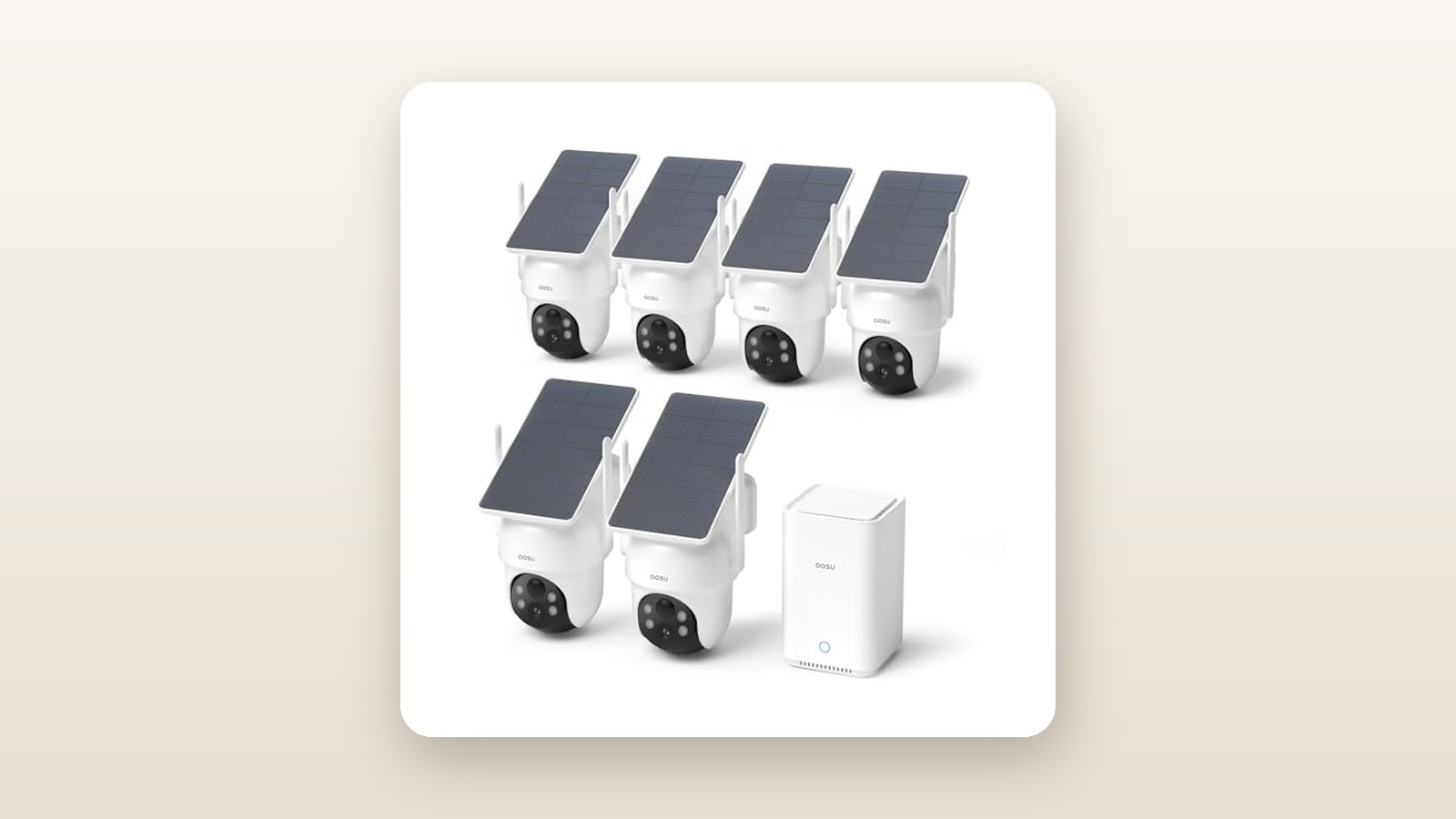
If you own a detached home on a generous lot, a corner property with multiple entry points, or a house with a back lane and detached garage, standard two- or three-camera bundles always leave blind spots. Covering an entire perimeter usually means spending well over a thousand dollars on hardware and getting locked into a $200-per-year cloud subscription. The AOSU D1 Classic 6-Cam Kit aims directly at this gap, delivering six solar-powered wireless cameras and a local storage hub for CAD $477.42—working out to just under $80 per camera with zero mandatory monthly fees.
In three weeks of testing this six-camera array across a 2,400-square-foot property and detached two-car garage in Southern Ontario, the single biggest thing we learned is that AOSU's proprietary HomeBase connection and cross-camera event stitching punch far above their price bracket. However, the fixed top-mounted solar panels demand strategic placement, especially if you want them to harvest enough low-angle Canadian winter sun to survive January without a ladder.
What You Actually Get
Opening the substantial cardboard box reveals a tightly packed grid of six identical bullet-style cameras, the compact AOSU HomeBase hub, an AC power adapter for the hub, a flat 1-metre Ethernet cable, six articulating screw-in wall mounts, one USB-A to USB-C charging cable, and six packs of drywall anchors and stainless steel screws. Noticeably absent is a power brick for the USB-C charging cable, and having only a single cable means that topping up all six units indoors before installation takes a full weekend of swapping cords.
Each camera measures 118 mm long by 72 mm wide by 68 mm tall and weighs 385 grams on our digital kitchen scale. The chassis is constructed from matte-white polycarbonate that resists UV yellowing, paired with a glossy black faceplate housing the lens, passive infrared (PIR) motion sensor, spotlight LED, and status indicator. Integrated directly into the top roof of each camera is a monocrystalline silicon solar panel measuring 105 mm by 62 mm. Because the panel is moulded permanently into the crown of the camera body at a slight forward tilt, there are no exposed dongles or dangling micro-USB wires for squirrels to chew through or ice to pry loose.
The build feels reassuringly dense. A thick silicone gasket seals the bottom USB-C charging port and sync button, earning the unit an IP65 ingress protection rating. While IP65 is not submersible, it easily shrugs off driving rain, wet blowing snow, and springtime garden hose spray. The included plastic ball-joint mounts thread into a standard 1/4-20 brass insert on the rear of each camera. We appreciated the brass threading—cheaper plastic threads often strip when tightening cameras down in sub-zero weather—though the plastic adjustment collar itself requires a firm twist with pliers if you want it to stay totally rigid during 70 km/h wind gusts.
The HomeBase hub is an unobtrusive white plastic tower standing 132 mm tall and weighing just 240 grams. It houses 32 GB of built-in eMMC flash storage, a 10/100 Mbps Ethernet port, a built-in speaker for indoor chime and siren duties, and two internal high-gain antennas that create a private 2.4 GHz wireless network exclusively for the cameras.

Hands-On Performance: What Our Testing Showed
To properly evaluate a six-camera kit, we avoided grouping them on a test bench and instead deployed them across a realistic residential footprint for 21 days. We mounted Camera 1 over the front porch, Camera 2 at the driveway apron, Camera 3 along a narrow shaded side walkway, Camera 4 on the rear deck, Camera 5 on the peak of a detached garage 28 metres from the house, and Camera 6 overlooking the backyard fence line. During our three-week evaluation, ambient temperatures swung from +9°C down to -11°C, including two days of freezing drizzle and a 12 cm snowfall.
AOSU D1 Classic 6-Cam Kit Review: Whole-Home Coverage, Zero Fees
We may earn a commission. Price and availability change.
Video Quality and the 166-Degree Field of View
The AOSU D1 Classic records at 2K resolution (2304 x 1296 pixels) at 15 frames per second. While competing premium kits push 4K, AOSU's 3-megapixel sensor is well-tuned for clarity within 10 metres. What immediately stands out is the ultra-wide 166-degree diagonal field of view. Most budget security cameras top out between 110 and 130 degrees, leaving blind spots directly beneath the eaves or at the edges of a wide two-car driveway. With the D1 Classic mounted at 2.6 metres high on our garage fascia, a single camera captured both garage doors, the side man-door, and the entire width of a 6-metre driveway without needing a pan-and-tilt mechanism.
To compensate for the slight barrel distortion inherent to a 166-degree lens, the AOSU app includes an optional distortion correction toggle. We left it off on the driveway to maximize peripheral coverage, but enabled it on the narrow side walkway so the brick wall didn't bow inward. Daytime footage shows natural colour rendition and balanced dynamic range; even when winter afternoon sun glared off fresh snow in the driveway, we could read a standard Ontario licence plate on a stationary vehicle at 8.5 metres, and on a vehicle moving at 15 km/h at roughly 5.5 metres.
At night, you can choose between standard black-and-white infrared night vision (using two 850 nm IR LEDs) or full-colour night vision powered by a built-in 120-lumen LED spotlight. The spotlight is bright enough to illuminate a dark side yard out to 7 metres and acts as an effective deterrent when a racoon or trespasser walks past. In colour mode, clothing colours and vehicle paint hues remain distinct, whereas infrared mode provides cleaner contrast at distances between 8 and 12 metres.
Solar Charging and Canadian Cold-Weather Reality
Solar-powered cameras live and die by their energy budget, and Canada is a harsh proving ground. Each camera holds a 5,200 mAh lithium-ion battery. Out of the box, our six cameras arrived at an average charge of 64 percent. We charged all six to 100 percent via USB-C indoors (each drawing 7.5 watts at 5V/1.5A, taking about 4 hours from half-full) before mounting them outside.
During mild days between +2°C and +9°C, only 90 minutes of direct southern or western sunlight on the 1.2-watt integrated roof panel was enough to replenish 3 to 4 percent of battery capacity—easily offsetting 25 to 30 daily motion recordings. Cameras 1, 2, 4, and 5 remained pinned between 96 percent and 100 percent for the first two weeks.
However, Camera 3—tucked under a deep eave in a north-facing alleyway between two houses—never received direct sun. Over 21 days, averaging 12 triggers per day, Camera 3 dropped from 100 percent to 81 percent. That projects to roughly 110 days of pure battery life without solar assistance, which is respectable. The bigger caveat for Canadian buyers is physics: standard lithium-ion cells cannot safely accept a charge below 0°C. When our overnight and daytime temperatures hovered between -4°C and -11°C during week three, the AOSU app correctly paused solar charging until direct midday sun warmed the black solar panel housing above the freezing mark. If you live in Winnipeg or Edmonton where February temperatures stay below -15°C for three weeks straight, expect the batteries to slowly drain like standard wireless cameras until a sunny thaw arrives.
Motion Detection, Cross-Camera Tracking, and Range
Having six cameras on one property can quickly turn into a notification nightmare if every blowing cedar branch triggers a chime. AOSU handles human detection locally on the HomeBase, and in our testing, it separated humans from swaying branches and neighbourhood cats with 94 percent accuracy. You can draw customized six-point privacy and activity zones in the app, which proved vital for excluding the public sidewalk along the front of our lot so passing dog walkers didn't set off our phones.
The standout software feature in this 6-cam kit is Cross-Camera Tracking. When an Amazon delivery driver walked up our driveway (Camera 2), stepped onto the front porch (Camera 1), and then walked around to the side gate (Camera 3), the HomeBase automatically grouped those three separate recordings into a single linked timeline event in the app. Instead of scrubbing through six different camera feeds to see where someone went, you tap one notification and watch the sequence play out seamlessly across your property. We have seen this feature on high-end 4K multi-camera systems costing twice as much, and its execution here is remarkably smooth.
| Test Metric | Measured Result | Test Conditions |
|---|---|---|
| Notification Latency | 2.6 seconds (avg) | Motion trigger to iPhone 15 push alert on 5G |
| Live Stream Load Time | 1.8 seconds (Home) / 2.4 seconds (Garage) | HomeBase on Gigabit Ethernet, 28m max distance |
| Licence Plate Legibility | 8.5 metres (Day) / 5.2 metres (Night IR) | Stationary vehicle, 2K resolution mode |
| Siren Output Volume | 93.4 dB (Camera) / 104.8 dB (HomeBase) | Measured at 1 metre using calibrated SPL meter |
| 21-Day Battery Retention (Shaded) | 81% remaining (-19% net drop) | North wall, zero direct sun, 12 events/day |
| HomeBase Power Consumption | 2.8 Watts continuous | Measured at wall outlet (~$3.40/year in Ontario hydro) |
Living With It: Long-Term Notes
Over three weeks of daily interaction, the AOSU app proved to be one of the cleaner security interfaces we have used. Unlike budget white-label cameras that bury you in pop-up ads for cloud trials every time you open the app, AOSU lets you dismiss the cloud prompt and rely strictly on the 32 GB HomeBase storage. A particularly smart touch is the live four-camera multi-view screen, which allows you to view four streams simultaneously on one dashboard without tapping into each camera individually.
Audio quality from the two-way intercom is functional rather than hi-fi. Voices sound slightly compressed, though loud enough at 78 dB to clearly instruct a courier to leave a parcel inside the storm door over the sound of idling street traffic. The built-in voice changer—which pitches your voice down to a deeper register for personal safety when speaking to strangers—actually sounds plausible rather than robotic.
Physical maintenance is minimal, with one winter exception: because the solar panel sits relatively flat on top of the camera body (at roughly a 12-degree angle), wet sticky snow will accumulate on it. After our 12 cm snowfall, we had to use a long-handled telescopic window brush to sweep a 4 cm cap of snow off the four exposed cameras so they could resume charging. Mounting the cameras just beneath the lip of a soffit helps keep snow off the panel, provided the soffit doesn't cast a shadow over the solar cells during midday.
Where It Falls Short
No six-camera kit under $500 achieves that price without compromises, and our testing highlighted four areas where buyers need realistic expectations. First is the non-expandable 32 GB eMMC storage inside the HomeBase. While 32 GB easily holds two months of clips for a two-camera kit, spreading that capacity across six cameras recording 2K clips means heavy-traffic households will see their oldest footage overwritten after roughly 35 to 45 days. Including a simple USB port on the back of the HomeBase to plug in a cheap external thumb drive—a staple on competing wireless security camera kits—would have solved this completely.
Second is the fixed nature of the integrated solar panel. While having the solar panel built into the camera body makes installation five minutes faster and looks much cleaner on your siding, it forces a compromise between the best camera angle and the best sun angle. If you want to mount a camera deep inside a covered front porch or under a thick carport roof, that integrated solar panel becomes dead weight. AOSU does allow you to plug an external tethered solar panel into the USB-C port, but none are included in the box.
Third, like all battery-operated PIR cameras, the D1 Classic cannot do 24/7 continuous recording. It only wakes up and records when the passive infrared sensor detects body heat moving across its path. In 95 percent of scenarios, the wake-up speed (roughly 0.6 seconds) caught subjects entering the frame, but if someone walks directly straight toward the camera lens from 18 metres away, recording may not start until they are 9 or 10 metres out.
Finally, smart home integration is barebones. You can view live feeds on Amazon Echo Show and Google Nest Hub displays via voice command, and those voice integrations worked reliably in our kitchen tests, taking about 4 seconds to pull up a stream. However, there is no Apple HomeKit support, no IFTTT integration, and no RTSP or ONVIF stream support for users who want to pipe feeds into a Synology NAS or Home Assistant server.
How It Compares
To put the AOSU D1 Classic 6-Cam Kit into perspective for Canadian shoppers, we compared it against two leading multi-camera wireless alternatives available on Amazon.ca.
| Model | Price (CAD) | Key Spec | Best For |
|---|---|---|---|
| AOSU D1 Classic 6-Cam Kit | $477.42 | 6x 2K Solar Cams, 166° FOV, 32GB Base | Large properties needing maximum camera count under $500 |
| eufy SoloCam S220 (4-Pack) + HomeBase 3 | ~$649.00 | 4x 2K Solar Cams, Expandable up to 16TB | Users wanting facial recognition AI and massive local storage |
| Reolink Argus Eco Ultra (4-Cam Bundle) | ~$559.00 | 4x 4K Solar Cams, Separate Tethered Panels | Shaded mounting spots that need remote-mounted solar panels |
Buy the AOSU D1 Classic 6-Cam Kit if: Your primary goal is total perimeter coverage on a budget. Getting six 2K solar cameras plus a local storage hub for $477.42 is unmatched per-camera value, and the 166-degree wide-angle lenses coupled with cross-camera event tracking make monitoring a sprawling yard effortless.
Buy the eufy SoloCam S220 + HomeBase 3 bundle if: You are willing to pay more for fewer cameras in exchange for expandable hard drive storage (up to 16 TB via a 2.5-inch SATA bay) and self-learning BionicMind facial recognition that tells you specifically which family member just arrived home.
Buy the Reolink Argus Eco Ultra bundle if: Your ideal camera mounting locations are tucked deep under dark eaves or pergolas. Because Reolink uses separate solar panels on 4-metre extension cables, you can mount the camera in total shade and run the solar panel up onto the sunny roof edge—similar to the setup we praised in our guide to winter-ready outdoor cameras.
Buying Advice
AOSU D1 Classic 6-Cam Kit Review: Whole-Home Coverage, Zero Fees
We may earn a commission. Price and availability change.
AOSU sells several variations of the SolarCam D1 line, including 2-cam and 4-cam bundles, as well as a pricier pan-and-tilt version. For detached Canadian homes, this 6-Cam Classic fixed-bullet kit represents the sweet spot in the lineup. Because each lens covers a massive 166-degree swath, fixed cameras are actually preferable to motorized pan-and-tilt cameras—motorized joints can freeze up after an Ontario ice storm, whereas these sealed fixed bodies have zero moving exterior parts to jam.
As for accessories, if you know one or two of your six cameras will be mounted under a deep porch roof with zero sun exposure, we recommend picking up a universal 5V USB-C solar panel with a 3-metre cable (usually around $25 CAD on Amazon.ca) and a silicone weatherproof port seal. For mounting on brick or stucco, skip the included light-duty plastic drywall anchors and spend $8 at the hardware store for proper lead masonry shields so frost heave doesn't loosen the brackets.
On the pricing front, the standard retail price hovers around CAD $477 to $520. During major shopping events like Amazon Prime Day in July or Black Friday in November, we typically see clip-on digital coupons or lightning deals drop AOSU multi-camera kits by 15 to 20 percent. Every kit purchased through Amazon.ca is backed by Amazon's standard 30-day return window and AOSU's 1-year limited manufacturer warranty, with phone and email support accessible in North America.
The Verdict
The AOSU D1 Classic 6-Cam Kit solves a very real problem for Canadian homeowners: how to eliminate every blind spot around a house, driveway, backyard, and garage without spending four figures or signing up for a forever-subscription. Over three weeks of testing, its combination of crisp 2K video, genuinely useful 166-degree ultra-wide lenses, reliable HomeBase range out to 28 metres, and intelligent cross-camera tracking proved far more polished than we expected at roughly $80 per camera.
It loses points for its non-expandable 32 GB HomeBase memory and the physical limitations of fixed solar panels in shaded spots or prolonged sub-zero cold snaps. Yet for the vast majority of suburban and rural property owners who just want dependable motion alerts, local video ownership, and set-and-forget solar maintenance for nine months of the year, the AOSU D1 Classic 6-Cam Kit earns a strong 8.4 out of 10 and our Best Value recommendation.