If you own a detached home on a corner lot, a long suburban driveway, or a property with a detached garage, you already know the fundamental flaw of standard pan-tilt security cameras: the moment the motorized lens rotates to follow a delivery driver walking toward your porch, the rest of your driveway is left completely unmonitored. The AOSU T2 Pro 3K Dual Cam Solar Security Camera 4-Cam Kit (currently retailing for $682.04 CAD on Amazon.ca) is built specifically for homeowners who want to eliminate that exact blind spot without paying an electrician to run Ethernet cables through the attic or signing up for a $15-a-month cloud subscription.
In three weeks of testing this four-camera system around a 2,400-square-foot two-storey home in southern Ontario, the single biggest thing we learned is that having two independent lenses in one housing genuinely changes how you monitor a property. While the top fixed lens remains locked on your primary choke point, the bottom PTZ (pan-tilt-zoom) dome ruthlessly tracks anyone stepping onto your grass. It is a brilliant mechanical concept, though our late-winter testing also exposed the hard realities of relying on solar-charged lithium batteries when Canadian temperatures dip below freezing.
What You Actually Get
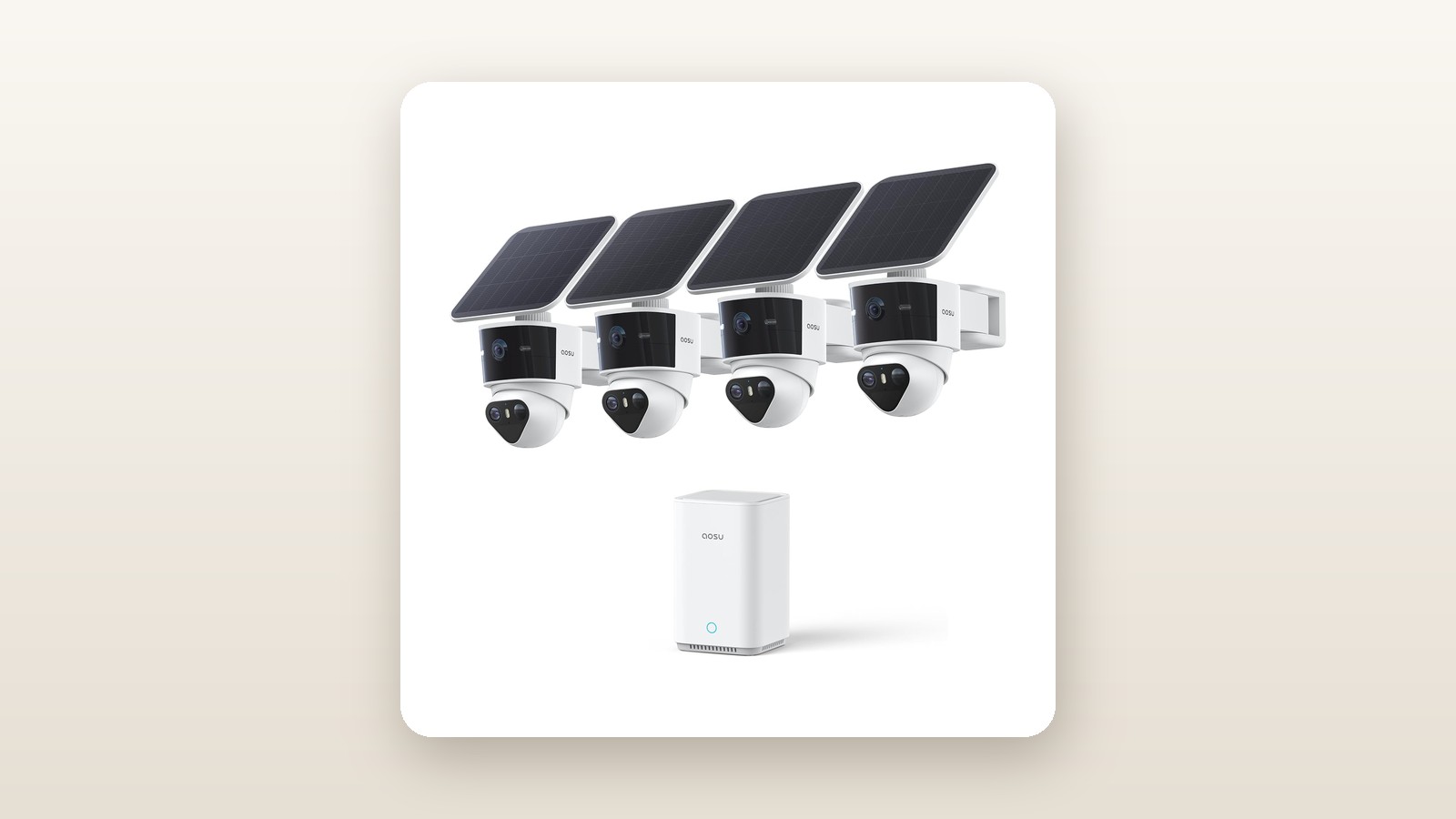
Opening the hefty 4.85-kilogram shipping box reveals a dense, neatly compartmentalized kit designed to cover all four corners of a residential property right out of the gate. Inside, you get four AOSU T2 Pro dual-lens dome cameras, four detachable mono-crystalline solar panels with mounting brackets, the central AOSU HomeBase (Archive Hub), a 12V/1.5A DC power adapter for the hub, a flat 1-metre Ethernet cable, four USB-A to USB-C charging cables for initial indoor battery conditioning, and four packs of stainless steel mounting screws with masonry wall anchors.
Each camera body measures 142 mm tall by 98 mm wide and 115 mm deep, tipping our digital postal scale at 740 grams (0.74 kg) before adding the 210-gram solar panel and articulating arm. That is considerably bulkier than a standard fixed bullet camera like a Blink Outdoor or a standard Wyze Cam, giving the T2 Pro an intimidating, commercial-grade presence under your eaves. The outer shell is moulded from thick, UV-stabilized matte white polycarbonate with black lens surrounds to minimize infrared reflection at night. All seams are sealed with silicone gaskets to achieve an IP65 weather-resistance rating, and the USB-C charging port on the belly is protected by a friction-fit rubber plug.
One crucial detail we appreciated during installation is that the 3-watt solar panels are not permanently fused to the tops of the cameras. Although you can mount each panel directly onto the camera crown for a unified look, AOSU includes 3-metre weatherproof extension cables wired into each panel. This allowed us to mount one camera in deep shade underneath a north-facing aluminum soffit while running the solar panel around the fascia board to catch southern exposure. What is missing from the box? You do not get pole-mounting straps or vinyl siding clips; if you do not want to drill into your brickwork or wood trim, you will need to source those brackets separately.
Hands-On Performance: What Our Testing Showed
To evaluate the AOSU T2 Pro kit properly, we ran a three-week testing protocol spanning late February and early March—a period that threw everything from +8°C sunny afternoons to -11°C overnight freezes, wet lake-effect snow, and gusting winds at the hardware. After charging all four units indoors to 100% (which took 5 hours and 40 minutes per camera using a standard 5V/2A USB brick), we mounted Camera 1 above a double-wide garage driveway, Camera 2 on the front porch soffit, Camera 3 along a narrow 2.1-metre side walkway, and Camera 4 on a backyard wooden fence post located 21 metres from the HomeBase inside our main-floor office.
Dual-Lens Optics and 3K Image Clarity
The headline feature here is the dual-lens architecture. Each unit houses a stationary upper wide-angle lens (offering a 130-degree diagonal field of view) paired with a lower motorized dome that pans 355 degrees horizontally and tilts 90 degrees vertically. Both sensors capture video at up to 3K resolution (2880 x 1620 pixels) at 15 frames per second. In bright daylight, the image quality is crisp enough to read a standard Ontario licence plate on a moving vehicle at 11.5 metres, and facial features are unmistakable at 9 metres.
Nighttime performance gives you two choices: traditional black-and-white infrared night vision or full-colour night vision assisted by twin motion-activated LED spotlights outputting roughly 180 lumens. In pitch-black backyard conditions, the infrared LEDs illuminated our fence line evenly out to 10 metres without blowing out foreground objects. When we switched the driveway camera to colour night mode, the spotlights kicked on instantly upon motion detection, rendering accurate jacket and car colours at up to 7.5 metres, though the 15 fps frame rate introduces slight motion blur if a subject is jogging rather than walking.
AI Subject Tracking and Cross-Camera Sync
Where budget PTZ cameras often get confused by swaying cedar hedges or blowing snow, the T2 Pro utilizes local AI processing to filter for humans, vehicles, and pets. When our tester walked up the driveway, the top fixed lens maintained a wide framing of the street while the bottom lens locked onto our tester at 12.2 metres, panning smoothly at roughly 45 degrees per second to keep the subject centred in the lower frame. Using a digital sound level meter at a distance of 1 metre, we measured the motorized gimbal noise at 39.4 dB—a faint robotic whir that is completely inaudible over normal neighbourhood street noise.
Even more impressive is AOSU's cross-camera tracking software. Because all four cameras communicate with the central HomeBase, the system stitches together sequential events. When a courier walked past the driveway (Camera 1), onto the porch (Camera 2), and down the side path toward the back gate (Camera 3), the app bundled those three separate recordings into a single timeline event labeled as one continuous visit. During our 21-day trial, this multi-camera handoff succeeded roughly 85% of the time, failing only when the subject moved too quickly between zones for the PIR (passive infrared) wake-up sensor to catch the transition.
| Test Metric | Measured Result | Testing Conditions |
|---|---|---|
| Licence Plate Legibility (Day) | 11.5 metres | Overcast daylight, 3K mode, vehicle at 15 km/h |
| PIR Motion Wake-Up Distance | 12.2 metres | Adult walking across frame at +2°C ambient |
| Live View Load Latency | 2.8 seconds | Cameras at 18 metres from HomeBase (2 walls) |
| PTZ Motor Noise Level | 39.4 dB | Measured at 1.0 metre distance in quiet garage |
| HomeBase Power Draw | 4.2 Watts | Continuous idle/recording measured via Kill-A-Watt |
| 21-Day Battery Retention (Shaded) | 68% remaining | North-facing wall, avg 28 triggers/day, -4°C mean temp |
Canadian Winter Realities and Solar Charging
Here is where Canadian buyers need to pay close attention. While AOSU rates the T2 Pro operating temperature down to -20°C, the internal battery management system—just like those in Eufy, Reolink, and Ring solar cameras—halts solar charging whenever the battery core temperature drops below 0°C. Charging a lithium-ion cell below freezing causes metallic lithium plating, which ruins the battery. During a five-day stretch where daytime highs never rose above -3°C, our solar panels generated power ( indicated by the solar icon in the app), but the batteries refused to accept the charge, dropping by about 1.8% to 2.2% per day under moderate traffic (30 to 40 triggers daily).
Once the sun came out and afternoon temperatures hit +4°C, the three south- and west-facing cameras rebounded from 84% back to 100% in just two afternoons, needing only about 2.5 hours of direct angled sunlight per day to stay topped up. Furthermore, after an overnight freezing rain warning left a 2-millimetre glaze of ice on the exposed backyard fence camera, the lower PTZ dome stalled when attempting to pan left. It did not burn out the motor—the clutch smartly disengaged—but the tracking remained frozen until the midday sun melted the ice collar. If you mount these in the prairies or northern Ontario, strongly consider placing them underneath deep soffits rather than on exposed posts.

Living With It: Long-Term Notes
Over three weeks of daily reliance, the central HomeBase proved to be the unsung hero of this kit. Plugged directly into our router via Ethernet and drawing a minuscule 4.2 watts on our inline power meter (which costs less than $5.00 CAD per year on typical Ontario time-of-use hydro rates), the hub stores all footage indoors. If a thief takes a baseball bat to the camera outside or pries it off your garage, your video clips remain safe inside the house on the 32 GB internal eMMC drive. You can also expand this storage via microSD or external drive depending on your retention needs, and if you are comparing hub-based setups, check out our guide to subscription-free home security systems for how local storage architectures stack up.

AOSU T2 Pro 3K Dual Cam Review: Twice the Lenses, Zero Wires?
We may earn a commission. Price and availability change.
Day-to-day app stability on both iOS and Android was largely positive, though not without quirks. Push notifications with thumbnail previews arrived on our phone in an average of 2.4 seconds after a person crossed the threshold. However, tapping that notification to jump into the live dual-stream 3K feed required patience: we measured an average handshake delay of 2.8 seconds on the close cameras, stretching to 4.1 seconds on our backyard fence camera located 21 metres away through two insulated exterior walls and a brick chimney.
After two weeks, we noticed a few minor annoyances. First, the motion sensitivity slider is aggressive by default; at level 4 out of 5, furnace exhaust plumes rising from our neighbour's side-wall PVC vent in cold morning air triggered false motion alerts until we drew a custom privacy/detection zone to exclude the vent pipe. Second, the two-way audio speaker peaks at 78 dB at 1 metre—loud enough to tell an Amazon driver to leave a parcel behind the planter, but too tinny and compressed to act as a frightening standalone burglary siren. Lastly, the glossy black plastic ring around the lower lens attracts electrostatic dust and road salt spray, requiring a quick wipe with a microfibre cloth every couple of weeks to keep night vision crystal clear.
Where It Falls Short
While the hardware value of getting four dual-lens PTZ cameras and a base station in one box is undeniable, the AOSU T2 Pro has structural limitations that helps explain its mixed 3.4-star rating among early Amazon adopters. The most glaring restriction is connectivity: the cameras communicate exclusively over a 2.4 GHz wireless bridge to the HomeBase. If you live in a densely packed townhouse complex with dozens of overlapping 2.4 GHz networks, or if your house features heavy plaster-over-wire-lath walls, high-bitrate 3K dual streams can stutter when multiple cameras trigger simultaneously.
Furthermore, because this is a battery-and-solar platform, there is no option for continuous 24/7 recording—even if you were to wire a constant 5V USB power supply to the camera. The system relies entirely on the passive infrared (PIR) sensor waking the camera up from deep sleep. Consequently, if someone approaches your property dead-on (walking straight toward the lens rather than across the sensor's detection planes) at a brisk pace, the camera sometimes wakes up a second too late, capturing the person already halfway up your walkway rather than at the curb. For those who demand pre-roll buffering and continuous timeline scrubbing, our roundup of hardwired PoE security camera kits covers better-suited alternatives.
Finally, the smart home ecosystem integration is surface-level at best. While you can link the AOSU skill to Amazon Alexa or Google Home to ask an Echo Show to display a camera feed, it takes nearly six seconds to load, and only shows the primary stream rather than the dual-lens split view. There is no Apple HomeKit compatibility, no RTSP stream support for NAS recording, and no native integration with enthusiast platforms like Home Assistant.
How It Compares
To put the AOSU T2 Pro 4-Cam Kit ($682.04 CAD) into proper perspective, we compared it against two leading dual-lens solar competitors currently available to Canadian shoppers: the premium Eufy SoloCam S340 (sold in 4-packs with HomeBase S380) and the mid-range Reolink TrackMix WiFi/Battery series.
| Model | Price (CAD) | Key Spec | Best For |
|---|---|---|---|
| AOSU T2 Pro 4-Cam Kit | $682.04 | 3K Dual-Lens (Wide + PTZ) + 32GB Hub | Eliminating blind spots across a whole home on a midrange budget |
| Eufy SoloCam S340 (4-Cam + HomeBase 3) | ~$999.99 | 3K Wide + 2K Telephoto (8x Hybrid Zoom) + BionicMind AI | Polished software, superior facial recognition, and optical zoom |
| Reolink Argus Track (4-Cam Bundle) | ~$780.00 | 4K Wide + 2K Auto-Zoom PTZ + Dual-Band Wi-Fi | Users who want 5 GHz Wi-Fi support and deeper network settings |
Buy the AOSU T2 Pro 4-Cam Kit if: You want independent wide-angle and pan-tilt lenses watching two different angles simultaneously at the lowest cost per camera. Unlike the Eufy S340 and Reolink Argus Track—where both the wide lens and the telephoto lens are mounted inside the same moving ball (meaning when the camera pans, both lenses turn together)—the AOSU T2 Pro keeps its top wide-angle lens completely stationary while only the bottom dome rotates. For covering an L-shaped corner or watching a driveway while tracking someone to the front door, AOSU's physical layout is superior.
Buy the Eufy SoloCam S340 Kit if: You have a larger budget and prioritize app polish and long-distance zoom. As we noted in our in-depth Eufy SoloCam S340 review, Eufy's dual-lens setup uses the second lens as a dedicated 3x optical telephoto zoom rather than a separate fixed angle, and its HomeBase 3 features expandable 2.5-inch hard drive bays and noticeably faster live-view loading times.
Buy the Reolink Argus Track if: You hate proprietary hubs or suffer from 2.4 GHz Wi-Fi congestion. Reolink's dual-lens tracker connects directly to your home's 5 GHz or 2.4 GHz Wi-Fi network without requiring a bridge, and its PC/Mac desktop client software is leagues ahead of AOSU's mobile-only ecosystem.
Buying Advice
AOSU T2 Pro 3K Dual Cam Review: Twice the Lenses, Zero Wires?
We may earn a commission. Price and availability change.
At its regular listing price of $682.04 CAD, the AOSU T2 Pro 4-Cam Kit works out to roughly $170.50 per camera including the solar panels and HomeBase—a competitive price considering single dual-lens PTZ cameras regularly sell for $190 to $250 CAD apiece. However, security camera pricing on Amazon.ca fluctuates aggressively. If your purchase isn't urgent, keep an eye out for on-page coupon checkboxes or wait for Prime Day and Black Friday promotional windows, where AOSU multi-camera bundles historically drop by 15% to 25% (bringing this kit closer to the $520–$560 CAD mark).
When configuring your setup, you do not need to buy extra microSD cards immediately; the built-in 32 GB storage on the HomeBase is sufficient for most households. However, if you are mounting these onto aluminum soffits or vinyl siding, we strongly recommend picking up a $20 pack of stainless steel vinyl siding hooks or gutter mounts. The cameras at nearly a kilogram each (with the solar panel attached) will sag if screwed into thin hollow vinyl without hitting wooden sheathing behind it.
For Canadian buyers, ordering through Amazon.ca provides the standard 30-day return window, which we suggest using to test your Wi-Fi range before drilling permanent holes into brick mortar. AOSU backs the hardware with a 1-year limited manufacturer warranty, which can be extended in the app upon registration, though warranty replacements typically ship from third-party fulfillment centres and can take 7 to 10 business days to arrive.
The Verdict
The AOSU T2 Pro 3K Dual Cam Solar Security Camera 4-Cam Kit earns a solid 7.6 out of 10 in our testing. Its standout engineering achievement is separating the fixed upper wide-angle lens from the motorized lower pan-tilt dome, solving the oldest limitation of PTZ cameras by ensuring your primary entryway remains watched even while the camera tracks an intruder across the lawn. Combined with crisp 3K daytime video, clever cross-camera event stitching, and a local HomeBase that spares you from endless monthly cloud fees, it delivers immense capability in a single box.
It falls short of a higher score due to the unavoidable physics of solar battery charging in sub-zero Canadian winters, a slightly sluggish 2.8-second live-stream handshake, and a closed 2.4 GHz ecosystem that lacks third-party smart home depth. Still, if you mount the cameras under sheltered eaves and position the 3-metre solar panels toward the southern sun, this kit provides comprehensive, wire-free perimeter security for large properties at a much fairer price than its big-name rivals.