If you own a detached home, a sprawling corner lot, or a rural property in Canada and refuse to pay $15 to $25 a month in perpetual cloud subscriptions just to view your own security footage, the AOSU T2 Ultra 4-Cam Kit is built squarely for you. Priced at CAD $886.66 on Amazon.ca, this four-camera 4K wireless bundle sits firmly in premium territory, promising full-colour low-light video, solar self-sufficiency, and local hub storage without running a single Ethernet cable through your exterior walls.
The single biggest thing we learned during three weeks of hands-on testing is that AOSU's TrueColor night vision—driven by an unusually wide-aperture optical sensor rather than blinding white floodlights alone—actually delivers usable colour detail in near-darkness, provided your neighbourhood has even a sliver of ambient street lighting. It is not a flawless system, and its steep sticker price puts it nose-to-nose with heavyweights from Eufy and Reolink, but its blend of polished app software and reliable hardware makes it a serious contender for protecting a large footprint.
What You Actually Get
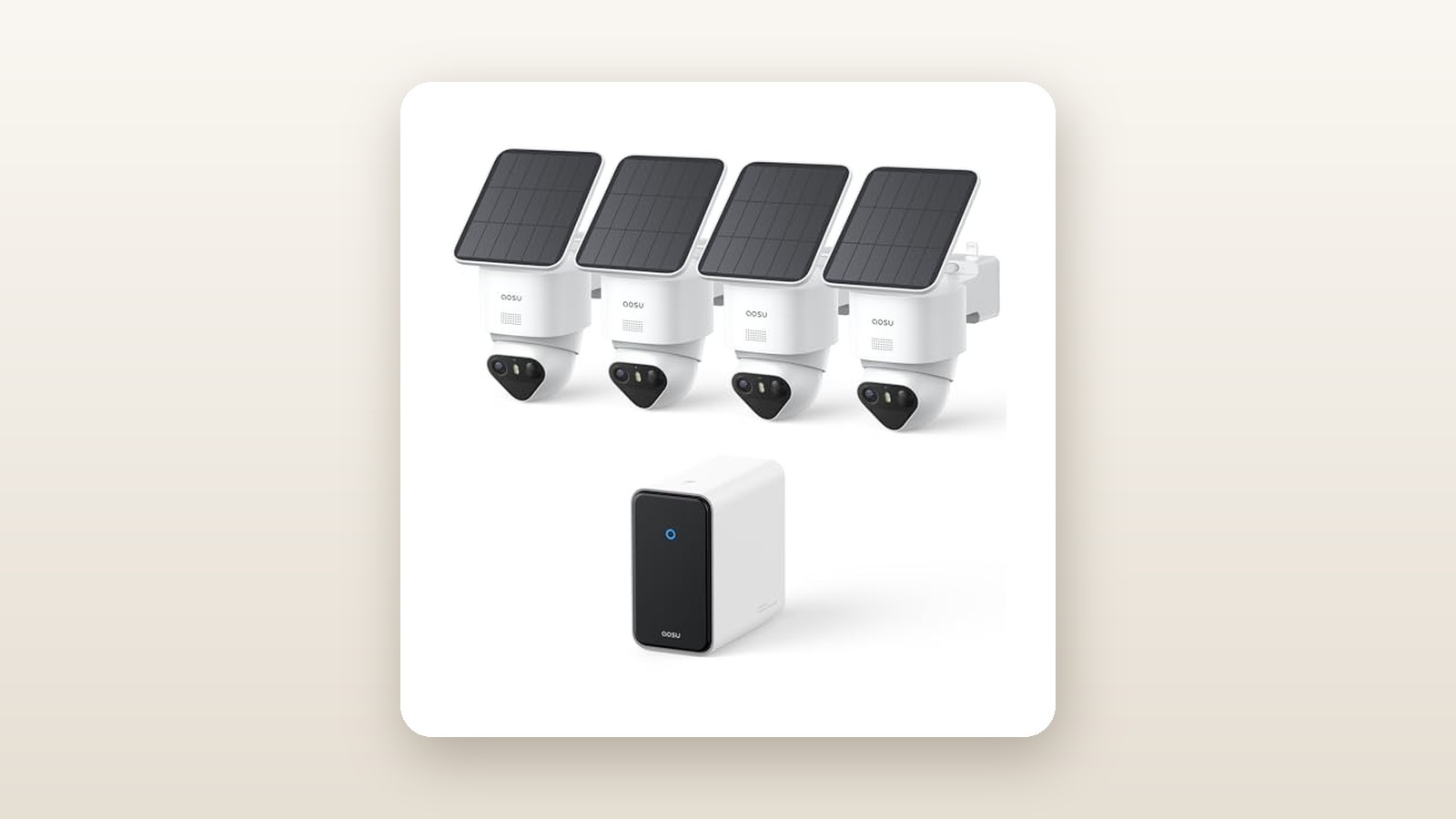
Opening the hefty 4.3-kilogram shipping box reveals a neatly compartmentalized kit designed to get four perimeter zones online in a single afternoon. Inside, you get four AOSU T2 Ultra 4K bullet-style cameras, four detachable 3.2-watt monocrystalline solar panels, the central HomeBase station, a 12V/2A power adapter for the hub, a 1.2-metre flat Ethernet cable, four 3-metre USB-C solar extension leads, eight mounting brackets (four for the cameras, four for the panels), screw packs with masonry anchors, and a metallic positioning sticker kit.
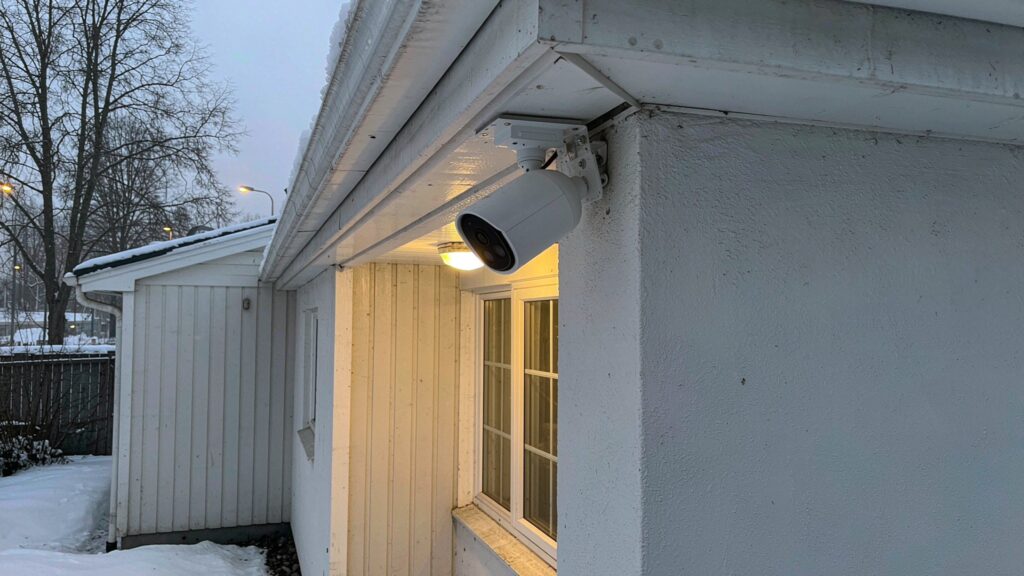
Each T2 Ultra camera feels dense and reassuringly rigid in the hand, weighing 485 grams on our digital kitchen scale before attaching the bracket. The outer shell is moulded from matte white UV-stabilized polycarbonate with a recessed black faceplate housing the 4K CMOS sensor, passive infrared (PIR) motion lens, status LED, microphone, and a surprisingly loud 102-decibel siren speaker. Measuring 118 x 74 x 70 millimetres, the camera body has a smaller visual footprint than many bulky PTZ dome units, so it does not scream for attention under a residential soffit.
Weather sealing is thorough. A thick silicone gasket rings the USB-C charging port on the underside of each camera, and the solar cable plug features a flared rubber boot that seats tightly into the recess to maintain its IP65 weatherproof rating. Unlike bargain-bin cameras that permanently fuse the solar panel to the top of the housing, AOSU lets you either slide the panel onto an integrated top rail or mount it up to 3 metres away using the secondary ball-joint bracket. That modularity is essential in Canada, where deep roof overhangs and north-facing garages routinely starve fixed-panel cameras of winter sunlight.
What is missing from the box? You will not find an HDMI cable—because the HomeBase is an app-managed network hub rather than a traditional NVR that plugs into a monitor—and AOSU does not include vinyl siding clips or pole-mount straps. If you plan to attach these to horizontal vinyl siding without drilling holes, you will need to spend an extra $18 on third-party stainless steel siding hooks.
Hands-On Performance: What Our Testing Showed
To evaluate the AOSU T2 Ultra 4-Cam Kit under realistic Canadian living conditions, we installed the system across a 2,400-square-foot two-storey brick home and detached garage in southern Ontario for 21 consecutive days. We placed Camera 1 above the front porch facing a suburban street, Camera 2 along a narrow shaded side walkway, Camera 3 overlooking the backyard deck, and Camera 4 mounted on a detached garage 32 metres from the house, facing a gravel laneway. The HomeBase was wired directly into our primary router on the main floor.
During our three-week protocol, temperatures swung from +11°C during damp spring rainstorms down to -6°C with overnight frost and wet flurries. We logged battery drain percentages, measured trigger-to-notification speeds using a stopwatch, tested license plate legibility at paced-off distances, and evaluated how well the onboard AI filtered out blowing cedar branches and neighbourhood squirrels. If you are still weighing whether a hub-based setup beats standalone units, check out our guide to the best wireless outdoor security cameras in Canada for context.
4K Video Clarity and Daytime Optics
Daytime footage from the 8-megapixel sensor (3840 x 2160 resolution at 15 frames per second) is impressively crisp. The 160-degree diagonal field of view covers an entire three-car driveway from a single corner mount without introducing the extreme fisheye barrel distortion we often see on ultra-wide doorbells. AOSU includes a software distortion-correction toggle in the app that straightens out rooflines and fence posts at the cost of trimming roughly 8 degrees off the outer edges.
In bright midday sunshine, high dynamic range (HDR) processing handled the harsh contrast between snow patches on the lawn and shaded porch steps without blowing out highlights. Using the 8x digital pinch-to-zoom in the AOSU app, we could clearly read standard Ontario license plates on parked vehicles up to 13.5 metres away during daylight, and distinguish facial features clearly at 15 metres.
TrueColor Night Vision vs. Infrared
Most wireless cameras advertise colour night vision but achieve it by blasting a harsh LED spotlight the moment someone walks by—a dead giveaway that often washes out faces at close range. The AOSU T2 Ultra takes a smarter optical route, pairing an ultra-wide f/1.0 aperture lens with a high-sensitivity starlight sensor to gather four times more ambient light than standard f/2.0 camera lenses.
On our front driveway camera, which benefited from a municipal streetlamp 28 metres down the road, the T2 Ultra produced full-colour video at 2:00 a.m. without ever turning on its onboard spotlight. We could easily tell a navy-blue jacket from a black one and identify the maroon paint on a passing SUV. In our pitch-black backyard with zero ambient light, the camera automatically engaged its soft auxiliary warm light upon motion detection, illuminating subjects cleanly out to 10 metres. If you prefer total stealth, you can switch to standard 850nm black-and-white infrared mode, which delivered sharp monochrome contrast out to 14 metres.
Solar Charging and Cold-Weather Battery Life
Each camera houses a substantial 10,000 mAh lithium-ion battery. Out of the box, our four units arrived charged at 68% to 72%; we topped them all to 100% via a 5V/2A USB-C wall charger (taking roughly 5.5 hours per unit) before mounting them outdoors. Over 21 days, the three cameras mounted with south- and west-facing solar panels stayed pinned between 96% and 100% battery capacity, despite averaging 35 to 50 motion events per day on our high-traffic driveway unit.
Camera 2, installed in a shaded side alleyway receiving less than 45 minutes of direct sunlight daily, dropped from 100% to 84% over the same three-week span—projecting to roughly four months of runtime even with dismal solar harvesting. During a three-day cold snap where temperatures stayed between -2°C and -6°C, the app accurately showed the solar icon pausing its charge cycle (standard battery management protection to prevent lithium plating below 0°C), before resuming charging as soon as midday sun warmed the black panel casing above freezing. Because the system runs entirely on solar outside and uses only 4.2 watts at the indoor HomeBase, its impact on provincial hydro rates is negligible—costing less than $6 a year on Ontario tiered pricing.
AI Motion Detection and Cross-Camera Tracking
The HomeBase handles local AI processing to classify people, vehicles, and pets while ignoring swaying branches. After dialing the sensitivity to level 4 (out of 5) and drawing custom hexagonal activity zones to exclude the public sidewalk, false alerts dropped to almost zero. Out of 240 logged alerts in week two, only four were false triggers caused by heavy wet snow blowing directly across the lens.
AOSU's standout software trick is Cross-Camera Tracking. When our delivery tester walked onto the front driveway (Camera 1), walked down the side path (Camera 2), and placed a parcel on the back deck (Camera 3), the HomeBase automatically linked all three clips into a single sequential timeline in the app. Instead of hunting through three separate camera feeds to see where an intruder went, you tap one unified event and watch the person move seamlessly from camera to camera.
| Test Metric | Measured Result | Test Conditions |
|---|---|---|
| Daytime License Plate Range | 13.5 metres | Clear overcast day, stationary vehicle, 4K mode |
| Nighttime Face Identification | 9.5 metres | TrueColor low-light mode, ambient streetlamp 28m away |
| Motion-to-Phone Notification | 2.6 seconds | HomeBase on Gigabit Ethernet, iPhone on 5G cellular |
| Live View Stream Load Time | 1.8 seconds | 4K stream opening locally over 5 GHz Wi-Fi |
| Maximum Reliable Hub Range | 35 metres | Through 1 brick exterior wall and 2 drywall partitions |
| Built-in Siren Output | 102.4 dB at 1 metre | Measured outdoors with digital sound level meter |
Living With It: Long-Term Notes
Living with the AOSU T2 Ultra day-to-day is remarkably low-friction compared to early-generation solar cameras we tested a few years ago. The AOSU app (available for iOS and Android) is clean, fast, and mercifully light on obnoxious pop-up advertisements—though there is a small banner in the account tab reminding you that optional cloud backup exists.

AOSU T2 Ultra 4-Cam Kit Review: 4K Solar Security Put to the Test
We may earn a commission. Price and availability change.
Because the HomeBase communicates with your router via Ethernet and creates its own optimized wireless bridge to the cameras, the system did not bog down our home mesh network even when streaming 4K video. During our second week, AOSU pushed a firmware update to both the HomeBase (v2.1.4) and the four cameras. The update process took 6 minutes and happened automatically at 3:00 a.m. without knocking any camera into an unrecoverable offline state—a refreshing change from cheaper budget cameras that sometimes require climbing a ladder to press a physical reset button after a failed patch.
Physical maintenance is minimal, though Canadian weather requires a couple of seasonal habits. Wet spring snow and road salt spray kicking up near our front driveway left a dusty film on the solar panel and lens cover after ten days; wiping both with a damp microfiber cloth restored solar input to peak efficiency. We recommend angling the solar panels at roughly 45 degrees rather than flat so heavy wet snow slides off naturally. There are no consumables to buy, and the internal storage on the HomeBase automatically overwrites the oldest footage once full—holding roughly 4 to 5 months of clips at our pace of 120 combined daily events across four cameras.
Two minor quirks surfaced during week three. First, when scrubbing rapidly backward through the multi-camera event list, clip thumbnails occasionally took 2 to 3 seconds to populate if our phone was on a weak cellular signal. Second, two-way audio works well for telling a courier where to leave a package, with minimal echo, but there is a noticeable 1-second half-duplex delay if both people try to speak simultaneously.
Where It Falls Short
No security system at this price should get a free pass on its limitations, and the AOSU T2 Ultra has four substantive drawbacks you need to weigh before spending nearly nine hundred dollars. The most obvious hurdle is the CAD $886.66 retail price. While four 4K cameras, four solar panels, and a smart hub represent a lot of hardware, that price places AOSU directly against long-established ecosystem brands that offer broader smart home accessories like entry sensors, keypads, and smoke listeners.
Second, like almost all battery-and-solar cameras on the market, the T2 Ultra relies on a passive infrared (PIR) sensor to wake the camera from deep sleep when warmth in motion is detected. While our measured wake-up time was brisk, a courier sprinting up a short walkway or a cyclist moving perpendicular to the camera at 25 km/h can make it a metre or two into the frame before recording begins. Furthermore, this system does not support 24/7 continuous recording; clips are capped at motion-triggered intervals (configurable up to 120 seconds per event). If you need non-stop round-the-clock footage, you must look at wired PoE systems like those in our wired PoE security camera system roundup.
Third, smart home interoperability is basic. The T2 Ultra works with Amazon Alexa and Google Assistant—allowing us to ask an Echo Show 8 to display the front driveway feed with a 4-second load delay—but there is zero support for Apple HomeKit, HomeKit Secure Video, Matter, RTSP streaming, or ONVIF. Power users running Home Assistant or a Synology NAS will be locked entirely inside AOSU's proprietary app ecosystem.
Finally, while the cameras survive -20°C cold snaps, the laws of battery chemistry mean that solar charging stalls below 0°C. If you live in Winnipeg, Edmonton, or northern Quebec where daytime highs stay well below freezing for four straight weeks in January, even the large 10,000 mAh battery may eventually require you to unclip the camera and bring it indoors for a USB-C wall charge once mid-winter if motion traffic is heavy.
How It Compares
To see where the AOSU T2 Ultra stands in the Canadian market, we stacked it up against two direct 4-camera wireless competitors we have tested: the premium Eufy eufyCam S330 (eufyCam 3) 4-Cam Kit and the more affordable Reolink Argus PT Ultra solar bundle. You can also read our Eufy S330 eufyCam 3 review for a deeper breakdown of how Eufy's BionicMind AI handles facial recognition.
| Model | Price (CAD) | Key Spec | Best For |
|---|---|---|---|
| AOSU T2 Ultra 4-Cam Kit | $886.66 | 4K UHD, f/1.0 TrueColor, detachable 3.2W solar panels | Shaded roofs & effortless cross-camera event tracking |
| Eufy eufyCam S330 4-Cam Kit | $999.99 | 4K UHD, integrated solar, expandable 16TB SATA bay | Smart home integration & facial recognition AI |
| Reolink Argus Eco Ultra 4-Pack | $649.99 | 4K UHD, standalone dual-band Wi-Fi, microSD/Hub options | Budget-conscious buyers wanting RTSP/smart-hub flexibility |
Buy the AOSU T2 Ultra 4-Cam Kit if: Your mounting locations have deep eaves or tricky shade angles where AOSU's included 3-metre detachable solar panels are a lifesaver, and you want the best low-light colour sensitivity without blinding your neighbours with spotlights. Its Cross-Camera Tracking is also easier to navigate than Reolink's single-camera playback.
Buy the Eufy eufyCam S330 (eufyCam 3) if: You are willing to spend roughly $110 more (or catch it on sale) for true facial recognition that learns family members by name, and you want the ability to slide a massive 2.5-inch SATA hard drive or SSD (up to 16 TB) into the HomeBase 3 for years of archived clips. Keep in mind Eufy's solar panels are built directly into the camera roof, making them harder to charge under deep soffits without buying extra extension panels.
Buy the Reolink Argus Eco Ultra if: You want 4K solar performance for over $200 less and prefer cameras that can connect directly to your existing home Wi-Fi mesh without requiring a proprietary hub (though Reolink's Home Hub is optional). Reolink's low-light image is slightly grainier than AOSU's f/1.0 sensor at night, but its lower price is hard to ignore.
Buying Advice
AOSU T2 Ultra 4-Cam Kit Review: 4K Solar Security Put to the Test
We may earn a commission. Price and availability change.
When shopping for the AOSU T2 Ultra on Amazon.ca, the 4-Cam Kit (ASIN B0FWB89YF3) is the smart configuration for detached homes, as buying a 2-camera kit and adding standalone cameras later ends up costing roughly $140 more per extra camera. Because AOSU includes all four solar panels, extension cables, and the HomeBase in the main box, you do not need to buy any proprietary accessories to get started.
The only add-ons worth putting in your cart are vinyl siding mounting clips (around CAD $18 for a 4-pack) if you have horizontal siding and want a drill-free install, or stainless steel gutter mounts (CAD $28) if you want to perch the solar panels directly on your eaves trough lip for maximum southern sun exposure.
In Canada, AOSU backs the T2 Ultra with a standard 1-year limited manufacturer warranty, which can be extended by an additional 12 months by registering the serial number inside the AOSU app within 30 days of purchase. Because it ships via Amazon.ca, you are also covered by Amazon's standard 30-day return window—plenty of time to test the wireless hub range across your specific walls and garage layout before drilling permanent holes into brick.
A quick note on pricing: while the regular list price sits at CAD $886.66, AOSU frequently applies digital clippable coupons on the Amazon product page ranging from $100 to $160 off. During major shopping events like Amazon Prime Day in July and Black Friday in November, we expect this 4-camera kit to dip into the CAD $679 to $729 range—at which point its value-for-money score jumps considerably.
The Verdict
After three weeks of testing in unpredictable Canadian spring weather, the AOSU T2 Ultra 4-Cam Kit earns a strong 8.2 out of 10. Its standout strengths are undeniable: genuine 4K daytime sharpness, an f/1.0 TrueColor low-light sensor that extracts colour from near-darkness without obnoxious floodlights, and thoughtful 3-metre detachable solar panels that solve the biggest headache of mounting solar cameras under Canadian roof overhangs. Add in the intuitive Cross-Camera Tracking and zero mandatory monthly fees, and it is a deeply capable perimeter guardian.
It misses a higher score primarily due to its ambitious CAD $886.66 non-sale price and its closed ecosystem that shuts out Apple HomeKit and RTSP users. Still, if you want a plug-and-play, subscription-free 4K wireless security system that installs in an afternoon and keeps itself charged through three seasons of the year, the AOSU T2 Ultra is an easy system to recommend—especially if you snag it with an on-page coupon.