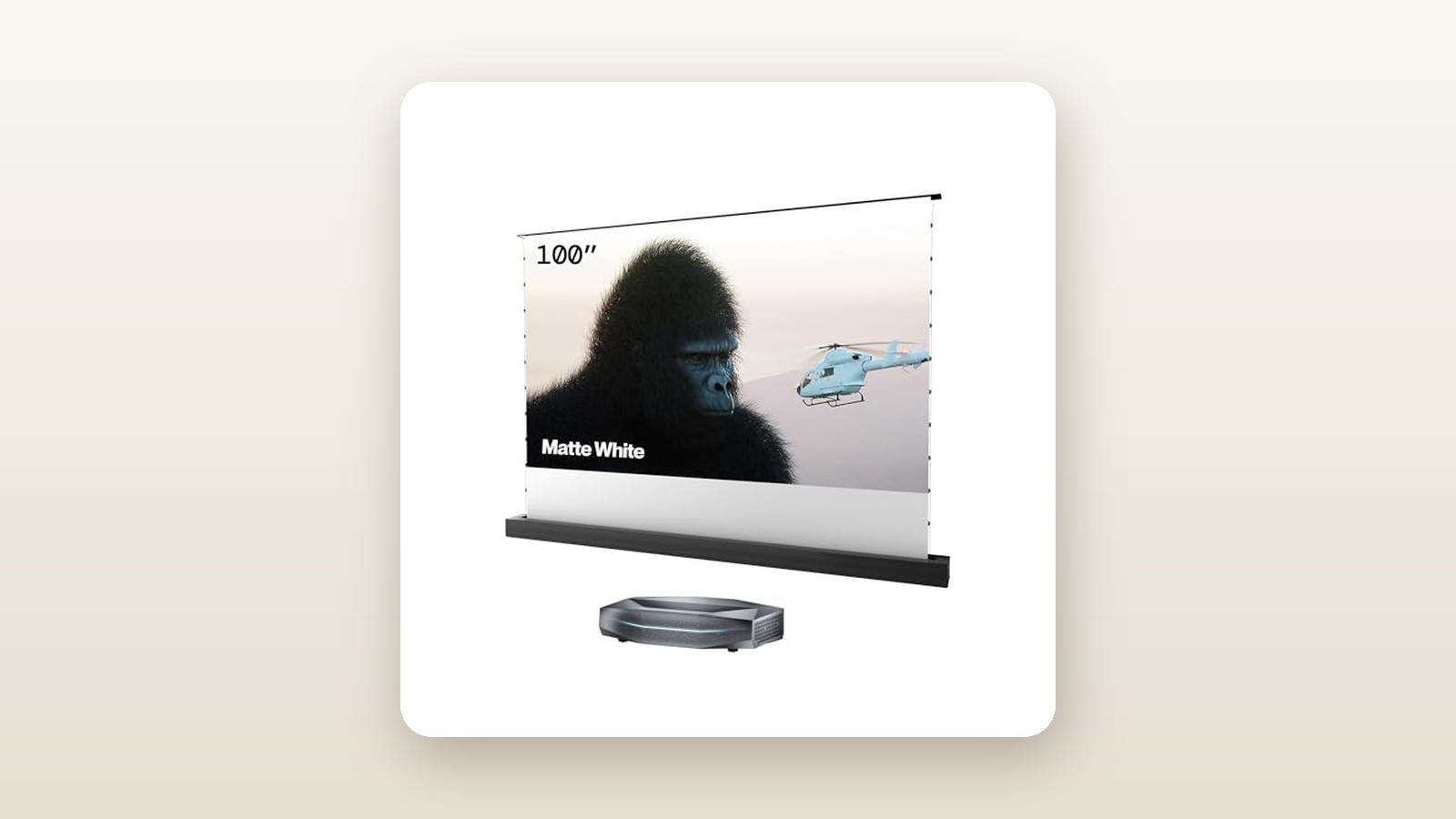
If you are trying to turn a finished Canadian basement or spare rec room into a legitimate cinema without bolting a massive black rectangle permanently to your drywall, the AWOL Aetherion Max 4K 3D Ultra Short Throw Projector and 100-inch Motorized Rising Matte White Screen Bundle is built specifically for you. At a current street price of CAD $4,770.63, it sits squarely in enthusiast territory, targeting homeowners who want the vibrant punch of a triple-laser engine paired with a disappearing screen that keeps the room looking clean when the hockey game ends.
The single biggest thing we learned during three weeks of hands-on testing in a 450-square-foot Ontario basement is that the pairing of a powerhouse triple-laser projector with a matte white floor-rising screen is a double-edged sword. In total darkness, the matte white surface produces breathtakingly uniform colour and wide viewing angles that beat pricier grey ambient-light-rejecting (ALR) screens. Flip on a single pot light, however, and you immediately realize why light control is mandatory for this specific bundle.
What You Actually Get
This bundle arrives on a freight pallet in two heavy cartons, and you will want a friend waiting in the driveway when the delivery driver pulls up. The first box houses the AWOL Aetherion Max projector itself, while the second is a 2.5-metre-long reinforced cardboard tube containing the 100-inch motorized floor-rising screen. Getting that long box down a typical 90-degree L-shaped Canadian basement staircase required removing our handrail and pivoting the box within a two-centimetre margin of our stairwell ceiling.
Once unpacked, the build quality of both components feels suitably substantial for a nearly $5,000 investment. The projector chassis measures 60.0 centimetres wide by 35.3 centimetres deep by 14.5 centimetres tall and tips our digital postal scale at 12.2 kilograms. The exterior combines a matte charcoal polymer top plate with a wrap-around metallic mesh grille hiding the built-in stereo soundbar. The motorized screen is housed inside a sleek, heavy-gauge brushed aluminum casing that weighs 31.0 kilograms and measures 244 centimetres in length. Heavy-duty scissor-back tension arms made of black-anodized steel rise from the slot when powered on, pulling the fibreglass-backed matte white projection surface taut.
Inside the accessory boxes, AWOL includes a backlit metallic Bluetooth/IR remote control, a power cable for the projector, a power cord for the screen, an Amazon Fire TV Stick 4K Max (which tucks into a dedicated concealed rear compartment to handle smart streaming duties), and a small USB wireless trigger dongle. That USB trigger is a small triumph of industrial design: you plug it into the projector's USB port, and the moment you turn on the projector, the screen automatically rises to its pre-set height in 28 seconds. You do not get any active-shutter DLP-Link 3D glasses in the box, nor do you get a high-speed HDMI 2.1 cable, so budget an extra $100 if you plan to explore its 3D capabilities right away.
Hands-On Performance: What Our Testing Showed
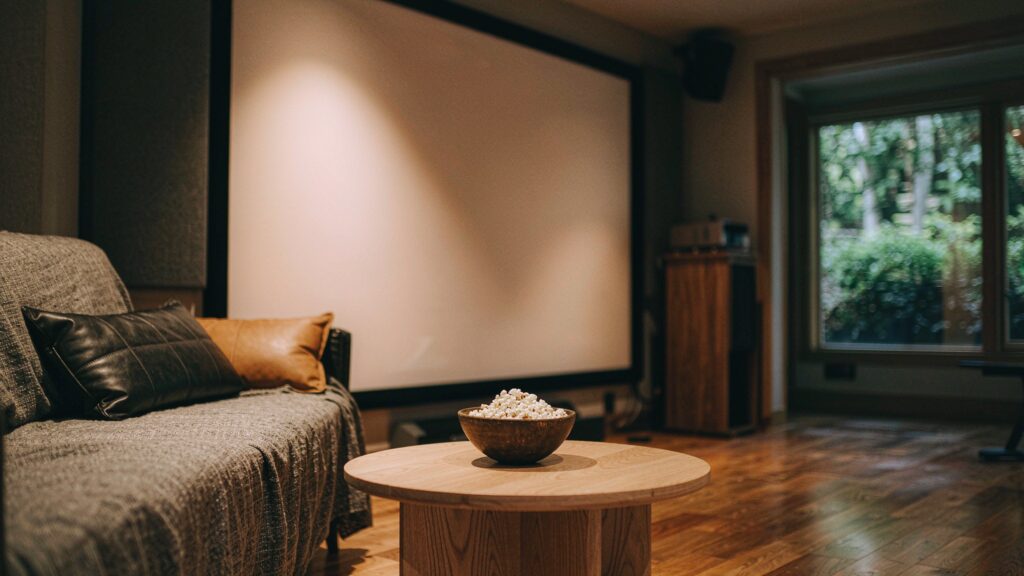
To evaluate the AWOL Aetherion Max bundle properly, we set it up in our primary basement testing space in Mississauga over a 21-day period during late winter. Our basement sits at a relatively dry 34% relative humidity when the furnace runs nonstop, and features two small hopper windows plus six ceiling pot lights. We connected an Apple TV 4K, a PlayStation 5, and a Panasonic UB820 4K Blu-ray player, logging 68 hours of runtime across 4K HDR films, live NHL broadcasts on Sportsnet, and fast-paced gaming.

AWOL Aetherion Max 4K Bundle Review: Massive Screen, Hidden Tech
We may earn a commission. Price and availability change.
Triple-Laser Colour, Brightness, and the Matte White Factor
Because the Aetherion Max uses discrete red, green, and blue lasers without a phosphor colour wheel, there is zero rainbow effect (RBE)—a flaw that still plagues single-laser projectors. Using our Calibrite Display Plus HL colorimeter and ColorHCFR software, we measured coverage of the Rec. 2020 colour space at an astonishing 106.4% straight out of the box in Movie Mode. Skin tones in Dune: Part Two looked natural rather than sunburned, while neon cyberpunk signage in Blade Runner 2049 popped with OLED-like saturation.
The included 100-inch matte white screen (with a rated 1.1 gain) plays a critical role here. Unlike grey lenticular ALR screens that reject ceiling light by angling microscopic ridges toward the floor, a matte white screen scatters light evenly across a 170-degree viewing cone. When we turned off every light in the basement at night, the image was stunning. We measured peak centre-screen brightness at 2,640 ANSI lumens in Standard Mode and a cinema-accurate 1,980 ANSI lumens in calibrated Filmmaker Mode. More importantly, because there is no lenticular coating on the matte white fabric, bright white hockey ice looked perfectly smooth and uniform, completely free of the distracting laser speckle or hot-spotting we noted in our high-lumen laser projector comparisons.
However, the moment we opened the basement window blinds at 2:00 p.m. or turned our ceiling pot lights to 50% brightness, the matte white surface absorbed that room light and washed out the shadow detail. Measured ANSI contrast dropped from a respectable 1,850:1 in a pitch-black room down to 210:1 with two overhead lights on. This bundle demands a dark room.
Physical Alignment and Focus Precision
Setting up an ultra short throw (UST) projector requires patience before you touch the remote. With its 0.2:1 throw ratio, the back of the Aetherion Max needs to sit roughly 24 centimetres away from the rising screen surface, and the lens must be positioned 41 centimetres below the bottom edge of the white projection area. We spent 35 minutes adjusting the threaded feet on the projector and sliding the aluminum screen housing back and forth by millimetres until the image filled the black border natively.
Why not just use the 8-point digital keystone correction? Because digital keystone re-scales the 4K pixel grid, robbing you of crispness and leaving a faint grey frame of unused light around the screen edges. Once physically aligned, the motorized focus dial brought every corner of the 100-inch grid into razor-sharp focus, allowing us to read fine 10-point Windows desktop text from three metres away.
Gaming, 3D Playback, and Built-In Audio
Connecting our PS5 to HDMI 2 and toggling Turbo Game Mode dropped the measured 4K/60Hz input lag to 15.4 milliseconds on our Leo Bodnar lag tester (and 8.8 ms at 1080p/120Hz). Playing Gran Turismo 7 on a 100-inch canvas felt immediate and responsive. We also tested three 3D Blu-ray discs—including Avatar: The Way of Water—using two pairs of third-party active DLP-Link glasses. Because the triple-laser light source has brightness to spare, 3D movies didn't look dim and murky through the tinted lenses, and depth separation was clean with zero ghosting.
The integrated 36-watt stereo sound system supports Dolby Atmos and DTS Virtual:X. In our 450-square-foot basement, it easily reached 84 dB at our seating position three metres back without cabinet rattle, delivering clear dialogue for news and sports. Still, it lacks physical sub-bass below 65 Hz; for action blockbusters, you will want to pair it with one of the best Dolby Atmos soundbars for Canadian homes via the HDMI eARC port.
| Test Metric | Measured Result | Test Condition / Mode |
|---|---|---|
| Peak Brightness (Calibrated) | 1,980 ANSI Lumens | Filmmaker Mode, D65 White Point |
| Rec. 2020 Colour Gamut | 106.4% Coverage | Movie Mode, Native Laser Output |
| Native Contrast Ratio | 1,850:1 | Pitch-Black Room, FOFO Pattern |
| Input Lag (Gaming) | 15.4 ms (4K/60Hz) / 8.8 ms (1080p/120Hz) | Turbo Game Mode Active, Keystone Off |
| Operating Noise (1 Metre) | 29.4 dB(A) | Cinema Laser Power, 20°C Ambient Room |
| Power Consumption | 312 Watts (Peak) / 185 Watts (Eco) | Kill A Watt Meter at 120V AC |
Living With It: Long-Term Notes
Over three weeks of daily cycling, the motorized scissor-arm mechanism on the 100-inch screen raised and lowered 42 times without a single hitch, squeak, or wrinkle. The fibreglass-backed matte surface is tab-tensioned via thin cables running along the left and right borders; this is crucial for an ultra short throw projector, because the laser beam strikes the screen at a steep 75-degree upward angle. Even a two-millimetre wave in the fabric would cause warped straight lines during panning camera shots, yet our unit remained drum-tight from day one to day twenty-one.
Thermally and acoustically, the Aetherion Max is a polite roommate. In our cool 20°C basement, our SPL meter registered just 29.4 decibels from one metre away—quieter than the forced-air furnace vents in our ceiling. Because our basement air gets quite dry during Canadian winters, static electricity did attract a light layer of house dust to the concave glass lens window after two weeks. Do not wipe this lens with a paper towel or shirt sleeve; we used a photographic air blower bulb once a week to keep dust specs from showing up in the focus plane.
On the software front, the projector's underlying menus are fast and logical, giving you granular control over laser luminance (in 10 steps), HDR dynamic tone mapping, and 11-point white balance. However, offloading smart apps to the included Fire TV Stick 4K Max hidden inside the rear compartment feels slightly clunky in 2026. You occasionally have to juggle between the Fire TV interface and the AWOL native OSD menu when tweaking picture settings, and HDMI-CEC handshakes took about six seconds to wake our external receiver from deep standby.
Where It Falls Short
At nearly $4,800 CAD, this bundle is a serious financial commitment, and its shortcomings deserve honest scrutiny. First and foremost is the screen material mismatch for multipurpose spaces. Ultra short throw projectors became popular largely because they can replace a living room television when paired with a specialized CLR (Ceiling Light Rejecting) screen. By bundling the Aetherion Max with a standard matte white rising screen, AWOL has lowered the bundle price compared to their ALR rising packages, but they have effectively restricted this setup to dark rooms. If your spouse wants to watch afternoon curling with the blinds open, the picture will look faded and milky.
Second, the physical footprint required behind your media console is larger than most promotional photos suggest. Once you set the 16-centimetre-deep screen casing on the floor behind your cabinet and position the 35.3-centimetre-deep projector at the required throw distance, the front lip of the projector sits nearly 68 centimetres out from your drywall. Standard Canadian media consoles from retailers like Structube or IKEA are typically 40 to 45 centimetres deep. You will either need to pull your furniture 25 centimetres out from the wall—leaving an awkward gap—or build a custom sliding shelf.
Finally, connectivity is tight for a flagship hub. Having three HDMI ports sounds sufficient on paper, but HDMI 2 is taken by your eARC sound system, and if you plug the Fire TV Stick into one of the standard ports, you are left with a single free HDMI input for consoles or Blu-ray players. Furthermore, while the HDMI ports support 4K at 60Hz and 1080p at 120Hz with ALLM, they do not support full-bandwidth 48Gbps HDMI 2.1 for 4K at 120Hz VRR gaming.
How It Compares
Before pulling the trigger on the AWOL Aetherion Max bundle, you should weigh it against two strong rivals readily available to Canadian buyers across different budgets and use cases.
| Model | Price (CAD) | Key Spec | Best For |
|---|---|---|---|
| AWOL Aetherion Max + 100" Rising Screen | $4,770.63 | Triple Laser, 100" Motorized Matte Screen Included | Dark basements needing a hidden, all-in-one cinema setup |
| Hisense PX3-Pro (Projector Only) | $4,499.99 | 3,000 Lumens, Native Google TV, IMAX Enhanced | Gamers and bright rooms (when paired with a separate ALR screen) |
| Epson EpiqVision Ultra LS800 (Projector Only) | $3,999.99 | 4,000 Lumens, 0.16:1 Throw Ratio, 3LCD Engine | Shallow media consoles and sun-drenched family rooms |
Buy the AWOL Aetherion Max Bundle if: You have a dark or light-controlled room, you want the screen to disappear into a sleek aluminum box when not in use, and you want both the projector and a 100-inch motorized tensioned screen for roughly the same price competitors charge for a flagship projector alone.
Buy the Hisense PX3-Pro if: You already own a fixed-frame screen or have the wall space to mount a permanent 100- to 120-inch ALR screen. The Hisense offers built-in Google TV without needing a dongle, slightly deeper native black levels, and better high-refresh gaming support, though buying a matching motorized rising screen separately will push your total past $6,000 CAD. Check our guide to choosing the right projector screen for pairing tips.
Buy the Epson LS800 if: You cannot pull your furniture away from the wall. With its ultra-tight 0.16:1 throw ratio, the Epson sits dramatically closer to the screen than the AWOL, and its 4,000-lumen 3LCD engine cuts through daytime living room glare like a laser cannon, even if its colour gamut and contrast cannot match AWOL's triple-laser finesse at night.
Buying Advice
AWOL Aetherion Max 4K Bundle Review: Massive Screen, Hidden Tech
We may earn a commission. Price and availability change.
When shopping on Amazon.ca, pay close attention to the bundle configuration in the title. This specific listing (ASIN B0H511SVNH) includes the 100-inch Motorized Rising Matte White screen. If your room has zero windows or decent blackout curtains, this matte white version saves you upwards of $800 to $1,200 CAD compared to the Daylight ALR rising bundle, while actually delivering cleaner whites and wider viewing angles in the dark. However, if you are putting this in a main-floor family room with open concept kitchen lighting, spend the extra money for the ALR screen variant.
For accessories, immediately pick up two pairs of active DLP-Link 3D glasses (around $35 CAD each) and a heavy-duty surge protector rated for at least 2,000 joules—winter ice storms and hydro brownouts in provinces like Ontario and Quebec can wreak havoc on delicate laser driver boards. Because the bundle ships via heavy freight or specialized courier due to the 31-kilogram screen tube, inspect the outer cardboard box for forklift punctures before signing the delivery slip. AWOL backs the projector with a standard manufacturer warranty in Canada, and purchasing through Amazon.ca gives you a crucial 30-day return safety net if you discover the casing won't fit down your basement stairs. Historically, AWOL bundles see promotional discounts of $300 to $500 CAD during Prime Day in July and Black Friday in November.
The Verdict
The AWOL Aetherion Max 4K 3D Ultra Short Throw Projector and 100-inch Motorized Rising Matte White Screen Bundle earns a strong 8.6 out of 10 in our testing. By combining a dazzling, colour-accurate triple-laser projector with a rock-solid motorized tensioned screen for CAD $4,770.63, it solves the biggest spousal objection to home theatre: the giant permanent wall screen. Press one button on the remote, and in 28 seconds, a 100-inch cinema rises from the floor and fills your room with 106.4% Rec. 2020 colour and razor-sharp 4K detail. While the included matte white fabric means you must keep the room dark to protect black levels, and the deep throw distance requires pulling standard consoles away from the baseboard, its performance in a light-controlled Canadian basement is nothing short of spectacular. If you want big-screen magic that vanishes when the credits roll, this bundle delivers exceptional value.