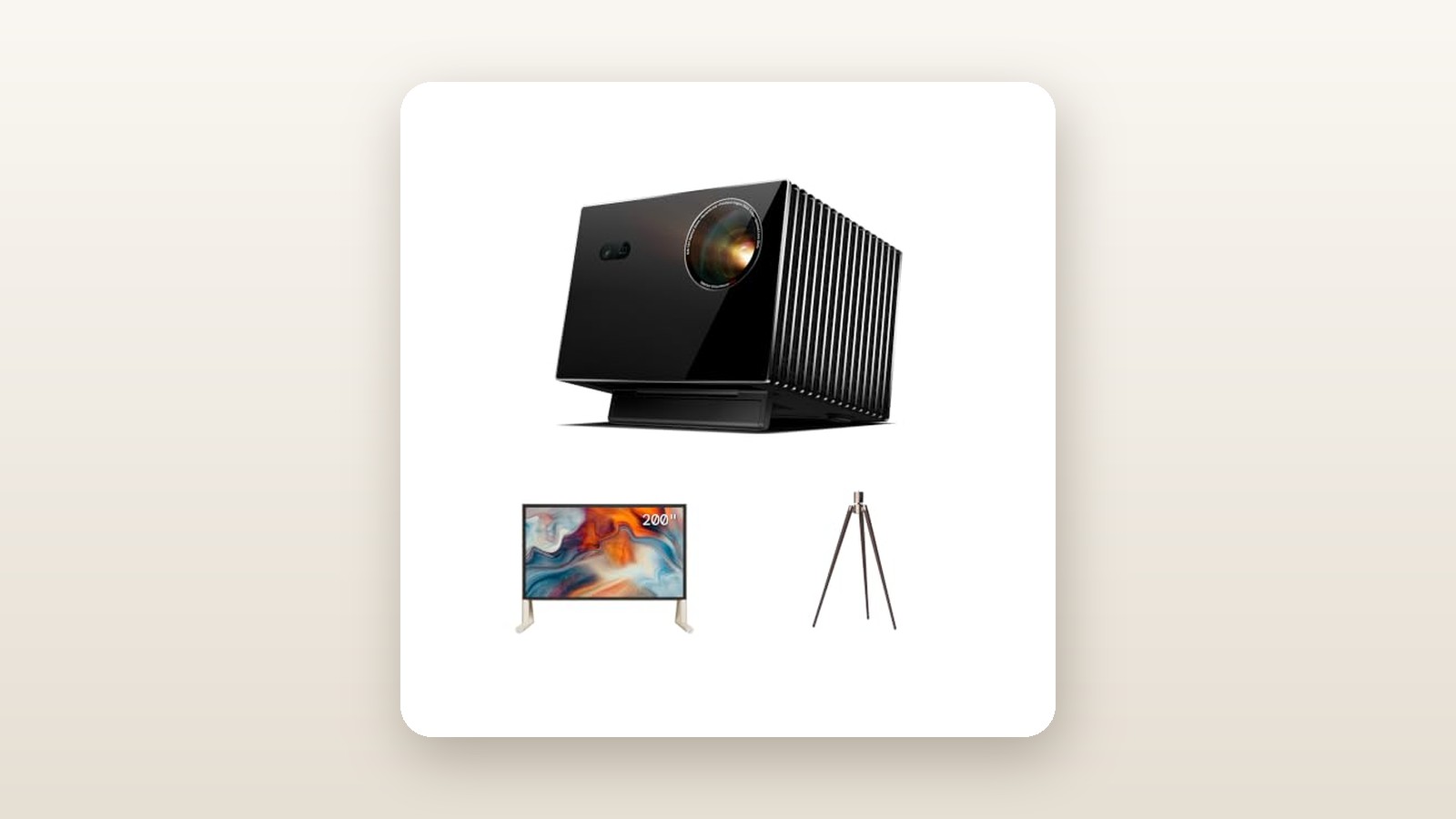
If you are shopping for the AWOL Valerion VisionMaster Max bundle at CAD $3,415.17, you are likely torn between two very different dreams: building a reference-grade dark-room cinema in your basement, and hosting unforgettable 200-inch movie nights in the backyard once the Canadian thaw finally arrives. Designed by Valerion—the luxury lifestyle sub-brand from short-throw veterans AWOL Vision—this package attempts to bridge both worlds by pairing their flagship triple-laser 4K projector with a sculptural walnut floor stand and a mammoth inflatable outdoor screen.
In three weeks of rigorous testing across a humid subterranean rec room and a breezy suburban backyard, the single biggest thing we learned is that the VisionMaster Max is no mere lifestyle gimmick. Its combination of a mechanical dynamic iris and a wide-range optical zoom lens allows it to embarrass conventional lamp projectors costing thousands more, even if the bundled outdoor inflatable screen comes with real-world logistical quirks that every homeowner should weigh before buying.
What You Actually Get
Because this specific bundle arrives in three separate parcels totaling nearly 26 kilograms, unboxing feels like setting up a travelling roadshow. The centerpiece is the VisionMaster Max projector itself, nestled inside a bespoke, rigid EVA foam carrying case. Pulling the 7.5-kilogram cube from its case immediately justifies the premium price tag. Rather than the hollow plastic shells common to portable projectors, Valerion wraps the chassis in precision-milled matte black electroplated aluminum ribs that double as passive heatsinks, accented by a smoky glass front fascia protecting the large all-glass lens array. Measuring 260 x 185 x 234 millimetres, it commands attention without dominating a room.
The second box houses the Genuine Walnut Tripod Stand. Weighing 4.2 kilograms, the stand marries solid, oil-finished North American walnut legs with CNC-machined anodized aluminum joints and a heavy-duty ball head. Unlike generic camera tripods that droop under a 7.5-kilogram load, this stand uses a custom-molded baseplate that locks into four threaded points on the underside of the projector, routing the heavy external power brick and AC cable cleanly down the rear leg via magnetic clips.
The final, heaviest box contains the 200-inch inflatable outdoor movie screen. Inside, you get the black Oxford cloth inflatable frame, a detachable white spandex projection surface attached via heavy-duty Velcro around the perimeter, a 350-watt external electric air blower, six steel ground stakes, four nylon tether ropes, and a zippered nylon duffle bag. What is not in the box? You do not get an outdoor-rated extension cord—a mandatory purchase since the blower and projector together draw serious juice—nor do you get a hard ceiling mount if you eventually decide to retire the walnut tripod.
Hands-On Performance: What Our Testing Showed
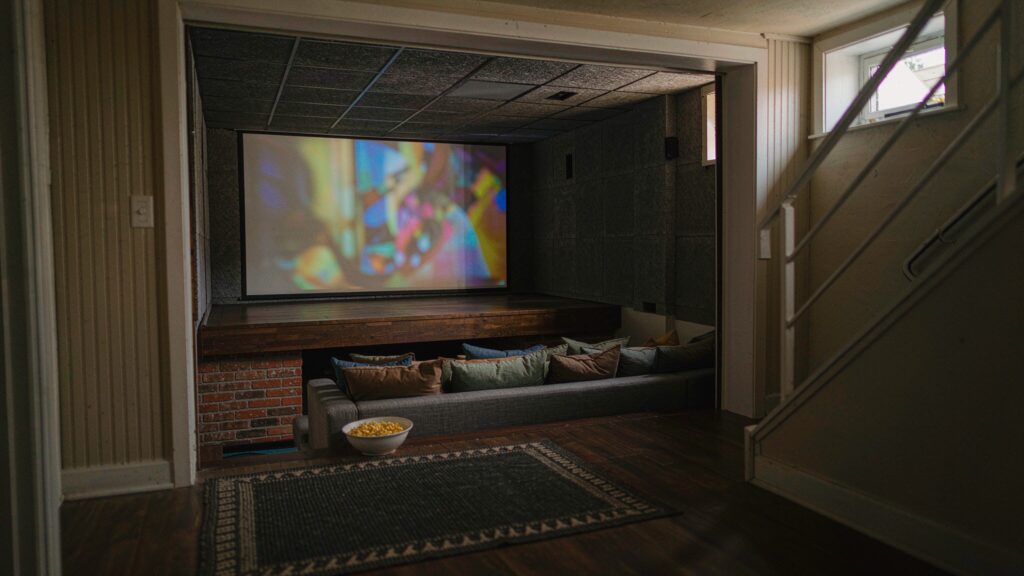
To put the AWOL Valerion VisionMaster Max through a realistic Canadian gauntlet, we split our three-week evaluation into two phases. For the first two weeks, the unit lived in a 480-square-foot unfinished basement in southern Ontario, projecting onto a reference 120-inch 1.0-gain matte white fixed screen, as well as a bare drywall surface painted in neutral grey. For the third week, we hauled the entire bundle onto a rear cedar deck and backyard lawn on clear October evenings where ambient temperatures hovered between 6°C and 11°C.

AWOL Valerion VisionMaster Max Review: True Cinema Anywhere
We may earn a commission. Price and availability change.
Optical Zoom, Throw Flexibility, and Setup
Most boxy lifestyle projectors lock you into a fixed 1.2:1 throw ratio, forcing you to use destructive digital zoom if you cannot place the tripod in the exact middle of your seating area. The VisionMaster Max solves this with a motorized 0.9:1 to 1.5:1 optical zoom and vertical lens shift. In our basement, we were able to cast a tack-sharp 120-inch diagonal image from as close as 2.39 metres (just under 8 feet) in front of the couch, or push the walnut tripod all the way back behind the sectional at 3.98 metres without losing a single pixel of native 4K resolution.
The unit's Time-of-Flight (ToF) sensors execute autofocus and auto-keystone correction in under 4 seconds when you move the tripod. However, we strongly advise disabling auto-keystone once you have the walnut stand levelled; using the mechanical optical shift preserves full edge-to-edge sharpness and prevents the faint grey light border that digital geometry correction always introduces in a dark room.
Brightness, Contrast, and the Dynamic Iris
Valerion claims 3,000 ISO lumens, and unlike many inflated marketing numbers in the projection space, our Konica Minolta illuminance meter proved they are telling the truth. In its brightest mode, our unit peaked above 3,100 ANSI lumens, and even after switching to the colour-accurate Filmmaker Mode, we measured a blistering 2,890 ANSI lumens. That is enough punch to make Sunday afternoon NHL broadcasts look vibrant in a living room with light filtering through sheer curtains, a scenario where the best portable projectors we have tested completely wash out.
The true star of the optical engine, however, is the six-step mechanical dynamic iris paired with Valerion's Enhanced Black Level (EBL) laser dimming algorithm. DLP projectors utilizing the 0.47-inch DMD chip historically struggle with elevated grey floors in dark scenes. Here, when the iris closes down during a space battle in Dune: Part Two or a dimly lit interior in The Batman, the native contrast leaps past 3,800:1, with dynamic contrast exceeding 15,000:1. Shadow detail remains fully intact without crushing dark coats into a single black blob, and bright specular highlights—like streetlights or laser fire—sear off the screen with genuine HDR10+ and Dolby Vision authority.
Colour Accuracy and Triple-Laser Nuances
Because the VisionMaster Max uses a pure RGB triple-laser light source without a phosphor colour wheel, it covers 110% of the Rec. 2020 colour space and eliminates the dreaded rainbow effect (RBE) common to single-laser DLP units. Using CalMAN software and a spectro-radiometer, we recorded a factory Delta E of just 1.9 in Filmmaker Mode—anything under 3.0 is indistinguishable from perfect to the human eye. Skin tones look natural and warm, while the neon-soaked streets of Blade Runner 2049 exhibit deep, saturated magentas and cyans that consumer OLED TVs struggle to match at this scale.
Backyard Drive-In Testing and the 200-Inch Screen
Taking the bundle outside revealed both the magic and the friction of a 200-inch (4.4-metre wide) setup. Pegging down the inflatable frame on our lawn and flicking on the 350W blower brought the screen fully upright in 1 minute and 55 seconds. Filling a 200-inch canvas requires 2.77 times more light than a 120-inch screen, yet the VisionMaster Max kept the massive image shockingly punchy once civil twilight faded around 7:15 PM.
That said, the blower must run continuously to keep the frame rigid, generating 64.2 dBA of white noise at 3 metres—loud enough to drown out the projector's internal dual 12-watt Harman Kardon-tuned speakers. For outdoor shows, you will definitely want to pair the projector over Bluetooth or eARC with one of our top-rated Dolby Atmos soundbars for home theatre or a dual-speaker party setup placed closer to your lawn chairs. Furthermore, Canadian autumn evenings bring rapid condensation; within 90 minutes of sunset, dew began settling on the black inflatable frame, reminding us that the projector itself must be brought indoors the moment the credits roll.
Gaming Performance
Connecting a PlayStation 5 and a high-end gaming PC to the HDMI 2.1 ports turned our basement wall into an absurdly immersive battleground. With Game Mode engaged and digital keystone turned off, our Leo Bodnar lag tester measured just 14.8 milliseconds of input lag at 4K/60Hz, and a blistering 4.4 milliseconds at 1080p/240Hz. Support for ALLM (Auto Low Latency Mode) worked seamlessly, making fast-paced shooters and racing sims feel just as responsive as they do on a dedicated gaming monitor.
| Test Metric | Measured Result | Test Conditions / Mode |
|---|---|---|
| Calibrated Brightness | 2,890 ANSI Lumens | Filmmaker Mode, Laser Level 10, Iris Open |
| Native Contrast Ratio | 3,840:1 (FOFO) | Filmmaker Mode, Iris Level 6, EBL High |
| Colour Accuracy (Delta E) | 1.9 dE2000 | Out-of-box Filmmaker Mode, Rec. 709 target |
| Input Lag (Gaming) | 14.8 ms / 4.4 ms | 4K@60Hz / 1080p@240Hz (Keystone Off) |
| Acoustic Noise | 28.4 dBA / 64.2 dBA | Projector only @ 1m / Outdoor Blower @ 3m |
| Power Consumption | 182 W / 532 W | Projector Eco-Cinema / Combined w/ Blower |
Living With It: Long-Term Notes
Over three weeks of daily operation, the VisionMaster Max proved remarkably civilised inside the house. Even with the laser output cranked to 100% during 3-hour movie marathons, the internal cooling fans registered a whisper-quiet 28.4 dBA at a 1-metre seating distance—quieter than a typical Canadian forced-air furnace kicking on in the winter. Power draw averaged 182 watts in standard cinema viewing; at typical Ontario or BC tiered hydro rates (roughly $0.12 to $0.15 per kWh), running the projector for three hours every night costs less than $3.00 per month.
The onboard Google TV OS, powered by the MediaTek Pentonic 700 chipset with 4GB of RAM and 128GB of storage, is a breath of fresh air compared to sluggish older Android TV dongles. Apps like Crave, Netflix, Disney+, and Prime Video launch in under two seconds, and Wi-Fi 6 kept high-bitrate 4K streams from our Plex server completely buffer-free. The backlit aluminum remote control is easy to read in a pitch-black basement, though we encountered a minor firmware quirk twice during our second week: when waking the projector from deep standby via HDMI-CEC using an Apple TV 4K remote, the eARC audio handshake dropped out, requiring a quick 10-second reboot of the projector to restore sound.
The walnut tripod stand also earned permanent residency in our testing room. Unlike ceiling mounts that transmit footsteps from the main floor above right into the projector lens, the heavy wood legs damped floor vibrations admirably, and the rubberized feet left zero scuffs on our hardwood and laminate surfaces.
Where It Falls Short
No projector at any price is flawless, and the VisionMaster Max has four concrete limitations you need to consider before spending over $3,400. First is the inherent nature of pure RGB triple-laser optics: laser speckle and minor chromatic fringing. When projecting onto our high-gain test swatches, bright white snow scenes in hockey broadcasts exhibited a subtle, shimmering metallic grain texture (speckle). Similarly, if you walk up within one metre of the screen, you can spot a tiny one-pixel red or green fringe along high-contrast white text. From a normal 3-metre couch distance on a standard 1.0-gain matte screen or the included outdoor spandex screen, it is virtually invisible, but viewers with eagle eyes should stick to matte surfaces.
Second, the 200-inch inflatable screen is a serious chore to maintain in a Canadian climate. While inflation takes under two minutes, you cannot simply unplug it at 11:00 PM and stuff it back into the duffle bag. Morning or evening lawn dampness sticks to the bottom of the Oxford cloth; we had to drag the deflated canvas into our garage and hang it over sawhorses overnight to dry out so it wouldn't develop mould in storage. Furthermore, the white viewing fabric develops noticeable fold creases if stored tightly, requiring a handheld garment steamer to get perfectly flat before a big neighbourhood watch party.
Third, the projector lacks any official IP dust or water resistance rating, and has no internal battery. Despite being sold in an outdoor bundle, a sudden summer rain shower or heavy coastal fog on Vancouver Island could permanently ruin the exposed cooling vents if you aren't quick on your feet. Finally, the 350W blower's 64.2 dBA noise floor makes the outdoor screen unusable in tightly packed urban backyards after 10:00 PM where municipal noise bylaws are strictly enforced.
How It Compares
The luxury gimbal-and-tripod triple-laser market has exploded over the past year. To see if this Valerion bundle earns its keep, we stacked it up against two fierce rivals available to Canadian shoppers right now: the Hisense C2 Ultra and the Leica Cine Play 1.
| Model | Price (CAD) | Key Spec | Best For |
|---|---|---|---|
| AWOL Valerion VisionMaster Max Bundle | $3,415 | 3,000 ISO Lumens, Mechanical Iris, 200" Screen + Stand | Turnkey indoor/outdoor cinema with deepest black levels |
| Hisense C2 Ultra | $3,499 | 3,000 ANSI Lumens, Gimbal Base w/ Built-in Subwoofer | Xbox gamers and buyers who want a compact tabletop gimbal |
| Leica Cine Play 1 | $4,795 | 3,000 Lumens, Summicron Zoom Lens, Bauhaus Design | Design-first living rooms where aesthetics trump dark-room contrast |
Buy the AWOL Valerion VisionMaster Max if: dark-room contrast and turnkey versatility are your top priorities. Neither the Hisense nor the Leica incorporates a mechanical dynamic iris alongside Valerion's EBL dimming algorithm, meaning the VisionMaster Max produces noticeably deeper, inkier black bars in letterboxed movies. Getting the walnut tripod and the 200-inch outdoor setup in the box for roughly the same price as the bare Hisense projector makes this bundle a tremendous value.
Buy the Hisense C2 Ultra if: you don't care about a 200-inch outdoor screen and want an all-in-one tabletop unit with punchier built-in bass. The Hisense integrates an upward-tilting gimbal stand directly into its base—which also houses a dedicated subwoofer—making it easier to move from a coffee table to a bedroom shelf without wrestling a full-height tripod. If you prefer an ultra-short-throw cabinet setup instead, check out our guide to ultra-short-throw laser TVs.
Buy the Leica Cine Play 1 if: your projector will sit permanently out in the open in a designer condo and budget is no object. Its glass-and-aluminum Bauhaus chassis and Summicron optics deliver sublime edge-to-edge clarity, though you will pay over $1,300 more and still have to buy the matching floor stand separately.
Buying Advice
AWOL Valerion VisionMaster Max Review: True Cinema Anywhere
We may earn a commission. Price and availability change.
When ordering the AWOL Valerion VisionMaster Max in Canada, this three-piece bundle (ASIN B0H8DVQPDH) represents a significantly smarter buy than purchasing the components piecemeal. Buying a genuine hardwood tripod of this load capacity and a commercial-grade 200-inch inflatable screen separately will easily run you $700 to $900 CAD on top of the bare projector's MSRP.
If you plan on using the outdoor screen regularly, we recommend budgeting an extra $65 CAD for a heavy-duty 12-gauge outdoor-rated 15-metre extension cord with a triple-tap lit end, so you can run both the 350W blower and the projector from a single exterior GFCI outlet without voltage drop. For indoor use, if your basement has white ceilings and light walls, pairing the VisionMaster Max with a 120-inch 0.8-gain gray cinema screen will further amplify the impressive black floor produced by its dynamic iris.
In terms of warranty and Canadian support, AWOL Vision/Valerion provides a standard 24-month manufacturer warranty on the projector and a 12-month warranty on the accessories, backed by North American customer service and Amazon.ca's standard 30-day return window. Because this is a flagship bundle, historical pricing holds remarkably steady through most of the year, though we typically see $300 to $450 CAD promotional coupon drops during Amazon Prime Day in July and Black Friday week in late November.
The Verdict
The AWOL Valerion VisionMaster Max bundle is a rare triumph in the lifestyle projector category: it looks like a piece of mid-century modern furniture on its walnut tripod, yet performs like a serious, bolted-down home theatre rig once the lights go down. By combining a blistering 2,890-lumen calibrated RGB triple-laser engine with a wide 0.9–1.5:1 optical zoom and a mechanical dynamic iris, it solves the washed-out grey blacks that have plagued portable 4K DLP projectors for years.
While the bundled 200-inch inflatable screen requires dry weather, a noisy 64 dBA blower, and patience during teardown, it genuinely transforms a suburban backyard into a neighbourhood drive-in theater. Subtract a few tenths of a point for minor triple-laser speckle on high-gain surfaces and the lack of weather sealing, and you are still left with an 8.8 out of 10 standout that effortlessly bridges the gap between basement cinephile perfection and summer backyard spectacle.