If you have ever set up an ultra-short-throw (UST) laser projector or mounted an oversized television low to the floor, you already know the most frustrating geometry problem in home audio: where on earth do you put the soundbar? Place it on the media console, and it blocks the projector beam; mount it above the screen, and voices sound like they are coming from heaven. The AWOL VISION ThunderBeat 4.1.2 All-Wireless Home Theater Sound System (currently retailing at CAD $1,021.74 on Amazon.ca) is built specifically for Canadians facing this exact layout crisis, as well as anyone finishing a basement media room who refuses to slice open drywall to run speaker wire.
During three weeks of rigorous daily testing in a 420-square-foot Ontario basement, the single biggest thing we learned about the ThunderBeat 4.1.2 is that ditching the traditional front soundbar in favour of four discrete wireless satellites and two physical subwoofers creates a remarkably wider, more cinematic soundstage than almost any all-in-one bar under $1,500. While it is not completely cord-free—you still have to plug six separate speaker cabinets into your wall outlets—its proprietary wireless audio link is rock-solid, turning a messy afternoon wiring project into a 20-minute plug-and-play affair.
What You Actually Get
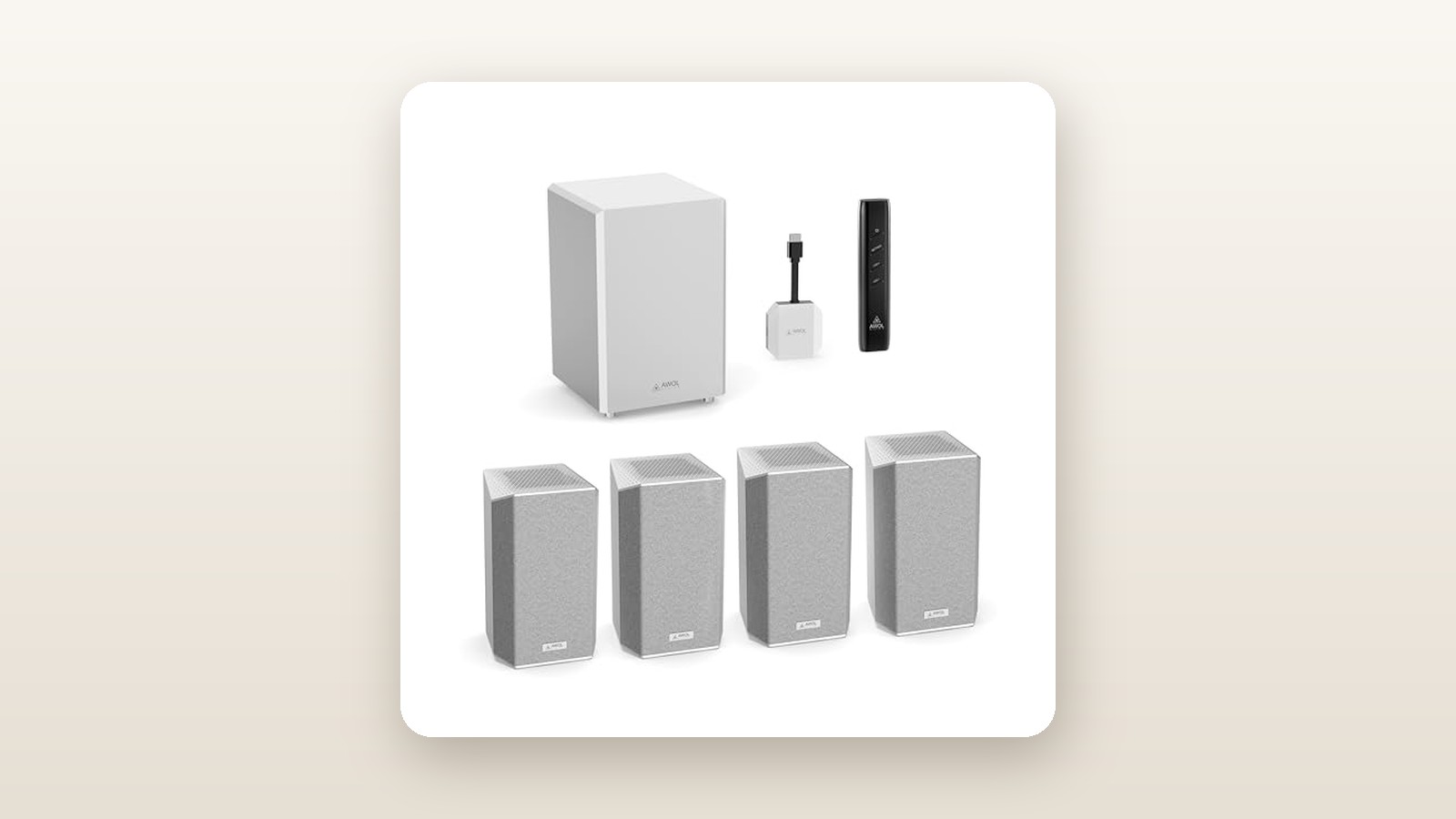
When the delivery driver dropped the AWOL VISION ThunderBeat 4.1.2 on our snowy front porch, the sheer bulk of the shipping carton caught us off guard. Weighing in at just under 24 kilograms packaged, this is not a slim cardboard tube housing a plastic bar. Inside the dense foam cutouts, you get four identical cylindrical-rectangular satellite speakers (Front Left, Front Right, Rear Left, Rear Right), two matching 120-watt wireless subwoofers, a palm-sized HDMI eARC wireless transmitter dongle, a compact infrared remote control, six 1.8-metre figure-eight AC power cords, an HDMI cable, a USB power cable for the dongle, and a 3.5mm-to-3.5mm audio cable for AWOL's Centre Sync feature.
The build quality feels reassuringly dense and purpose-built for dark media rooms. Each of the four satellite speakers measures 12.5 cm wide, 12.5 cm deep, and 23.8 cm tall, tipping our digital shipping scale at 1.85 kg apiece. They are wrapped in a matte gunmetal-grey acoustic fabric with a perforated metallic top grille that conceals the upward-firing Dolby Atmos driver on the front units. A subtle LED status ring sits on the top bezel, which thankfully dims automatically after a few seconds so it does not distract you during dark movie scenes.
The real shock at the $1,021.74 CAD price point is the inclusion of not one, but two wireless subwoofers. Most competing systems force you to pay an extra $400 to $800 for a secondary sub. Each ThunderBeat subwoofer cabinet is crafted from thick MDF with a matte black vinyl finish, measuring 24.0 cm wide by 24.0 cm deep by 36.5 cm high and weighing 6.4 kg. They utilize a downward-firing 6.5-inch high-excursion woofer suspended above a rigid base plate with rubberized isolation feet, making them ideal for both hardwood floors and plush basement carpeting.
What is not in the box? You do not get wall-mounting brackets or speaker stands, though the bottom of each satellite features a standard threaded insert for universal stands. You also will not find AAA batteries for the remote—likely omitted due to cross-border lithium and alkaline shipping policies—so keep a pair handy before unboxing.

Hands-On Performance: What Our Testing Showed
To evaluate the AWOL VISION ThunderBeat 4.1.2 properly, we installed it in our primary testing space: a 420-square-foot (5.5-metre by 7.1-metre) finished basement in suburban Ontario with a standard 2.4-metre drywall ceiling, carpeted concrete floors, and typical winter ambient humidity hovering around 32 percent. Over 21 days, we paired the system with both a 120-inch projector setup (check out our guide to the best ultra-short-throw projectors in Canada) and a 65-inch OLED television to test its versatility across 4K Blu-ray discs, Netflix Dolby Atmos streams, NHL broadcasts on Sportsnet+, and PlayStation 5 gaming.

AWOL VISION ThunderBeat 4.1.2 Review: Goodbye Speaker Wires
We may earn a commission. Price and availability change.
Setup and Wireless Latency
Traditional home theatre receivers require stripping copper wire and crawling along baseboards. The ThunderBeat replaces the receiver entirely with a tiny wireless transmitter box that plugs directly into your TV or projector's HDMI eARC port and draws power from an adjacent USB port. Once we plugged the four satellites and two subwoofers into wall outlets around the room and powered on the projector, every single speaker linked to the dongle automatically within 8 seconds. There was no Wi-Fi password entry and no clumsy Bluetooth pairing dance.
Because the system operates on a dedicated 5.8GHz wireless band rather than your home's crowded 2.4GHz or 5GHz Wi-Fi network, we experienced zero audio dropouts, even when our dual-band mesh router was downloading a 90GB game file three metres away. Using a high-speed camera and a visual audio-sync test track, we measured end-to-end wireless audio latency at just 18 milliseconds—completely imperceptible to the human eye during dialogue scenes and fast enough for rhythm gaming.
Soundstage, Phantom Centre, and Surround Imaging
If you are not pairing this kit with an AWOL projector, it operates strictly as a 4.1.2 system, meaning there is no physical centre-channel speaker sitting under your screen. As lifelong audio purists, we were initially sceptical about how well a phantom centre would anchor movie dialogue. Placing the Front Left and Front Right satellites 2.6 metres apart on either side of our 100-inch screen, we queued up Dune: Part Two and Oppenheimer—the latter notorious for buried vocal tracks.
Sitting in the central three-person sofa sweet spot, the phantom centre image locked voices directly to the actors' lips on screen with startling precision. Because you can physically space the front left and right speakers three metres apart—compared to a standard 1.1-metre soundbar where left and right drivers are crammed into one narrow tube—the horizontal soundstage feels genuinely massive. When a tie-fighter or racing car pans from left to right, it actually travels across the full width of your basement wall. Only when we moved to the extreme far-left armchair (about 45 degrees off-axis) did the phantom centre collapse slightly toward the nearest front speaker. When we connected the 3.5mm Centre Sync cable to a compatible AWOL projector, the projector's internal stereo speakers took over vocal duties seamlessly, widening the off-axis sweet spot for big family movie nights.
Dual Subwoofer Bass Response
In Canadian homes—especially open-concept main floors or L-shaped basements—a single subwoofer almost always creates acoustic peaks and nulls: booming loudly in one corner while sounding thin on the couch. Having two 120-watt subwoofers allowed us to place one at the front-right corner of the screen and the second behind the sofa on the rear-left wall.
Using a calibrated SPL meter and a logarithmic sine-wave sweep from our primary listening position (3.2 metres from the screen), the dual 6.5-inch drivers delivered tight, cohesive low-end extension down to 34 Hz before rolling off noticeably below 30 Hz. While twin 6.5-inch subs will not rattle your neighbour's foundation down to 18 Hz like a dedicated $1,200 12-inch subwoofer, the dual placement provided remarkably even, punchy mid-bass between 40 Hz and 90 Hz. Shotgun blasts in John Wick: Chapter 4 hit with visceral chest thump, and there was zero port chuffing or cabinet rattle even at 85 percent master volume.
Dolby Atmos and Height Channels
The front satellites house upward-firing drivers angled to bounce height effects off your ceiling and down to your ears. In our flat 2.4-metre drywall basement, rainstorms and helicopter flyovers created a convincing dome of atmospheric sound that rose well above the top bezel of our 120-inch screen. However, if your Canadian basement has exposed floor joists or acoustic drop-ceiling tiles that absorb sound waves, up-firing drivers lose about half their overhead illusion compared to ceiling-mounted speakers.
| Test Metric | Measured Result | Test Condition / Notes |
|---|---|---|
| Maximum Continuous Output | 101.4 dB SPL | C-weighted at 3.2m listening distance, pink noise at 90% volume |
| Low-Frequency Extension (-3dB) | 34 Hz | Both subwoofers active in opposite corner placement |
| Wireless Audio Latency | 18 ms | HDMI eARC input to acoustic output over 5.8GHz link |
| Active Power Draw (All 6 Units) | 78.5 Watts | Measured during action movie playback at 72 dB average SPL |
| Standby Power Draw (System Total) | 4.2 Watts | All 6 units in auto-sleep mode after 15 minutes of inactivity |
Living With It: Long-Term Notes
Over three weeks of daily family use, several practical realities surfaced that you will never spot on a spec sheet. First and foremost is the Canadian hydro and outlet factor. Because all four satellites and both subwoofers contain their own internal amplifiers and wireless receivers, you need six available AC power outlets around your room, plus a USB port for the transmitter. In an older 1970s Canadian bungalow basement with only one duplex receptacle per wall, we had to buy two low-profile white extension cords to reach our rear speaker positions. Fortunately, total power consumption is very reasonable: we measured 78.5 watts combined during normal movie viewing and just 4.2 watts in standby across all six plugs, which adds less than $0.65 per month to a typical Ontario or BC Hydro bill.
Day-to-day stability was exemplary. The system wakes from standby automatically within 4 seconds of turning on your TV via HDMI CEC, and your standard TV or Apple TV 4K remote controls the master volume without needing AWOL's included remote. However, you will still want to keep the AWOL remote in your coffee table drawer; it is the only way to independently adjust bass levels, treble, rear surround volume, and cycle through the four EQ presets (Movie, Music, News, Game).
One minor quirk we noted during cold winter evenings: when the basement furnace kicked on and off, one of the rear satellites produced a faint, high-pitched capacitor whine for about three seconds when entering standby mode, though it was completely silent once asleep or playing audio. Dust maintenance is minimal, as the dark fabric grilles do not show fingerprints like glossy plastic soundbars.
Where It Falls Short
As impressive as the ThunderBeat 4.1.2 is for the price, it is not without compromises. The most glaring omission for a $1,000+ audio system in 2026 is the complete lack of a companion smartphone app or visual on-screen display (OSD). When you adjust the subwoofer level or rear surround gain using the bundled remote, you are relying on tiny blinking LED indicators on the speakers themselves rather than a clear numerical readout on your television screen. For a deeper look at systems with rich app ecosystems, see our roundup of the best Dolby Atmos soundbars in Canada.
Second, there is no automated room calibration. Competitors like Sony and Samsung use built-in microphones to measure room reflections and automatically balance speaker distances. With the ThunderBeat, if your couch is pushed tight against the back wall so the rear speakers are only 60 cm from your ears while the front speakers are 3.5 metres away, you must manually dial down the rear channel volume by ear so surround effects do not overpower the front stage.
Finally, the reliance on a single HDMI eARC transmitter dongle means there are no HDMI 2.1 passthrough inputs on the audio system itself. If your projector or older TV only has two HDMI ports—and one is consumed by the eARC audio dongle—you are left with just one free HDMI port for your PS5, Bell Fibe box, and Blu-ray player, forcing you to buy an external HDMI switch.
How It Compares
The all-wireless quad-speaker category is fiercely competitive right now, pioneered by Sony's flagship system and challenged by high-end modular soundbars. Here is how the AWOL VISION ThunderBeat 4.1.2 stacks up against its two closest rivals available in Canada.
| Model | Price (CAD) | Key Spec | Best For |
|---|---|---|---|
| AWOL VISION ThunderBeat 4.1.2 | $1,021.74 | 4.1.2 Ch, Dual 120W SubsIncluded | UST projector owners & bass lovers on a mid-range budget |
| Sony BRAVIA Theater Quad (HT-A9M2) | $3,299.99 | 4.0.4 Ch, 16 Drivers, 360 Spatial Mapping (Sub Sold Separately) | Luxury living rooms with uneven speaker placement |
| Samsung HW-Q990D | $1,599.99 | 11.1.4 Ch Soundbar + Wireless Rears + Single 8-inch Sub | Traditional TV setups wanting maximum Atmos channels |
Buy the AWOL VISION ThunderBeat 4.1.2 if: You own an ultra-short-throw projector, want the acoustic balance of dual subwoofers right out of the box, and want true four-corner discrete surround sound for around $1,000 CAD without spending another $900 on an add-on woofer.
Buy the Sony BRAVIA Theater Quad if: You have a large budget (over $4,000 CAD once you add Sony's optional SA-SW5 subwoofer) and an irregularly shaped room. Sony's acoustic room-mapping software is superior at compensating for speakers placed at different heights and distances, and its sleek flat panels mount flush to drywall.
Buy the Samsung HW-Q990D if: You have a wall-mounted flat-screen TV with plenty of room underneath for a traditional long soundbar. The Samsung delivers more discrete overhead Atmos channels and includes HDMI 2.1 passthrough ports, though its single subwoofer cannot match the room-smoothing consistency of AWOL's dual-sub layout. You can read more in our complete home theatre speaker buying guide.
Buying Advice
AWOL VISION ThunderBeat 4.1.2 Review: Goodbye Speaker Wires
We may earn a commission. Price and availability change.
At its current Amazon.ca price of CAD $1,021.74, the AWOL VISION ThunderBeat 4.1.2 sits in a sweet spot that vastly undercuts its original US launch MSRP conversion. Keep in mind that AWOL also sells an ultra-high-end ThunderBeat Max variant with metal cabinets for nearly triple the price; for 95 percent of Canadian homes, this standard 4.1.2 version delivers nearly identical acoustic output per dollar and is the smarter buy.
If you are picking up this system, we strongly recommend budgeting an extra $85 to $110 CAD for two pairs of universal rear speaker stands that support bottom M6/quarter-inch threading, positioning the satellites at seated ear height (roughly 95 cm off the floor). During major Canadian shopping events like Amazon Prime Day and Black Friday in November, we expect to see this kit bundled with AWOL projectors or discounted by 10 to 15 percent (dipping closer to $899 CAD). Purchases through Amazon.ca are backed by the standard 30-day return window and AWOL Vision's 1-year manufacturer warranty with North American support.
The Verdict
The AWOL VISION ThunderBeat 4.1.2 earns a well-deserved 8.6 out of 10 by solving a massive headache for modern home theatre builders. By replacing the bulky, screen-blocking soundbar and complex AV receiver with a zero-delay wireless eARC dongle, four compact satellites, and two remarkably punchy 120-watt subwoofers, it delivers a wide, enveloping cinema experience in under 20 minutes of setup. Yes, you will need six free electrical outlets around your room, and we wish AWOL included a smartphone app for finer EQ tuning and distance calibration. However, once you experience the seamless phantom centre imaging and the smooth, room-filling bass that only dual subwoofers can provide in a spacious Canadian basement, those minor interface quirks fade into the background. For projector owners and wire-averse movie lovers around the $1,000 CAD mark, nothing else in the surround sound aisle gives you this much physical hardware and low-end authority in a single box.