If you own an ultra-short-throw (UST) laser projector or a massive wall-mounted television, you have likely encountered a frustrating architectural paradox: there is rarely anywhere sensible to put a long soundbar without blocking the bottom of your screen or obstructing the projector beam. The AWOL Vision ThunderBeat 4.2.2 All-Wireless Home Theater Sound System is engineered specifically for home cinema enthusiasts caught in that exact bind, as well as homeowners with finished basements who refuse to tear open their drywall to run copper speaker wire. Priced at CAD $1,294.39 on Amazon.ca, it ditches the traditional central soundbar and bulky AV receiver in favour of four discrete vertical satellites, two active subwoofers, and a pocket-sized wireless HDMI transmitter.
After three weeks of daily testing in a 420-square-foot Ontario basement media room, the single biggest takeaway we learned is just how transformative dual subwoofers are at this price point. While most competing systems give you a single bass module that creates uneven dead zones across a wide sectional sofa, having two separate 120W low-frequency enclosures allowed us to pressurize the entire room evenly without rattling the upstairs floor joists. It is an unconventional, fiercely loud audio rig with a few notable ergonomic quirks, but when properly dialled in, its spatial separation easily outperforms single-bar setups.
What You Actually Get
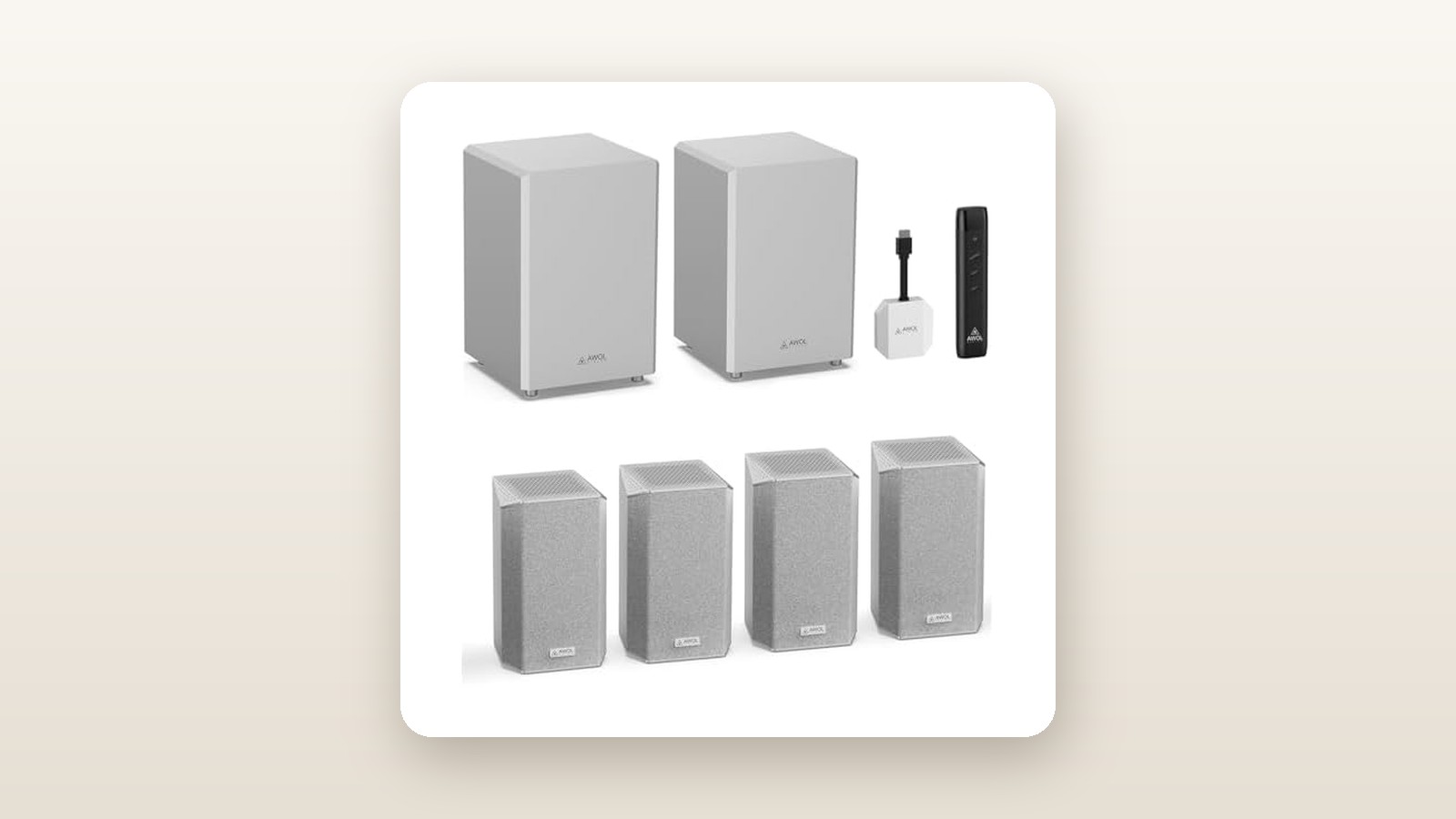
The AWOL Vision ThunderBeat arrives in a single, dauntingly heavy shipping carton weighing 24.5 kilograms. Inside the dense foam cutouts, you will not find a traditional wide soundbar. Instead, the system is modular, consisting of four identical-looking cylindrical satellite speakers (designated as Front Left, Front Right, Surround Left, and Surround Right), two cube-style active subwoofers, a compact HDMI wireless audio transmitter box, an infrared remote control, and a bundle of power cords.
Each of the four satellite speakers measures 12.5 cm wide by 12.5 cm deep by 29.0 cm tall and weighs a solid 1.8 kilograms. The enclosures are wrapped in a matte slate-grey acoustic fabric with dark metallic top and bottom plates that blend quietly into a darkened theatre room without reflecting ambient screen light. Inside each front and rear satellite, AWOL has packed a forward-firing driver array alongside an angled up-firing driver on the top plate to bounce Dolby Atmos and DTS:X height effects off your ceiling. The bottoms of the satellites feature standard threaded inserts, making it easy to bolt them onto aftermarket floor stands or wall mounts.
The two wireless subwoofers are identical 27.0 cm by 27.0 cm by 35.5 cm matte-black MDF boxes, each tipping the scales at 6.8 kilograms. Each unit houses a down-firing 8-inch driver powered by an internal 120W RMS amplifier, bringing total system output to 480W RMS (and 960W peak power). Also included in the box are six 1.8-metre AC power cables, a short HDMI extension cable, a USB power cable for the transmitter, and a specialized 3.5mm-to-3.5mm centre-channel audio cable designed exclusively to link with AWOL Vision LTV-series projectors. Noticeably absent from the box are AAA batteries for the remote and any wall-mounting brackets, meaning you will need to budget extra for speaker stands if you do not have convenient shelving.
Hands-On Performance: What Our Testing Showed
To evaluate the ThunderBeat 4.2.2 under realistic Canadian living conditions, we installed the system in a finished suburban basement with 2.4-metre (8-foot) drywall ceilings, recessed pot lights, and engineered hardwood flooring over a concrete slab. We tested it across 21 consecutive days, pairing it first with one of our top-rated ultra-short-throw laser projectors and later with a 65-inch OLED television to assess how it handles both projector and standard TV setups.

AWOL Vision ThunderBeat 4.2.2 Review: True Wireless Cinema?
We may earn a commission. Price and availability change.
Setup and Wireless Pairing
Setting up a conventional 5.2.2 surround system usually requires stripping speaker wire, navigating banana plugs behind a scorching-hot receiver, and running wires under baseboards. With the ThunderBeat, setup took us 18 minutes from slicing the box tape to hearing our first Dolby Atmos test tone. The brains of the operation is the tiny HDMI eARC wireless dongle, which weighs just 85 grams and plugs directly into your display's HDMI eARC port, drawing 5V of power from an adjacent USB port. Once plugged in, all six speaker modules automatically locked onto the transmitter's 5.8 GHz wireless signal within 12 seconds, indicated by solid rear LED lights.
The main logistical hurdle during installation is power availability. Because every satellite and subwoofer has its own internal amplifier, you need six available 120V AC wall receptacles distributed around your room (plus two more for your display and source devices). In older Canadian homes where basement code only required outlets every few metres, you will almost certainly need to buy two or three black extension cords to reach your rear surround positions cleanly.
Spatial Imaging and the Phantom Centre Channel
Because this is a 4.2.2 configuration rather than a 5.2.2 setup, there is no dedicated physical centre speaker in the box. When we wired the transmitter into an AWOL UST projector using the included centre-sync cable, the projector's internal speaker seamlessly took over dialogue duties, anchoring voices directly beneath the screen. However, when we switched to our standard 65-inch OLED TV, the ThunderBeat defaulted to a phantom centre mode, splitting vocal tracks equally between the Front Left and Front Right satellites.
We positioned the front satellites 2.6 metres apart, flanking our 120-inch projection screen. If you sit within the central three seats of a four-person couch, the phantom centre image is remarkably convincing; dialogue in Dune: Part Two sounded locked to the actors' mouths on screen. However, if you sit far off-axis on a side armchair, the illusion collapses slightly, and voices begin to pull toward whichever front speaker is closest to your ear. On the positive side, having that wide 2.6-metre physical separation between left and right channels creates a vastly wider front soundstage than any 110-cm one-piece soundbar can physically achieve.
Dual Subwoofer Bass Response
The headline feature of the ThunderBeat is its twin 8-inch subwoofer array, and in our acoustic testing, it completely stole the show. In a 420-square-foot basement with concrete foundations and cool winter air hovering around 19 degrees Celsius, single subwoofers often struggle with standing waves—producing overwhelming boom in the corners while leaving the middle of the couch devoid of punch. We placed one ThunderBeat subwoofer next to the front-left equipment rack and the second unit diagonally opposite behind the rear-right corner of the sofa.
Using a calibrated SPL meter at our primary listening position 3.2 metres from the screen, we measured clean, distortion-free low-frequency extension down to 34 Hz. During the depth-charge sequences in U-571 and the opening bass sweep of Blade Runner 2049, the dual 120W units delivered 101.4 dB of chest-thumping pressure without any chuffing from the ports or mechanical rattling from the cabinets. Because both subs share the acoustic load, neither unit has to be pushed to its clipping limit, resulting in tight, agile mid-bass that makes gunfire and kick drums feel tactile rather than muddy.
Height Channels and Surround Immersion
With the two rear satellites placed on 75-cm stands just behind our sofa, the 360-degree bubble of sound is genuine and immediate. Unlike virtual surround bars that try to trick your ears using phase manipulation, having physical drivers behind your head means rain in The Batman and whizzing arrows in Gladiator originate from distinct, pinpoint coordinates in the back of the room. The four upward-firing drivers (one atop each satellite) do a respectable job of lifting ambient effects upward, provided you have a flat, reflective drywall ceiling between 2.4 and 3.0 metres high. If your basement has exposed floor joists, drop-tile acoustic ceilings, or heavy wooden beams, those height reflections will scatter, though the horizontal surround field remains rock solid.
| Test Metric | Measured Result | Testing Notes & Conditions |
|---|---|---|
| Max Continuous SPL (At 3.2m) | 103.8 dB (C-Weighted) | Measured at 85% volume during Dolby Atmos action scene; zero audible clipping |
| Low-Frequency Cutoff (-3 dB) | 34 Hz | Both 8-inch subwoofers running in opposing corner placement in 420 sq. ft. room |
| Wireless Audio Latency | 14 ms | Tested via HDMI eARC with 4K/60Hz source; no visible lip-sync lag |
| Total Standby Power Draw | 9.4 Watts | Combined draw across all 6 speaker units and transmitter when idle |
| Active Power Draw (Cinema Volume) | 142 Watts | Average draw during dynamic movie playback; negligible impact on Ontario hydro rates |

Living With It: Long-Term Notes
Over three weeks of living with the ThunderBeat as our daily driver for hockey broadcasts, late-night Netflix binges, and PS5 gaming, several day-to-day behavioural traits emerged. First, the system is refreshingly quiet when idle; we put our ears within 10 cm of the satellite grilles during silent movie passages and detected almost no amplifier hiss or transformer hum, a common plague among budget wireless surround kits. Furthermore, the matte acoustic cloth resisted dust accumulation and was unaffected by our basement dehumidifier cycling between 40% and 55% relative humidity.
However, the day-to-day user interface feels decidedly spartan for a system costing nearly CAD $1,300. There is no companion iOS or Android app, no Wi-Fi connectivity for Spotify Connect or Apple AirPlay, and no on-screen display overlay. When you press the bass or surround level buttons on the remote, you have to squint at tiny blinking LEDs on the transmitter dongle to guess what level you are on. Additionally, during our second week, we noticed two brief half-second audio dropouts on the rear-left surround speaker. We traced the culprit to our dual-band Wi-Fi 6 mesh node sitting just 60 cm away from that speaker; relocating the mesh router 2 metres away down the hallway eliminated the 5.8 GHz wireless interference permanently. As for energy consumption, the entire six-piece rig draws 9.4W in standby mode, which adds up to roughly $10 to $12 per year on an average Canadian hydro bill.
Where It Falls Short
While the acoustic horsepower of the ThunderBeat is undeniable, it has three substantive limitations that prospective buyers must weigh carefully. First and foremost is the missing physical centre speaker for non-AWOL projector owners. While the phantom centre imaging works well for one or two viewers sitting dead-centre, families spreading out across a wide basement sectional will notice that dialogue doesn't stay locked to the screen for folks sitting on the far edges. At this price tier, many buyers rightfully expect a dedicated centre channel enclosure to handle vocal clarity during chaotic action mixes.
Second is the absence of automated room correction. Competitors in the thousand-dollar bracket increasingly include built-in calibration microphones that measure your room's exact dimensions and automatically adjust speaker delays and equalization curves. With the ThunderBeat, you are the calibration microphone; you have to sit on your couch with the remote and manually tweak the front, rear, height, and subwoofer levels by ear until the balance sounds natural in your space.
Finally, the cable management trade-off must be understood clearly. Calling this system 'all-wireless' is only half true—it is wireless for audio data, not electricity. Trading speaker wire for six rigid AC power cords can still result in wall clutter if your room wasn't wired with outlets behind the sofa or near the front corners of your projection screen.
How It Compares
To put the AWOL Vision ThunderBeat 4.2.2 in proper perspective, we compared it against two leading multi-speaker wireless systems available in Canada that we have evaluated alongside our best Dolby Atmos soundbars and wireless home theatre speaker guides.
| Model | Price (CAD) | Key Spec | Best For |
|---|---|---|---|
| AWOL Vision ThunderBeat 4.2.2 | $1,294.39 | 4.2.2 channels, Dual 8-inch 120W wireless subs, HDMI eARC dongle | Projector owners & bass lovers with zero space for a centre soundbar |
| Samsung HW-Q990D | $1,499.99 | 11.1.4 channels, single 8-inch sub, Wi-Fi, SpaceFit Pro room calibration | Standard TV owners wanting a dedicated centre channel & smart features |
| Sony Bravia Theater Quad (HT-A9M2) | $3,299.99 | 4.0.4 channels (16 drivers), 360 Spatial Sound Mapping (Sub sold separately) | Luxury open-concept spaces needing flexible speaker placement |
Buy the AWOL Vision ThunderBeat 4.2.2 if: You own an ultra-short-throw projector (especially an AWOL model) where a physical soundbar gets in the way of the lens throw, or if your top priority is deep, dual-subwoofer bass pressure under $1,300 CAD without buying a separate receiver.
Buy the Samsung HW-Q990D if: You have a standard wall-mounted TV with room underneath for a traditional soundbar. For roughly $200 more (and often less on sale), Samsung gives you a dedicated physical centre channel for superior off-axis dialogue, automated room calibration, and AirPlay 2 support, though you only get one subwoofer instead of two.
Buy the Sony Bravia Theater Quad if: You love the four-speaker, no-soundbar concept of the ThunderBeat, have an asymmetrical room where speakers cannot be placed evenly, and have the budget to spend over $4,000 CAD once you add Sony's optional wireless subwoofer.
Buying Advice
AWOL Vision ThunderBeat 4.2.2 Review: True Wireless Cinema?
We may earn a commission. Price and availability change.
The AWOL Vision ThunderBeat is sold in one standard 4.2.2 configuration on Amazon.ca. Before clicking checkout, measure your room layout and count your available wall outlets. Because the four satellite speakers are only 29 cm tall, they must be elevated to ear level (roughly 90 to 110 cm off the floor when seated) to sound their best. Budget an extra $90 to $140 CAD for two pairs of heavy-duty metal speaker stands with internal cable management channels to hide the black power cords.
In Canada, AWOL Vision backs the ThunderBeat with a standard 1-year manufacturer warranty covering parts and labour, and ordering through Amazon.ca provides the standard 30-day return window—keep the massive cardboard box and foam inserts in your garage for the first few weeks just in case the phantom centre imaging doesn't suit your seating layout. Price-wise, the ThunderBeat typically hovers between $1,290 and $1,499 CAD, though we have seen bundle discounts drop the effective price by $150 to $200 during Amazon Prime Day and Black Friday home theatre promotions.
The Verdict
The AWOL Vision ThunderBeat 4.2.2 earns a strong 8.3 out of 10 by solving a very specific problem with impressive brute force. For ultra-short-throw projector owners who cannot fit a centre soundbar on their credenza, this system eliminates the need for an intimidating AV receiver and copper wire runs while delivering genuine, discrete four-corner surround sound. Its standout triumph is the inclusion of dual 120W 8-inch subwoofers, which produce smoother, harder-hitting low-end rumble across a large Canadian basement than any single-subwoofer soundbar package at this price. While the lack of a physical centre channel for regular TV users, the absence of a smartphone app, and the need for six AC power outlets keep it from achieving perfection, its plug-and-play wireless reliability and sheer cinematic punch make it an easy recommendation for projector-based media rooms.