If you have ever bought a $70 massage gun off Amazon only to watch the motor sputter and stall the moment you leaned it into a tight hamstring, the Bob and Brad D6 Ultra was built specifically for you. Designed by physical therapists Bob Schrupp and Brad Heineck, this triangular powerhouse targets heavy lifters, distance runners, and hockey players who need genuine 16-millimetre percussive stroke depth without paying the steep $400-plus Canadian retail price commanded by flagship competitors. After three weeks of daily testing on sore quads, calves, and lower backs, the single biggest takeaway is that amplitude matters infinitely more than speed—and this machine delivers mechanical punch that easily rivals devices costing twice as much.
However, raw mechanical aggression is a double-edged sword. At CAD $203.57, the D6 Ultra introduces an electrically powered infrared and heated attachment to the familiar heavy-duty D6 frame, bridging the gap between thermal prep and deep myofascial release. It is not a dainty, throw-in-your-gym-tote gadget; it is a two-handed piece of recovery hardware that demands respect around bony landmarks and rewards users who have dense muscle mass to work through.
What You Actually Get
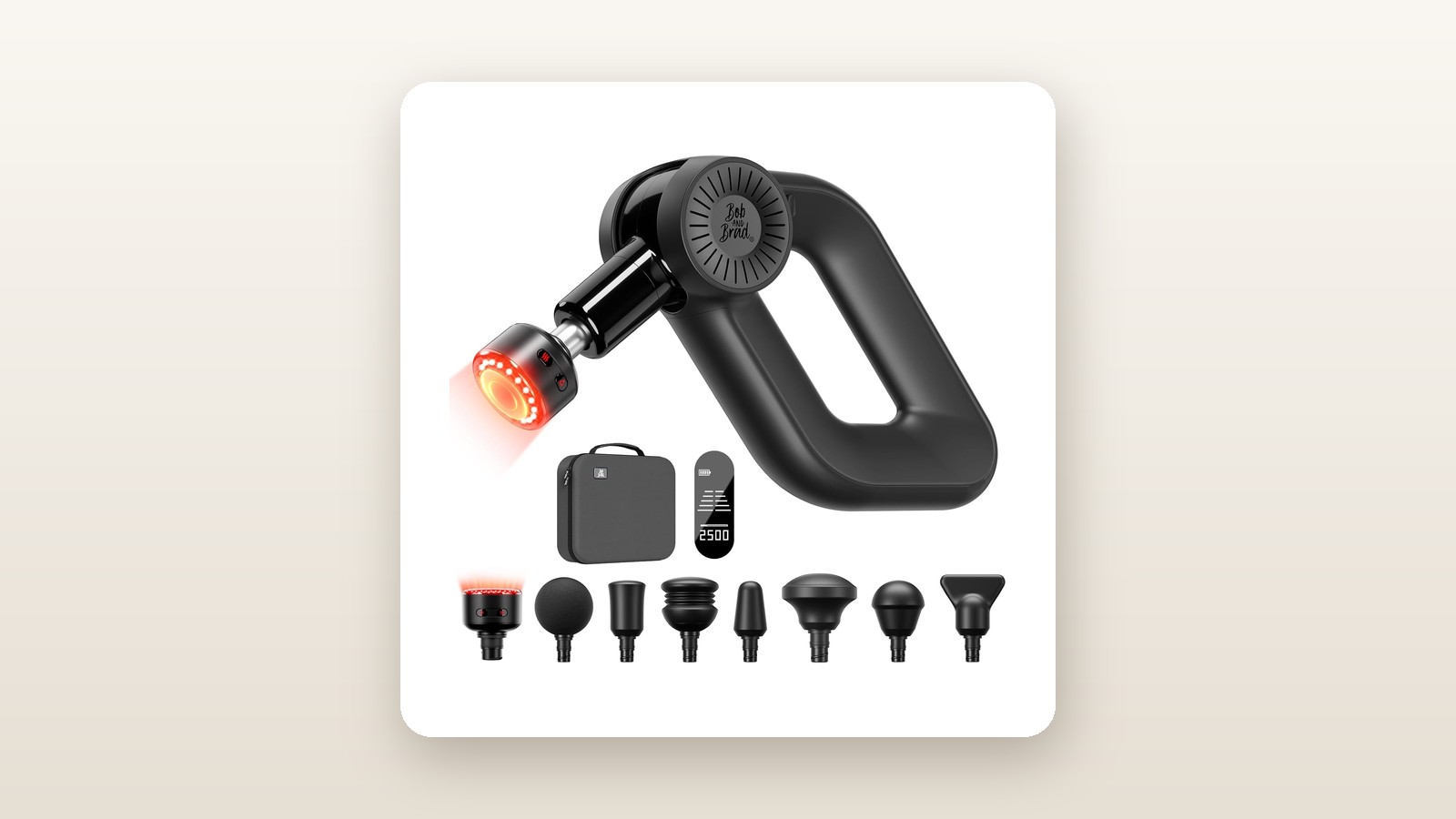
The Bob and Brad D6 Ultra arrives in a rigid, zippered EVA travel case covered in grey heather fabric that feels substantial enough to survive bouncing around the trunk of an SUV alongside hockey gear or kettlebells. Measuring 29 by 24 by 10.5 centimetres, the case keeps every component seated in dense moulded foam cutouts so nothing rattles during transit. Inside, you get the D6 Ultra massage gun body, seven interchangeable massage heads, a braided 1-metre USB-C to USB-C charging cable, a small zip pouch of spare rubber O-ring gaskets, and a straightforward user manual showing basic muscle maps.
Noticeably absent from the box is a wall charging brick. Like most personal electronics sold in 2026, you will need to supply your own 15-watt to 30-watt USB-C power adapter. Be aware that cheap, older USB-A-to-USB-C cables sometimes fail to trigger the charging circuit on this unit; stick with a modern USB Power Delivery (PD) wall block for reliable topping up.
In the hand, the gun itself feels dense, balanced, and unmistakably industrial. Our digital kitchen scale clocked the bare tool at 1.16 kilograms (2.55 pounds), which climbs to 1.24 kilograms (2.73 pounds) once you snap in the primary powered infrared attachment. The chassis measures 23.2 centimetres long by 17.8 centimetres tall, with a grip barrel circumference of 13.8 centimetres. The outer shell is moulded from matte black ABS plastic wrapped in high-traction silicone overmoulding along all three sides of its triangular handle. Unlike standard T-shaped massage guns that force your wrist into an awkward angle when reaching behind your own shoulder blades, this open-triangle layout lets you grab the rear spine, the top arch, or the lower front strut depending on the angle of attack.
The seven included attachments cover every realistic recovery scenario:
- Powered Infrared & Heated Flat Head: Connects via metal contact pins inside the chuck to deliver optical red/infrared light alongside a two-stage warming metal plate.
- Air Cushion (Pneumatic) Head: A hollow, squishy silicone dome that compresses on impact, essential for taming the 16mm stroke near the shins, neck, or IT band.
- Large Spherical Foam Ball: High-density EVA foam for broad sweeping passes across quads, hamstrings, and glutes.
- Bullet Head: A firm conical tip aimed at deep trigger points in the plantar fascia, piriformis, or palms.
- Fork (U-Shaped) Head: Spaced 4.2 centimetres apart to straddle the Achilles tendon or paraspinal muscles without hammering the bone itself.
- Wedge (Shovel) Head: A wide, bevelled blade designed for scraping techniques and flushing fluid along the calves and lats.
- Standard ABS Flat Head: A non-powered hard plastic disc for general chest and thigh percussion when you want to conserve battery by skipping the heater.
Hands-On Performance: What Our Testing Showed
To evaluate the Bob and Brad D6 Ultra properly, we ran it through a structured three-week testing protocol inside an unheated detached garage gym in southern Ontario and a humid basement rec room. Ambient temperatures in the garage hovered around 8°C during early morning lifting sessions, making it a punishing environment for both stiff human tendons and lithium-ion battery chemistry. Two testers—a 92-kilogram recreational powerlifter and a 64-kilogram half-marathon runner—used the device for 15 to 20 minutes daily across 21 consecutive days, logging battery drain, surface temperatures with an infrared thermometer, acoustic output with a calibrated decibel metre, and stall resistance on a mechanical bathroom scale.
Bob and Brad D6 Ultra Review: 16mm Deep Tissue Power Without the Markup
We may earn a commission. Price and availability change.
16mm Amplitude and Stall Force
The defining specification of the D6 Ultra is its 16-millimetre stroke length. Most entry-level and mid-range massage guns sold in Canada operate at a 10mm or 12mm amplitude. Those extra four to six millimetres completely transform the sensation on the body. Instead of producing an itchy, high-frequency buzz on the surface of the skin, the D6 Ultra delivers a slow, heavy, rhythmic punch that sends visible shockwaves across thick quadriceps and glute tissue. If you have already browsed our guide to the best massage guns in Canada, you know that true 16mm machines rarely dip below the $300 mark.
Manufacturer specs often exaggerate stall force, so we tested the D6 Ultra directly against a mechanical platform scale. At Speed 1 (1,500 RPM), it took 21.4 kilograms (47 pounds) of downward vertical pressure to choke out the brushless motor. Stepping up to Speed 6 (2,500 RPM), our unit withstood a massive 26.8 kilograms (59 pounds) of force before the overload protection kicked in and halted the piston. In practical human terms, you cannot accidentally stall this gun during self-massage. Even when our heavier tester lay face-up on the floor and rested the full weight of his thigh directly onto the moving head, the piston kept chugging without a hint of gear grinding.
| Metric Tested | Speed 1 (1,500 RPM) | Speed 4 (2,100 RPM) | Speed 6 (2,500 RPM) |
|---|---|---|---|
| Measured Noise at 1 Metre | 54.2 dBA | 59.6 dBA | 63.8 dBA |
| Measured Stall Force | 21.4 kg (47.1 lbs) | 24.9 kg (54.8 lbs) | 26.8 kg (59.0 lbs) |
| Infrared Head Temp (High Setting) | 45.2°C (after 35 sec) | 45.4°C (after 35 sec) | 45.6°C (after 35 sec) |
| Continuous Runtime (Heat Off) | 245 minutes | 170 minutes | 118 minutes |
| Continuous Runtime (Heat + IR On) | 112 minutes | 88 minutes | 64 minutes |
The Infrared and Heated Attachment in Cold Conditions
Unlike standard passive plastic heads that you simply twist and shove into the barrel, the primary therapy head on the D6 Ultra features an indexed notch and metallic contact pins inside its collar. Once seated flush, a dedicated button on the rear control panel activates the thermal plate and surrounding LED ring. Working out in an 8°C Canadian garage in late winter or early spring means your plastic massage heads usually feel like blocks of ice when you first press them against bare skin. Here, the heated head proved genuinely transformative.
Using an optical thermometer, we timed the metal faceplate climbing from an ambient 14°C to 40.5°C on its Low setting in just 24 seconds. Switching to High pushed the surface temperature to 45.4°C within 35 seconds. That is warm enough to trigger immediate localized vasodilation and relax guarding muscles before the percussion even ramps up, yet safely below the threshold that would burn skin. Regarding the glowing red and infrared LED ring: while near-infrared photobiomodulation has clinical backing when delivered via high-wattage stationary panels for 10 to 15 minutes per spot, sweeping a small moving ring over a muscle for 90 seconds provides mostly superficial warmth rather than deep cellular repair. Still, the combination of 45°C conductive metal heat and 16mm percussion noticeably reduced morning Achilles stiffness faster than percussion alone.
Noise Output and Vibration Feedback
High-amplitude guns are notoriously loud, often sounding like reciprocating saws in quiet rooms. Bob and Brad engineered the D6 Ultra with an internal floating motor mount that keeps acoustic output surprisingly civil. At 1 metre in a quiet 36 dBA basement, our sound metre registered 54.2 dBA on Speed 1—roughly the volume of a modern dishwasher running in the next room. At maximum throttle (2,500 RPM), the volume rose to 63.8 dBA. More importantly, the acoustic pitch is a low-frequency mechanical thrum rather than a high-pitched whine, so we had no trouble watching a hockey broadcast at normal television volume while working through tight calves on the couch.
Battery Life and Charging Efficiency
Inside the handle sits a 2,500 mAh lithium-ion battery pack. How long it lasts depends entirely on how heavily you lean on the heating element. When using standard non-powered heads like the foam ball or air cushion at moderate speeds (Speeds 2 and 3) with medium pressure, we logged just over three hours (188 minutes) of cumulative use before the OLED battery percentage indicator dropped to 10%. However, running the heated infrared attachment on High alongside Speed 5 percussion cut total runtime down to 72 minutes—which still equates to roughly seven full 10-minute recovery sessions. Recharging from empty to 100% via a 20W USB-C brick took 2 hours and 50 minutes, drawing negligibly on home hydro rates at roughly 16 watts peak input.

Living With It: Long-Term Notes
Over three weeks of daily handling, several practical nuances emerged that you will not spot on a spec sheet. First is the built-in pressure sensor ring wrap around the rear display. As you press harder into a muscle, the LED ring shifts colour from blue (light) to green (moderate) to orange/red (heavy). Unlike budget guns whose pressure sensors flicker erratically, the D6 Ultra calibrated smoothly to our applied force, helping our smaller tester avoid over-compressing her IT bands when reaching blindly behind her legs.
The automatic 10-minute shutoff timer works precisely as advertised, preventing you from zoning out on the sofa and overworking a single muscle group or overheating the motor windings. One minor operational quirk involves the control buttons: the power, speed, and heat buttons sit close together on the rear face, and because they are flush membrane switches rather than raised tactile toggles, it is easy to accidentally bump the speed up when shifting your grip from the top handle to the rear handle mid-session.
Maintenance is minimal but mandatory if you share the device in a multi-person household. The closed-cell EVA foam ball head does not soak up sweat like cheap open-cell sponge heads do, so a quick wipe with a damp microfibre cloth and mild dish soap kept it fresh. Do not use alcohol wipes on the rubberized silicone handle grip, as repeated alcohol exposure can eventually turn soft-touch coatings tacky in humid summer basements. After 21 days and roughly 40 attachment swaps, the internal chuck remained rock-solid, though we rubbed a tiny drop of coconut oil onto the rubber O-ring of the standard heads during week two so they would slide in and out with less brute force.
Where It Falls Short
No recovery tool is universal, and the exact traits that make the D6 Ultra a beast on thick glutes make it frustrating in other contexts. The most obvious barrier is physical mass. At 1.24 kilograms fully loaded, holding this machine aloft with one hand to target your own opposite trapezius or rear deltoid gets tiring after about 90 seconds. The triangular handle helps by allowing your second hand to reach across your chest and support the nose of the barrel, but users with small hands, wrist tendonitis, or limited shoulder mobility will find the chassis cumbersome compared to compact models we have covered in our compact travel massage gun roundup.
Second, the floor of the speed range is simply too aggressive for delicate anatomy. Speed 1 starts at 1,500 RPM, and when combined with a 16mm piston throw, even that lowest gear delivers a heavy mechanical thud. If you try to use the hard flat head or bullet tip near your collarbones, shins, or cervical spine, the gun will violently bounce off the bone. You are essentially forced to use the compressible air-cushion attachment anywhere above the chest or below the mid-calf.
Third, the proprietary nature of the heated infrared attachment requires careful handling. Because it relies on exposed electrical pins at the base of the shaft, you must align the notch properly before pushing it home; jamming it in twisted could bend the contacts over time. Furthermore, you cannot apply massage lotions, magnesium sprays, or CBD creams prior to using the heated head, as oils can seep into the pin housing or bake onto the LED lens ring.
How It Compares
To put the Bob and Brad D6 Ultra in perspective for Canadian buyers, we stacked it up against its closest sibling and the undisputed category king from Therabody. If you are also exploring whole-leg circulation tools to pair with a percussive gun, check out our compression recovery boots guide for a breakdown of passive versus active recovery gear.
| Model | Price (CAD) | Key Spec | Best For |
|---|---|---|---|
| Bob and Brad D6 Ultra | $203.57 | 16mm amplitude, 26.8 kg stall force, Heated IR head | Lifters & athletes wanting flagship power plus heat under $220 |
| Theragun PRO Plus (Gen 6) | $799.00 | 16mm amplitude, 27.2 kg stall force, Built-in LED + Biometrics | Clinicians & pros who want Bluetooth app routines and modular therapy |
| Bob and Brad Q2 Mini | $89.99 | 7mm amplitude, 0.43 kg weight, Pocket-sized | Travellers, seniors, & office workers wanting gentle surface relief |
Buy the Bob and Brad D6 Ultra if: You want 95% of the mechanical tissue penetration and stall resistance of a clinical-grade Theragun for roughly one-quarter of the price. You lift weights, run long distances, or work physical jobs where standard 10mm massage guns feel like toys, and you appreciate a fast-heating metal head for warming up stiff tendons.
Buy the Theragun PRO Plus if: Budget is no object and you want integrated biometric heart-rate sensors, guided Bluetooth routines on your phone, an adjustable-angle ergonomic triangle handle, and breathwork haptic cues. It is a slightly more refined instrument, though its CAD $799 price tag is tough to justify for solo home use.
Buy the Bob and Brad Q2 Mini if: You looked at the 1.24 kg weight of the D6 Ultra and winced. At under half a kilogram with a gentle 7mm stroke, the Q2 Mini slips into a purse or gym bag and treats sore necks and forearms without beating you up, though it lacks the horsepower to penetrate deep glute knots.
Buying Advice
Bob and Brad D6 Ultra Review: 16mm Deep Tissue Power Without the Markup
We may earn a commission. Price and availability change.
When shopping on Amazon.ca, pay close attention to the model suffix. Bob and Brad sells the D6 Pro and the D6 Ultra on similar-looking product pages. If the price gap between the two is within $20 to $30 CAD, the D6 Ultra is easily the smarter buy purely for the rapid-heating thermal attachment and the upgraded seven-head kit. You do not need to buy any aftermarket attachments—everything required is already nested inside the included case—though picking up a dedicated 20W or 30W USB-C wall adapter for $15 CAD is smart if you do not have a spare one lying around.
In terms of Canadian pricing history, the D6 Ultra typically retails around the $200 to $230 CAD mark, occasionally accompanied by an on-page digital coupon box that knocks $20 to $30 off at checkout. During major promotional windows like Amazon Prime Day in July or Black Friday in November, we expect lightning deals to push the street price down closer to $169–$179 CAD. Bob and Brad backs their massage guns sold through their official Amazon Canada storefront with a standard 1-year limited warranty (which can often be extended to 2 years by registering the order number with their customer support team), and their reputation for replacing units that develop battery or chuck rattle is among the strongest in the direct-to-consumer recovery space.
The Verdict
The Bob and Brad D6 Ultra earns a strong 8.6 out of 10 because it refuses to compromise on the two metrics that actually matter in percussive therapy: stroke depth and motor torque. By pairing a relentless 16-millimetre amplitude and nearly 27 kilograms of stall resistance with a genuinely useful 45°C heated attachment, it solves the biggest complaint athletic users have with sub-$250 massage guns. Yes, it is heavy at 1.24 kilograms, the button layout could be more tactile, and its lowest speed setting is still too fierce for delicate users or bony areas without the air-cushion tip installed. Yet when compared against flagship competitors retailing for $500 to $800 in Canada, those grievances fade quickly. If your legs take a beating on the squat rack, the trail, or the rink, the D6 Ultra is the hardest-hitting value in Canadian recovery gear right now.