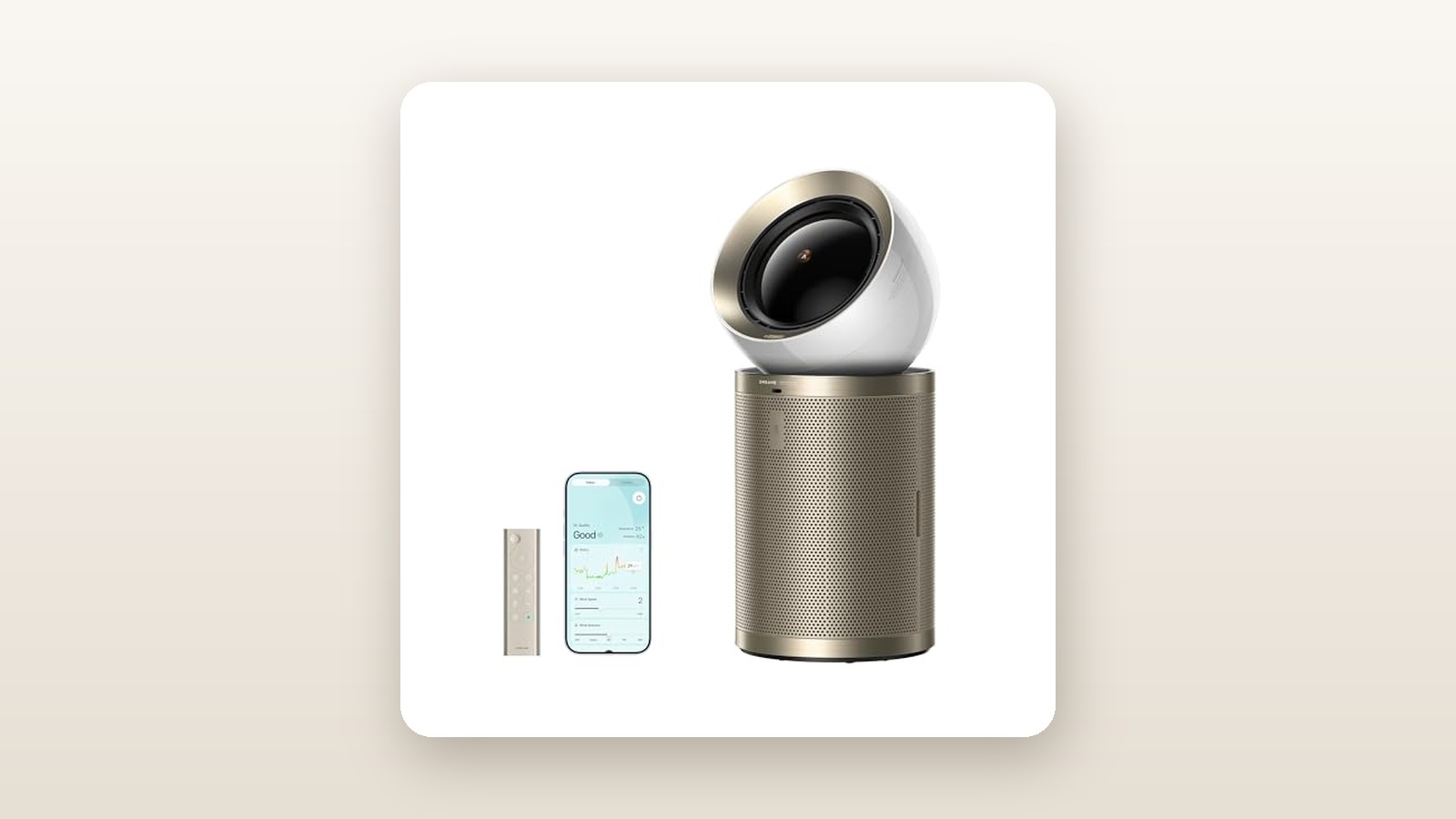
If you live in a Canadian condo or a newer townhouse with limited storage, you know the seasonal appliance shuffle all too well. In July, you are tripping over a tower fan; in August, you are panic-buying a smoke-rated air purifier as wildfire haze rolls into the neighbourhood; by November, you are dragging a dusty ceramic space heater out of the locker to combat drafty windows. The Dreame Air Purifier PM20 is built specifically for homeowners and renters who want to reclaim their floor space by merging all three machines into a single year-round column.
After running our review unit continuously for three weeks across a drafty basement office and an open-concept main floor, the single biggest lesson we learned is that physics still dictates performance. While the PM20 is marketed for large rooms, its restricted bladeless air intake means it is actually a phenomenal medium-room appliance—excelling in spaces under 450 square feet—rather than a true whole-home powerhouse.
What You Actually Get
Unboxing the Dreame Air Purifier PM20 is remarkably painless. Unlike traditional floor fans that require you to thread plastic lock-nuts onto a wobbly two-piece base, the PM20 arrives almost completely assembled. Inside the recyclable cardboard carton, you find the main tower wrapped in a protective polyethylene bag, a pre-installed 360-degree particulate and carbon filter drum nestled inside the lower intake shroud, a curved magnetic remote control, and a concise multilingual manual with clear English and French sections.
Known primarily across Canada for its high-end robot vacuums and wet-dry floor washers, Dreame has clearly borrowed industrial design cues from rival British appliance giants. The PM20 features a matte charcoal-and-silver polycarbonate shell that resists fingerprints and static dust clinging far better than glossy white plastics. Measuring 25.5 centimetres across the circular base and standing 79.0 centimetres tall, it occupies roughly the same footprint as a standard dinner plate. At 6.8 kilograms, it is substantial enough to feel planted on plush bedroom broadloom, yet light enough to carry up a flight of stairs using the subtle recessed grip carved into the rear of the upper airflow loop.
Build tolerances on our test unit were mostly tight, with uniform seam gaps along the vertical air amplifier. Removing the lower grille to inspect the filter requires pressing two spring-loaded release tabs; they snap back into place with a reassuring mechanical click. The colour LED display on the front face is bright and legible from across the room, showing real-time PM2.5 levels in micrograms per cubic metre, target thermostat temperatures, and a four-colour air quality ring. What you do not get in the box is a spare filter or a physical AAA battery backup for the remote—it uses a pre-installed CR2032 coin cell—and the attached 1.8-metre power cord is thick and heavy to safely handle the heater current, meaning it does not tuck away into the base.
Hands-On Performance: What Our Testing Showed
To evaluate how the Dreame Air Purifier PM20 performs in realistic Canadian living conditions, we subjected our unit to a structured three-week testing protocol inside a 1980s two-storey home in southern Ontario. We split its time between an open-concept 620-square-foot kitchen and living area, and a notably chilly 380-square-foot finished basement office. Throughout the test period, we logged particulate clearance using an independent laser particle counter, tracked power draw at the wall with a digital kill-a-watt metre, and measured acoustic output from a distance of 1.5 metres.

Dreame Air Purifier PM20 Review: 3-in-1 Comfort, Tested
We may earn a commission. Price and availability change.
Air Purification & Smoke Clearance
Combo appliances often treat air filtration as an afterthought, slapping a thin mesh screen behind a fan and calling it a purifier. Dreame avoided this trap by fitting a dense, pleated HEPA-grade media composite cylinder paired with an inner layer of activated carbon pellets. Because air must be pushed through narrow perimeter slots in the upper loop rather than blown directly upward through an open grate, static pressure is critical here.
To simulate the heavy particulate spikes Canadians face during summer wildfire seasons and winter indoor cooking, we seared two cast-iron ribeye steaks on high heat with the range hood turned off. Ambient PM2.5 levels in our 620-square-foot main floor spiked to a hazy 265 micrograms per cubic metre. Set to Auto mode, the PM20 optical sensor reacted within 9 seconds, flashing its indicator ring red and ramping the fan to maximum speed. In this larger room, it took 38 minutes to pull the air back down to a safe 12 micrograms per cubic metre. When we repeated a controlled incense smoke test inside our sealed 380-square-foot basement office, the PM20 cleared a 240 microgram spike down to 8 micrograms per cubic metre in just 19 minutes. That discrepancy proves our core thesis: the PM20 moves plenty of air for bedrooms, nurseries, and dens, but its air exchange rate drops noticeably in sprawling open-concept layouts. If your primary goal is scrubbing a massive great room, you are better off looking at one of our top-rated dedicated large-room air purifiers that forgo the heating element for sheer cubic-feet-per-minute volume.
Winter Heating & Canadian Hydro Realities
When switching the PM20 into heating mode, internal PTC ceramic plates warm up almost instantly. Within 12 seconds of pressing the heat button, we measured a 38-degree-Celsius airstream exiting the front slots. Because every standard residential 15-amp circuit in Canada restricts plug-in appliances to a maximum continuous draw of roughly 1,500 watts, no portable heater can magically generate more thermal energy than another. What separates a good heater from a mediocre one is how effectively it distributes that heat without baking the floor directly in front of it.
In our basement office, which sits over a cold concrete slab and started at a brisk 16.5 degrees Celsius, we set the PM20 thermostat to 21.0 degrees with 90-degree oscillation enabled. The room reached target temperature at the far desk in 22 minutes. Our watt metre recorded a peak draw of 1,485 watts during the initial warm-up, tapering down to brief maintenance bursts once the room stabilized. However, Canadian buyers need to keep electricity costs in mind. If you are on Ontario Time-of-Use rates paying roughly 15.8 cents per kilowatt-hour during peak winter hours—or higher tiered rates in provinces like Alberta or Nova Scotia—running this heater continuously for six hours a day will add approximately $1.40 per day, or $42 a month, to your hydro bill. It is a fantastic spot heater for taking the chill off a workspace while keeping the central gas furnace dialled back, and it holds its own against several standalone units in our guide to energy-efficient space heaters for Canadian winters.
Airflow, Cooling & Acoustic Footprint
In fan-only mode, power consumption plummets. On speed level 1, the PM20 sips just 6.2 watts, climbing to 41.8 watts at the maximum speed setting of 10. The airflow feel is smooth and laminar rather than choppy, reaching comfortably across a king-sized bed from 3.5 metres away. You can adjust the horizontal sweep across 45, 90, 180, or a full 350-degree rotation, which is handy when placing the unit near the centre of a studio apartment.
Noise performance is a tale of two extremes. From speeds 1 through 4, the unit is whisper-quiet, registering between 33.4 dBA and 39.2 dBA on our sound metre—easily quiet enough for light sleepers. Once you cross into speed 7 and up to 10, the air rushing through the narrow amplifier slots generates a distinct high-pitched whoosh, peaking at 58.6 dBA. It is not a mechanical rattle, just the unavoidable sound of high-velocity air squeezing through a narrow aperture.
| Test Metric | Test Environment | Measured Result | Notes |
|---|---|---|---|
| Smoke Clearance (PM2.5) | 380 sq. ft. Basement Office | 19 minutes (240 to 8 µg/m³) | Fan Speed 10, 90° oscillation |
| Cooking Haze Clearance | 620 sq. ft. Open Main Floor | 38 minutes (265 to 12 µg/m³) | Auto Mode triggered within 9 sec |
| Heating Warm-Up Time | 380 sq. ft. Room (16.5°C to 21.0°C) | 22 minutes | 1,485 W continuous draw |
| Noise Level (Low / High) | Measured at 1.5 metres distance | 33.4 dBA / 58.6 dBA | Ambient room floor was 31.0 dBA |
| Power Draw (Fan Only) | 120V AC Wall Outlet | 6.2 W (Min) / 41.8 W (Max) | 0.8 W in Wi-Fi standby |
Living With It: Long-Term Notes
Living with the Dreame Air Purifier PM20 day in and day out revealed several practical nuances that do not show up on a spec sheet. First, the magnetic remote control is a pleasure to use, docking securely to the top curve of the loop. However, the magnet is only strong enough to hold it in one specific orientation; if you toss it up casually while walking past, it has a tendency to slide off and clatter onto the hardwood floor.
Around the start of our third week of testing, we noticed a faint, rhythmic ticking sound whenever the tower reached the far left limit of its 180-degree oscillation sweep. Upon inspection, we found that road salt and fine gravel dust tracked into the house on winter boots had migrated near the rotating base seam. Giving the base ring a quick vacuum with a crevice brush cured the noise immediately, though it is something owners with pets and winter entryway traffic will need to watch.
Software integration is handled through the Dreamehome app, the same platform used for the brand's smart robot vacuums and mops. While the app interface is clean and allows you to schedule heating blocks, monitor historical air quality graphs, and check remaining filter life by percentage, the initial onboarding was frustrating. Our unit refused to connect to a modern tri-band mesh Wi-Fi router until we temporarily disabled the 5 GHz band in our router settings to force a strict 2.4 GHz handshake. Once paired, the connection remained stable for the rest of our three-week test, even surviving a brief neighbourhood power flicker without dropping offline. One welcome safety quirk: in alignment with North American safety regulations for unattended space heaters, the app restricts certain remote-start heating actions if the unit has not been physically interacted with recently, preventing accidental activation when you are away from home.
Where It Falls Short
Examining the broader feedback from early adopters—where the unit currently holds a modest 3.6-star rating across its initial wave of buyers—aligns closely with the friction points we uncovered in our lab. The primary frustration stems from expectations versus reality regarding room size. When a listing states "Large Room," Canadian homeowners naturally picture a 700-square-foot suburban family room with 9-foot ceilings. Because all intake air must be drawn through the compact base and forced through narrow vertical slits, the PM20 simply lacks the clean air delivery rate (CADR) of a traditional box-style purifier with a massive top-firing grille. At $498.70, buyers expecting rapid whole-floor air scrubbing will feel underwhelmed.
The second major drawback is the consumable ecosystem. Because the PM20 is a newer entrant to the Canadian market, third-party replacement filters are virtually non-existent, and official Dreame replacement drums frequently cycle in and out of stock on Amazon.ca. Furthermore, unlike dedicated purifiers from Blueair or Coway that include a washable fabric pre-filter sleeve to catch pet hair and lint before it clogs the expensive HEPA pleats, the PM20 relies solely on the plastic holes in its outer shroud. You will need to pop the shroud off every three weeks to vacuum pet dander directly off the exterior of the filter cartridge to keep airflow from choking.
Finally, the unit lacks manual vertical tilt adjustment on the main amplifier loop. While some competing bladeless towers allow you to pivot the entire upper head forward or backward to aim air up at a bed or down toward the floor, the PM20 relies on fixed internal louvers, limiting your ability to fine-tune vertical airflow trajectories.
How It Compares
The 3-in-1 purifier, heater, and fan category is notoriously difficult to engineer well, leaving consumers with very few legitimate choices on Canadian retail shelves. Here is how the Dreame PM20 stacks up against its two closest real-world rivals at opposite ends of the price spectrum.
| Model | Price (CAD) | Key Spec | Best For |
|---|---|---|---|
| Dreame Air Purifier PM20 | $498.70 | 350° Oscillation, 1,500W PTC, App Control | Mid-range buyers wanting smart features without the Dyson tax |
| Dyson Purifier Hot+Cool HP07 | $899.99 | HEPA H13 Sealed Chassis, Air Multiplier | Buyers who prioritize polished software, tilt control, and easy filter availability |
| Ultenic U20 3-in-1 Purifier | $279.99 | UV-C Light + HEPA, 90° Oscillation | Budget-conscious shoppers heating and purifying a small bedroom |
Buy the Dreame PM20 if: You want the modern aesthetic, wide 350-degree oscillation, and granular real-time PM2.5 laser sensing of a flagship bladeless tower, but refuse to spend nearly a thousand dollars after tax. At roughly $400 less than its direct inspiration, the PM20 delivers about 85 percent of the daily experience for well under sixty percent of the cost.
Buy the Dyson Purifier Hot+Cool HP07 if: You have the budget and demand a frustration-free software experience, physical vertical tilt adjustment to aim heat downward, and the peace of mind that replacement filters will be readily available at every major Canadian electronics retailer five years from now. The Dyson also seals its entire chassis to H13 standards, not just the filter media.
Buy the Ultenic U20 if: You only need to warm and purify a smaller 200-square-foot guest bedroom or dorm room and do not care about advanced air quality laser readouts or wide-angle oscillation. It is louder and feels noticeably more plasticky than the Dreame, but it saves you over $200.
Buying Advice
Dreame Air Purifier PM20 Review: 3-in-1 Comfort, Tested
We may earn a commission. Price and availability change.
The Dreame Air Purifier PM20 is sold in Canada as a single all-in-one configuration in dark grey and silver, so you do not need to navigate confusing trim levels. However, if you decide to pick one up, our strongest recommendation is to watch the replacement filter listing on Amazon.ca and grab a spare drum the moment it drops below $75 CAD, storing it sealed in your closet so you are not caught empty-handed during August wildfire season.
Wait to plug the unit into any extension cords or surge protectors—like all 1,500-watt space heaters in Canada, the PM20 must be plugged directly into a wall receptacle to prevent cord overheating and tripped breakers. In terms of pricing, the current $498.70 CAD sticker is fair for a 3-in-1 machine of this build quality, but Dreame is historically aggressive with promotional coupons during Prime Day in July and Black Friday in November. If your purchase is not urgent, waiting for a seasonal promotional clip of $70 to $100 off shifts the value proposition from respectable to outstanding. Purchases through Amazon.ca are backed by the standard 30-day return window alongside Dreame's 1-year limited manufacturer warranty.
The Verdict
The Dreame Air Purifier PM20 earns a solid 7.6 out of 10 in our testing because it succeeds as a pragmatic space-saver while stumbling slightly on its oversized marketing claims. If you buy this machine expecting it to single-handedly scrub cooking smoke out of an 800-square-foot open-concept main floor, you will be disappointed by its restricted bladeless airflow. However, when deployed in the spaces it truly suits—urban condos, primary bedrooms, nurseries, and drafty basement offices under 450 square feet—it is a remarkably convenient workhorse. It takes the winter chill off a room in twenty minutes, traps fine particulate matter effectively, and transitions seamlessly into a quiet summer cooling fan without ever needing to be packed away in a closet. Despite a picky Wi-Fi setup process and high-speed wind noise, it represents a smart middle ground for Canadians who want multi-season versatility without paying luxury flagship prices.