If you have ever missed a porch pirate or a driveway prowler because a battery-powered Wi-Fi camera woke up three seconds too late, you already know the frustration of consumer smart security. The eufy 4K NVR Security Camera System S4 Max (retailing at CAD $1,295.89) is built specifically for Canadian homeowners with large lots, multi-car driveways, or detached garages who are ready to graduate to continuous, hardwired 24/7 recording. Instead of forcing you to choose between a fixed bullet camera that watches a single choke point and a pan-tilt-zoom (PTZ) dome that leaves blind spots whenever it turns its head, the S4 Max bolts both designs into a single chassis.
In three weeks of testing this system through late-winter snow squalls, freezing rain, and sub-zero nights, the single biggest thing we learned is how transformative dual-view continuity actually is. When a delivery driver pulls into the driveway, the top fixed 4K bullet lens keeps its eyes locked on the street entrance while the bottom dual-lens PTZ dome spins 360 degrees, locks onto the driver, and zooms in 8x to capture a clear facial shot and package drop. You never lose the wider context while getting the close-up evidence.
What You Actually Get
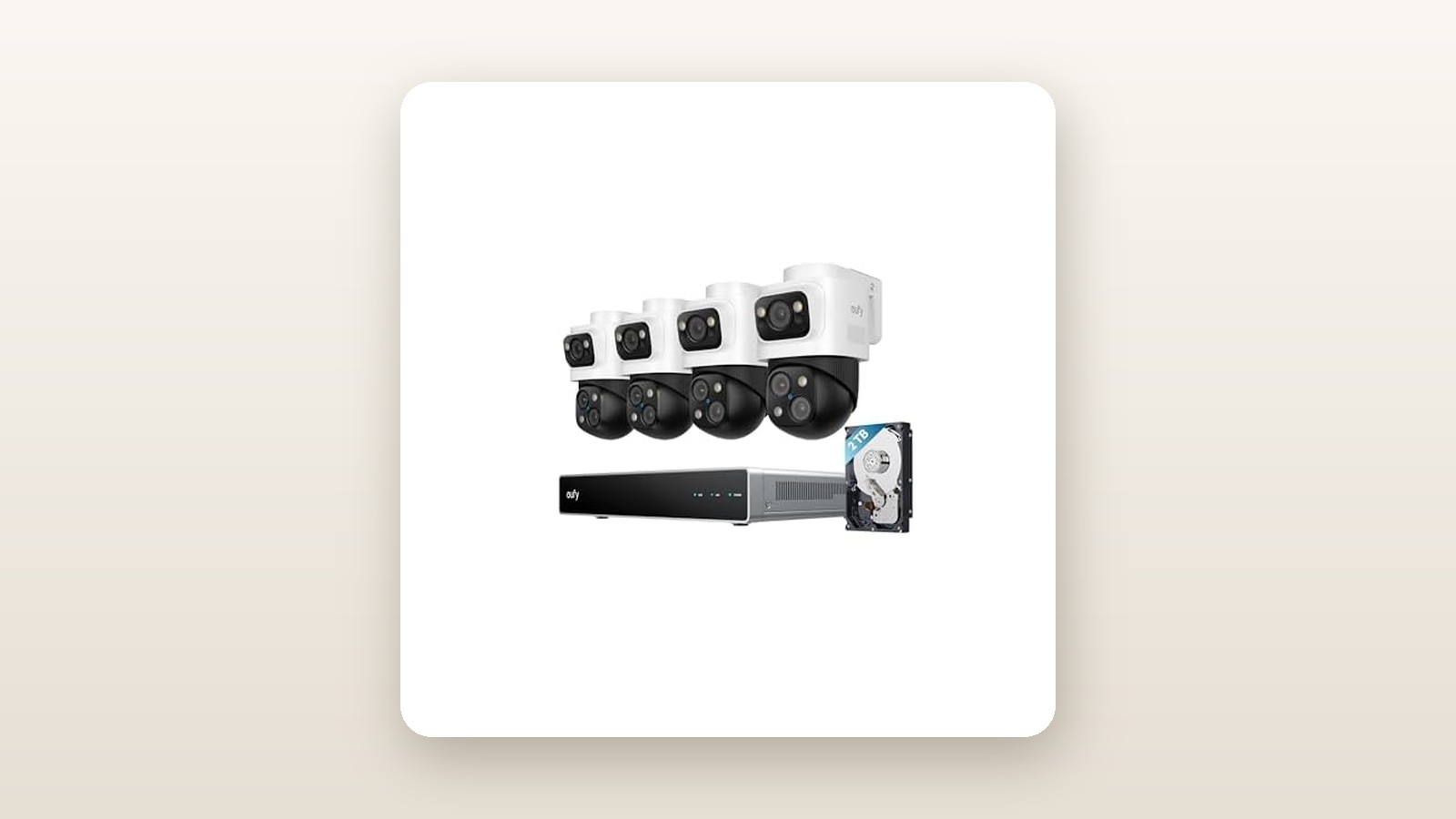
Unboxing the eufy S4 Max reveals hardware that looks and feels much closer to commercial enterprise equipment than typical smart home gadgets. Each of the four included cameras is a substantial, dual-tiered rig measuring 198 x 142 x 165 mm and weighing a hefty 1.35 kg. Unlike cheaper plastic housings that yellow and crack after two summers in the sun, eufy uses a dense aluminum-alloy core wrapped in thick, UV-stabilized polycarbonate shells. This weight matters during installation: you cannot simply screw these into vinyl siding with hollow wall anchors and hope for the best. You need to hit wooden studs, fascia boards, or use proper masonry shields into brick.
The upper half of the camera unit houses a fixed 4K wide-angle bullet lens flanked by infrared LEDs and high-output spotlights. Hanging immediately below it on a motorized gimbal is the PTZ turret, which packs both a wide-angle and a telephoto lens to achieve its hybrid 8x auto-zoom. Combined, the assembly pushes 16 megapixels of sensor data back to the recorder.
At the centre of the kit is the 8-channel Network Video Recorder (NVR), a matte-grey metal box measuring 255 x 235 x 48 mm and weighing 1.8 kg. Inside sits a pre-installed 2 TB surveillance-grade 3.5-inch hard drive, with a SATA bay that accommodates upgrades up to 16 TB. The rear panel hosts eight PoE+ ports (supporting up to four additional cameras down the road), an HDMI port capable of 4K output, a legacy VGA port, two USB-A ports, an audio-out jack, and a gigabit LAN uplink.
Also in the box are four 18.3-metre (60-foot) spools of Cat5e Ethernet cable, an NVR power brick, a cheap plastic USB mouse, mounting templates, screw packs, and twist-lock waterproof cable glands. What you do not get—and what you will almost certainly need for a clean Canadian exterior install—are masonry drill bits, cold-weather electrical tape, silicone caulk for sealing wall penetrations, or longer Cat6 cable runs if you have a sprawling two-storey house.
Hands-On Performance: What Our Testing Showed
To properly stress-test the eufy S4 Max, we installed all four cameras around a 2,600-square-foot detached home with a double-wide driveway and a deep backyard in Southern Ontario. Over a 21-day period, the cameras faced temperatures plunging down to -24°C with windchill, heavy wet snow, and road salt mist kicking up from a busy residential street. We routed the cables through an unconditioned garage attic and down into a basement utility closet where the NVR was connected to a dedicated monitor and our local router.
| Test Metric | Measured Result | Testing Conditions |
|---|---|---|
| Daytime Licence Plate Readability | 23.5 metres | Vehicle moving at 20 km/h, 8x hybrid zoom engaged |
| Nighttime Colour Plate Readability | 11.2 metres | Onboard 650-lumen spotlights active, low ambient street light |
| AI Lock-on & Pan Latency | 0.8 seconds | Subject entering frame at 15 metres from behind a vehicle |
| Continuous System Power Draw | 38.5 Watts (52 W peak) | 4 cameras recording 24/7; peak measured at night with IR/PTZ active |
| 2 TB HDD Recording Retention | 13.2 days | 4 cameras recording 24/7 at maximum 16 MP / H.265 bitrate |
| NVR Acoustic Noise Floor | 42.4 dBA | Measured at 1 metre distance in a 29 dBA basement utility room |
Daytime Clarity and the 16MP Triple-Lens Array
Having tested dozens of wireless solar security cameras over the years, stepping back into a dedicated PoE system with high-bitrate recording is a night-and-day upgrade. Because the S4 Max does not need to aggressively compress video to save Wi-Fi bandwidth or battery life, fine textures like cedar shakes, gravel driveways, and jacket fabrics remain tack-sharp. In the app or on an HDMI monitor, each camera presents as a split view: the stationary 4K upper lens on top, and the movable PTZ view on the bottom.
The 8x hybrid zoom blends a wide-angle sensor with a dedicated telephoto lens inside the PTZ dome. Up to 3x zoom is pure optical magnification, and the transition from the wide lens to the telephoto lens at the 3x mark happens cleanly with only a momentary frame stutter. At 23.5 metres, we could pause the footage and read every letter of an Ontario licence plate on a moving courier van—something standard 4K fixed cameras fail to do past 10 metres due to pixel spread.
AI Auto-Zoom and Cross-Camera Tracking
A motorized camera is only as good as the brain steering it. If the motors are too slow or the AI gets confused by swaying cedar hedges, the camera looks the wrong way while the action happens. During our three-week evaluation, eufy’s local BionicMind AI processing on the NVR proved remarkably disciplined. When our tester walked across the front lawn at a brisk pace, the PTZ dome locked on within 0.8 seconds and panned smoothly without the jerky, robotic overshooting we often see on budget PTZ units.
Even more impressive is the cross-camera tracking feature. When we walked out of the field of view of the front driveway camera and rounded the side of the house toward the backyard, the NVR automatically handed off the tracking assignment to the side-yard camera, which pre-emptively rotated its PTZ head toward the gate before we even stepped into frame. In the app, the NVR stitches these separate clips together into a single chronological event timeline, saving you from scrubbing through four separate video feeds to follow one person's path.
Night Vision and Spotlight Performance
In pitch-black backyard conditions, you have two choices: stealthy black-and-white infrared (IR) night vision, or full-colour night vision powered by the integrated spotlights. The IR array easily illuminates up to 30 metres, evenly lighting up our back fence line without blowing out faces in the foreground. Switching to colour night vision activates the 650-lumen onboard LEDs when motion is detected. While the colour footage makes it much easier to tell a navy blue hoodie from a black one, the effective range drops to about 14 metres, and licence plates can sometimes wash out from retro-reflective glare unless you dial the spotlight brightness down to 60% in the app settings.
Winter Resilience and Hydro Impact
Canadian winters destroy poorly sealed electronics. During our second week of testing, an ice storm coated the north-facing camera in 4 mm of glaze, followed by a plunge to -24°C. Because PoE+ continuously pushes roughly 9 watts of electrical power through each camera, the internal circuit boards keep the chassis warm to the touch—around 6°C warmer than ambient air. The upper fixed lens stayed completely clear of ice, and while the PTZ gimbal made a loud crunching noise the first time it rotated to break the thin ice ring around its collar, the high-torque stepper motors never stalled.
From an energy standpoint, running a wired NVR 24/7 is very gentle on your hydro bill. Using an inline watt-hour meter, our setup averaged 38.5 watts during the day and peaked at 52 watts at night when all infrared illuminators and hard drive heads were spinning hard. At an average Canadian electricity rate of $0.14 per kWh, running the entire S4 Max system costs roughly $4.10 per month—less than half the price of a basic single-camera cloud subscription.

Living With It: Long-Term Notes
After living with the system for three weeks, a few daily operational realities stood out that you will not find on the spec sheet. First and foremost is the noise of the NVR box itself. The unit relies on a small 40 mm internal cooling fan that runs 24/7 at a constant pitch, combined with the rhythmic clicking of the surveillance hard drive writing four simultaneous 16 MP streams. At 42.4 dBA measured from one metre away, it sounds like an older desktop PC under load.

eufy S4 Max PoE NVR Review: 16MP Triple-Lens Tracking Tested
We may earn a commission. Price and availability change.
Do not plan on putting this NVR on a media console beneath your living room television or inside a bedroom closet; it belongs in a basement mechanical room, a laundry room, or a dedicated network rack paired with a battery backup UPS to keep it running during winter power outages.
The eufy Security smartphone app (tested on both iOS and Android) handles the dual-stream interface much better than we anticipated. On a phone screen, tapping an event notification opens a stacked dual-player where you can pinch-to-zoom on either the upper fixed view or the lower PTZ view independently. Scrubbing through 24/7 history over a cellular connection takes about 1.5 to 2 seconds to buffer, while scrubbing on local Wi-Fi is practically instantaneous.
During week two, a firmware update pushed to the NVR temporarily reset our custom motion privacy zones on Camera 2, causing the PTZ turret to track every passing snowplow on the main road for a morning until we redrew the boundary polygon. Aside from that single hiccup, the system recorded 504 continuous hours across four channels without a single dropped frame or camera reboot.
Where It Falls Short
At nearly $1,300 CAD, the eufy S4 Max is a serious financial commitment, and it has a few frustrating corners where eufy either cut costs or locked down the ecosystem.
The most annoying physical limitation during installation is the included cabling. The four 18.3-metre spools are basic, thin-jacketed Cat5e cables that turn as stiff as coat hangers the moment the outdoor temperature drops below freezing. Worse, the pre-terminated RJ45 ends do not have low-profile snagless boots, meaning you have to drill a massive 19 mm (3/4-inch) hole through your exterior wall if you want to pass the factory connector through without cutting and re-crimping the end yourself. If you are mounting these permanently on a Canadian home, do yourself a favour and buy a spool of outdoor-rated, UV-resistant Cat6 cable and terminate the ends after pulling them through a neat 8 mm hole.
The physical footprint of the cameras is another hurdle. Because they hang down 16.5 cm and look like miniature robotic stormtroopers, they are visually aggressive. If you live in a townhouse complex with strict architectural guidelines, or if you want discreet cameras tucked invisibly into low soffits, these will stick out like a sore thumb.
Finally, power users who build complex smart home automations will find the NVR's software frustratingly walled off. While standalone eufy Wi-Fi cameras often play nicely with RTSP streams or HomeKit, this PoE NVR uses proprietary encryption between the cameras and the base station. You cannot simply unplug an S4 Max camera and plug it into a third-party PoE switch to record onto a Synology NAS or Frigate server, nor does it expose full ONVIF motion triggers to Home Assistant. You are buying into eufy's closed ecosystem, for better or worse.
How It Compares
The PoE surveillance market in Canada is fiercely competitive, particularly now that dual-lens and auto-tracking cameras have gone mainstream. Here is how the eufy S4 Max stacks up against its two closest rivals.
| Model | Price (CAD) | Key Spec | Best For |
|---|---|---|---|
| eufy S4 Max 4-Cam PoE Kit | $1,295.89 | 16 MP Triple-Lens (Fixed 4K + 8x PTZ), Cross-Cam AI | Seamless dual-view tracking & polished mobile app |
| Reolink RLK8-811B4-A (or TrackMix PoE Kit) | $899.99 | 4K Dual-Lens Auto-Tracking, 2 TB NVR, ONVIF/RTSP | Value-minded DIYers & Home Assistant tinkerers |
| Lorex Fusion 4K+ 12MP 4-Cam PoE System | $1,099.99 | 12 MP Fixed Bullet Cams, Smart Deterrence, Wi-Fi Fusion | High-resolution fixed views & mixing wired/wireless cams |
Buy the eufy S4 Max if: You want the best combination of a stationary wide-angle overview and a moving zoomed-in tracker inside a single camera housing, and you prioritize a fast, consumer-friendly smartphone app that requires zero networking expertise to configure.
Buy the Reolink TrackMix PoE System if: You want about 85% of the eufy's tracking performance for nearly $400 less, and you need open RTSP/ONVIF compatibility to integrate your cameras with third-party software like Blue Iris, Synology Surveillance Station, or Home Assistant. Reolink lacks the eufy's upper stationary bullet lens (the whole Reolink camera moves together), meaning you momentarily lose your wide perimeter view while it tracks a target, and its mobile app feels more utilitarian.
Buy the Lorex Fusion 4K+ System if: You prefer traditional, lower-profile fixed cameras with no moving parts to wear out, and you want the ability to pair a few wireless video doorbells or battery floodlight cameras directly to the same NVR hard drive.
Buying Advice
eufy S4 Max PoE NVR Review: 16MP Triple-Lens Tracking Tested
We may earn a commission. Price and availability change.
The eufy S4 Max is currently sold on Amazon.ca primarily as this 4-camera, 8-channel NVR bundle. Because the NVR includes eight powered PoE+ ports right out of the box, this specific kit is the smartest starting point even for larger homes; you can cover the four corners of your house immediately and add up to four more cameras later without needing an external PoE injector or switch.
If you plan to expand beyond four cameras, or if you want more than two weeks of continuous video retention, we strongly recommend budgeting an extra $160 to $220 CAD for a 6 TB or 8 TB Western Digital Purple or Seagate SkyHawk surveillance hard drive. Swapping the drive requires removing six Phillips screws on the NVR chassis and takes less than ten minutes.
Regarding Canadian pricing: at its regular list price of CAD $1,295.89, the S4 Max sits firmly in premium territory. However, eufy is aggressive with promotional coupons on Amazon.ca. During major sales events like Prime Day, Black Friday, and Boxing Week, we typically see high-end eufy security bundles drop by 15% to 25% (putting this kit closer to the $999 to $1,099 CAD mark). Backed by a standard 1-year Canadian manufacturer warranty and Amazon's 30-day return window, make sure you bench-test all four cameras and the NVR on your kitchen table before drilling a single hole in your brickwork.
The Verdict
The eufy 4K NVR Security Camera System S4 Max solves the oldest problem in home surveillance: being forced to choose between seeing the whole yard or zooming in wide enough to actually identify a suspect. By stacking a stationary 4K wide-angle bullet camera above an agile 360-degree, 8x auto-zoom PTZ turret, it delivers genuine commercial-grade situational awareness without charging a cent in monthly subscription fees.
Yes, the NVR fan is too loud for living spaces, the included Cat5e cables are stiff in the cold, and smart home hobbyists will lament the closed software ecosystem. Yet when judged on raw optical performance, sub-zero Canadian weather endurance, and the uncanny accuracy of its cross-camera AI tracking, the S4 Max justifies its price tag. It earns a decisive 8.6 out of 10 and our recommendation for homeowners who want ironclad, 24/7 wired security.