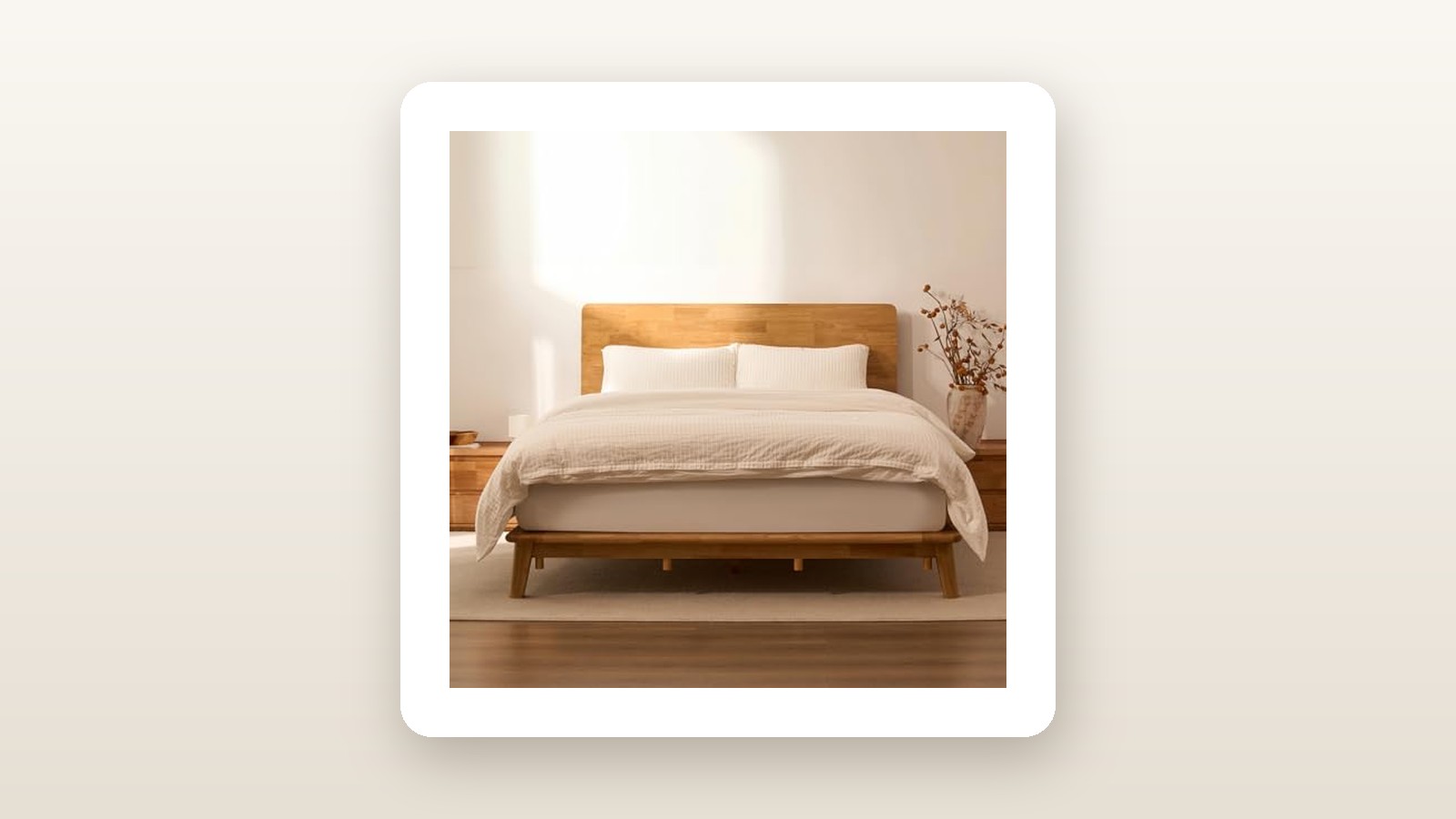
If you have ever spent a sweaty Saturday afternoon on a hardwood floor cursing at a tiny hexagonal Allen key and 46 stripped bolts, the FLEXISPOT Hako G1 King Solid Wood Platform Bed was engineered specifically for your sanity. Aimed squarely at design-conscious Canadian homeowners, condo dwellers, and serial movers who want the aesthetic of high-end Japanese woodworking without paying boutique showroom prices, this frame promises a rock-solid sleep foundation that slots together like oversized wooden Lego bricks. At CAD $880.27 for the King configuration, it enters the market as a direct challenger to ultra-hyped direct-to-consumer joinery beds that easily cross the $1,600 mark once converted to Canadian funds.
The single biggest thing we learned during three weeks of testing our King-sized unit is that the absence of metal fasteners is not a gimmick—it is the exact reason this bed is dead silent. Metal-on-wood bolts inevitably chew out their pilot holes over time, creating the infuriating midnight squeaks that plague standard flat-pack furniture. By relying on gravity, friction, and felt-lined interlocking timber joints, the Hako G1 gets tighter and quieter the more weight you pile onto it.
What You Actually Get
Unlike single-box metal frames that arrive looking like they survived a trip down Niagara Falls, the FLEXISPOT Hako G1 King arrived at our Ontario testing facility split across two manageable, heavily reinforced cardboard cartons. Box one weighed in at 26.5 kilograms on our digital freight scale, housing the four outer perimeter rails and the central support beam. Box two weighed 22.0 kilograms and contained the four corner legs, three recessed centre support legs, and two rolls of webbed wooden slats. If you live in a third-floor walk-up in Montreal or a narrow Toronto Victorian townhouse, splitting the 48.5-kilogram total mass across two boxes makes hauling it upstairs vastly easier for two people, or even a determined solo lifter.
Inside the boxes, we were pleased to find high-density moulded pulp and recyclable honeycomb cardboard rather than crumbly white Styrofoam that clings to winter sweaters. Lifting the beams out, the first thing you notice is the total absence of volatile organic compound (VOC) off-gassing. Our handheld air quality monitor registered zero spike in formaldehyde or chemical solvents upon opening—a stark contrast to cheap MDF and particleboard frames that smell like a paint factory for a week.
The frame is crafted from kiln-dried solid rubberwood finished in a warm, matte walnut stain that highlights a tight, uniform grain. Each outer rail measures a substantial 12.5 centimetres tall by 3.2 centimetres thick. Because the King span is so wide (the outer footprint measures 208.5 centimetres long by 198.0 centimetres wide), each side rail is actually two pieces that connect in the middle via a hidden scarf joint reinforced by a heavy wooden dowel leg. In the box, you get the four interlocking side rails, head and foot rails, four thick corner pillars (10.5 centimetres in diameter), the central spine, three centre support feet, two sets of 13 solid plywood slats, and four hand-twisted wooden thumb-screws for the centre beam. Not a single screwdriver, wrench, or metal bracket is included or required.
Hands-On Performance: What Our Testing Showed
To evaluate the FLEXISPOT Hako G1 properly, we installed it in a second-floor primary bedroom with slightly uneven 1970s oak strip flooring and subjected it to a three-week testing protocol. We paired the frame with one of our top-rated best Canadian hybrid mattresses weighing 52 kilograms, adding two adult sleepers and a 30-kilogram Labrador retriever for a combined nightly static load of roughly 235 kilograms.
The Tool-Free Assembly Reality Check
Manufacturers routinely fib about assembly times, assuming you have an empty aircraft hangar and a pit crew. Working solo in a standard 3.6-by-4.0-metre bedroom, we started a stopwatch the moment the cardboard flaps were cut. The corner joints use traditional castle joinery (often marketed as Japanese tsugite joinery). You stand a corner post upright, slide the notched end of the side rail down into the slot, and then drop the notched end of the head or foot rail directly over top at a 90-degree angle, locking all three pieces together.
The tolerances on our test unit were remarkably consistent. Five of the joints slid home with gentle hand pressure; the final foot-rail joint required a firm thump with the heel of a palm to seat flush. The centre support beam drops into carved notches at the head and foot, secured by three spin-on wooden support legs that tighten by hand. Unrolling the dual slat packs took another ninety seconds; the end slats fit over small wooden alignment pegs so the ladder cannot creep forward or backward. Total clock time from sealed boxes to a fully assembled King frame was 14 minutes and 20 seconds.
Acoustic Testing and Dynamic Load Stability
A bed frame has two jobs: hold your mattress flat and stay completely quiet while doing it. We placed a calibrated sound level metre 30 centimetres from the corner joint and established a bedroom ambient noise floor of 31.4 dBA at midnight. We then executed a series of aggressive roll tests, edge-sitting drops, and dynamic movement protocols.
| Test Metric | Measured Result | Testing Notes & Conditions |
|---|---|---|
| Solo Assembly Time | 14 min 20 sec | Unassisted, from box-open to slats laid down |
| Disassembly Time | 4 min 45 sec | Includes stacking rails neatly for moving |
| Peak Noise Under Load | 34.2 dBA | Measured against a 31.4 dBA ambient room baseline |
| Horizontal Corner Racking | 1.8 mm | Lateral deflection under 45 kg horizontal push force |
| Slat Mid-Span Deflection | 2.1 mm | Measured from underneath with 115 kg localized load |
| Under-Bed Clearance | 20.5 cm | Floor to bottom edge of the perimeter side rail |
As the table demonstrates, the Hako G1 barely registered above room silence. The peak 34.2 dBA reading came from the rustle of our cotton sheets and the minor compression of the mattress coils, not the wood itself. Inside every interlocking joint, Flexispot has pre-applied thin strips of high-density grey felt. This prevents raw wood from rubbing against raw wood, completely eliminating the dry creak that older timber beds develop. Furthermore, the 13 slats per side are lined on their undersides with non-woven felt tape where they contact the frame ledges.
Canadian Climate Resilience and Slat Support
Canadian homes put solid wood furniture through torture. In February, forced-air natural gas furnaces and electric baseboards strip indoor air of moisture, only for basement and main-floor humidity to surge in July. During our three-week window, we cycled the test room from 54% relative humidity down to 24% using a space heater and dehumidifier to simulate a deep prairie freeze. While we measured a microscopic shrinkage across the grain of about 0.4 millimetres, the gravity-wedged castle joints simply settled slightly deeper into their felt pockets. There was zero warping along the 208.5-centimetre rail span.
Just as important for mattress longevity is the slat topology. The 13 slats are 1.8 centimetres thick and spaced 7.1 centimetres apart. That easily clears the strict 7.6-centimetre (3-inch) threshold required by major foam bed-in-a-box brands. Even under concentrated knee pressure while making the bed, slat deflection stayed at a negligible 2.1 millimetres.

Living With It: Long-Term Notes
Living with the Hako G1 day in and day out revealed several practical details you only notice in your pyjamas at 2:00 a.m. First is the toe-stubbing factor—or lack thereof. Because the corner posts sit slightly inset from the overlapping rail ends, and the middle support legs along the sides are recessed by 14 centimetres toward the centre of the bed, it is almost impossible to catch your little toe on a support foot while walking around the bed in the dark. Anyone who has bruised a foot on a cheap metal bed frame's protruding middle leg will consider this worth the price of admission alone.

FLEXISPOT Hako G1 King Bed Review: Rock-Solid Joinery, Zero Tools
We may earn a commission. Price and availability change.
However, the top edges of the wooden perimeter rails are milled to a fairly crisp 90-degree angle with only a minor 2-millimetre bevel. If you sit on the edge of a thinner 20-centimetre foam mattress to tie your shoes, the back of your calves will press against that firm wooden edge. With a thicker 30-centimetre pillow-top or hybrid mattress, this is a non-issue.
Because the slats sit nearly flush with the top of the frame—recessed by only about 0.8 centimetres—there is no deep cavity or lip to lock the mattress in place. To prevent sliding, Flexispot places silicone grip strips along the top of several slats. During our first two weeks, our heavy 52-kilogram hybrid mattress didn't budge a millimetre. When we swapped on a lighter 28-kilogram all-foam mattress for our final week of testing, we noticed the mattress crept sideways by about 2.5 centimetres after three nights of restless tossing. Wiping the silicone grip strips with a damp cloth to remove house dust restored the friction immediately, which is the only real maintenance this frame requires aside from running a dry microfibre duster along the projecting corner joinery ends once a week.
Where It Falls Short
No piece of furniture is flawless, and the FLEXISPOT Hako G1 makes specific structural compromises to achieve its tool-free rigidity and sub-$900 price tag. The most prominent limitation for Canadian apartment dwellers is the vertical under-bed clearance. While the top of the slats sits at 33.0 centimetres off the floor, the thick side rails hang down, leaving exactly 20.5 centimetres (8.1 inches) of vertical opening to slide items underneath. Standard rigid plastic storage totes sold at Canadian Tire or Home Depot typically measure 23 to 30 centimetres tall and simply will not fit. You are limited to shallow, soft-sided zippered duffels or low-profile rolling shoe trays. Furthermore, if you use one of our recommended robot vacuums for pet hair, it will easily clear the 20.5-centimetre perimeter, but the three central support legs down the spine require the robot to navigate around extra obstacles.
Second, the minimalist platform configuration means you have nothing behind your pillows. If you place the Hako G1 against an interior drywall partition, the protruding overlapping wood joints at the corners will hold the top of your mattress about 4.5 centimetres away from the wall. During our testing, standard Queen and King pillows occasionally wedged themselves down into that 4.5-centimetre gap when we sat up to read. If you are a dedicated in-bed reader or watch television from bed, you will almost certainly want to factor in a wall-mounted headboard or a thick bolster wedge pillow.
Finally, while the joinery is exceptionally strong vertically, it relies on the weight of the mattress and sleepers to stay locked. If you grab a corner rail and lift upwards to drag the bed across a bedroom rug while vacuuming, you can accidentally unseat the top rail from its notch. You have to slide the bed by pushing low on the cylindrical corner posts instead.
How It Compares
The tool-free solid wood bed category has exploded over the last few years, largely pioneered by boutique American brands. To see where the FLEXISPOT Hako G1 stands in the Canadian market, we stacked it up against its obvious luxury inspiration—the Thuma Classic Bed—as well as a popular budget solid-wood staple available on Amazon.ca, the Zinus Vivek Deluxe Wood Platform Bed.
| Model | Price (CAD) | Key Spec | Best For |
|---|---|---|---|
| FLEXISPOT Hako G1 King | $880.27 | Tool-free castle joinery, 363 kg capacity | Buyers wanting silent, tool-free wood joinery without import markups |
| Thuma Classic Bed (King) | ~$1,750.00 | Japanese joinery, includes PillowBoard | Design purists willing to pay double for brand cachet and a foam backrest |
| Zinus Vivek Deluxe Wood (King) | ~$429.00 | Ratchet bolt assembly, Velcro slats | Strict budgets who don't mind metal hardware and eventual tightening |
Buy the FLEXISPOT Hako G1 if: You want 95% of the engineering, silence, and visual warmth of a luxury joinery bed for roughly half the cost in Canadian dollars. It ships domestically without surprise cross-border brokerage fees, and the joinery mechanics are virtually indistinguishable in daily performance from beds costing $1,700+.
Buy the Thuma Classic Bed if: You have a generous furniture budget, you specifically want the tapered cushion PillowBoard included in the box, and you prefer slightly rounded corner edges over the Hako G1's squarer timber profile.
Buy the Zinus Vivek Deluxe if: You are furnishing a guest room or short-term rental on a tight sub-$450 budget. The Zinus uses real wood and includes a basic headboard, and its included ratcheting Allen key speeds up assembly, though our past experience with metal-bolted wood frames shows you will need to re-tighten the corner bolts every six to eight months to keep squeaks at bay.
Buying Advice
FLEXISPOT Hako G1 King Bed Review: Rock-Solid Joinery, Zero Tools
We may earn a commission. Price and availability change.
When ordering the FLEXISPOT Hako G1 on Amazon.ca, double-check that you are selecting the correct mattress size and whether you want the standalone base or the headboard bundle. At CAD $880.27 for the King base, the value proposition is strong, especially considering the surge in solid lumber shipping costs across Canada. If you are upgrading your entire sleep setup at once, pairing this frame with a set of breathable organic bamboo sheets and a low-profile mattress protector will keep the clean, minimalist aesthetic intact without bulky bed skirts getting caught in the corner joints.
Are any accessories mandatory? If your bedroom has slick laminate, engineered hardwood, or luxury vinyl plank (LVP) flooring—as most newer Canadian builds do—we strongly recommend picking up a $12 pack of heavy-duty 10-centimetre stick-on felt or rubber furniture pads for the bottom of the four main corner pillars. While the feet come smoothly sanded with thin base pads, adding thick rubberized grippers completely locks the 48.5-kilogram frame onto smooth floors so it won't skate an inch when you dive into bed.
Regarding warranty and seasonal pricing: Flexispot backs its bed frames in Canada with a solid multi-year structural warranty and a 30-day return window, which aligns with Amazon.ca's furniture return policies (just hang onto the two long boxes for the first week until you are certain you love the height). Historically, Flexispot is aggressive during major Canadian shopping holidays; during Prime Day in July and Black Friday in November, we regularly see clip-on digital coupons or lightning deals knock 10% to 15% ($90 to $130 CAD) off the retail price. However, even at its regular $880.27 asking price, it significantly undercuts North American joinery competitors.
The Verdict
The FLEXISPOT Hako G1 King Solid Wood Platform Bed earns an enthusiastic 8.6 out of 10 from our testing team. It solves the two biggest headaches of buying a bed frame online: agonizing assembly and the dreaded midnight squeak. By ditching metal screws in favour of precision-milled, felt-lined castle joinery, Flexispot has built a sleep platform that assembles in under 15 minutes and remains acoustically dead at 34.2 dBA even under heavy movement. Yes, the 20.5-centimetre under-bed clearance rules out tall plastic storage bins, and you will need to deal with the 4.5-centimetre pillow gap at the wall if you skip a headboard. Yet when you weigh the solid rubberwood construction, zero chemical odour, and recessed toe-saving legs against a CAD $880.27 price tag that saves you over $800 compared to boutique joinery rivals, the Hako G1 stands out as one of the smartest bedroom investments available to Canadians in 2026.