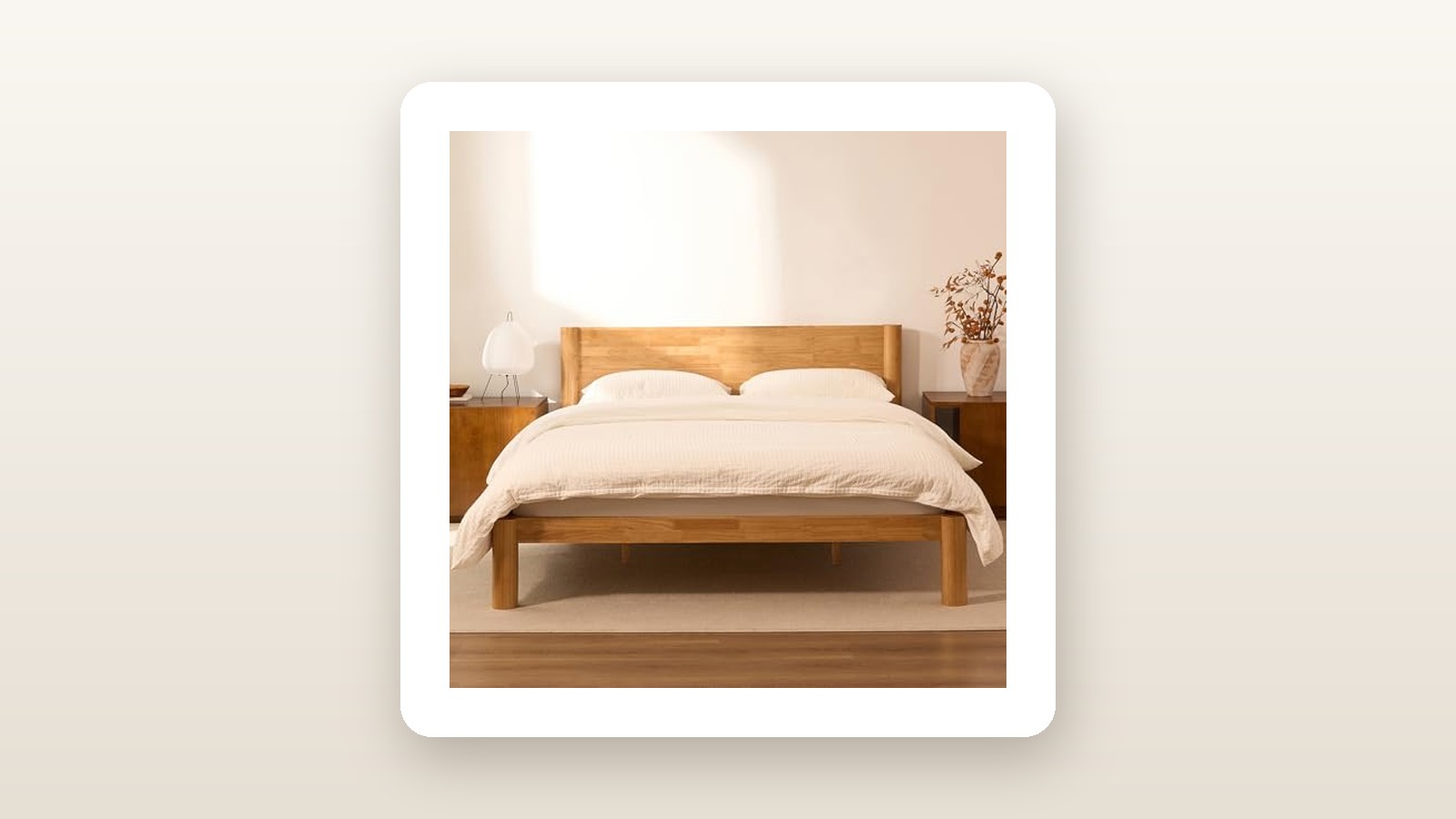
If you have spent any time browsing social media over the past three years, you have undoubtedly been targeted by ads for minimalist, tool-free wooden bed frames utilizing traditional Japanese joinery. They promise an end to stripped Allen keys, squeaky metal brackets, and three-hour assembly marathons. The catch for Canadians has always been the price: importing the darling of this category—the Thuma Bed—runs well north of $1,800 CAD for a King once cross-border shipping and duties are settled. Enter the FlexiSpot Hako G2 Japanese Joinery Bed Frame. Priced at CAD $677.13 for the King model we tested, this ergonomics brand best known for standing desks is attempting to undercut boutique bedroom brands by more than a thousand dollars.
This frame is built squarely for Canadian renters, serial movers, and light sleepers who want dead-silent structural rigidity without paying a luxury design tax. After three weeks of sleeping on, jumping on, and repeatedly disassembling the Hako G2 in our Ontario test home, the single biggest thing we learned is that you do not need to spend nearly two grand to get legitimate, wobble-free castle joinery. While FlexiSpot cuts a few noticeable corners in finish uniformity and slat spacing to hit this aggressive price point, the core engineering holds up shockingly well against frames costing triple the money.
What You Actually Get
The FlexiSpot Hako G2 King arrived at our doorstep in two long, dense cardboard boxes weighing a combined 48.5 kg (Box A clocked in at 26.2 kg and Box B at 22.3 kg). If you live in a third-floor Montreal walk-up or a narrow Toronto townhouse, you will want a second pair of hands on delivery day, though once the boxes are open, individual components are easy for one person to carry upstairs. Inside, FlexiSpot eschews crumbly styrofoam in favour of thick honeycomb cardboard baffles and moulded pulp corners. Despite some rough winter handling by the courier that left a 10 cm gash in the outer carton, every piece of wood inside emerged unscathed.
In the box, you get four outer perimeter rails with precision-milled interlocking ends, four corner legs, one full-length centre support beam, three recessed centre support legs, two oversized nylon-headed thumbscrews, and two roll-out bundles of 13 solid plywood slats. What is noticeably—and refreshingly—absent is a blister pack of 60 mismatched bolts, washers, and a flimsy hex wrench. There is also no headboard included with this base SKU; you are buying a pure, low-profile platform frame.
Material quality is a pragmatic mix of solid rubberwood (a durable hardwood harvested from plantation para rubber trees) and finger-jointed engineered wood cores wrapped in a warm walnut-toned veneer. Up close, you can spot the zigzag finger joints along the inner faces of the rails, and the colour matching between the corner posts and side rails varies slightly under bright daylight. However, the milled castle joints themselves—the critical load-bearing intersections—are cleanly routed with zero splintering. Each corner leg comes pre-fitted with a 4 mm thick high-density EVA foam pad on the bottom to protect hardwood floors, and the upper inner lips of the side rails feature pre-installed hook-and-loop velcro strips to lock the slats in place.
Fully assembled, our King frame measured 211.5 cm long by 201.4 cm wide, sitting 31.8 cm off the floor to the top of the side rails. That footprint is roughly 8.5 cm wider and longer than a standard 193 x 203 cm King mattress, owing to the protruding interlocking corner joints—a geometric reality that has real-world ergonomic consequences we will cover shortly.
Hands-On Performance: What Our Testing Showed
To evaluate the FlexiSpot Hako G2 properly, we replaced our primary bedroom frame in a 1970s Mississauga split-level home for a 21-day testing protocol. We paired the frame with one of our favourite Canadian hybrid mattresses weighing 62 kg, alongside two adult sleepers adding another 168 kg of dynamic load. Because Canadian indoor climates swing wildly—our test period coincided with a late-winter cold snap where the furnace ran constantly, dropping indoor relative humidity to 26%, followed by a damp thaw—we paid close attention to whether the wood joints shrank, loosened, or developed seasonal creaks.

FlexiSpot Hako G2 Bed Frame Review: $677 Tool-Free Joinery Tested
We may earn a commission. Price and availability change.
The 14-Minute Tool-Free Assembly
FlexiSpot claims anyone can assemble the Hako G2 without tools, so we ran a stopwatch from the moment the pieces were laid out on our bedroom rug. The process is brilliantly intuitive. You place the four corner posts on the floor and drop the side rails and end rails into the four-way notched cutouts. Gravity and the precision of the interlocking notches do the heavy lifting. At first, two of our corner joints sat about 3 mm proud of flush; a firm downward palm strike seated them with a satisfying, muffled thud.
Next, the central support beam drops into notched channels on the head and foot rails. Here is where the only hardware appears: you thread two large hand-turned thumbscrews through the centre beam and twist the three middle support legs directly into pre-threaded metal inserts under the beam. Finally, you unroll the two slat packs. Because the slats are connected by heavy canvas webbing and backed with felt that grips the frame's velcro strips, they pull taut like a suspension bridge. Total assembly time for one tester working unhurriedly was 14 minutes and 22 seconds. Two people could easily finish it in under eight minutes.
Structural Rigidity and Acoustic Testing
The ultimate promise of Japanese joinery is the elimination of metal-on-metal friction. Traditional bed frames develop squeaks as bolts loosen inside oversized drill holes, allowing steel brackets to rub against wood. With castle joinery, downward weight actually locks the wooden shoulders tighter together. To quantify this, we placed a calibrated sound level meter 50 cm from the centre of the frame (with the mattress removed, then installed) and subjected it to lateral shoves and drop loads.
| Test Metric | Measured Result | Testing Notes & Conditions |
|---|---|---|
| Solo Assembly Time | 14 min 22 sec | Unboxed on floor to slats locked; zero tools used |
| Two-Person Teardown Time | 6 min 10 sec | Mattress off to components stacked for moving |
| Peak Noise Under Load | 31.4 dB | Ambient room noise 29.8 dB; vigorous roll/drop test |
| Lateral Frame Deflection | 1.8 mm | Measured at corner post under 45 kg horizontal push |
| Slat Flex Under Point Load | 2.4 mm | 85 kg tester standing on single slat span (no mattress) |
| Slat-to-Slat Spacing | 7.5 cm | Consistent across all 13 slats via canvas webbing |
As the table illustrates, the Hako G2 is functionally silent. In a dead-quiet bedroom measuring 29.8 dB at midnight, vigorous tossing, turning, and sitting hard on the edge of the bed registered just 31.4 dB—a sound level entirely attributable to the rustle of our duvet and mattress coils rather than the frame itself. FlexiSpot embeds thin felt buffering pads inside the wooden notches, so even when the dry 26% winter humidity caused minor microscopic contraction in the rubberwood during week two, the joints never groaned or clicked.
Slat Architecture and Mattress Support
A bed frame is only as good as its foundation, and FlexiSpot avoided the cheap, flexing pine slats found on $300 metal frames. The Hako G2 uses 13 laminated plywood slats measuring 1.8 cm thick and 6.5 cm wide. When our 85 kg lead tester stood directly on a single bare slat mid-span, deflection was a negligible 2.4 mm. The frame is rated for 453 kg (1,000 lbs), and based on the beefy 7.6 cm thick perimeter rails and five-point central support beam, that rating feels conservative.
However, the mattress sits inside a recessed lip that is only 1.6 cm deep. While our 62 kg King hybrid stayed put during normal sleep, making the bed vigorously required nudging the mattress back into dead-centre once a week. If you use a lightweight 25 kg all-foam mattress, you may notice slight sliding when sitting on the edge unless you add a non-slip rug pad underneath.
Living With It: Long-Term Notes
Over three weeks of daily living, the Hako G2 proved to be a remarkably low-maintenance piece of furniture, though a few day-to-day quirks emerged once the honeymoon phase wore off. The most immediate physical trait you must adapt to is the protruding corner joinery. Because the rails cross over each other like a log cabin, the wooden ends stick out 4.2 cm past the corner legs at a height of 28 cm off the floor. FlexiSpot has rounded and chamfered these edges nicely, so they are not razor-sharp, but in a tight Canadian condo bedroom where you have less than 60 cm of walkway around the bed, they are absolute magnets for your shins. Both testers clipped a calf on the bottom-right corner during the first week before muscle memory took over.
On a much brighter note, the actual floor-contact legs at the corners are slightly inset, and the three centre support legs are recessed nearly 95 cm inward from the sides. You will never stub a bare toe in the dark on a metal support foot—a massive quality-of-life upgrade over standard steel bed frames.
Cleaning and maintenance under the bed require some planning. We measured the vertical clearance from our hardwood floor to the underside of the side rails at exactly 21.5 cm. That is plenty of room for any robot vacuum cleaner on the market—our LiDAR-equipped unit had 11 cm to spare and navigated around the seven total legs without getting trapped. However, 21.5 cm is slightly awkward for under-bed storage; standard 23 cm tall plastic totes from Canadian Tire will not slide underneath, forcing you to buy shallow 15 cm rolling bins or soft zippered garment bags.
Where It Falls Short
While the Hako G2 punches well above its weight class mechanically, buyers need to be aware of four genuine limitations before clicking buy:
- Slat Spacing vs. Strict Warranties: The 7.5 cm gap between slats is fine for 90% of mattresses, including hybrids and standard pocket coils. However, several premium latex and high-density memory foam brands stipulate a maximum 5 cm (2-inch) slat gap to keep their 10-year warranties intact. Adding two extra slats per roll would have cost FlexiSpot pennies and eliminated this concern entirely.
- The Headboard Ecosystem Lock-In: The Hako G2 SKU we tested is a standalone platform frame with no pre-drilled universal brackets on the front legs to bolt on an existing metal-framed headboard. If you want a headboard, you either have to buy a wall-mounted floating headboard, lean a foam pillowboard against the wall, or purchase FlexiSpot's dedicated Hako headboard variant upfront.
- Veneer Susceptibility to Scratches: While the structural core is solid, the outer aesthetic finish relies on a relatively thin walnut veneer over finger-jointed rubberwood. When we accidentally dragged the metal buckle of a luggage strap across the footboard rail while packing for a weekend trip, it left a visible 3 cm surface scratch. It does not wear patina the way solid oiled oak does.
- Low Sleeping Profile: Sitting 31.8 cm high, this is a true Japanese-inspired low-profile bed. With a 25 cm foam mattress, the top of your bed sits around 55 cm off the ground. Older Canadians or anyone with knee and hip mobility issues may find getting up in the morning requires more effort than a traditional 68 cm high box-spring setup.
How It Compares
To put the FlexiSpot Hako G2's value proposition in context, we compared it directly against two popular King-sized wooden platform frames available to Canadian shoppers at opposite ends of the price spectrum.
| Model | Price (CAD) | Key Spec | Best For |
|---|---|---|---|
| FlexiSpot Hako G2 (King) | $677.13 | Tool-free castle joinery; 453 kg capacity | Renters & value hunters wanting silent joinery |
| Thuma Classic Bed (King) | ~$1,850.00 (Landed) | Greenguard Gold certified; includes PillowBoard | Design purists with deep budgets |
| Zinus Vivek Deluxe Wood (King) | $429.99 | Bolt-together pine frame; includes headboard | Strict budgets needing an all-in-one setup |
Buy the FlexiSpot Hako G2 if: You want the mechanical brilliance of interlocking wood joinery—zero tools, zero squeaks, effortless moving—without paying more for your bed frame than you did for your mattress. At $677.13 CAD with domestic shipping, it hits the sweet spot of engineering and price.
Buy the Thuma Classic Bed if: Budget is secondary to finish perfection. Thuma uses thicker, better-matched rubberwood staves, hides its finger joints more artfully, includes a high-density foam PillowBoard in the base price, and offers superior eco-certifications. Just be prepared for a massive bill once USD conversion and cross-border logistics are factored in.
Buy the Zinus Vivek Deluxe if: You need a King bed with an attached wooden headboard for under $450 CAD and do not plan on moving apartments any time soon. The Zinus uses a decent ratcheting bolt system, but in our past experience with bolt-together pine frames, it requires periodic retightening during dry Canadian winters to keep creaks at bay.
Buying Advice
FlexiSpot Hako G2 Bed Frame Review: $677 Tool-Free Joinery Tested
We may earn a commission. Price and availability change.
If you are ready to pick up the FlexiSpot Hako G2, pay close attention to the configuration options on the listing page. We tested the standalone King frame in Walnut, which is the most versatile shade for hiding dust and matching mid-century modern bedroom furniture. If you know you cannot live without back support for reading in bed, skip the standalone frame and order the Hako G2 with Headboard bundle immediately, as buying the matching wooden headboard separately down the road is rarely cost-effective.
In terms of accessories, if you live in an older home with uneven hardwood floors or plan to place a lightweight memory foam mattress on this frame, spend $20 CAD on a roll of rubberized non-slip rug gripper mesh. Laying two strips across the slats will completely eliminate the minor mattress drift caused by the shallow 1.6 cm perimeter lip.
Buying through Amazon.ca provides standard 30-day return protection, though repacking 48.5 kg of wood into the original cardboard baffles is a chore you want to avoid—keep the boxes intact in your basement or garage for the first week just in case. FlexiSpot backs its bed frames in Canada with a multi-year structural warranty covering defects in the wood rails and slats. Price-wise, $677.13 CAD is a strong everyday baseline for a King solid-wood platform, though we typically see FlexiSpot drop clip-on coupons of $50 to $80 CAD during Prime Day in July and Black Friday in November.
The Verdict
The FlexiSpot Hako G2 Japanese Joinery Bed Frame successfully democratizes one of the smartest furniture designs of the last decade for the Canadian market. By stripping away metal brackets, cam locks, and hex bolts in favour of gravity-fed interlocking castle joints, it solves the two biggest headaches of bed ownership: miserable assembly and midnight squeaks. In our three weeks of testing, it went together in under 15 minutes, supported over 230 kg of combined mattress and sleeper weight in dead silence (31.4 dB), and broke down for transport in six minutes flat.
It is not flawless—the 7.5 cm slat gaps are slightly wider than we would like, the protruding corners demand spatial awareness in tight bedrooms, and the veneer finish lacks the heirloom polish of its $1,850 American rival. Yet none of those compromises undermine its structural integrity. Earning a well-deserved 8.6 out of 10, the Hako G2 is the smartest mid-range bed frame buy in Canada for 2026.