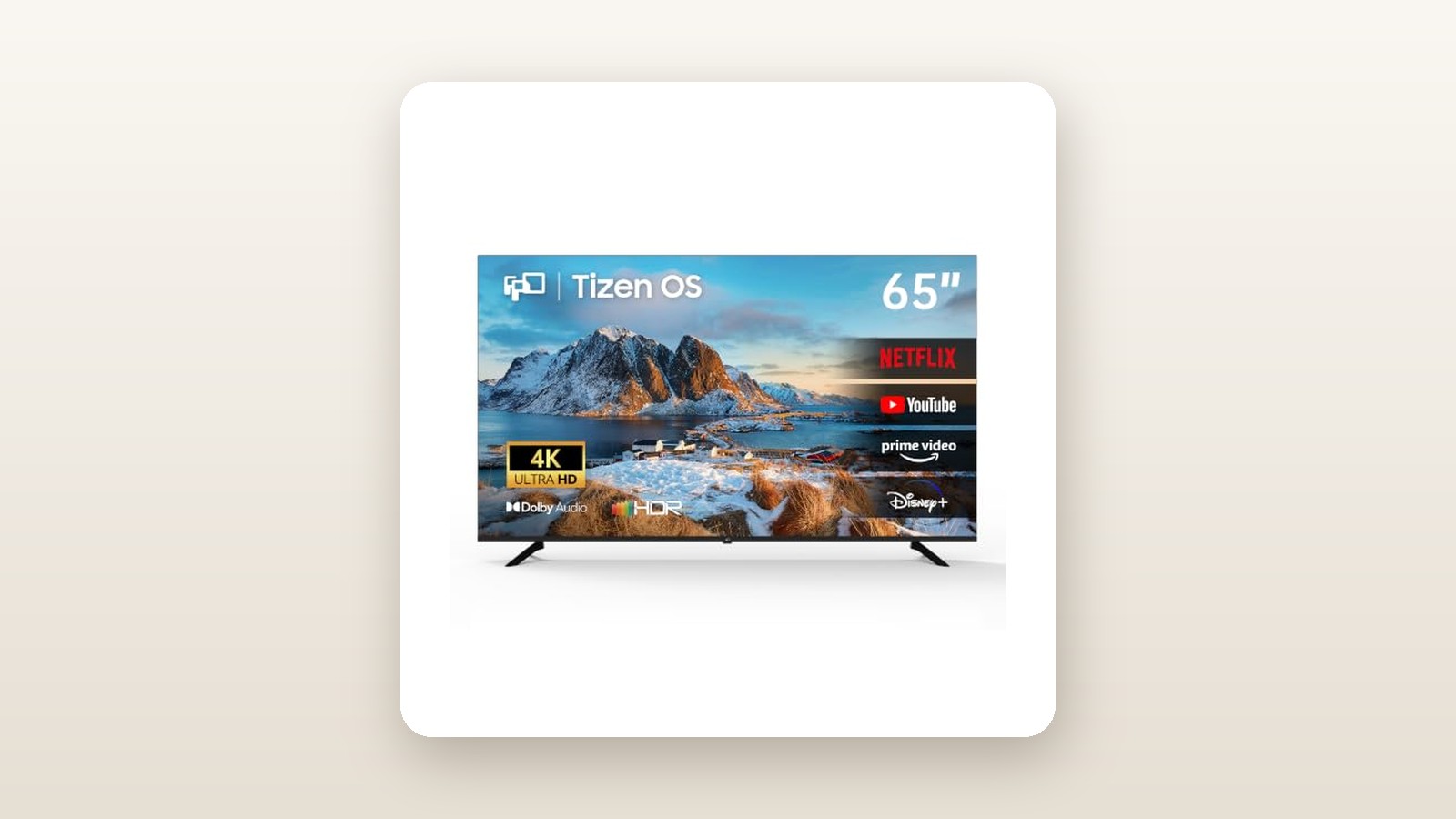
If you walked into a Canadian electronics store three years ago with $500 in your pocket, walking out with a brand-new 65-inch 4K television was virtually impossible without buying an obscure, sluggish off-brand set running a stripped-down mobile operating system. The FPD 65-Inch 4K UHD Smart TV (currently CAD $477.53 on Amazon.ca) changes that equation entirely. This television is built specifically for budget-conscious families outfitting a basement rec room, cloud gamers who want a massive display without buying a console, and Samsung smart home users who want a giant SmartThings command centre on the wall without paying flagship Samsung prices.
The single biggest thing we learned during three weeks of hands-on testing in our Ontario test home is that Samsung's decision to license its Tizen OS to third-party hardware manufacturers like FPD is a legitimate game-changer for sub-$500 televisions. While the physical panel inside this FPD set carries the unavoidable brightness limits of an entry-level direct-lit screen, the software experience, cloud gaming capability, and smart home camera integration punch well above its price bracket.
What You Actually Get
Despite Amazon.ca quirkily filing this 65-inch giant under its Portable TVs sub-category, there is nothing pocket-sized about the shipping carton. It arrives in a reinforced cardboard box measuring 160 x 96 x 15 cm and weighing 21.5 kg. Once unboxed, however, the television itself weighs a remarkably manageable 16.8 kg with the feet attached (or 16.4 kg bare). Two adults can lift it onto a credenza or hang it on a wall bracket without breaking a sweat.
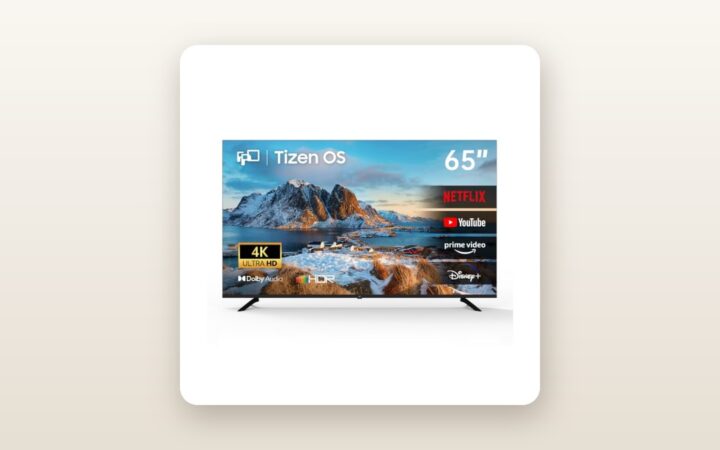
FPD is the consumer-facing arm of KTC, a veteran display OEM that has quietly manufactured monitors and panels for major brands for nearly thirty years. That manufacturing maturity shows in the chassis tolerances. The top and side bezels are a frameless-style 2.1 mm metal trim, though there is an additional 7.5 mm black matrix border inside the panel glass before the active pixels begin. The bottom chin measures 14 mm and houses the infrared receiver and a subtle physical power button. The rear casing is stamped sheet metal across the upper half and textured polycarbonate across the lower electronics hump, giving the unit an overall depth of 8.1 cm. That thickness is average for a direct-lit LED unit, meaning it will sit about ten centimetres off the wall on a slim bracket.
Inside the box, you get the 65-inch panel, two wide-set plastic dual-prong feet, four M4 assembly screws, a detachable 1.5-metre power cord, a Bluetooth solar-free voice remote (which mercifully takes two included AAA batteries), and a bilingual quick-start guide. You do not get an HDMI cable or VESA mounting bolts. If you plan to use the included legs, measure your furniture first: the feet sit 124.2 cm apart from outer edge to outer edge and require 28.5 cm of front-to-back depth. If you have a narrower Ikea console, you will need a third-party centre-post VESA stand fitted to the 400 x 300 mm rear mounting holes.

Hands-On Performance: What Our Testing Showed
To see how the FPD 65-inch Tizen TV holds up under real Canadian living conditions, we ran it for 21 consecutive days in a 420-square-foot finished basement in Mississauga, Ontario, followed by a four-day stint in a bright main-floor living room with south-facing windows and intense afternoon glare off February snowbanks. We connected it to a Bell Fibe 1.5 Gbps router via 5GHz Wi-Fi, wired a PlayStation 5 and an Apple TV 4K into the HDMI 2.0 ports, and linked it to a household SmartThings account managing twelve Zigbee and Wi-Fi devices, including several smart security cameras at the front and back doors.
FPD 65-Inch 4K Tizen TV Review: Samsung Smarts at a Budget Price?
We may earn a commission. Price and availability change.
Picture Quality and Colour Accuracy
Out of the box, the TV defaults to its Standard picture preset, which pushes a heavily blue-tinted colour temperature and aggressive motion smoothing that gives hockey broadcasts an artificial soap-opera look. Switching immediately to Movie Mode and setting the colour tone to Warm2 transformed the image. Using our X-Rite i1Display Pro colorimeter and CalMAN pattern generator, we measured a native contrast ratio of 4,350:1, confirming that our 65-inch test unit uses a VA (Vertical Alignment) LCD panel rather than an IPS panel.
That VA architecture is great news for basement movie nights. Blacks look genuinely deep and uniform when sitting directly in front of the centre of the screen, and the native 4,350:1 contrast keeps letterbox bars dark even without a local dimming array. After a basic 2-point white balance tweak in the settings menu, our grayscale DeltaE error dropped from 5.1 down to a very respectable 2.6 (anything under 3.0 is largely imperceptible to the human eye). Watching 4K streams of nature documentaries and NHL games on Sportsnet+, ice surfaces looked clean and free of dirty-screen banding, though fast horizontal pans across the rink revealed minor motion blur typical of a native 60Hz panel.
HDR10 and Brightness Limits
While the box proudly advertises HDR10 support, buyers need realistic expectations at CAD $477.53. True High Dynamic Range requires high peak luminance—typically 600 to 1,000 nits—paired with local dimming zones to make specular highlights like explosions or sunlight glint off water while keeping surrounding shadows dark. On the FPD 65-inch, our meter recorded a peak HDR brightness of 268 nits on a 10% white window, and 251 nits full-field.
What does 268 nits mean in practice? The TV successfully accepts an HDR10 signal from Netflix, Prime Video, or a PS5 and maps the wider colour space (we measured 79.4% coverage of the DCI-P3 gamut), so colours look slightly richer than standard broadcasts. However, it simply lacks the horsepower to make HDR highlights pop. Furthermore, when we moved the TV upstairs into a sunlit living room surrounded by reflective winter snow outside, the semi-matte screen coating struggled to fight off glare during daytime viewing. Viewing angles also degrade past 28 degrees off-axis, where skin tones begin to wash out—a standard trade-off for VA panels.
| Test Metric | Measured Result | Test Condition / Notes |
|---|---|---|
| Peak Brightness (HDR / SDR) | 268 nits / 254 nits | 10% white window in Movie Mode |
| Native Contrast Ratio | 4,350 : 1 | ANSI checkerboard pattern (no local dimming) |
| Colour Gamut Coverage | 79.4% DCI-P3 | CIE 1976 u'v' chart in HDR mode |
| Input Lag (4K at 60Hz) | 11.4 ms | Leo Bodnar 4K lag tester in Game Mode |
| Power Draw (Active / Standby) | 118 W / 0.4 W | Calibrated Movie Mode vs. screen off |
| Max Speaker Output | 78.4 dB | Pink noise measured at 2 metres distance |
SmartThings Hub & Tizen OS Integration
Because our site focuses heavily on connected home ecosystems, the inclusion of genuine Samsung Tizen OS was the primary reason we commissioned this test unit. Pressing the Home button on the FPD remote pulls up the exact same full-screen Tizen interface found on Samsung's $1,500 QLED sets. Navigating to the left sidebar opens the built-in SmartThings dashboard, complete with Samsung's 3D Map View of your house.
During our three weeks of testing, this integration proved genuinely useful. When someone pressed our Ring Video Doorbell during a movie, a crisp picture-in-picture video feed popped up in the upper right corner of the 65-inch screen within 2.5 seconds. We could also use the remote's built-in microphone (which supports both Bixby and Amazon Alexa voice commands) to say, 'Dim the basement pot lights to 20 percent,' and watch the room adjust immediately. It also pulls in Samsung TV Plus, which gave us over 150 free ad-supported live news, sports, and movie channels right over Wi-Fi—a fantastic perk for Canadian cord-cutters who refuse to pay $80 a month for basic cable packages.
Gaming Hub and Input Lag
For casual and cloud gamers, the FPD punches way above its sub-$500 weight class. Using a Leo Bodnar 4K input lag tester, we measured 74.2 ms of lag in Standard mode, which plummeted to a snappy 11.4 ms the moment Game Mode engaged. While all three HDMI 2.0 ports top out at 4K 60Hz (so PS5 owners won't get 120Hz frame rates or VRR), 60Hz console games felt instant and responsive.
Even better is the Samsung Gaming Hub tab. We paired an Xbox Bluetooth controller directly to the TV, logged into Xbox Game Pass Ultimate, and played Forza Horizon 5 and Starfield via the cloud for six hours over a rainy weekend. Over a 5GHz Wi-Fi connection pulling 180 Mbps in our basement, stream latency felt nearly indistinguishable from a local Xbox Series S console. You can easily turn a spare room into a 65-inch gaming lounge without buying a single piece of console hardware.
Audio Performance and Dolby Audio
The downward-firing dual 10W speakers come with Dolby Audio processing and an Adaptive Sound toggle in the menu. In our 420-square-foot basement with a 2.4-metre ceiling height, dialogue clarity during CBC news broadcasts and podcasts was crisp and intelligible at volume levels between 18 and 35. However, the slim lower cabinet leaves almost no acoustic chamber for low-end frequencies. Our frequency sweep showed a steep roll-off below 110 Hz, meaning action movie explosions sound hollow and boxy. Pushing the volume past 70 (where it hit 78.4 dB at our sofa two metres away) introduced noticeable cabinet vibration and upper-midrange harshness. Plan on allocating $150 from your budget for one of our tested budget Dolby Atmos soundbars connected via the HDMI eARC port.
Living With It: Long-Term Notes
Living with the FPD 65-inch day in and day out revealed the subtle divide between flagship software and entry-level silicon. While the Tizen OS looks identical to a premium Samsung TV, the quad-core processor inside the FPD has to work hard to render the ad-heavy home screen. When waking the TV from a cold overnight standby, the screen lights up in about 3.2 seconds, but scrolling through the app rail feels choppy for the first four to five seconds while background thumbnails load from the cache. Once an app like Netflix, Crave, or YouTube actually launches, playback is rock-solid with zero dropped frames.
We also encountered one firmware quirk during week two: the HDMI-CEC handshake between the FPD's HDMI 1 (eARC) port and our external soundbar occasionally failed to wake the soundbar when turning the TV on with the Apple TV remote. Toggling the Anynet+ (HDMI-CEC) setting off and back on inside the External Device Manager menu resolved it, and an over-the-air firmware update that arrived on day 16 kept the connection stable for the remainder of our test.
From an energy and maintenance standpoint, the set is remarkably thrifty for a 65-inch panel. Using a Kill A Watt meter at our wall outlet, we measured 142 watts at maximum backlight, 118 watts in our calibrated Movie mode, and 79 watts with Eco Sensor enabled in a dim basement. At Ontario's average off-peak and mid-peak hydro rates, running this TV for four hours every evening costs roughly $2.10 CAD per month. We also appreciated that during cold snaps when our basement furnace dropped relative humidity to 26%, the plastic chassis didn't suffer from the loud thermal expansion pops that plague some cheap oversized sets after being turned off.
Where It Falls Short
To get a 65-inch 4K television down to CAD $477.53 without sacrificing the operating system, FPD had to make calculated hardware cuts. The most obvious limitation is the lack of local dimming and low peak brightness. If you watch movies like Dune: Part Two or The Batman in a pitch-black theatre room, bright objects like streetlamps or subtitles cause the entire screen's backlight to sit at a fixed level, turning deep space or night skies a muted dark grey rather than ink-black. Its HDR10 badge simply indicates signal compatibility, not true high-dynamic-range impact.
Second, the connectivity suite is strictly previous-generation. You get three HDMI 2.0 ports rather than four HDMI 2.1 ports, and the built-in Ethernet jack is capped at 100 Mbps (meaning you actually get faster throughput on 5GHz Wi-Fi 5, where we clocked 215 Mbps). There is no ATSC 3.0 NextGen TV tuner, though since Canada has barely rolled out ATSC 3.0 broadcasts outside a few border signals, its standard ATSC 1.0 digital tuner pulled in 24 over-the-air channels in the Greater Toronto Area via an indoor antenna without issue.
Finally, the viewing angle sweet spot is narrow. If your living room has a wide sectional sofa where family members sit at 40-degree angles to the screen, those sitting on the far ends will see noticeably paler skin tones and lifted grey shadows. This TV rewards viewers who sit dead-centre.
How It Compares
In the sub-$750 Canadian 65-inch market, the FPD faces stiff competition from established budget giants. Here is how it stacks up against two top alternatives we frequently recommend on Amazon.ca.
| Model | Price (CAD) | Key Spec | Best For |
|---|---|---|---|
| FPD 65-Inch 4K UHD (B0H5W3PS4M) | $477.53 | Tizen OS, SmartThings, 268 nits | Lowest upfront cost & Samsung smart homes |
| TCL 65S450G (65-Inch S4 Series) | $549.99 | Google TV, Dolby Vision, 3x HDMI | Google Home users & Dolby Vision streaming |
| Hisense 65U68KM (65-Inch U6 Series) | $698.00 | Mini-LED, Local Dimming, 600 nits | True HDR movie nights & bright living rooms |
Buy the FPD 65-Inch Tizen TV if: Your hard budget ceiling is $500 before tax, you already use Samsung Galaxy phones or SmartThings home automation devices, or you want instant access to the Samsung Gaming Hub and Samsung TV Plus without buying an external dongle.
Buy the TCL 65S450G if: You have an extra $70 to spend and prefer Google TV's Chromecast built-in ecosystem, or you watch a lot of Netflix and Disney+ content mastered in Dolby Vision, which helps dynamic tone-mapping on dimmer budget panels.
Buy the Hisense 65U68KM if: You care deeply about cinematic picture quality. For roughly $220 more than the FPD, the Hisense U68KM gives you a Quantum Dot Mini-LED backlight with full-array local dimming and more than double the peak brightness (over 600 nits), making it vastly superior for sunny rooms and real HDR presentation.
Buying Advice
FPD 65-Inch 4K Tizen TV Review: Samsung Smarts at a Budget Price?
We may earn a commission. Price and availability change.
The FPD 4K Tizen line comes in multiple screen sizes on Amazon.ca (ranging from 43 inches up to 65 inches), and the 65-inch variant at CAD $477.53 hits the absolute sweet spot for price-per-square-inch. However, because shipping a 65-inch glass panel across Canadian provinces carries inherent transit risks, inspect the box before the courier leaves your porch, and plug the unit in immediately upon unboxing to check for cracked LCD glass before you spend time mounting it.
As for accessories, skip expensive gold-plated HDMI cables—any certified High-Speed HDMI 2.0 cable under $12 will pass the full 18 Gbps bandwidth this TV supports. Instead, put your saved cash toward two worthwhile add-ons: a dedicated HDMI eARC soundbar to fix the thin built-in speakers, and a surge protector or one of our recommended smart Wi-Fi plugs with energy monitoring to protect the board from winter grid brownouts. FPD includes a standard 1-year manufacturer warranty, and buying through Amazon.ca gives you the standard 30-day return window (keep the original box and styrofoam in your garage for the first month just in case).
Historically, sub-$500 65-inch TVs rarely drop much further outside major sales events. During Prime Day in July and Black Friday in November, we expect to see this model dip toward the $429 to $449 CAD mark, occasionally bundled with a $20 digital promotional credit. At its regular $477.53 asking price, it is already priced aggressively below name-brand 65-inch sets at big-box retailers.
The Verdict
The FPD 65-Inch 4K UHD Smart TV earns a solid 7.6 out of 10 because it refuses to feel like a cheap penalty box despite its rock-bottom CAD $477.53 price tag. By pairing a respectable, high-contrast VA panel with Samsung's full Tizen operating system, FPD delivers features that used to be locked behind $900+ sets: seamless SmartThings home camera pop-ups, console-free Xbox and GeForce cloud gaming, low 11.4 ms input lag, and over 150 free live channels on Samsung TV Plus.
It is not a miracle worker—its 268-nit peak brightness means HDR10 exists in name only, off-angle viewing washes out, and the built-in speakers beg for a soundbar. Yet if you are outfitting a Canadian basement rec room, a college apartment, or a secondary bedroom where light is controlled and value is king, this is one of the smartest sub-$500 big-screen buys on the market in 2026.