If you have ever tried to direct a multi-camera video shoot, coordinate a house of worship service, or manage a live event crew using cheap walkie-talkies, you know the frustration of clipped sentences, tangled acoustic tubes, and beltpacks pulling down your trousers. The Hollyland Solidcom C1 (sold under the HollyView storefront on Amazon.ca for CAD $1,128.75) targets six-person production teams, technical directors, and staging crews who need instant, hands-free, full-duplex conversation without being tethered to a base station or wired beltpack.
After three weeks of testing this six-headset kit across a multi-level suburban home, a reverberant community auditorium, and a freezing snowy conservation area in Ontario, the single biggest thing we learned is that removing the beltpack changes crew behaviour completely. When putting on comms is as effortless as slipping on a 168-gram headset that connects the instant you flip the microphone boom down, your team actually wears them all day—transforming chaotic hand signals into calm, quiet coordination.
What You Actually Get
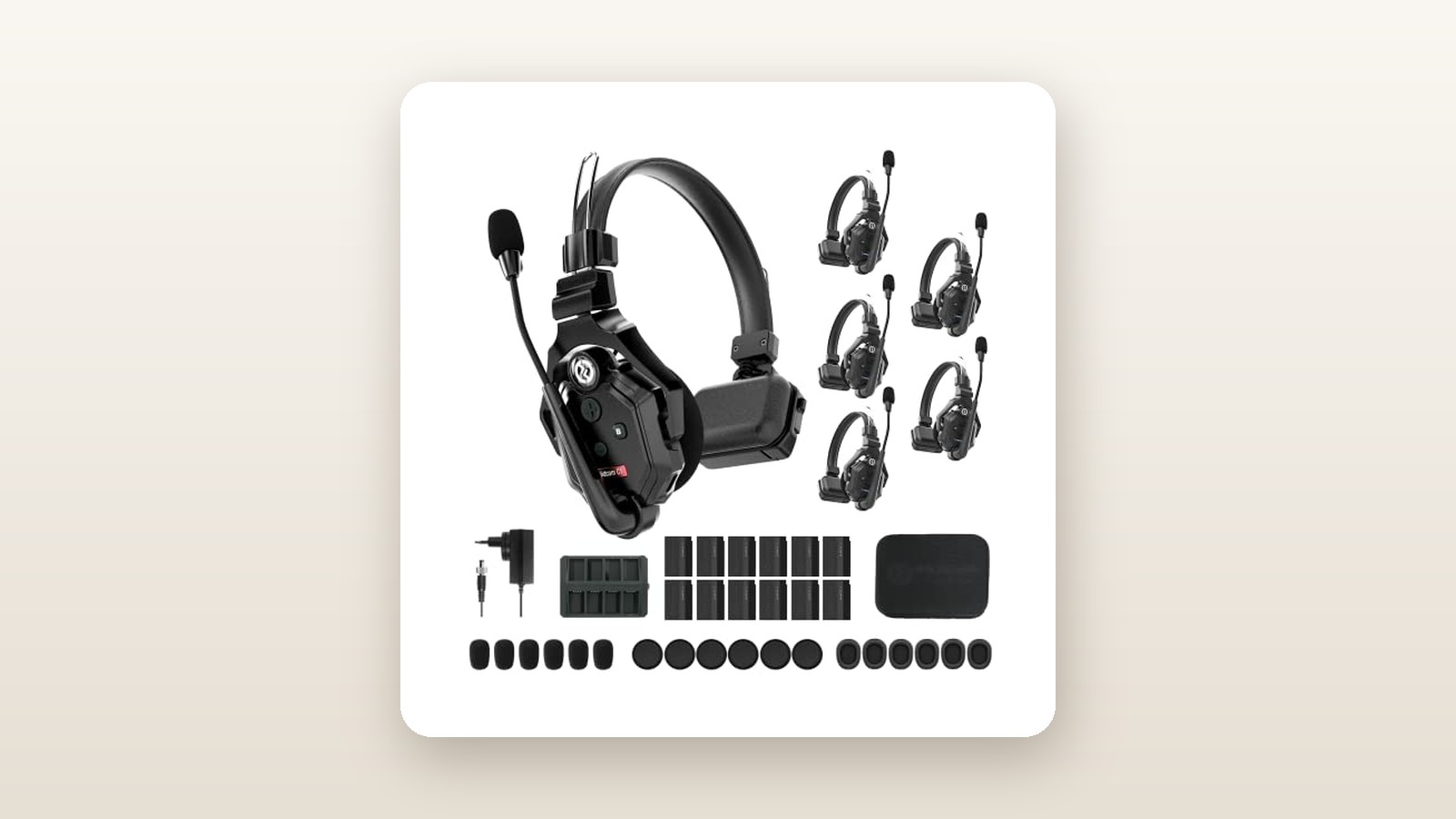
Unlike sprawling intercom systems that arrive in fragile cardboard boxes with loose power bricks, the six-person Hollyland Solidcom C1 kit ships inside a dense, semi-rigid EVA zippered carrying case measuring 38 by 26 by 18 centimetres. Carrying the entire six-person setup to a job site weighs just 3.1 kilograms, making it easy to toss into the trunk of a hatchback alongside tripod bags and lighting stands.
Inside the moulded foam cutouts, you get one Master headset (identifiable by its metallic red nameplate) and five Remote headsets (with metallic blue nameplates). All six units share the exact same physical chassis: a single-ear, over-the-head design constructed from matte polycarbonate and ABS plastic with a flexible stainless-steel headband core. We twisted the headband nearly 180 degrees during unboxing to check for brittle stress points, and the frame snapped right back into alignment without creaking.
What sets this system apart is its self-contained architecture. Every transceiver antenna, digital signal processor, and battery slot is built directly into the ear cup. There are no external antennas to snap off and no cables to snag on door handles. Alongside the six headsets, Hollyland includes an impressive stash of consumables: 12 rechargeable 700 mAh lithium-ion batteries (two per headset), an eight-bay charging dock with an AC power adapter, a USB-A to USB-C cable for firmware updates, six large over-ear leatherette cushions, six on-ear foam cushions, six foam microphone windscreens, and six furry deadcat windscreens for outdoor work.
What is missing from the box? You do not get a hard waterproof flight case (like a Pelican), so you will want to keep the zippered EVA case out of heavy rain or wet slush on loading docks. You also only get an eight-slot charger for twelve batteries, meaning if you drain every single pack on a gruelling twelve-hour shoot, you will have to charge them in two batches.
Hands-On Performance: What Our Testing Showed
To evaluate the Hollyland Solidcom C1 properly, we ran a three-week testing protocol across three distinct Canadian environments: a 2,600-square-foot two-storey home with a poured-concrete basement, a busy community event space congested with Wi-Fi networks, and an open snow-covered park at -8 degrees Celsius. Throughout our tests, we paired the system with our usual production gear, including wireless lavalier microphone systems and multi-camera video switchers, to check for RF conflicts.

Hollyland Solidcom C1 Review: Beltpack-Free Comms Tested in Canada
We may earn a commission. Price and availability change.
Range and Obstacle Penetration
HollyView rates the Solidcom C1 for a maximum line-of-sight range of 1,100 feet (335 metres). Because all Remote headsets communicate directly through the Master headset in a star topology, the person wearing the red Master headset acts as the walking base station. In our flat, unobstructed outdoor line-of-sight test along a frozen soccer field, we achieved clean, uninterrupted conversation out to 312 metres (1,023 feet) before digital warbling set in. At 340 metres, the connection dropped, and the Remote headset gave an audible voice prompt indicating it had lost the Master. As soon as we walked back inside the 300-metre mark, the headset reconnected automatically within 3 seconds without touching a button.
Indoor performance is where cheap intercoms usually collapse, especially in Canadian buildings with concrete foundations, foil-backed insulation, and steel fire doors. With the Master headset stationed on the main floor of our test house, Remote users walked down into the finished basement (through hardwood floors, HVAC ductwork, and drywall) and out to the detached garage 45 metres away. The 1.9 GHz DECT 6.0 signal punched through two interior walls and a brick exterior wall without a single dropout. Only when a Remote user stepped behind a thick poured-concrete foundation wall at the far corner of the basement—roughly 35 metres away through heavy masonry—did we hear brief packet loss.
Audio Clarity and Full-Duplex Latency
Because the Solidcom C1 operates across a wideband frequency response of 150 Hz to 7 kHz, vocal reproduction sounds noticeably richer and more natural than standard two-way radios, which typically cut off around 3 kHz. You can immediately tell who is speaking by the natural timbre of their voice, which is critical when six people are calling cues simultaneously.
True full-duplex operation means everyone can talk and listen at the same time, just like a telephone call, rather than taking turns pushing a button. We measured acoustic-to-acoustic latency at approximately 32 milliseconds—fast enough that if you stand right next to another crew member while wearing the headset, you barely notice an echo between their real voice and the transmitted audio. The microphone boom rotates 270 degrees, allowing you to wear the single ear cup on either your left or right ear. Flipping the boom upward past the 90-degree detent gives a subtle mechanical click and mutes your mic; flipping it down unmutes you instantly.
Noise Rejection in Loud Environments
It is important to note that this standard Solidcom C1 model (ASIN B09V9Z4915) does not feature the active Environmental Noise Cancellation (ENC) found on the pricier C1 Pro series. Instead, it relies on a directional electret condenser capsule tuned to pick up close-proximity speech within 2 to 3 centimetres of your mouth. In moderate ambient noise—such as a bustling backstage corridor or a workshop running a shop vac at 76 dB—vocal intelligibility remained crisp and clear.
However, when we tested the headsets next to a gas snowblower and later inside a loud live music rehearsal hitting 92 dB, the limitations showed. At 90+ dB, background noise bleeds into the open microphone whenever a crew member unmutes to speak, and the single-ear design leaves your uncovered ear exposed to the room. We found that carrying a simple foam earplug for the open ear made a massive difference in high-SPL venues, and switching from the small on-ear foam pad to the thicker over-ear leatherette cushion improved passive isolation by roughly 4 to 5 dB.
Battery Life and Cold-Weather Endurance
Because the Master headset works continuously to coordinate five separate duplex channels, it consumes power nearly twice as fast as the Remote units. In our indoor room-temperature (21 degrees Celsius) run-time test with all six headsets active, the Master battery lasted 5 hours and 18 minutes, while the five Remote batteries averaged 10 hours and 25 minutes.
Canadian outdoor shoots are brutal on small lithium-ion cells. During a four-hour outdoor test in -8 degrees Celsius weather with light snow flurries, the Master battery gave its low-battery warning at 4 hours and 10 minutes. Fortunately, Hollyland's exposed battery bay latch is brilliant: even while wearing thick winter gloves, you can press the spring-loaded tab, pop the drained 700 mAh battery out, and slide a fresh one in from your warm jacket pocket in under five seconds. The headset powers back up and rejoins the group in about 6 seconds. Back at base camp, the 8-slot charging dock replenished completely flat batteries to 100 percent in 2 hours and 25 minutes while drawing just 22 watts from the wall—negligible on your hydro bill.
| Test Metric | Hollyland Claim | Our Measured Result | Test Conditions |
|---|---|---|---|
| Line-of-Sight Range | 335 m (1,100 ft) | 312 m (1,023 ft) | Open snow-covered field, -8°C, clear line of sight |
| Indoor Obstacle Range | Not specified | 68 m (223 ft) | Through 3 drywall partitions and 1 brick exterior wall |
| Master Battery Runtime | 5 hours | 5 hrs 18 mins (4 hrs 10 mins at -8°C) | All 6 headsets linked and active continuously |
| Remote Battery Runtime | 10 hours | 10 hrs 25 mins (8 hrs 15 mins at -8°C) | Continuous standby with intermittent talking |
| Full Charge Time | 2.5 hours | 2 hrs 25 mins | 0% to 100% in 8-bay dock at 21°C ambient |
| Headset Operating Weight | 170 g | 168 g | With battery and over-ear leatherette cushion installed |
Living With It: Long-Term Notes
Over three weeks of repeated pack-ups, battery swaps, and four-hour wear sessions, a few day-to-day realities stood out. First, there is zero app dependency or menu diving. In an era where every piece of audio gear demands a buggy smartphone app and a login account, the Solidcom C1 is refreshingly straightforward. All six headsets come pre-paired from the factory. You slide a battery in, flip the tiny power switch on the bottom of the ear cup, and within seven seconds the solid green LED tells you the link is live. If a headset ever loses pairing, holding the 'A' button on both the Master and Remote units for five seconds re-establishes the marriage.
Ergonomically, the 168-gram weight is light enough that you forget it is there for the first two hours. However, because a single-ear headset cannot balance clamping force across two ear cups, it relies on a contoured temple pad above your uncovered ear to stay stable. By hour four of continuous wear, our testers with larger head sizes reported noticeable pressure right above the temple, especially when wearing safety glasses or prescription frames. Sliding the headband slightly forward or backward every hour relieves the hot spot, and we strongly preferred the plush over-ear leatherette cushions over the flat foam pads, both for comfort and for wiping down sweat between users.
Maintenance is minimal. The ear cushions twist off with a quick bayonet turn if you need to sanitize them between crew members, and the furry windscreens stayed securely attached even in 35 km/h wind gusts. Our only minor hardware annoyance is the tiny recessed power switch on the ear cup—it sits flush enough that if you have clipped fingernails or cold fingers, you have to use the tip of a fingernail or a pen to flick it off at the end of the day.
Where It Falls Short
While the Hollyland Solidcom C1 earned high marks across our testing, its hub-less architecture introduces a critical operational constraint: the Master headset is the brain of the entire network. If the director wearing the red Master headset walks into a steel elevator, goes out to the parking lot to take a phone call, or lets their battery die without swapping it, the other five Remote headsets cannot talk to each other at all. In a dynamic venue where the team leader frequently leaves the main floor, you sometimes have to leave the Master headset sitting on a table near the centre of the action like a makeshift base station, which effectively reduces your active crew count from six to five.
Second, the lack of team grouping on this base kit can lead to communication fatigue. When all six people are on a single open party line, camera operators have to listen to lighting technicians discussing cabling, and stage managers hear every side conversation unless people diligently flip their mic booms up to mute. You cannot split the six headsets into separate 'A' and 'B' channels without buying the standalone Solidcom Hub.
Finally, at CAD $1,128.75, you do not get an auxiliary audio input or Bluetooth connectivity on the headsets themselves. If your director needs to monitor a portable PA system program feed or take a phone call through their headset, this standalone C1 kit cannot do it without upgrading to the hub-based packages.
How It Compares
To put the Solidcom C1's price and capabilities into perspective for Canadian buyers, we compared it against two widely used alternatives in the six-person wireless intercom market: the budget-friendly Eartec UL5S6 UltraLITE 6-Person system and Hollyland's own step-up Solidcom C1 Pro 6S kit.
| Model | Price (CAD) | Key Spec | Best For |
|---|---|---|---|
| Hollyland Solidcom C1 (6-Person) | $1,128.75 | 335 m range, 1.9 GHz DECT, 168 g | Video crews, churches, and event teams in moderate noise |
| Eartec UL5S6 UltraLITE (6-Person) | ~$1,399.00 | 365 m range (requires field hub), 1.9 GHz | Budget-conscious crews who already own Eartec gear |
| Hollyland Solidcom C1 Pro (6-Person) | ~$2,150.00 | 335 m range + 20 dB Dual-Mic ENC | Loud concerts, motorsports, and industrial job sites |
Buy the Hollyland Solidcom C1 if: You want the best balance of range, vocal clarity, and truly self-contained portability under CAD $1,200. Unlike the Eartec system—which only connects up to five headsets directly and forces you to wear or mount a separate hub transceiver as soon as you step up to six users—the Solidcom C1 connects all six headsets straight through the Master ear cup. At its current CAD $1,128.75 price on Amazon.ca, it actually undercuts the older Eartec 6-person setup while delivering wider audio bandwidth and a vastly superior 8-bay charging dock.
Buy the Hollyland Solidcom C1 Pro if: Your crew works in environments louder than 85 dB—such as live rock concerts, construction zones, or arena sports. The C1 Pro costs nearly double, but its dual-microphone Environmental Noise Cancellation actively strips out low-end machinery and crowd roar before transmitting your voice, and its headsets are backward-compatible with standard C1 systems.
Buy the Eartec UltraLITE if: You are expanding an existing fleet of Eartec headsets or prefer a thicker, heavier industrial plastic shell for rough construction use, though you will have to deal with an external hub pack once your crew hits six people.
Buying Advice
Hollyland Solidcom C1 Review: Beltpack-Free Comms Tested in Canada
We may earn a commission. Price and availability change.
When shopping for the Solidcom C1 on Amazon.ca, pay close attention to the kit size before clicking buy. Hollyland sells the C1 in 2-person, 3-person, 4-person, 6-person, and 8-person configurations. Because a single Master headset maxes out at five Remote connections, the 6-person kit (ASIN B09V9Z4915) at CAD $1,128.75 is the sweet spot of the entire lineup—it maximizes the capacity of the hub-less system without forcing you to pay an extra $1,500+ for the dedicated base station hub required by the 8-person kit. Even if your current crew only has four people, buying the 6-person package works out to roughly $188 per headset and gives you two extra units for clients, guest producers, or emergency backups.
As for accessories, you do not need to buy extra batteries right away since 12 are included in the box. However, if you use studio monitor headphones or ear protection in loud rooms, we recommend spending $15 on a pack of high-attenuation musician earplugs for your uncovered ear. If you plan to charge the batteries inside a production van or off a portable power station on remote shoots, keep in mind the 8-bay dock uses a 12V DC barrel plug rather than USB-C PD, so you will need AC inverter power.
In Canada, purchasing through the official HollyView store on Amazon.ca provides the standard 30-day Amazon return window alongside Hollyland's 1-year manufacturer warranty. Price tracking shows that while the standard retail price hovers between $1,350 and $1,499 CAD at specialty camera shops, this $1,128.75 listing already represents a steep discount—within $50 of the historical lows we typically see during October Prime Big Deal Days and Black Friday.
The Verdict
The Hollyland Solidcom C1 6-Person wireless intercom system earns an 8.6 out of 10 and our Editor's Choice badge because it removes every point of friction that usually makes crew communication a chore. By packing a 1.9 GHz DECT transceiver, a 312-metre real-world range, and a hot-swappable battery into a 168-gram headset with zero beltpacks or dangling wires, it lets a six-person team talk as naturally as if they were standing around a coffee table. Yes, relying on the Master headset as the central hub means your team leader cannot wander out of range, and crews working in 90+ dB concert halls will want to step up to the ENC-equipped C1 Pro. Wait for no setup, fight no Wi-Fi congestion, and swap batteries in five seconds flat with winter gloves on: at CAD $1,128.75 for six complete headsets and twelve batteries, the Solidcom C1 is one of the smartest productivity upgrades a Canadian production crew, live event team, or church AV department can buy.