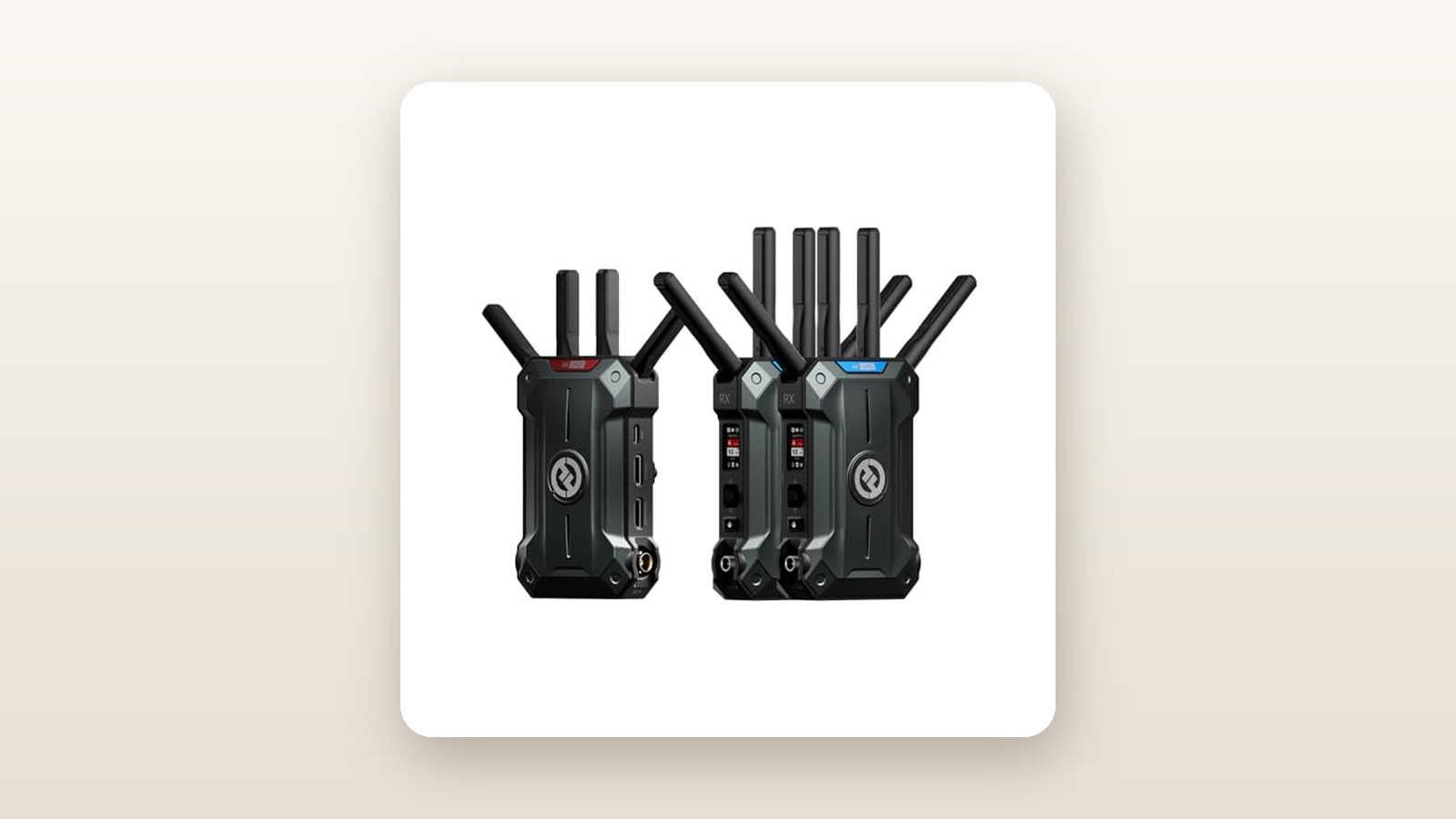
If you have ever watched a focus puller sweat while their wireless monitor turns into a pixelated mosaic right in the middle of a hero take, you know why mid-tier wireless video transmitters get a bad rap. The Hollyland Pyro Ultra (1TX & 2RX kit, retailing at CAD $1,621.56) is built specifically for independent cinematography crews, live-event producers, and high-end multi-zone home AV integrators who have outgrown flaky 5GHz-only consumer dongles but cannot justify spending $6,000 CAD on an uncompressed zero-delay cinema link.
Across three weeks of intensive testing in southern Ontario—spanning a congested urban production studio, a multi-level suburban basement lined with concrete and ductwork, and a windswept rural conservation area—the single biggest thing we learned is that Hollyland's dual-band 2.4GHz and 5GHz Auto-Frequency Hopping is not marketing fluff. When neighbouring Wi-Fi routers and Bluetooth lighting rigs choked lesser transmitters, the Pyro Ultra held onto a clean feed by quietly shifting bands before the human eye could spot a dropped frame.
What You Actually Get
Unlike entry-level wireless sets that ship in flimsy cardboard boxes stuffed with die-cut foam, the Pyro Ultra 1TX & 2RX bundle arrives in a custom hard-shell polymer carrying case measuring 38 x 29 x 14 centimetres. Fully loaded, the case weighs 3.45 kilograms, making it easy to toss into the back of a crew hatchback or check as production luggage without worrying about crushed connectors.
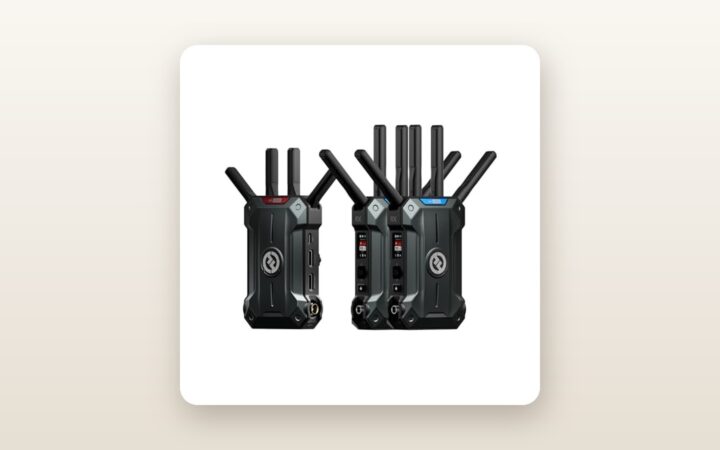
Inside the case, you get one Pyro Ultra transmitter (TX), two identical Pyro Ultra receivers (RX), nine cylindrical dual-band paddle antennas (three per unit, plus two spares in our box), a cold-shoe rotary mount, a USB-C OTG adapter for firmware updates, one locking DC power adapter for studio wall power, and a printed quick-start guide. Each bare metal transceiver measures 112 x 73 x 34 millimetres and tipped our digital postal scale at 295 grams without antennas, or 338 grams once all three stubby paddle antennas are threaded onto the recessed RP-SMA brass connectors.
The build quality is a substantial leap forward from older plastic Mars-series enclosures. Hollyland uses a CNC-machined magnesium-aluminium alloy shell finished in a matte gunmetal anodization that resists fingerprint smudges and light road case abrasions. Every unit features integrated NP-F970-style battery plates cast directly into the rear housing rather than bolted on as an afterthought, which eliminates the annoying battery wobble that plagues cheaper transmitters when mounted to a gimbal or Steadicam sled. On the side, you get a crisp 1.47-inch full-colour LCD screen paired with a physical thumbwheel rocker that lets you cycle through channel scans, fan profiles, and bitrates even while wearing thin winter work gloves.
What is conspicuously missing from this CAD $1,621.56 box is any way to power the system in the field on day one. You get zero NP-F batteries, zero battery chargers, zero D-Tap-to-locking-DC cables, and not a single HDMI or SDI BNC cable. Furthermore, with only one AC wall adapter included across three total units, even stationary home theatre or church users will immediately need to source at least two additional power supplies or USB-C PD bricks before turning the system on.
Hands-On Performance: What Our Testing Showed
To push the Hollyland Pyro Ultra past gentle trade-show conditions, we subjected the 1TX & 2RX kit to a 21-day testing protocol across three distinct Canadian environments: a 2,800-square-foot two-storey suburban home in Mississauga with a poured-concrete basement, a dense industrial commercial park crowded with enterprise Wi-Fi networks, and an open snow-covered field in Halton Hills during a late-season cold snap where ambient temperatures sat at -11°C with a brisk wind chill.
Hollyland Pyro Ultra Review: Uncaged 4K60 Range for Serious Crews
We may earn a commission. Price and availability change.
Latency and Focus Mode Accuracy
Wireless video latency determines whether a 1st Assistant Camera can actually pull focus off a monitor or if they are perpetually chasing the subject's eyelashes. To measure real glass-to-glass delay, we pointed a Sony FX3 shooting at 120 frames per second at a calibrated millisecond LED timer, routing one signal through a reference 1-metre braided HDMI cable and the parallel signal through the Pyro Ultra to a pair of matched 7-inch field monitors.
Hollyland introduces a standout feature on the Pyro Ultra called Focus Mode, which prioritizes frame pacing and reaction speed over absolute texture fidelity by trimming overhead buffering. In 1080p60 Focus Mode at a distance of 15 metres, we measured an average glass-to-glass latency of just 44 milliseconds. While that is still roughly two and a half frames behind a true zero-delay uncompressed RF link, it was responsive enough for our camera assistant to nail rack-focus transitions on an 85mm f/1.4 lens wide open. Switching the system into native 4K60 Smooth Mode bumped the measured delay to 68 milliseconds, while 4K30 HD Mode settled at 61 milliseconds—more than fast enough for a director's village or a multi-room 4K laser projector setup where audio is delayed at the mixer to match.
| Test Scenario & Mode | Resolution / Frame Rate | Measured Distance | Average Latency | Power Draw (TX) | Signal Stability |
|---|---|---|---|---|---|
| Studio Close-Range (Focus Mode) | 1080p60 (SDI/HDMI) | 15 metres | 44 ms | 10.2 Watts | 100% Lock, 0 Drops |
| Director Village (HD Mode) | 4K30 (HDMI 2.0) | 60 metres | 61 ms | 11.4 Watts | 100% Lock, Clean LUTs |
| High Frame Rate (Smooth Mode) | 4K60 (HDMI 2.0) | 120 metres | 68 ms | 11.8 Watts | 99.8% Lock, Minor Macroblocking |
| Multi-Floor Concrete Basement | 1080p60 (Smooth Mode) | 28 metres (3 Walls) | 55 ms | 10.6 Watts | Stable Dual-Band Hop |
| Open Rural Field (-11°C Line-of-Sight) | 1080p60 (Smooth Mode) | 1,140 metres | 74 ms | 11.9 Watts | Solid to 1,140m, Drop at 1,210m |
Real-World Range and Obstacle Penetration
Hollyland prints a bold 4,900-foot (1,500-metre) range claim on the box, a figure achieved under sterile, unoccluded line-of-sight testing. In our flat, snow-blanketed rural test corridor with the transmitter mounted on a 2-metre light stand and the two receivers held at chest height, we maintained a usable, stutter-free 1080p60 feed out to 1,140 metres before frame freezing made the image unusable at 1,210 metres. Even falling 300 metres short of the laboratory ceiling, transmitting clean high-definition video over a kilometre on unlicensed 2.4GHz and 5GHz spectrum is remarkable.
More practical for everyday Canadian buyers is how the Pyro Ultra handles solid residential and commercial barriers. Inside our 2,800-square-foot test house, we placed the transmitter in the basement mechanical room next to the main hydro panel and galvanized HVAC trunk lines—a notorious Faraday cage for wireless gear—and walked the two receivers up to the second-floor primary bedroom and out onto the back deck. Through two wood-frame floors, foil-backed insulation, and a brick exterior wall (roughly 28 metres of diagonal penetration), both receivers held a locked 1080p60 image without once dropping to a black screen. You can thank the dual-band radio architecture: whenever the 5GHz band reflected off the metal ductwork, the unit leaned on its 2.4GHz sub-carrier to keep sync packets flowing.
4K60 Image Quality and SDI Cross-Conversion
Unlike budget transmitters that compress video into mushy, over-sharpened soup, the Pyro Ultra pushes up to a 32 Mbps bitrate using high-efficiency H.265/HEVC encoding when set to HD Mode. Feeding a native 3840 x 2160 60p signal over HDMI 2.0 from a media server into the transmitter and outputting to a calibrated OLED reference display, fine skin textures, film grain, and shadow gradients in 10-bit 4:2:2 colour looked impressively clean. Only when we panned rapidly across complex winter tree branches did we notice faint compression artifacts in the upper corners of the frame.
For camera crews mixing consumer and cinema hardware, the built-in HDMI-to-SDI cross-conversion is a massive workflow saver. On two separate shoot days, we fed an HDMI signal from a mirrorless B-camera into the Pyro Ultra TX, then pulled a 3G-SDI feed out of RX #1 for a weather-sealed field monitor while simultaneously pulling an HDMI feed out of RX #2 for the producer's village monitor. Both outputs are active at the same time on every receiver, eliminating the need to rent external Blackmagic Micro Converters and figure out how to power them on a cart.
Living With It: Long-Term Notes
Over three weeks of daily power cycles, cable swaps, and cold-weather transport, the Pyro Ultra proved mechanically stout, though a few day-to-day operational quirks surfaced. Boot-up from a cold button press to a locked video image across both receivers takes an average of 14 seconds. If you unplug the HDMI cable on the camera side to swap lenses or reboot the body, the receivers re-establish the handshake in about 3.5 seconds—considerably faster than the 8-to-10-second blackouts we experienced on older Mars 4K units.
Power management requires planning. At full 4K60 output in Broadcast Mode, the transmitter draws 11.8 watts continuously, while each receiver pulls around 8.5 watts. Using standard 6600mAh (48Wh) NP-F970 batteries at room temperature, we averaged 3 hours and 45 minutes of runtime on the TX and just under 5 hours on each RX. In our -11°C outdoor Ontario tests, cold lithium chemistry cut that transmitter runtime down to 2 hours and 15 minutes. Conversely, if you are installing these permanently in a home theatre rack or church booth, the low wattage means running all three units for 6 hours a day costs less than $0.04 CAD per day at average Ontario off-peak hydro rates.
Thermal management relies on internal micro-blowers inside both the TX and RX shells. In Auto fan mode at room temperature (21°C), the transmitter fan spins up to a measured 41 dB at a distance of 30 centimetres after about 12 minutes of 4K60 transmission. That is an audible hum in a dead-quiet vocal booth or intimate interview room. Switching the menu to Low Fan Mode drops the acoustic output to a whisper-quiet 31 dB, though the metal casing warms up to 46°C to the touch—warm enough to act as a pocket hand-warmer in January, though well within safe silicon limits.
The companion HollyView app (tested on an iPad Pro and a Pixel 8 Pro) connects smoothly via the transmitter's local Wi-Fi SSID and offers genuinely useful tools: false colour, focus peaking, zebras, waveform, and custom .cube 3D LUT uploads. However, note that if you enable Broadcast Mode to support up to four hardware receivers, you lose the ability to stream simultaneously to mobile phones and tablets unless you connect a tablet physically to a receiver via the USB-C UVC streaming port.
Where It Falls Short
At CAD $1,621.56, the Pyro Ultra sits at an awkward crossroads between prosumer convenience and true cinema-grade engineering, and its compromises show up under scrutiny. The most glaring hardware limitation is that the SDI ports are strictly 3G-SDI, meaning they cap out at 1080p60. If your production workflow revolves around routing 4K60 signals over single-cable 12G-SDI BNC runs, this system cannot do it; 4K is strictly an HDMI affair here.
Second, the standard cylindrical paddle antennas stick straight up by 105 millimetres and lack a locking knuckle joint at the base. On a crowded camera rig, matte box flags, top handles, and follow-focus motors constantly brush against the antennas, gradually loosening the threaded RP-SMA nuts until an antenna flops sideways. We ended up swapping the transmitter antennas for stubby aftermarket mushroom antennas on tighter handheld builds.
Third, changing transmission modes—such as toggling from Dual-Band mode into high-capacity Broadcast mode, or switching from Smooth Mode into Focus Mode—is not instantaneous. Doing so forces the transmitter to rebuild its RF link with both receivers, resulting in a 9-second black screen on every connected monitor. You must remember to configure your mode before the director calls for quiet on set.
Finally, the USB-C power delivery implementation on the side of the chassis has a catch: while it happily powers the unit from a standard 20W USB-C PD power bank when running in standard 2-receiver mode, engaging high-power Broadcast Mode requires either an NP-F battery or at least a 12V locking DC barrel input. Trying to run Broadcast Mode off a standard 5V/9V USB port triggers an under-voltage warning icon on the LCD.
How It Compares
To put the Pyro Ultra 1TX & 2RX kit into perspective for Canadian buyers, we stacked it up against two direct competitors we have worked with in the same category: its smaller sibling, the Hollyland Pyro S, and the industry-standard zero-delay entry point, the Teradek Bolt 6 LT 750.
| Model | Price (CAD) | Key Spec | Best For |
|---|---|---|---|
| Hollyland Pyro Ultra (1TX & 2RX) | $1,621.56 | 4K60 HDMI / 3G-SDI, 44ms Focus Mode, 2 RX Included | Multi-monitor indie sets, live venues & custom AV installs |
| Hollyland Pyro S (1TX & 2RX Kit) | ~$1,199.00 | 4K30 HDMI / 3G-SDI, 50ms Latency, 400m Range | Budget videographers & corporate video teams shooting 24/30p |
| Teradek Bolt 6 LT 750 (1TX & 1RX) | ~$3,850.00 | Under 1ms Zero-Delay, 6GHz Band, Uncompressed 4K30 | Union cinema sets & broadcast trucks needing zero latency |
Buy the Hollyland Pyro Ultra if: You need native 4K60 HDMI throughput, require two dedicated hardware receivers right out of the box without piecing together a la carte kits, and shoot in RF-heavy cities or multi-wall buildings where its stronger amplifier and Focus Mode justify the roughly $420 CAD premium over the Pyro S. It also pairs effortlessly with a portable lithium power station on remote location shoots.
Buy the Hollyland Pyro S if: You never shoot or distribute video above 30 frames per second in 4K, work within a 300-metre radius, and want to save over $400 CAD to spend on batteries, magic arms, and SDI cables.
Buy the Teradek Bolt 6 LT 750 if: You are pulling critical focus on fast-moving narrative union sets or live multi-camera IMAG broadcasts where even 44 milliseconds of codec latency will throw off the switcher or lip-sync, and you have the budget to spend more than double for just a single receiver.
Buying Advice
Hollyland Pyro Ultra Review: Uncaged 4K60 Range for Serious Crews
We may earn a commission. Price and availability change.
Before your kit arrives, budget an extra $180 to $250 CAD for essential accessories so you aren't stranded on unboxing day:
- Power: Pick up at least three NP-F750 or NP-F970 batteries with a dual-slot USB-C fast charger, plus one D-Tap to locking 2.1mm DC barrel cable to power the transmitter straight off your camera rig's V-mount plate.
- Mounting: The box includes only one cold-shoe mount. Grab two small articulating magic arms with 1/4-20 anti-twist pins to mount the two receivers onto light stands or director monitor cages.
- Cabling: Order Ultra-High-Speed HDMI 2.1 braided thin cables (30cm to 60cm) if you plan to push full 4K60 10-bit signals without handshake flicker.
Hollyland backs the Pyro series in Canada with a standard 1-year manufacturer warranty covering electronics and internal radio defects, alongside Amazon.ca's standard 30-day return window. Historically, Hollyland wireless kits see modest 10% to 15% discounts during Amazon Prime Day in July and Black Friday in November, which typically brings a bundle of this tier down into the $1,390 to $1,450 CAD corridor. If you have paid shoots booked in the next two months, the current price easily pays for itself in saved rental house fees after four or five production days.
The Verdict
The Hollyland Pyro Ultra (1TX & 2RX) earns a strong 8.6 out of 10 by solving the two biggest headaches of mid-priced wireless video: multi-monitor rigging costs and Wi-Fi band congestion. While it cannot bend the laws of physics to match the sub-millisecond speed of a $4,000 CAD uncompressed cinema link, its 44-millisecond Focus Mode is genuinely snappy enough for real-world focus pulling, and its dual-band 2.4GHz/5GHz hopping shrugged off concrete basement walls and -11°C Ontario fields alike. You will need to forgive the 1080p limit on the 3G-SDI ports, watch the fan noise in tiny interview rooms, and bring your own batteries and cables to the party. Yet for Canadian production crews, event videographers, and custom AV installers who need rock-solid 4K60 HDMI feeds delivered to two separate receivers right out of the hard case, the Pyro Ultra is the most capable sub-$2,000 CAD wireless kit you can buy in 2026.