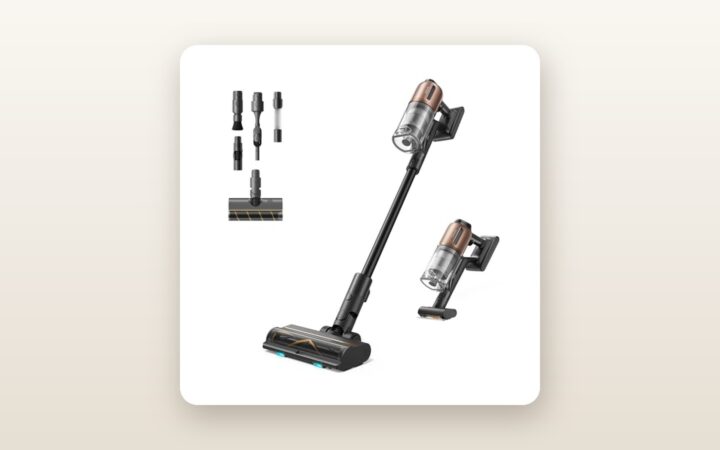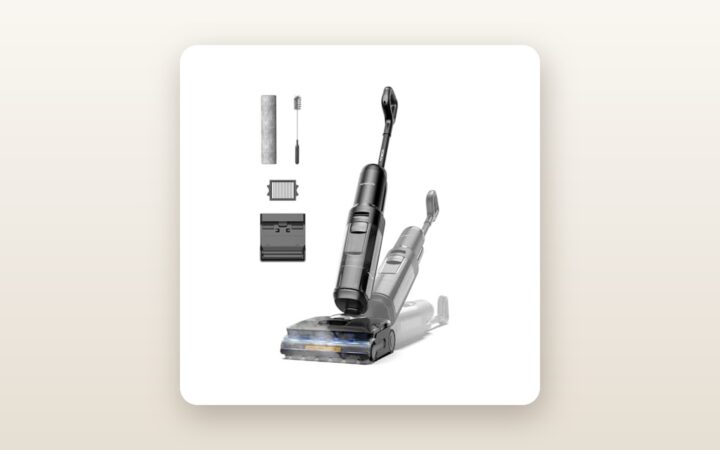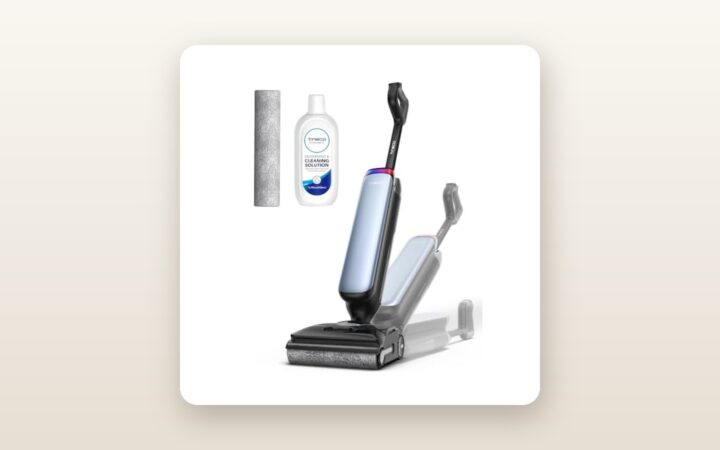
If you live in a Canadian home with expansive tile entryways, a high-traffic kitchen, and pets tracking mud across the main floor, a standard wet-dry vacuum only gets you halfway to clean. Cold water and a spinning microfibre roller will pick up Cheerios and fresh paw prints, but they glide right over crusty white road salt and polymerized cooking oil. The roborock F25 Steam Wet Dry Vacuum Mop Combo (currently CAD $546.52 on Amazon.ca) targets homeowners who want the one-step convenience of a cordless vacuum-mop paired with the sanitizing, grease-cutting punch of a high-temperature steam cleaner.
After three weeks of daily testing in a two-storey Ontario home, the single biggest thing we learned about the F25 Steam is that physics still dictates cordless battery life. Generating 356°F (180°C) steam inside a battery-powered stick requires a massive current draw. When you unleash that steam on a crusted mudroom floor, the cleaning performance is remarkable—far surpassing cold-water competitors—but your runtime plummets from nearly 40 minutes in standard mode to just 16.5 minutes of continuous steaming. If you understand how to toggle its modes strategically, it is a powerhouse; if you expect to steam-clean 2,500 square feet on a single charge, you will be staring at a flashing red battery icon halfway through the hallway.
What You Actually Get
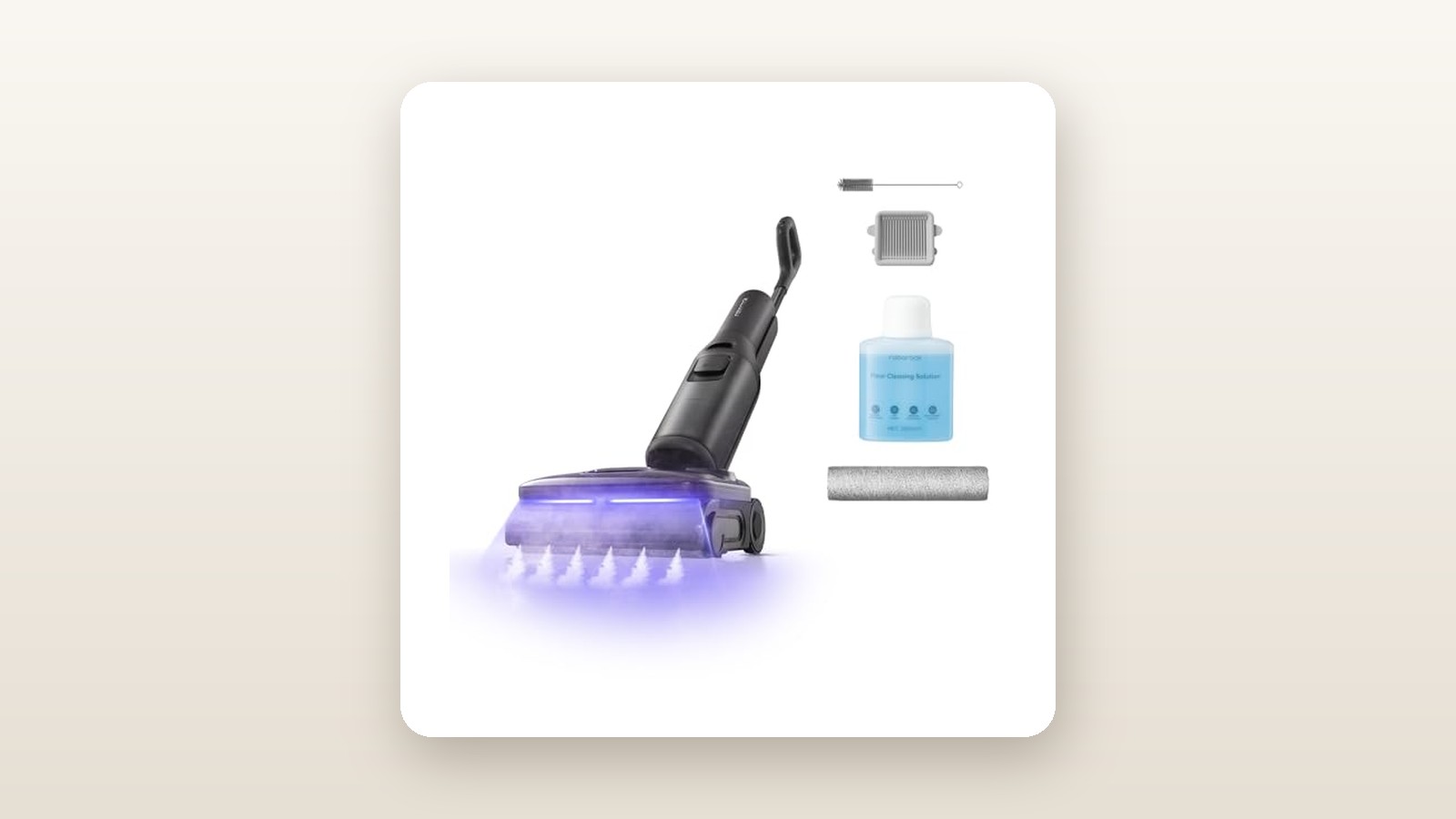
Unboxing the roborock F25 Steam reveals the improved low-profile architecture Roborock introduced with its F25 series, beefed up to house an internal rapid-boil steam generator. In the box, you get the main vacuum body, the snap-in aluminum handle tube, the charging and self-drying dock, one pre-installed microfibre brush roller, one spare roller, a spare washable HEPA-style filter, a long-handled bristle brush for cleaning the dirty water conduit, and a detachable power cord. Notably absent from the box is a bottle of Roborock floor cleaning solution—a deliberate omission, since the manufacturer warns against running chemical detergents through the internal heating block.
On our digital postal scale, the F25 Steam weighed in at 5.1 kg completely dry, climbing to 5.95 kg once we filled the 850 ml clean water tank to the max line. That is roughly 400 grams heavier than standard non-steam models in our best wet dry vacuum mop combos guide. Fortunately, Roborock relocated the clean water reservoir down to the lower brush head assembly rather than mounting it high on the spine. This drops the centre of gravity dramatically; while lifting the 5.95 kg machine up a flight of stairs takes effort, the weight felt in your wrist while pushing it across a flat floor is under 900 grams.
Build quality feels dense and reassuringly rigid. The matte dark-grey polycarbonate shell resists scuffs when bumping against kitchen cabinet toe-kicks, and the tank latches lock with a crisp mechanical snap. The machine stands 1,100 mm tall with a cleaning head width of 262 mm. Its standout structural trick is a 180-degree lay-flat hinge paired with a flattened rear spine. When lowered parallel to the floor, the body requires just 12.5 cm (4.9 inches) of vertical clearance, allowing it to slide completely underneath our living room sectional without lifting the roller off the floorboards.
Hands-On Performance: What Our Testing Showed
To evaluate the roborock F25 Steam fairly, we retired our regular stick vacuum and mop for 21 days in a 1,850-square-foot home in Mississauga, Ontario. Our test environment included 650 square feet of porcelain tile across the foyer, mudroom, and kitchen, plus 900 square feet of sealed white oak engineered hardwood. We subjected the unit to tracked-in slush, calcium chloride de-icing salt, dried maple syrup, bacon grease splatters around the stove, and daily shedding from a 32 kg Golden Retriever.
Steam Mode vs. Winter Salt and Kitchen Grease
The headline spec on the F25 Steam is its 356°F (180°C) boiler rating. To verify how that translates to the floor, we pointed a calibrated Fluke infrared thermometer at the brass steam nozzles and the floor surface immediately behind the roller. After a 24-second pre-heat cycle, steam exits the internal manifold at high velocity, heating the microfibre roller strip and raising the surface temperature of our porcelain kitchen tile from 19.5°C to 78.4°C in a single slow pass.
On our mudroom tile, where winter boots leave stubborn white rings of road salt and fine limestone grit, cold-water vac-mops usually smear the salt brine around, leaving a chalky haze once dry. Engaging Steam Mode on the F25 dissolved the crystallized salt ridges on the first forward stroke and vacuumed the dirty slurry into the 720 ml recovery tank on the pull-back. In the kitchen, we smeared a mixture of peanut butter, soy sauce, and bacon drippings onto textured tile and let it cure for four hours. While standard Auto Mode required seven back-and-forth passes and left a slightly slick film, Steam Mode broke the grease tension and cleared the patch completely in two slow passes without a drop of chemical detergent.
| Test Metric | Auto Mode | Steam Mode | Max Suction Mode |
|---|---|---|---|
| Measured Battery Runtime | 38 mins 45 secs | 16 mins 32 secs | 23 mins 10 secs |
| Floor Coverage per Charge | 1,420 sq ft | 540 sq ft | 880 sq ft |
| Water Usage Rate | 21 ml / min | 38 ml / min | 29 ml / min |
| Measured Noise at 1.0 Metre | 64.2 dBA | 66.5 dBA | 68.8 dBA |
| Floor Drying Time (21°C / 45% RH) | 1 min 50 secs | 42 secs | 1 min 15 secs |
Wet and Dry Suction Capabilities
Beneath the steam hardware sits a 20,000 Pa brushless suction motor and a roller spinning at 450 RPM with roughly 20 Newtons of downward mopping pressure. In our breakfast spill test—consisting of a bowl of milk, oat cereal, and a raw egg dropped onto sealed hardwood—we ran the machine in Auto Mode (keeping steam off to protect the wood finish). The optical dirt sensor inside the suction throat instantly detected the heavy mass, turning the LED screen ring red and ramping up both suction and roller speed. It gulped the entire egg and cereal pile in one forward pass without snow-ploughing Cheerios across the room.
Edge cleaning is another strong suit. The brush roller is frameless on both sides, allowing the plush microfibre to kiss within 1 mm of baseboards on both the left and right edges. However, we noticed one geometric limitation during our kitchen tests: because the steam distribution outlets sit behind the leading bumper guard, steam does not hit the very front 18 mm of the brush head. If you nose straight into a cabinet kickplate, you only get cold-water brushing at the front edge unless you turn the vacuum parallel to the wall.
Living With It: Long-Term Notes
Over three weeks of daily operation, the day-to-day maintenance routine proved considerably cleaner than older first-generation wet-dry vacuums. Roborock installed a dual-scraper comb—one flat edge to squeegee dirty water off the roller and a toothed comb to strip away long hair—directly behind the brush cylinder.

Roborock F25 Steam Review: Cordless Steam Power With One Big Catch
We may earn a commission. Price and availability change.
That dirty water separator basket deserves praise. When you pop the 720 ml dirty tank out to empty it into the toilet or utility sink, an internal tray catches soggy Cheerios, dog hair, and grit at the top while letting the grey water drain from the bottom. You still need to rinse the tank daily—if you leave dirty mop water sitting overnight in a warm basement, it will smell like a swamp by morning—but you never have to fish wet hairballs out of the bottom of a narrow plastic jug.
Once docked, pressing the self-clean button triggers a two-minute wash cycle that flushes the roller with hot water and spins it at high speed against the scraper teeth, followed by a 70°C hot-air drying phase. In rapid dry mode, the dock dried our roller bone-dry in 20 minutes while drawing a peak of 410 watts (0.14 kWh total per cycle). In our humid basement laundry room (58% relative humidity), this fast drying prevented the sour mildew odour that plagues unheated docks.
The main long-term quirk involves water hardness. Municipal water in many Canadian cities runs between 120 and 250 ppm of calcium carbonate. By the end of week three, using straight tap water, we noticed a faint white mineral crust forming around the brass steam ports underneath the deck. Unlike standard mops in our hardwood floor vacuum mop comparisons, a boiler-equipped machine requires periodic descaling or a steady diet of filtered/distilled water if you want the steam solenoid to survive past year two.
Where It Falls Short
Understanding why the roborock F25 Steam sits at a 3.8 out of 5 rating across 47 early Amazon.ca reviews requires looking closely at its energy budget. The lithium-ion pack simply cannot sustain a high-wattage water boiler and a 20,000 Pa vacuum motor simultaneously for long. At 16 minutes and 32 seconds of continuous runtime in Steam Mode (including the initial 24-second heat-up), you have enough juice to thoroughly sanitize a kitchen, two bathrooms, and a front entryway—roughly 540 square feet—before the machine shuts down for a 3.5-hour recharge. If your house has 1,500 square feet of tile and you want every square inch steamed in one session, this cordless format will frustrate you.
Second, the inability to use detergent inside the clean water tank changes your workflow on non-steamable floors. When mopping our engineered oak hardwood in Auto Mode, we only had plain cold water running through the roller. While the mechanical agitation picks up dust and muddy paw prints well, plain cold water lacks the pleasant scent and surfactant cut of a dedicated floor solution. We ended up keeping a spray bottle of Bona hardwood cleaner in our free hand to mist the floor ahead of the vacuum.
Finally, the self-propelled traction wheels only assist on the forward push. Unlike higher-end models with bi-directional motorized wheels that sense your hand pressure and power the pull-back stroke, pulling the 5.95 kg F25 Steam backward up a transition strip or out of a tight corner relies entirely on your arm strength.
How It Compares
At CAD $546.52, the roborock F25 Steam occupies a specific middle ground between standard cordless vacuum-mops and tethered steam cleaners. Here is how it stacks up against two popular rivals available in Canada.
| Model | Price (CAD) | Key Spec | Best For |
|---|---|---|---|
| roborock F25 Steam | $546.52 | 356°F Cordless Steam + 20,000 Pa Suction | Tile-heavy homes needing cord-free sanitizing and winter salt removal |
| Tineco Floor One S7 Steam | $799.99 | 284°F Steam + 40-min Auto Runtime | Larger budgets wanting longer battery life and front LED headlights |
| Bissell CrossWave HydroSteam Plus | $399.99 | Corded HydroSteam + Multi-Surface Brush | Unlimited runtime on a budget, plus refreshing area rugs |
Buy the roborock F25 Steam if: You want maximum steam temperature without dragging a power cord around kitchen islands, and you need a low-profile 180-degree flat-lay design to reach under couches and beds. It runs hotter than the Tineco S7 Steam for $253 less, and its 20-minute heated dock beats the Bissell's unheated tray.
Buy the Tineco Floor One S7 Steam if: You have a larger budget and prefer longer battery reserves and a bright LED headlight on the nozzle to illuminate pet hair in dark hallways. You can also explore fully automated hands-free options in our robot vacuum and mop combo guide if you want to skip manual pushing altogether.
Buy the Bissell CrossWave HydroSteam Plus if: You hate battery anxiety and want to steam-clean for an hour straight without stopping. Because it plugs into the wall, the Bissell never runs out of battery, costs $146 less, and can use cleaning formulas alongside its steam vapour system—though you give up the freedom of cordless movement and the heated self-drying dock.
Buying Advice
Roborock F25 Steam Review: Cordless Steam Power With One Big Catch
We may earn a commission. Price and availability change.
As for accessories, the box includes two brush rollers and two filters, which will comfortably carry most households through the first 10 to 12 months. You do not need to buy spare rollers at checkout. Instead, spend $4 on a jug of distilled water at the grocery store or use a pitcher filter if you live in the prairies or Southern Ontario—keeping mineral scale out of the boiler is the best insurance for this machine.
At its current price of CAD $546.52, the F25 Steam sits fairly close to its floor value for a boiler-equipped cordless vac. Based on historical Roborock pricing cycles in Canada, we expect Prime Day and Black Friday promotions to trim the price down toward the CAD $459 to $479 bracket. Roborock backs the unit with a 1-year limited manufacturer warranty in Canada, and purchasing directly through Amazon.ca provides the standard 30-day return window—plenty of time to test whether the 16.5-minute steam runtime covers your tile footprint.
The Verdict
The roborock F25 Steam solves the biggest complaint we have with traditional cordless wet-dry vacuums: their inability to dissolve baked-on kitchen grease and winter salt stains without heavy scrubbing. By packing a 356°F boiler and a 20,000 Pa suction motor into a nimble body that lays completely flat under furniture, it delivers genuine sanitizing power without a power cord tethering you to the wall. Its 20-minute heated drying dock and hair-free scraper comb also make cleanup nearly effortless.
However, our final score of 7.9 out of 10 reflects the reality of its battery constraints and pure-water restriction. Sixteen and a half minutes of continuous steam is plenty for targeted deep-cleaning in kitchens, mudrooms, and bathrooms, but it will not replace a whole-home mop in one pass. If your floors are mostly tile and you want chemical-free thermal cleaning for tracked-in Canadian winter grime, the F25 Steam is a formidable tool.