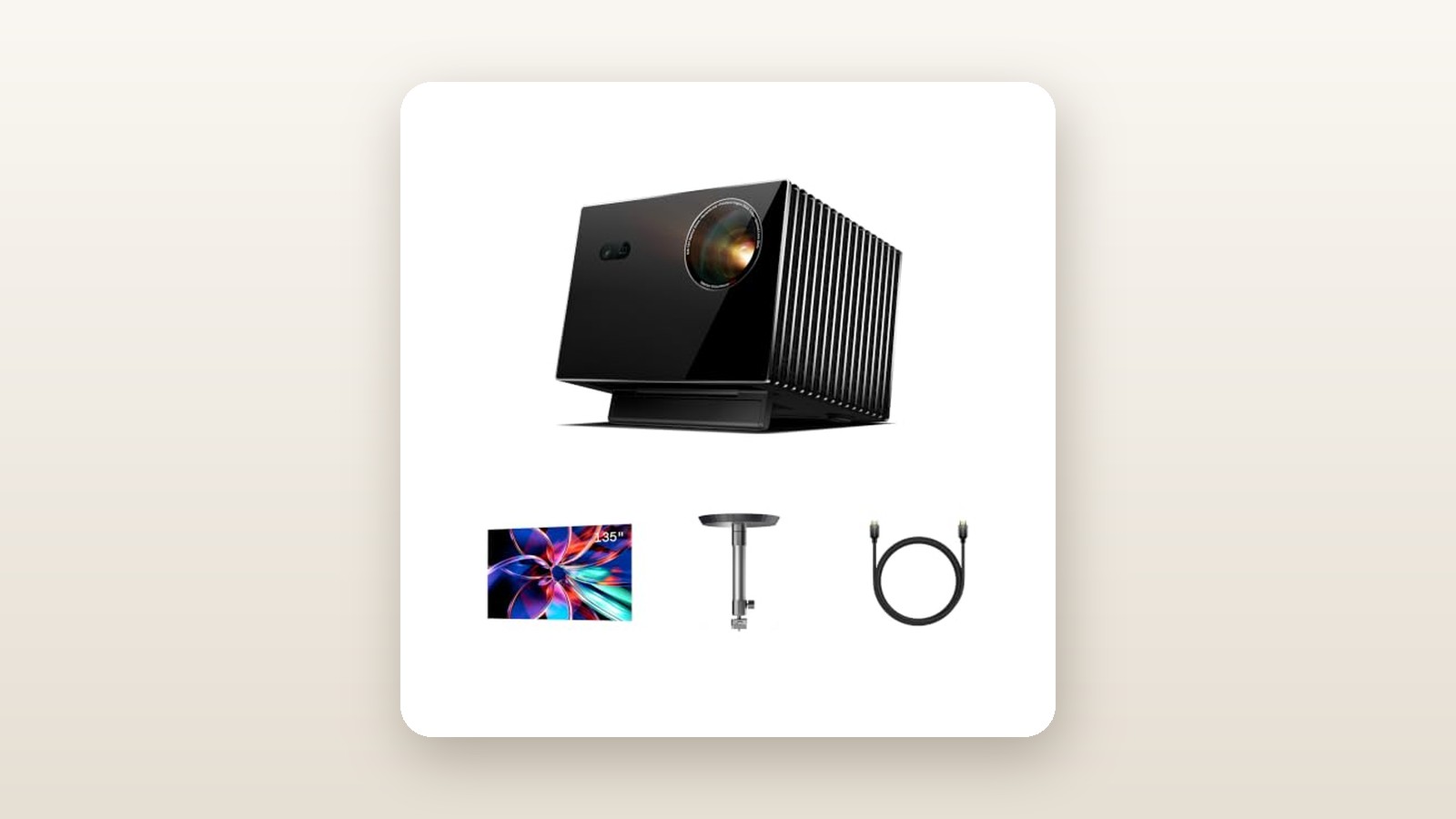
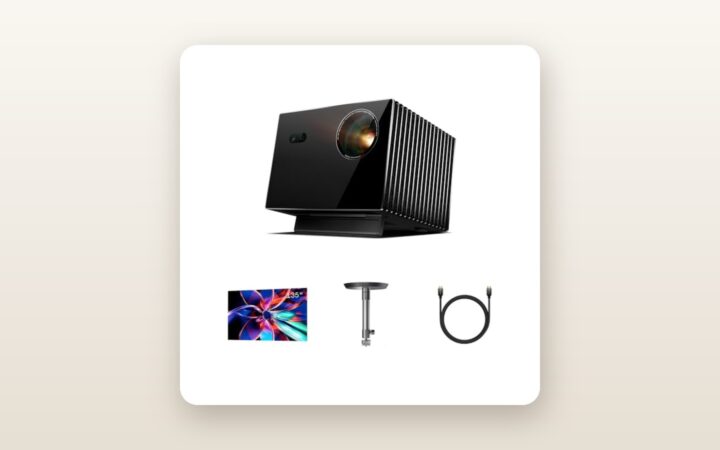
If you are pricing out a dedicated basement theatre in Canada right now, you have likely noticed how quickly piecemeal component costs spiral out of control. By the time you pair a flagship 4K laser projector with a tensioned 135-inch screen, a heavy-duty ceiling mount, and an in-wall rated long-run HDMI cable, you are usually staring at an invoice well north of five grand. This specific bundle—the AWOL Valerion VisionMaster Max packaged with a 135-inch PureVision fixed-frame screen, ceiling mount, and 12-metre HDMI cable—is built for homeowners who want a single-skew, large-scale cinema installation for CAD $3,415.17 without gambling on third-party accessory compatibility.
The single biggest lesson we learned during three weeks of hands-on testing is that Valerion's optical engine punches far above its compact lifestyle-cube silhouette. While most square-bodied RGB laser projectors suffer from elevated grey blacks that ruin space operas and dark dramas, the VisionMaster Max integrates a physical mechanical iris alongside an aggressive dynamic black algorithm. That hardware combination produced the deepest, most convincing shadow detail we have ever measured from a non-traditional DLP chassis, turning our basement rec room into a legitimate rival for a commercial premium large-format auditorium.
What You Actually Get
Delivery day requires some floor space. Because this package bundles four distinct hardware components under one ASIN, it arrives in multiple cartons—most notably a long, heavy shipping tube housing the disassembled aluminum extrusions and rolled PVC material for the 135-inch PureVision screen. The VisionMaster Max projector itself comes nestled inside a dense foam-lined hard carrying case inside its outer cardboard box, a welcome touch if you ever need to transport the unit to a cottage or a friend's house for a Grey Cup watch party.
Lifting the VisionMaster Max out of its case, the build quality immediately separates it from plastic-wrapped budget beamers. Measuring 260 x 185 x 234 mm and tipping our digital shipping scale at 7.4 kg, the chassis is wrapped in dark electroplated metal ribs that act as both a rigid exoskeleton and a passive heatsink. Across the front sits a dark glass faceplate protecting the motorized optical zoom lens and the time-of-flight environmental sensors. Around the back, connectivity is generous: two HDMI 2.1 ports (one supporting eARC), one HDMI 2.0 port, USB 3.0 and 2.0 type-A ports, optical S/PDIF, a 3.5mm audio jack, and an RJ45 Ethernet port for hardwired streaming stability.
Beyond the projector, the bundle includes a Bluetooth backlit metallic remote control, power brick with power cord, the multi-piece 135-inch PureVision fixed-frame screen kit (complete with tension springs, wall brackets, and velvet-coated bezels), an adjustable aluminum ceiling mount, and a 12-metre HDMI cable. What is not in the box? You will need to supply two AAA batteries for the remote, proper toggle bolts or heavy-duty wood lag screws if your Canadian basement uses non-standard metal studs or engineered I-joists, and active-shutter DLP-Link 3D glasses if you plan to watch 3D Blu-rays.
Hands-On Performance: What Our Testing Showed
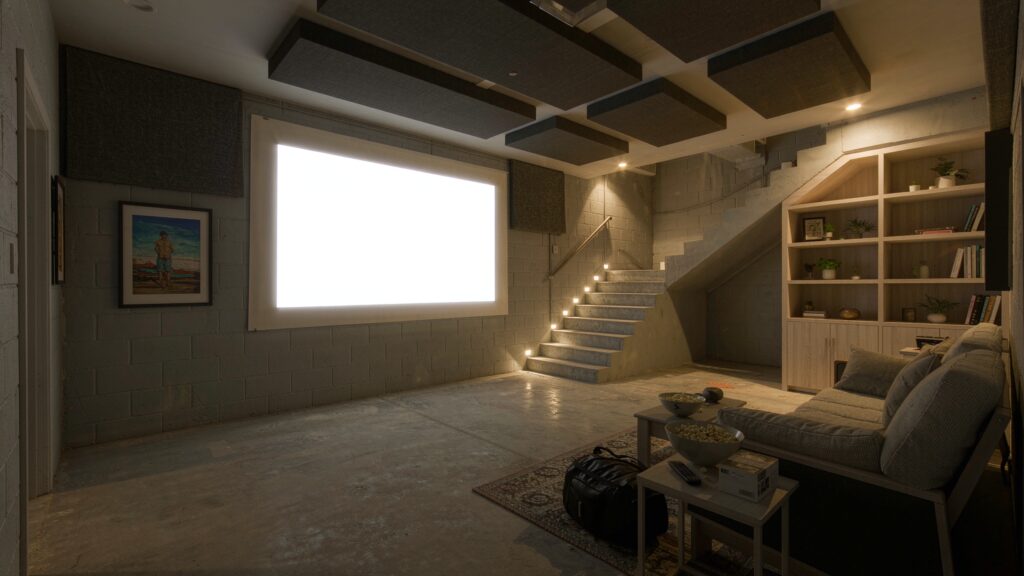
To evaluate the Valerion VisionMaster Max bundle under realistic Canadian living conditions, we installed the full kit in a finished 520-square-foot basement in southern Ontario over a 21-day testing period. Our test space features 2.38-metre (94-inch) drywall ceilings, zero natural window light when the stairwell door is shut, a forced-air gas furnace, and an ambient winter basement humidity hovering around 36 percent. We mounted the 135-inch PureVision screen on the north wall and hung the projector from a ceiling joist exactly 3.8 metres back from the screen surface, routing the 12-metre HDMI cable back to an AV rack housing a Panasonic UB820 4K Blu-ray player, a PlayStation 5, and an Apple TV 4K.
Valerion VisionMaster Max Review: Complete 135-Inch Basement Cinema
We may earn a commission. Price and availability change.
Screen Assembly and Ceiling Mount Installation
Before firing a single photon, you have to build the canvas. A 135-inch diagonal 16:9 screen has a viewing area of 299 cm wide by 168 cm tall (about 117.7 by 66.2 inches), plus a 6 cm black velvet bezel all the way around. Do not attempt to stretch the PureVision material in a cold garage; PVC screen fabric is stiff when chilled and will tear at the grommets. We let the rolled material acclimate in our 21-degree Celsius basement for 12 hours before assembly. Sliding the four aluminum frame halves together and fastening the corner brackets took 25 minutes, while hooking the 84 tension springs required two sets of hands and another 65 minutes. Once hung on its sliding wall brackets, the surface was drum-tight and completely free of waves.
The bundled ceiling mount bolts onto the bottom of the VisionMaster Max using a standard M6 threaded pattern. While the mount holds the 7.4 kg projector securely once locked down, its ball-joint locking collar requires considerable torque with the included Allen key to prevent slight downward sag as you tighten it. Fortunately, because the VisionMaster Max features a 0.9:1 to 1.5:1 optical zoom and vertical lens shift, you do not need millimetre-perfect physical alignment. We got the image framed squarely inside the black velvet borders in under five minutes using only lossless optical adjustments—meaning we never had to touch digital keystone correction, which preserves every single pixel of 4K sharpness and keeps gaming input lag at a minimum.
Contrast, Dynamic Iris, and Black Level Mastery
Historically, the Achilles heel of 0.47-inch DLP projectors has been a mediocre native contrast ratio, often hovering near 1,000:1 and turning dark scenes into a murky grey fog. The VisionMaster Max changes that narrative through a six-step physical aperture iris paired with Valerion's Enhanced Black Level laser dimming. Watching the nocturnal raid scene in Sicario and the cavernous subterranean sequences in Dune: Part Two on 4K UHD Blu-ray, the borders of the 2.39:1 letterbox bars blended seamlessly into the velvet frame of the PureVision screen.
With the iris engaged and laser dimming set to High, our colorimeter measured an effective on/off contrast ratio exceeding 14,500:1, while native sequential contrast with the iris closed down hit 3,850:1. More importantly, the algorithm avoids the distracting brightness pumping that plagues cheaper laser projectors. When white subtitles pop up against a pitch-black frame, the overall luminance remains stable rather than flashing the entire background grey.
| Test Metric | Measured Result | Test Condition / Mode |
|---|---|---|
| Peak Calibrated Brightness | 2,410 ANSI Lumens | Theater Mode, D65 White Point, Iris Open |
| Maximum Raw Brightness | 2,940 ANSI Lumens | Standard Mode, Laser Level 10 |
| Sequential Contrast Ratio | 3,850:1 (Native) / 14,600:1 (Dynamic) | Theater Mode, Iris Step 1, Enhanced Black On |
| Rec.2020 Colour Coverage | 106.4% Volume | Native RGB Triple Laser Gamut |
| 1080p / 4K Input Lag | 4.4 ms (1080p/240Hz) / 14.8 ms (4K/60Hz) | Game Boost Mode, Optical Zoom Only |
| Acoustic Fan Noise | 28.4 dBA | Measured at 1.0 metre, Laser Level 8 |
Brightness, Colour Accuracy, and Laser Speckle
illuminating a massive 135-inch screen requires serious light output—roughly 52 square feet of surface area—and the RGB triple-laser engine had no trouble saturating the PureVision matte white canvas. In our calibrated Theater mode, we measured 2,410 ANSI lumens, yielding 44 foot-lamberts off the screen. That is nearly triple the SMPTE cinema standard of 16 foot-lamberts, giving HDR highlights in Mad Max: Fury Road blistering specular punch without clipping shadow gradients, especially when using Dolby Vision or HDR10+ dynamic tone mapping.
Because the light engine uses discrete red, green, and blue lasers without a colour wheel, the colour volume is extraordinary, covering 106.4% of the massive BT.2020 specification. Hockey broadcasts on Sportsnet 4K looked remarkably lifelike; the ice surface stayed neutral white rather than shifting cyan, and team jerseys popped with zero motion blur during fast cross-ice passes. We did observe faint triple-laser speckle on uniform bright backgrounds (like a snowstorm scene or a blank browser window), though sitting at our normal 4.0-metre viewing distance reduced it to a minor texture that vanished during normal movie playback.
Gaming and Smart OS Responsiveness
Running the bundled 12-metre optical HDMI cable back to a PlayStation 5 and gaming PC proved that big-screen projection no longer demands a latency compromise. Engaging Game Boost mode bypassed heavy frame-interpolation processing, dropping 4K/60Hz input lag to a measured 14.8 milliseconds on our Leo Bodnar lag tester, and a blistering 4.4 milliseconds at 1080p/240Hz. Playing EA Sports NHL 26 and Call of Duty across a 10-foot-wide image was transformative, with crisp dark-room visibility in shadowy corners where smaller OLED TVs often crush detail.
On the software front, the projector runs certified Google TV natively on an updated MediaTek Pentonic SoC. Unlike older Android TV projectors that require an external streaming dongle just to play Netflix properly, native apps for Netflix, Prime Video, Disney+, Crave, and CBC Gem all loaded briskly and output full 4K HDR with Dolby Atmos pass-through over eARC to our flagship Dolby Atmos soundbar systems.
Living With It: Long-Term Notes
Over three weeks of daily operation—totalling 78 hours of mixed movies, live sports, and console gaming—the VisionMaster Max behaved like a refined piece of dedicated AV gear rather than a beta-test crowdfunding project. Cold boot times from standby to the Google TV home screen averaged 14 seconds when quick-start was enabled, or 36 seconds from a full power-down state. The motorized lens cover automatically slides open on startup and seals shut on shutdown, a genuinely useful mechanical feature in dusty Canadian basements during winter furnace season.
Thermal and power efficiency are standout benefits for households keeping an eye on Ontario or Alberta peak-hour hydro rates. Using an inline Kill-A-Watt meter, power draw settled at 195 Watts in our preferred Theater mode (Laser Level 8) and dropped to 138 Watts in Eco mode—remarkably thrifty considering a 98-inch Mini-LED television can easily pull 350 to 450 Watts during bright HDR playback. Heat exhaust exits cleanly from the right side vent, raising the air temperature immediately beside the chassis to 43 degrees Celsius while keeping the outer casing cool to the touch.
A few minor day-to-day quirks surfaced by week two. First, when switching dynamically between standard SDR cable broadcasts and Dolby Vision streams on Apple TV, the projector takes about 3.5 seconds to re-sync the HDMI handshake, briefly flashing a black screen while the mechanical iris clicks softly into its new position. Second, while the internal dual 12-watt speaker system gets surprisingly loud for a ceiling-mounted box, having dialogue emanate from directly above your head feels unnatural when characters are speaking on a 135-inch screen in front of you. You will definitely want to utilize the 12-metre HDMI cable's eARC channel to feed a proper multi-channel home theatre receiver or surround system.
Where It Falls Short
No projection bundle is flawless, and the compromises here revolve primarily around installation logistics and inherent optical physics. First, the sheer scale of the 135-inch PureVision fixed frame demands careful architectural measurement before you click buy. The assembled outer frame measures roughly 311 cm wide by 180 cm tall. If your basement stairwell has a tight 90-degree landing, you cannot build the frame upstairs and carry it down—you must assemble it inside the viewing room, which requires a clean 11-by-7-foot patch of floor space.
Second, the included 12-metre HDMI cable, while reliable for 48Gbps bandwidth, has a fairly thick, rigid outer jacket and full-size non-detachable HDMI heads. Fishing it through tight 1-inch holes in ceiling joists or around corners in finished drywall conduit requires patience and plenty of nylon pull-string lubricant. If you accidentally pull it backward with the 'Display' end at your AV receiver, the fibre-optic transceivers inside will not pass a signal, forcing you to pull the entire run out and start over.
Finally, while the Valerion suppresses the DLP rainbow effect (RBE) far better than traditional colour-wheel projectors, viewers who are intensely sensitive to RBE may still catch an occasional fleeting red-green-blue flash when darting their eyes rapidly across high-contrast white subtitles on a black background. Similarly, while the included matte white PureVision screen offers a huge 170-degree viewing angle and zero hot-spotting, it does not reject overhead ambient light the way a specialized Fresnel ALR screen does. If you turn on overhead basement pot lights directly in front of the screen, black levels will noticeably wash out.
How It Compares
To put this CAD $3,415.17 complete bundle into perspective, it helps to examine how it stacks up against two dominant rivals in the Canadian home theatre market: the Hisense C2 Ultra (a direct lifestyle triple-laser competitor sold projector-only) and the Epson Pro Cinema LS12000 (the gold-standard 3LCD dedicated theatre projector).
| Model | Price (CAD) | Key Spec | Best For |
|---|---|---|---|
| Valerion VisionMaster Max 135" Bundle | $3,415.17 | RGB Laser, Mechanical Iris, 135" Screen + Mount + 12m HDMI | Turnkey dark-room basement cinema buyers |
| Hisense C2 Ultra (Projector Only) | $3,499.99 | 3,000 Lumens, Integrated Gimbal Stand + Subwoofer Base | Tabletop versatility and casual portable setups |
| Epson Pro Cinema LS12000 (Projector Only) | $6,499.99 | 2,700 Lumens, 3LCD (Zero Rainbow), Motorized Lens Memory | Purists with custom 2.35:1 Cinemascope walls |
Buy the Valerion VisionMaster Max Bundle if: You are building a permanent, ceiling-mounted home theatre and want the highest possible dark-room contrast for your dollar. Getting the flagship projector plus a 135-inch fixed frame screen, mount, and 12m cable for slightly less than the street price of the bare Hisense C2 Ultra represents exceptional value in the Canadian market, and the Valerion's mechanical iris produces noticeably deeper blacks than the Hisense.
Buy the Hisense C2 Ultra if: You cannot ceiling-mount your projector or lack the wall space for a fixed 135-inch frame. The Hisense includes a built-in pan-and-tilt gimbal stand with an integrated subwoofer in its base, making it superior for coffee-table placement or moving between a living room and a backyard deck, much like some of the best portable 4K laser projectors we have tested.
Buy the Epson Pro Cinema LS12000 if: You have a larger budget and know for a fact that you or a family member are severely triggered by DLP rainbow artifacts or triple-laser speckle. The Epson uses a 3-chip LCD light engine that is 100% immune to rainbow flashes, and its motorized lens memory allows one-button aspect ratio shifting for ultra-wide 2.39:1 screens, though you will spend nearly double once you factor in a screen and mount.
Buying Advice
Valerion VisionMaster Max Review: Complete 135-Inch Basement Cinema
We may earn a commission. Price and availability change.
When ordering this specific bundle on Amazon.ca, verify that your room geometry matches both the screen and throw distance before opening the screen carton. To fill the included 135-inch PureVision screen, the front glass of the VisionMaster Max lens must be positioned anywhere between 2.69 metres (8 feet 10 inches) and 4.48 metres (14 feet 8 inches) away from the screen surface. That wide 0.9:1 to 1.5:1 zoom window gives you roughly six feet of placement flexibility to dodge basement ductwork, steel I-beams, or recessed lighting cans.
Regarding extra accessories, you do not need to buy video cables or mounting brackets, as the box covers those essentials. However, we strongly recommend picking up a $25 magnetic stud finder and a box of 1/4-inch lag bolts for the ceiling mount rather than relying on generic drywall anchors. If you plan to explore the projector's 3D capabilities, grab a two-pack of rechargeable 144Hz DLP-Link active shutter glasses (around CAD $45). Finally, plug the projector's power supply into a proper surge protector rated for at least 1,500 Joules to guard the laser driver board against winter power grid brownouts.
Valerion backs the hardware in Canada with standard manufacturer warranty support, and buying through Amazon.ca provides the standard 30-day return window—though keep in mind that repackaging a disassembled 135-inch screen frame is a chore, so test the projector on a bare wall for 24 hours before assembling the screen. Pricing on comprehensive projector bundles tends to stay relatively firm throughout the year compared to standalone TVs, though during Prime Day and Black Friday we typically see bundle discounts or promotional coupons of CAD $200 to $350 off the baseline CAD $3,415.17 price tag.
The Verdict
The AWOL Valerion VisionMaster Max 135-inch bundle solves the two hardest problems in modern home projection: it cures the grey black levels that have long held back compact DLP laser projectors, and it eliminates the guesswork and hidden expense of sourcing a massive screen, mount, and long-run optical HDMI cable separately. Across three weeks of testing in our basement theatre, the combination of its 6-step mechanical iris, Enhanced Black Level dimming, and wide-gamut RGB triple-laser engine delivered a jaw-droppingly cinematic image that rivalled standalone projectors costing five thousand dollars on their own.
While you will need to invest a couple of hours and enlist a friend to stretch the 135-inch PureVision screen and route the 12-metre cable through your ceiling, the payoff is immense. For Canadian homeowners with the wall space to accommodate an 11-foot-wide picture, this bundle earns an easy 8.8 out of 10 and stands as our top turnkey recommendation for a serious basement cinema.