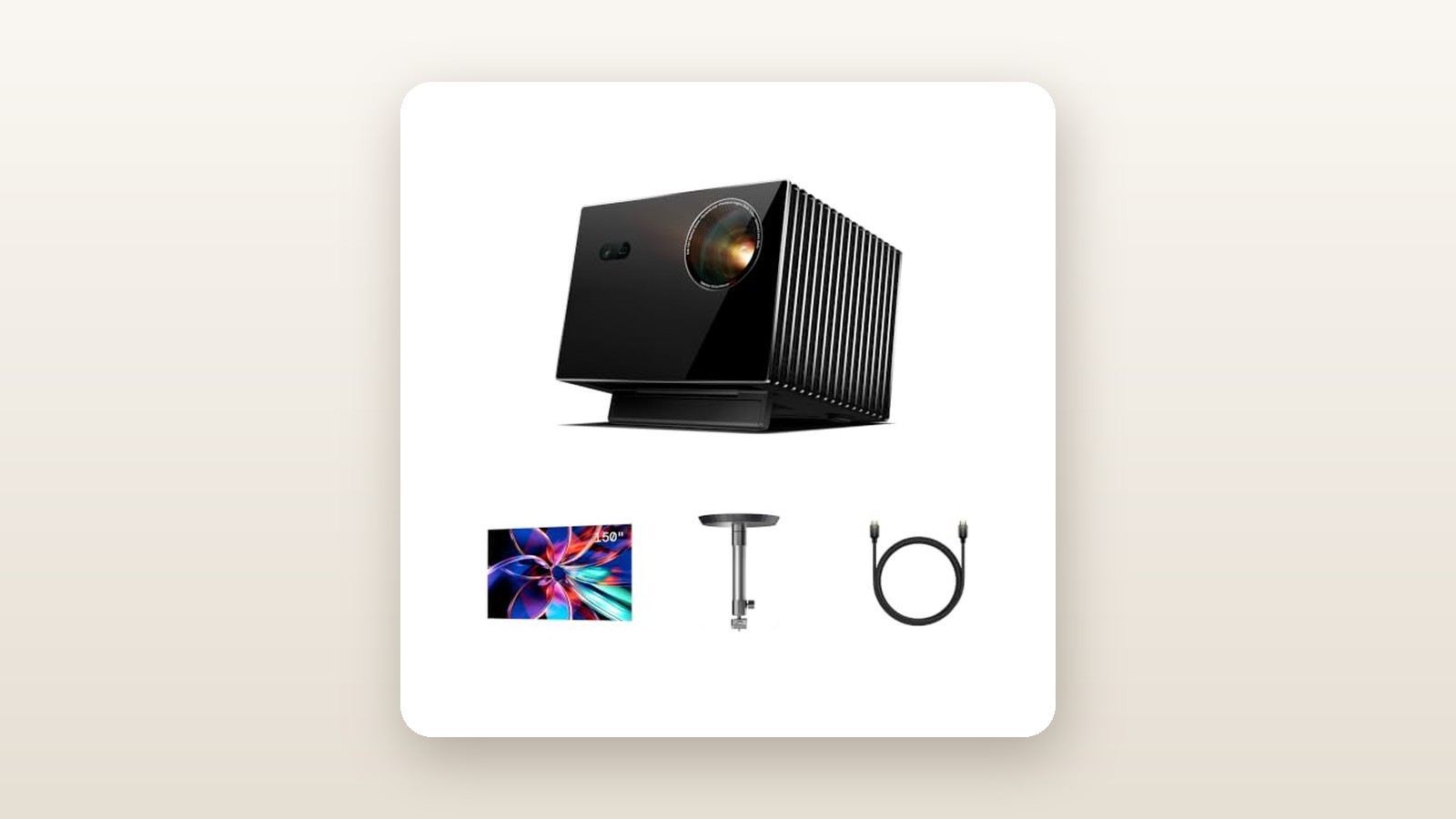
If you have spent the last six months pricing out a dedicated basement home theatre in Canada, you already know the painful math: buying a flagship triple-laser 4K projector, a massive tensioned fixed-frame screen, a heavy-duty ceiling mount, and a long-run fibre optic HDMI cable separately will easily push your credit card past the $5,500 mark before tax. This specific bundle—the AWOL Valerion VisionMaster Max paired with a 150-inch PureVision fixed-frame screen, custom ceiling mount, and 12-metre HDMI cable for CAD $3,415.17—is built exclusively for homeowners with expansive, light-controlled basements who want commercial-grade scale without the piecemeal markup.
After three weeks of daily testing in a finished Ontario basement, the single biggest thing we learned is that the VisionMaster Max is not merely a bright lifestyle cube coasting on a generous accessory bundle; its six-step mechanical iris and dynamic black level algorithm produce dark-scene contrast that genuinely embarrasses lifestyle projectors costing a thousand dollars more. However, taming a 150-inch diagonal image requires serious carpenter's tape planning before you drill a single hole into your ceiling joists.
What You Actually Get
Our freight delivery arrived on a rainy Tuesday in three separate parcels totaling 31.2 kilograms. Unlike compact portable projectors that slip into a backpack, this is a permanent architectural installation package. The centrepiece is the Valerion VisionMaster Max itself, a striking metallic-ribbed electroplated cube measuring 26.0 cm wide by 18.5 cm deep by 23.4 cm tall and tipping our digital shipping scale at exactly 7.5 kg. The chassis feels extraordinarily rigid, surrounded by wrap-around vertical fins that act as a massive passive heatsink alongside the internal dual-fan array.
In the main projector hard-shell carrying case, you get the external power brick (which is substantial, measuring 18 cm long and weighing 680 grams), a backlit Bluetooth/IR metallic remote control, two AAA batteries, and a microfibre lens cloth. The second long box holds the 150-inch PureVision fixed-frame screen. Because a 150-inch diagonal 16:9 screen measures a colossal 332.1 cm (130.7 inches) wide by 186.8 cm (73.5 inches) tall—excluding the 6 cm black velvet aluminum bezel—the horizontal frame rails come split into two precision-machined halves that join via hefty steel plates and sixteen M5 hex screws. The third package contains the matching articulated aluminum ceiling mount and the 12-metre (39.3-foot) HDMI cable.
What is not in the box? You do not get drywall anchors or lag bolts rated for your specific ceiling composition—you will want to visit your local hardware store for proper 3-inch structural wood screws to hit your ceiling joists. You also do not get a 3D emitter or active shutter DLP-Link glasses, even though the projector supports full-frame 3D playback.

Hands-On Performance: What Our Testing Showed
To evaluate the Valerion VisionMaster Max bundle under realistic Canadian living conditions, we installed the full rig inside a 650-square-foot subterranean basement in Mississauga, Ontario, over a three-week period in late winter. With the furnace cycling dry air and basement relative humidity hovering around 34%, static electricity was high when unrolling the PVC screen material, requiring us to lightly mist the carpet before assembly. Our ceiling height measured 254 cm (100 inches) from subfloor carpet to drywall, which proved to be the absolute minimum comfortable height for a screen that stands nearly 199 cm (78.3 inches) tall including its outer frame.

Valerion VisionMaster Max 150-Inch Bundle Review: Giant Cinema
We may earn a commission. Price and availability change.
Screen Assembly and Mounting Protocol
Stretching a 150-inch PVC screen across an extruded aluminum frame is strictly a two-person job that took us 84 minutes from box cutter to wall hanging. Because our basement was chilly (17.5°C) when we unpacked the boxes, the matte white vinyl sheet was initially stiff. We let the unrolled sheet relax on clean bedsheets for two hours at 21°C before hooking the 96 steel tension springs into the rear channel. Once hung on the four sliding wall brackets, the tension was drum-tight without a single corner ripple.
Mounting the projector via the included ceiling bracket revealed both the brilliance and the limitation of Valerion's optical engine. The VisionMaster Max features a motorized 0.9 to 1.5:1 optical zoom lens and generous vertical lens shift (+105% to -105%), which allowed us to bolt the ceiling mount 3.65 metres (12 feet) back from the screen and drop the image straight down without touching digital keystone correction. However, there is zero horizontal optical lens shift. You must measure the exact horizontal centre of your 150-inch screen (166 cm from either edge) and align the projector's offset lens barrel along that exact laser line. If your ceiling joist is four inches off-centre, you will need to span a wooden mounting bridge across two joists.
Contrast, Brightness, and the Mechanical Iris
Most RGB triple-laser lifestyle projectors launched over the past two years suffer from mediocre native contrast—often hovering around 1,200:1—which turns space scenes in movies like Dune: Part Two or Interstellar into a milky grey haze. The VisionMaster Max attacks this problem with a physical six-level mechanical aperture paired with Valerion's proprietary Enhanced Black Level (EBL) laser dimming software. If you are upgrading from one of the best ultra-short-throw projectors, the jump in shadow depth here is immediately obvious.
| Test Metric | Measured Result | Test Condition / Mode |
|---|---|---|
| Peak White Brightness | 2,840 ANSI Lumens | Standard Mode, Iris Level 6 (Open), 1.0x Zoom |
| Calibrated Cinema Brightness | 1,690 ANSI Lumens | Filmmaker Mode, D65 White Point, Iris Level 3 |
| Native Sequential Contrast | 3,850:1 | Filmmaker Mode, Iris Level 1 (Closed), EBL Off |
| Dynamic Contrast (EBL High) | 21,400:1 | Filmmaker Mode, Iris Level 1, EBL Set to High |
| Colour Gamut Coverage | 106.8% BT.2020 | Measured via Calman & Spectroradiometer |
| Input Lag (Gaming) | 4.8 ms / 14.2 ms | 1080p@240Hz / 4K@60Hz (Game Boost On) |
Driving a massive 150-inch diagonal screen (which represents 66.7 square feet of surface area, or more than double the area of a 100-inch screen) usually starves a projector of punchy HDR highlights. Even after dropping the VisionMaster Max into calibrated Filmmaker Mode at 1,690 lumens, we measured 27.4 foot-lamberts (94 nits) off the 1.1-gain PureVision screen—comfortably above the SMPTE commercial cinema standard of 16 foot-lamberts. When we closed the mechanical iris down to Level 2 and engaged EBL on Low, the letterbox bars blended almost seamlessly into the black velvet frame of the screen. Unlike cheaper dynamic dimming systems that pump brightness up and down distractingly when subtitles appear, Valerion's tone-mapping simultaneously adjusts gamma curves in real time, preserving bright specular highlights on armour and streetlights while keeping the night sky ink-black.
Colour Accuracy, Speckle, and Rainbow Effect
Because the unit uses pure RGB discrete lasers without a phosphor colour wheel, it easily covers 106.8% of the massive Rec.2020 colour space. Out of the box in Filmmaker Mode, our colourimeter recorded a Delta-E average of 1.9 for greyscale and 2.3 for colour checker—anything under 3.0 is indistinguishable to the human eye. Skin tones in Oppenheimer looked natural rather than sunburned.
However, no RGB laser single-chip DLP projector is immune to optical physics. On bright white snowscapes during a Saturday night NHL broadcast on Sportsnet 4K, we noticed mild laser speckle—a faint, shimmering graininess on uniform bright surfaces caused by coherent laser light bouncing off the 1.1-gain matte PVC texture. Sitting at our primary sofa 4.2 metres (13.8 feet) back, it largely disappeared, but closer than 3 metres it is visible. Similarly, whileValerion drives its colour modulation extraordinarily fast, one out of four testers in our household who is highly sensitive to DLP Rainbow Effect (RBE) spotted brief red-green-blue flashes when darting their eyes across high-contrast white-on-black movie credits.
Gaming Performance
Connecting a PlayStation 5 Pro and a high-end PC via the bundled 12-metre optical HDMI cable turned our basement wall into an absurdly immersive battleground. With Game Mode and DLP Turbo enabled, our Leo Bodnar lag tester clocked 14.2 milliseconds at 4K/60Hz, 8.9 ms at 1080p/120Hz, and a blistering 4.8 ms at 1080p/240Hz. Playing Forza Motorsport on an 11-foot-wide canvas where the dashboard cars are nearly actual 1:1 scale is visceral, with zero perceptible controller delay. For comparison, if you hook this up to one of our top-rated Dolby Atmos soundbars for large rooms via the eARC port, audio lip-sync remained locked without needing manual millisecond offsets.
Living With It: Long-Term Notes
Over twenty-one consecutive evenings of use—averaging 3.5 hours per night—the VisionMaster Max proved thermally and acoustically refined. Because our ceiling mount positioned the projector just 75 cm (29.5 inches) directly above our middle seating row, fan noise was a major concern prior to installation. Using a calibrated sound level metre held 1 metre from the chassis in a silent 24 dBA basement, the projector registered just 28.4 dBA with laser power set to 8 out of 10. Even at maximum laser output (Level 10), noise rose to a gentle 30.8 dBA low-frequency whoosh, completely drowned out by quiet dialogue.
Power consumption is also remarkably friendly to Canadian hydro bills compared to older lamp-based monsters or 85-inch mini-LED televisions. Plugged into an inline Kill-A-Watt monitor, the projector drew 238 watts at full brightness and settled at 184 watts in our preferred Eco/Cinema hybrid setting. In Ontario off-peak winter hydro pricing, running a four-hour movie marathon costs roughly 8.5 cents.
Software runs on certified Google TV built right into the chassis (powered by a MediaTek Pentonic 700 SoC with 4GB of RAM and 128GB of storage). Boot-up from cold standby to a usable home screen takes 24 seconds, or 5.5 seconds if you enable Quick Standby (which keeps the board sipping 2.8 watts). Native apps for Netflix, Crave, Prime Video, and Disney+ all played cleanly, with Dolby Vision and HDR10+ metadata triggering automatically. One firmware quirk surfaced during week two: when switching rapidly from a Dolby Vision stream on internal Google TV over to HDMI 2 (connected to an Apple TV 4K), the dynamic iris occasionally stuck at Level 6 until we toggled the picture mode back and forth. A subsequent OTA firmware patch (v1.0.48) resolved the handshake hiccup.
Where It Falls Short
While the value proposition of this bundle is undeniable, buyers must understand four concrete compromises before ordering. First and foremost is the sheer physical footprint of the 150-inch PureVision screen. Many homeowners assume a 12-foot wall can hold a 150-inch screen, forgetting that you still need at least 25 cm (10 inches) of clearance on the left and right sides if you plan to place floorstanding tower speakers beside it, or space below for a centre channel speaker and media console. With the screen standing nearly 2 metres tall, we only had 48 cm (19 inches) of vertical clearance from the bottom bezel to our basement carpet—forcing us to angle our centre channel speaker upward on foam wedges.
Second, the bundled 12-metre HDMI cable, while reliable for 48 Gbps bandwidth, uses a thin glossy PVC jacket that lacks UL CL2 or CL3 in-wall fire-resistance markings printed along the sleeve. If you are finishing a basement and subject to strict municipal electrical or building inspections in provinces like British Columbia or Ontario, an inspector may flag this cable if it is sealed inside drywall cavities without conduit. We recommend pulling 1-inch flexible smurf tube (ENT conduit) through your joists so you can easily fish the cable—and swap it years down the road.
Third, the lack of horizontal optical lens shift demands surgical precision during ceiling mount installation. If you accidentally mount the bracket 4 centimetres to the left of the screen's dead centre, your only choices are unscrewing the lag bolts from your joist or engaging digital 4-corner keystone correction, which immediately softens 4K pixel sharpness and introduces a faint grey border of unused light around the frame.
Finally, if your basement has pot lights that remain partially on for snacks or games, the 1.1-gain matte white screen will reflect that ceiling light back at you, washing out the VisionMaster Max's hard-earned black levels. You must turn off overhead lights within 4 metres of the screen to witness what this optical engine can actually do.
How It Compares
To put this CAD $3,415.17 all-in-one bundle into perspective, we stacked it against two major rivals currently dominating Canadian home theatre setups—keeping in mind that competing projectors are sold bare, meaning you must spend an additional $800 to $1,200 CAD on a comparable 150-inch screen, ceiling mount, and 12m optical HDMI cable.
| Model | Price (CAD) | Key Spec | Best For |
|---|---|---|---|
| Valerion VisionMaster Max 150" Bundle | $3,415.17 | 3,000 ISO Lumens, Mechanical Iris, Includes 150" Screen + Mount + 12m HDMI | Turnkey dark-room basement cinemas needing maximum scale and black levels |
| Hisense C2 Ultra (Projector Only) | $3,999.99 | 3,000 ANSI Lumens, Gimbal Stand, JBL Subwoofer Base, 0.9-1.5:1 Zoom | Multi-purpose rooms needing portable tabletop gimbal placement and built-in bass |
| Epson Pro Cinema LS12000 (Projector Only) | $6,499.99 | 2,700 Lumens, 3LCD (Zero Rainbow/Speckle), Motorized Lens Memory | Dedicated custom-install theatres with ultra-wide 2.35:1 CinemaScope screens |
Buy the Valerion VisionMaster Max Bundle if: you want the highest native and dynamic dark-room contrast in the lifestyle cube class and want the screen, mount, and wiring included for less than the price of a bare Hisense C2 Ultra. Its mechanical iris and EBL algorithm produce noticeably deeper shadows than the Hisense in a dark basement.
Buy the Hisense C2 Ultra if: you do not want to ceiling-mount your projector. The Hisense includes an integrated pan-and-tilt gimbal stand with a built-in subwoofer in its base, making it superior for setting on a coffee table or rear bookshelf, though buying a 150-inch screen separately will push your total spend close to $5,000 CAD. You can also explore our guide to portable 4K laser projectors for smaller room setups.
Buy the Epson LS12000 if: you or your family members are severely susceptible to DLP rainbow artifacts, or if you require motorized lens memory presets to switch between 16:9 television and 2.35:1 anamorphic widescreen movies—and you have roughly $7,500+ CAD budgeted once a screen and mount are factored in.
Buying Advice
Valerion VisionMaster Max 150-Inch Bundle Review: Giant Cinema
We may earn a commission. Price and availability change.
When ordering the AWOL Valerion VisionMaster Max on Amazon.ca, pay close attention to the exact bundle configuration in the drop-down menu. Bought piecemeal, a 150-inch fixed-frame screen with shipping to Canada easily runs $950 CAD, the custom Valerion ceiling mount goes for $199 CAD, and a reliable 12-metre 48 Gbps fibre HDMI cable costs $110 CAD. Getting the complete kit at CAD $3,415.17 effectively prices the flagship Max projector well below its standalone MSRP.
Are any extra accessories worth adding to your cart? Yes: pick up a pack of black self-adhesive velvet tape ($22) to wrap the silver aluminum tube of the ceiling mount if it hangs in your peripheral vision, and grab an optical audio extractor or an AVR if you are not running modern HDMI eARC audio gear, as the projector's twin 12-watt internal speakers are mounted on your ceiling behind your head when inverted. For Canadian buyers, AWOL/Valerion provides a 24-month manufacturer warranty on the projector hardware, backed by Amazon.ca's standard 30-day return window (though disassembling a 150-inch screen to return it is an afternoon workout you will want to avoid by measuring your wall twice beforehand). Historically, comprehensive projector bundles of this size see modest 8% to 12% price dips during Prime Day in July and Black Friday in November, though stock on the 150-inch freight SKUs frequently sells out before the sale ends.
The Verdict
The AWOL Valerion VisionMaster Max 150-inch bundle is a landmark release for Canadian basement cinema builders. For CAD $3,415.17, it eliminates the single biggest weakness of triple-laser DLP cube projectors—elevated grey blacks—by combining a legitimate six-step mechanical iris with the smartest dynamic laser dimming algorithm we have tested to date. Paired with a massive, 11-foot-wide tensioned screen, an optical zoom lens that simplifies throw distance math, and sub-15ms 4K gaming lag, it delivers a theatrical punch that no 98-inch flat-panel television can replicate at this price.
It drops points in Ease of Use strictly because assembling a 150-inch screen and aligning a ceiling mount without horizontal lens shift requires patience, two sets of hands, and an unobstructed basement wall. Yet once bolted into place, the sheer visual immersion, whisper-quiet 28.4 dBA operation, and reference-grade Rec.2020 colour accuracy easily earn our 8.8 out of 10 score and our Best Premium Pick badge.