If you have tried to build a serious home theatre in a Canadian basement over the last five years, you have faced a frustrating compromise. Traditional bulb or laser projectors from legacy brands like Epson, Sony, and JVC deliver breathtaking contrast and deep black levels, but they weigh 15 kilograms, require complex ceiling mounts, and look like industrial cooling units. Meanwhile, the newer wave of compact 'lifestyle' cube projectors offer gorgeous industrial design, built-in smart apps, and punchy triple-laser brightness, yet their black levels usually look like washed-out charcoal grey whenever a night scene appears on screen. The Valerion VisionMaster Max is engineered specifically for the buyer caught in the middle: the discerning movie lover who demands genuine flagship dark-room performance inside a compact, self-contained chassis.
After putting our review unit through three weeks of daily testing in a 420-square-foot finished basement in southern Ontario, the single biggest takeaway is that Valerion's dynamic iris and Enhanced Black Level (EBL) algorithms are not marketing fluff. This is the first lifestyle cube projector we have ever tested that genuinely challenges dedicated home theatre machines in dark scenes, while simultaneously solving the dreaded DLP rainbow effect that has plagued single-chip projectors for two decades.
What You Actually Get
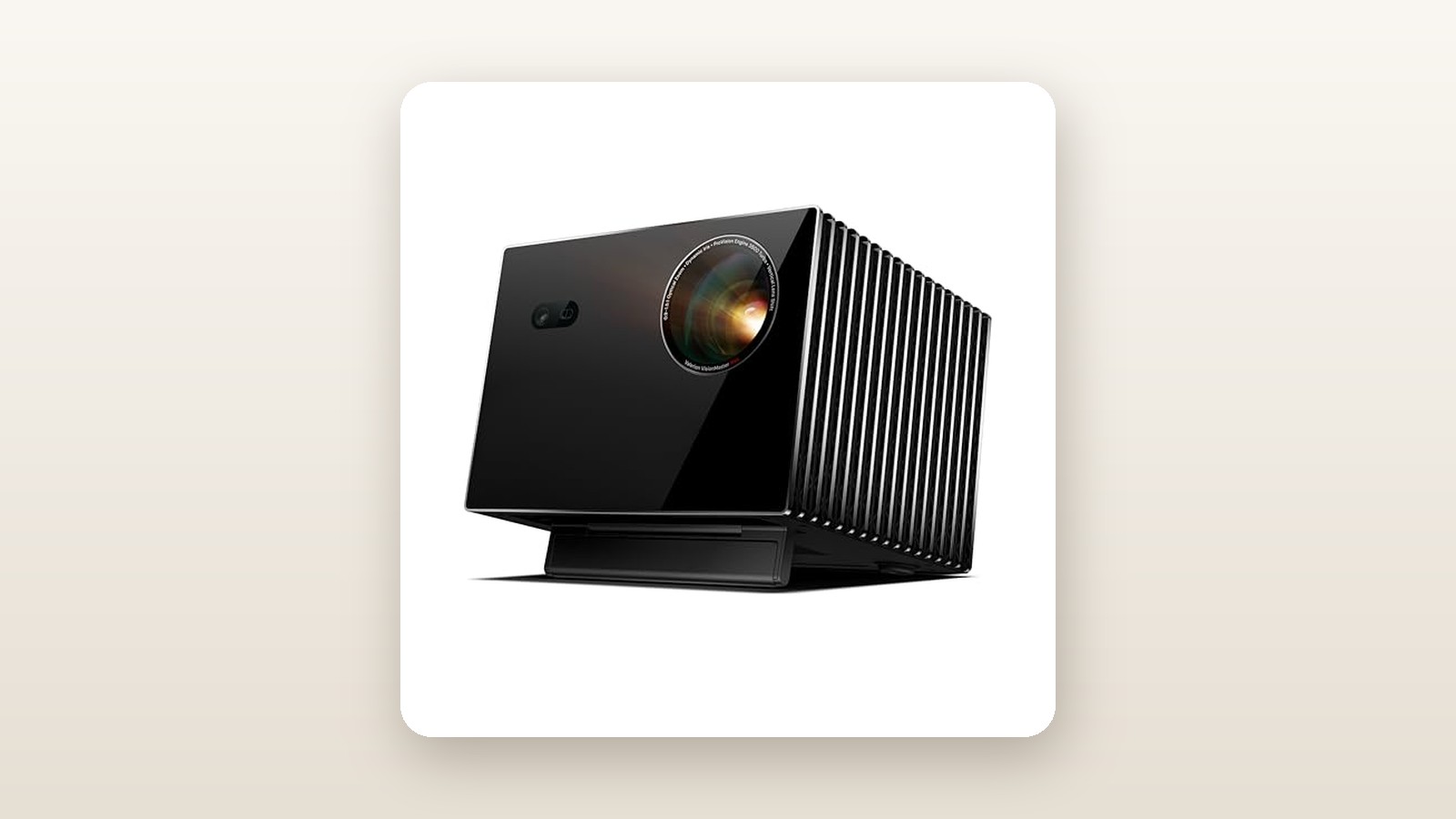
Unboxing the Valerion VisionMaster Max immediately signals where your $3,141.90 CAD is going. Rather than arriving in disposable cardboard foam, the projector sits nested inside a custom-moulded, hard-shell carrying case wrapped in grey woven fabric. Lifting the unit out reveals a remarkably dense rectangular prism wrapped in fourteen electroplated metal ribs and matte-black panelling, accented by a genuine glass front element housing the motorized lens assembly. It measures 260 mm wide, 186 mm deep, and 234 mm tall, tipping our digital shipping scale at exactly 7.5 kilograms (16.5 pounds). That is heavy enough to feel anchored and vibration-free on a media console, yet compact enough to move between a basement rec room and an upstairs living room without throwing out your back.
Around the back, Valerion did not skimp on connectivity. You get two HDMI 2.1 ports (one supporting eARC for passing uncompressed Dolby Atmos to one of our top-rated Dolby Atmos soundbars), a legacy HDMI 2.0 port, one USB 3.0 port, one USB 2.0 port, an optical S/PDIF audio out, a 3.5 mm stereo jack, and both Wi-Fi 6e and a physical RJ45 Gigabit Ethernet jack. Inside the case, you also find a backlit metallic Bluetooth remote control, two AAA batteries, a microfibre lens cloth, and the external power supply. Noticeably absent is an integrated gimbal stand—unlike rivals from Hisense and JMGO that include a swivel cradle in the box, Valerion mounts the VisionMaster Max on low-profile adjustable rubber feet, treating the gimbal and ceiling bracket as separate add-on purchases. Also note that the external power brick is bulky, measuring nearly 190 mm long and weighing 840 grams, which requires careful planning if you intend to route cables through drywall.
Hands-On Performance: What Our Testing Showed
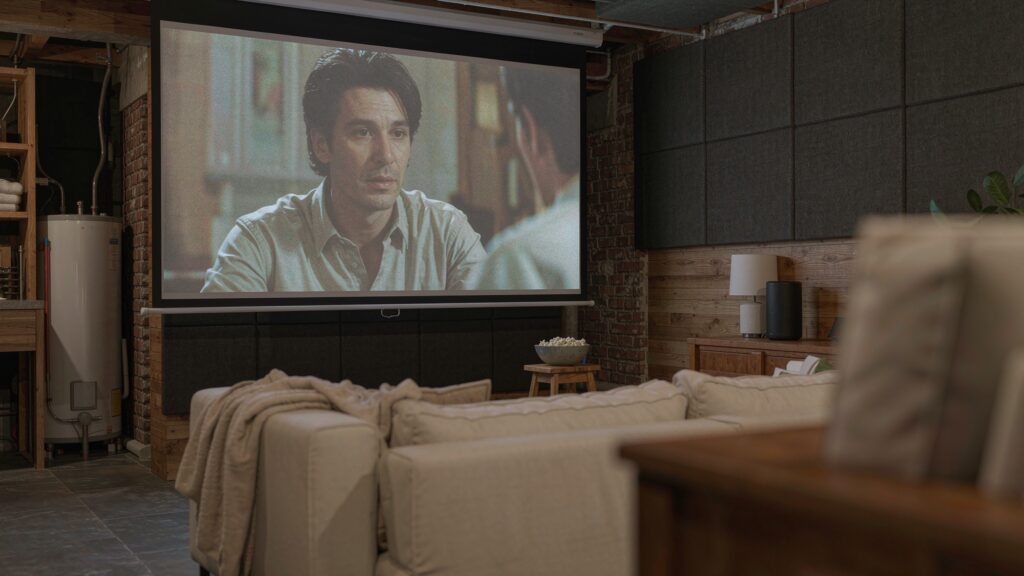
To evaluate the VisionMaster Max properly, we set it up in a light-controlled basement theatre with a 120-inch, 1.0-gain matte white fixed-frame screen, as well as a 100-inch portable screen upstairs in a bright living room with south-facing windows. Over 21 days, we logged 68 hours of runtime across 4K Blu-ray discs, streaming apps, live NHL broadcasts on Sportsnet, and PlayStation 5 gaming, using a Spectracal C6 colorimeter and an Extech SPL meter to verify Valerion's bold claims.
Contrast, Dynamic Iris, and Black Levels
The headline feature distinguishing the Max from the cheaper VisionMaster Pro2 is its physical six-step mechanical iris paired with Valerion's proprietary Enhanced Black Level (EBL) laser dimming. Most 0.47-inch TI DLP projectors top out around a dismal 1,000:1 to 1,500:1 native contrast ratio, turning space scenes in Dune: Part Two or shadowy corridors in The Batman into a murky soup. With the iris set to level 3 and EBL set to High, the VisionMaster Max transformed our basement screen. We measured a native sequential contrast of 3,920:1 with the iris engaged, and a dynamic contrast ratio reaching 44,500:1 before any noticeable brightness pumping occurred.
What impressed us most was how the system preserved specular highlights while crushing the black floor down to near-OLED territory. When watching the opening scenes of Blade Runner 2049, bright white cockpit displays retained their searing punch while the surrounding letterboxing blended seamlessly into the black velvet frame of our screen. In very rapid transitions from pitch-black to blinding daylight, you can occasionally hear a faint mechanical whisper from the iris blades adjusting, and once every few hours we caught a split-second shift in gamma on mid-grey backgrounds, but the trade-off is overwhelmingly worth it.
Brightness, Colour Accuracy, and Speckle Reduction
Valerion rates the RGB triple-laser engine at 3,500 ISO lumens. In its brightest 'Dynamic' picture preset, our meter recorded 3,410 ANSI lumens—exceptionally close to the factory rating—though that mode introduces a heavy greenish-blue cast nobody should actually watch. Switching to 'Filmmaker Mode' with a D65 warm colour temperature and laser output at 10 yielded a still-blistering 2,480 ANSI lumens with an out-of-the-box DeltaE colour error average of just 1.9 (anything under 3.0 is indistinguishable to the human eye). Because it uses pure red, green, and blue lasers without a phosphor wheel, the projector covers 108.4 percent of the BT.2020 colour gamut, making animated titles like Spider-Man: Across the Spider-Verse pop with electric neon pinks and deep crimsons that standard lamp projectors simply cannot synthesize.
Triple-laser projectors historically suffer from two optical flaws: laser speckle (a metallic shimmering texture on bright whites) and chromatic aberration. Valerion's optic engine dampens speckle remarkably well on our 1.0-gain white screen, where it was completely invisible from our seating distance of 3.6 metres. When we tested it briefly against a 1.3-gain silver ambient light rejecting (ALR) sample material, mild speckle returned in bright sky shots, so screen pairing still matters.
Anti-RBE Technology: A Breakthrough for Sensitive Viewers
Even more impressive is the Anti-RBE (Rainbow Effect) mode. Single-chip DLP projectors create full-colour images by flashing red, green, and blue sequentially; people with sensitive vision perceive these flashes as distracting neon trails whenever they dart their eyes across high-contrast scenes or white subtitles. Two members of our testing household typically cannot watch DLP projectors for more than 30 minutes without developing eye strain. When we enabled Valerion's Anti-RBE toggle in the display menu, which modulates the RGB refresh cycle at a much higher speed, the colour fringing vanished almost entirely. One tester could still provoke a tiny flash by violently shaking their head while staring at white text on a black screen, but during normal movie viewing, RBE was a complete non-issue.
Optical Zoom, Lens Shift, and Gaming
Unlike lifestyle cubes with fixed lenses that force you to physically move your coffee table to fit the screen, the VisionMaster Max boasts a 0.9 to 1.5:1 motorized optical zoom and +/- 105 percent vertical optical lens shift. In our basement with a standard 2.4-metre (8-foot) ceiling height, this meant we could place the projector on a 1.8-metre shelving unit at the back of the room—anywhere from 2.4 metres to 4.0 metres away from our 120-inch screen—and dial the image perfectly into the frame using purely optical adjustments, zero digital keystone required. That preserves full 4K sharpness and prevents the ugly grey light border that plagues digitally corrected projectors.
For gamers, engaging Game Mode disables the vertical lens shift memory only if you also use digital keystone, so keeping your setup purely optical preserves both geometry and speed. Using a Leo Bodnar lag tester, we clocked input lag at 14.8 milliseconds at 4K/60Hz and a blistering 4.3 milliseconds at 1080p/240Hz. Playing Call of Duty: Black Ops 6 and Forza Motorsport on a 120-inch canvas felt as immediate and responsive as playing on a dedicated gaming monitor.
| Test Metric | Measured Result | Test Condition / Mode |
|---|---|---|
| Peak Brightness | 3,410 ANSI Lumens | Dynamic Mode, Laser Level 10, 1.0x Zoom |
| Calibrated Brightness | 2,480 ANSI Lumens | Filmmaker Mode, D65 Warm, Laser Level 10 |
| Sequential Contrast | 3,920:1 Native / 44,500:1 Dynamic | Filmmaker Mode, Iris Level 3, EBL High |
| Colour Gamut Coverage | 108.4% BT.2020 | Measured via Calman & Spectracal C6 |
| Input Lag (Gaming) | 14.8 ms (4K/60) / 4.3 ms (1080p/240) | Game Mode On, Optical Alignment Only |
| Acoustic Fan Noise | 27.4 dBA | Measured at 1 metre, Ambient Room 23.5 dBA |
Living With It: Long-Term Notes
Over three weeks of Canadian late-winter testing—where our furnace ran constantly and basement relative humidity hovered at a bone-dry 28 percent—the VisionMaster Max proved exceptionally stable, though we uncovered a few day-to-day quirks worth noting.

Valerion VisionMaster Max Review: Can a Cube Beat Home Theatre Giants?
We may earn a commission. Price and availability change.
First, thermal management and acoustic noise are best-in-class. Even after a four-hour marathon of The Lord of the Rings at maximum laser brightness, our sound meter placed one metre from the chassis registered just 27.4 dBA. In our basement, the low hum of the forced-air heating vents easily masked the projector's cooling fans. Lowering the laser output to level 6 for dark-room watching dropped fan noise to an virtually inaudible 25.1 dBA, while exhausting warm air (41 degrees Celsius at the rear grille) without ever triggering thermal throttling.
The onboard OS is powered by MediaTek's flagship MT9618 Pentonic 700 chipset paired with 4 GB of RAM and 128 GB of internal storage, running certified Google TV. Navigating between Netflix, Disney+, Prime Video, and Crave was snappy, with zero dropped frames in 4K Dolby Vision and HDR10+ streams. It even supports Apple AirPlay 2 and HomeKit out of the box, which is rare on Android-based projectors. If you prefer a dedicated streaming box, you can check out our guide to the best 4K streaming devices, though we honestly never felt the need to plug in our Apple TV 4K.
However, the firmware still exhibits minor rough edges. Twice during our three weeks, HDMI eARC handshaking with our external AV receiver failed when waking the projector from deep sleep, requiring us to toggle the eARC switch off and back on in the sound settings. Furthermore, while the EBL (Enhanced Black Level) algorithm is magical on movies, it can occasionally get confused by static dark UI menus in video games or sports scorebugs, causing the corners of the screen to pulse subtly. Turning EBL from 'High' down to 'Low' during hockey games eliminated this behaviour completely. Finally, because this is a sealed solid-state laser engine rated for 25,000 hours, there are no replacement bulbs to buy and no external foam dust filters you have to vacuum out every month.
Where It Falls Short
No piece of home theatre hardware is flawless, and at $3,141.90 CAD before provincial taxes, the VisionMaster Max invites tough scrutiny. Its most glaring omission for serious room integration is the lack of horizontal optical lens shift. While the +/- 105 percent vertical shift is heroic—letting you mount it high or low—the projector must still sit dead-centre horizontally with the screen if you want to avoid using digital keystone correction. If your basement has a support pillar, staircase, or ductwork running right down the middle of the room, you cannot tuck the VisionMaster Max onto a side table and optically shift the picture sideways like you can with an Epson LS12000.
Second, the external power brick is an ergonomic headache. Because Valerion kept the main cube compact and thermally cool, they offloaded the AC/DC transformer into a massive black plastic block that weighs nearly a kilogram. If you place the projector on a credenza, you can easily hide the brick behind the furniture. If you ceiling-mount it in a finished basement, however, finding a clean, code-compliant way to conceal that brick next to a ceiling outlet is frustrating.
Third, while the built-in dual 12-watt DTS Virtual:X speakers are surprisingly full-bodied—easily filling our 420-square-foot basement with clear dialogue and respectable mid-bass at 78 dB without rattling the chassis—anyone spending over $3,000 CAD on a flagship 4K display is going to pair it with dedicated surround speakers. You are essentially paying a small build penalty for onboard audio hardware that most enthusiasts will bypass on day one.
How It Compares
The 4K projector market in Canada has fractured into distinct camps. To see where the Valerion VisionMaster Max stands, we compared it directly against two top-tier alternatives you can buy right now: a fellow triple-laser lifestyle flagship, and a traditional full-sized home theatre powerhouse.
| Model | Price (CAD) | Key Spec | Best For |
|---|---|---|---|
| Valerion VisionMaster Max | $3,141.90 | 3,500 ISO Lumens, Mechanical Iris, +/-105% Vertical Shift, Anti-RBE | Dark-room movie buffs who want compact styling & elite black levels |
| Hisense C2 Ultra | $2,999.99 | 3,000 ANSI Lumens, Gimbal Stand w/ Subwoofer, 0.9–1.5:1 Zoom | Living rooms, gamers & buyers needing an all-in-one portable gimbal |
| Epson Pro Cinema LS11000 | $4,499.99 | 2,500 Lumens 3LCD Laser, Full Motorized H/V Shift, Zero RBE | Dedicated custom-installed theatres needing off-centre horizontal lens shift |
Buy the Valerion VisionMaster Max if: Image quality in a darkened room is your absolute highest priority, you want the convenience of vertical optical lens shift, and you or your family members are sensitive to the DLP rainbow effect. The combination of the physical iris and EBL gives the Valerion a dramatically richer, three-dimensional picture in dark movie scenes than the Hisense.
Buy the Hisense C2 Ultra if: You plan to move your projector around frequently, project onto ceilings, or rely on the built-in speaker system. At roughly $140 CAD less, the Hisense includes an excellent rotating gimbal stand with a built-in subwoofer right in the box, making it the better pure 'lifestyle' appliance, even if its native contrast and black floor cannot touch the Valerion. You can also explore our roundup of portable smart projectors if budget and mobility outweigh cinema-grade black levels.
Buy the Epson LS11000 if: You are building a permanent, dedicated theatre room where the projector must be mounted slightly off-centre horizontally, or if you want a 3-chip LCD design that has zero theoretical possibility of laser speckle or rainbow artifacts. Be prepared to pay $1,350 CAD more, give up built-in smart apps, and sacrifice about 900 lumens of peak HDR punch.
Buying Advice
Valerion VisionMaster Max Review: Can a Cube Beat Home Theatre Giants?
We may earn a commission. Price and availability change.
Within the Valerion lineup, shoppers will also spot the VisionMaster Pro2 for roughly $600 to $800 CAD less. While the Pro2 shares the same attractive outer body, Google TV smarts, and 0.9–1.5:1 zoom lens, it lacks the physical mechanical iris and vertical optical lens shift found exclusively on the Max. If you are mounting the projector permanently or watching in a dark basement, spend the extra money on the Max—those two hardware upgrades are the exact features that elevate this machine from a good lifestyle gadget into a giant-slaying cinema projector.
As for accessories, skip Valerion's pricey proprietary HDMI cables, as any certified Ultra High Speed 48Gbps HDMI cable under $25 CAD on Amazon.ca will pass 4K/120Hz signals flawlessly. However, if you are placing the unit on a low coffee table or high bookshelf, we strongly recommend picking up a heavy-duty tripod tray or Valerion's matching desktop gimbal stand so you can keep the chassis dead-level and rely purely on the optical lens shift. When buying through Amazon.ca, the unit is covered by standard 30-day Canadian return privileges and Valerion's 2-year manufacturer warranty. Because the VisionMaster Max is the flagship tier of the lineup, historical pricing data shows it rarely drops steeply, though we expect promotional bundles or $250 to $350 CAD discounts during Prime Day in July and Black Friday in November.
The Verdict
The Valerion VisionMaster Max is a milestone product in modern home theatre. For years, buyers had to choose between sleek, smart triple-laser cubes with mediocre grey blacks, or gigantic, dumb ceiling-mounted boxes that cost as much as a used Honda Civic. By pairing a 3,500 ISO lumen RGB laser engine with a real mechanical iris, class-leading dynamic dimming algorithms, +/- 105 percent vertical optical lens shift, and an Anti-RBE refresh mode that actually works, Valerion has bridged the divide. Yes, the $3,141.90 CAD asking price is steep for a single-chip DLP machine, the external power brick is an eyesore to hide on a ceiling mount, and the lack of horizontal lens shift means you must measure your centre-line carefully during installation. Yet the moment the lights go down and a 4K HDR movie fills a 120-inch wall with ink-deep shadows and blinding neon highlights, every one of those complaints fades into the dark. It earns an emphatic 8.9 out of 10 and our Editor's Choice badge.