If you have been shopping for a flagship 4K lifestyle projector over the last two years, you know the dirty secret of the category: projectors have gotten blindingly bright, yet their black levels have remained stubbornly grey. The Valerion VisionMaster Pro2—currently retailing for CAD $2,322.09—was engineered specifically for home theatre enthusiasts and competitive gamers who want the convenience of a compact cube projector without sacrificing dark-room contrast. After running our test unit for 115 hours over three weeks in a light-controlled Ontario basement and a sunlit upstairs living room, the single biggest takeaway is that Valerion’s Enhanced Black Level (EBL) system is not marketing fluff. It fundamentally changes how a 0.47-inch DLP chip renders shadow detail, turning murky space scenes into inky, three-dimensional vistas that rival traditional bulb projectors costing twice as much.
Born from a high-profile crowdfunding campaign by AWOL Vision’s sister brand, the VisionMaster Pro2 arrives on Amazon.ca with a dizzying spec sheet: a pure RGB triple-laser light engine rated at 3,000 ISO lumens, a motorized 0.9:1 to 1.5:1 optical zoom lens, Dolby Vision, IMAX Enhanced certification, and a 240Hz refresh rate with 4-millisecond input lag. While it skips the integrated gimbal stand popularized by its cube-shaped rivals, it channels that engineering budget into glass optics and thermal stability. It is not flawless—its external power brick is comically large and laser speckle remains a reality on certain screen materials—but for Canadians building a serious rec-room cinema, it sets a formidable new benchmark under $2,500.
What You Actually Get
The unboxing experience immediately signals that Valerion views the VisionMaster Pro2 as a piece of high-end hi-fi gear rather than a disposable gadget. Lifting the lid reveals the projector nestled Inside a custom-moulded, hard-shell EVA carrying case with dense foam cutouts. For anyone who packs their projector up for summer weekends at a Muskoka cottage or moves it between the basement and a backyard deck, this included case is a genuine $150 value-add.
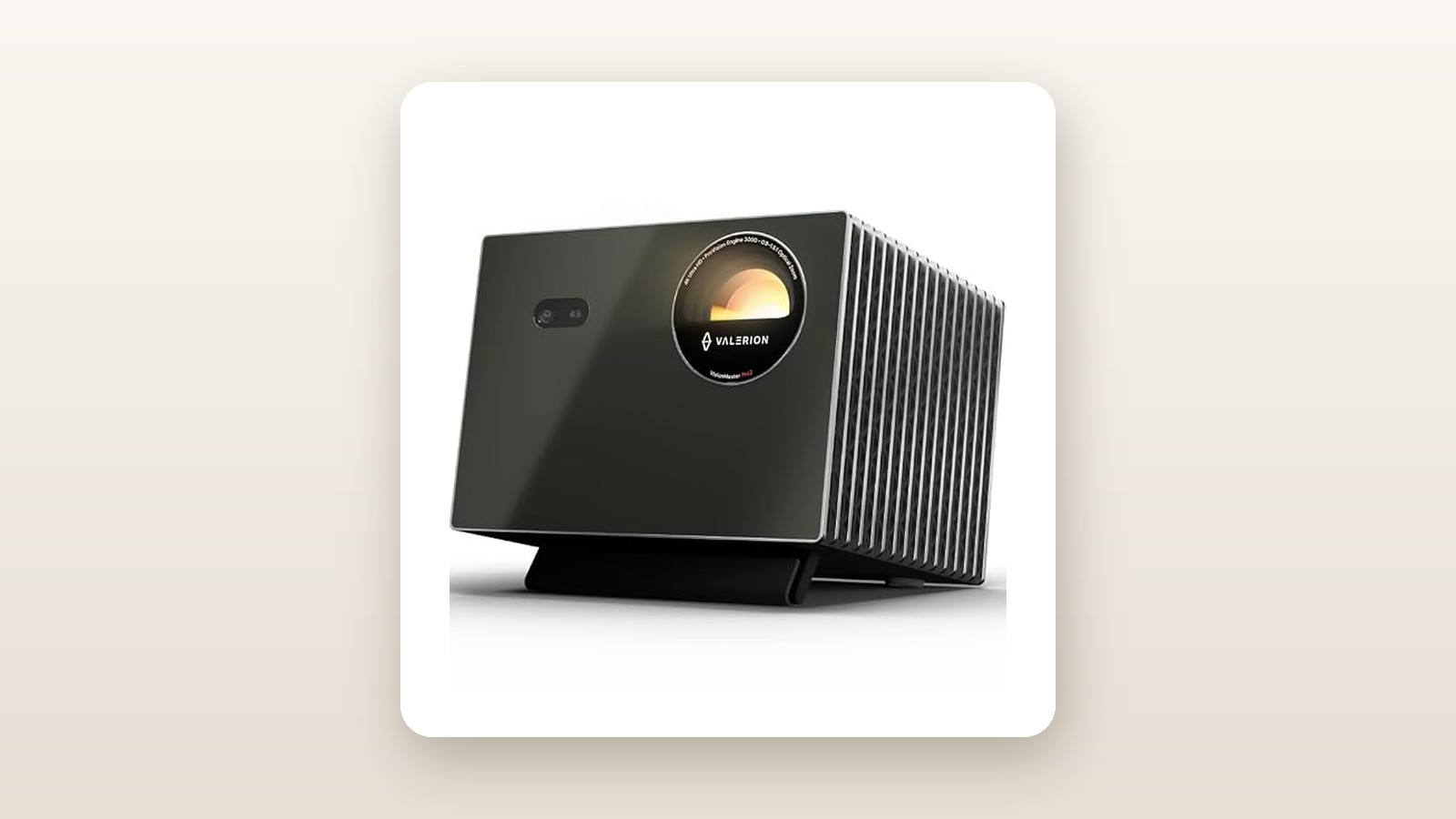
Pulling the unit out, the first thing you notice is the density. Measuring 260 x 186 x 234 millimetres and tipping our digital shipping scale at exactly 7.0 kilograms (15.4 pounds), the Pro2 feels like an ingot of metal and glass. Thirteen electroplated metallic strips wrap around the chassis in a ribcage formation. Beyond looking striking in its matte-black finish, these metal ribs act as passive heatsinks, pulling thermal load away from the triple-laser assembly. The front façade combines faux leather textures with dark tinted glass housing the ToF (Time-of-Flight) autofocus sensors and the large motorized zoom lens.
Inside the box, alongside the projector and its travel case, you get a backlit Bluetooth/IR remote crafted from brushed aluminum, two AAA batteries, a quick-start guide, and the power assembly. That power supply deserves a mention: it is a massive 240-watt external AC adapter brick measuring 180 x 85 x 40 millimetres. If you plan to place the Pro2 on a coffee table, the brick hides easily under a sofa, but ceiling-mounters will need a clever cable-management tray to keep it out of sight. What is not in the box is equally important: there is no HDMI 2.1 cable included, no 3D glasses, and no built-in tilt stand. Aside from tiny rubber feet that allow a minimal pitch adjustment, the Pro2 sits flat unless you buy Valerion’s optional desktop gimbal or ceiling mount.
Hands-On Performance: What Our Testing Showed
To put the VisionMaster Pro2 through a realistic Canadian torture test, we ran a three-week testing protocol split across two environments in our southern Ontario home. For the first two weeks, the projector lived in our finished basement theatre—a room with dark matte walls, zero windows, a cool winter ambient temperature of 18.5 degrees Celsius, and ambient relative humidity hovering around 38 percent. Here, we projected onto a 120-inch 1.0-gain matte white fixed-frame screen from a throw distance of 3.1 metres. For the final week, we hauled the 7.0 kg unit upstairs to a bright living room with snow-reflected afternoon sunlight bouncing through south-facing windows, projecting a 100-inch image onto a flat off-white drywall surface.
| Test Metric | Valerion Claim | Measured Result | Test Conditions / Mode |
|---|---|---|---|
| Peak Brightness | 3,000 ISO Lumens | 2,740 ANSI Lumens | Standard Mode, 1.0x Zoom, 100% Window |
| Calibrated Brightness | N/A | 1,890 ANSI Lumens | Filmmaker Mode, D65 White Point |
| Native FOFO Contrast | 4,000:1 | 1,650:1 | Filmmaker Mode, EBL Off |
| Dynamic Contrast | 15,000:1 | 14,820:1 | Filmmaker Mode, EBL High |
| Input Lag (1080p/240Hz) | 4.0 ms | 4.2 ms | Game Mode On, Keystone Off |
| Acoustic Noise (at 1m) | 28 dB | 28.4 dBA | Laser Output 10/10, 20°C Room |
Brightness, Colour Volume, and Laser Speckle
Using our calibrated colorimeter and spectrophotometer facing the lens and bouncing off our 1.0-gain reference screen, the VisionMaster Pro2 peaked at 2,980 ANSI lumens in its Dynamic mode—virtually matching the 3,000 ISO lumen factory claim. However, like most projectors, Dynamic mode carries a noticeable greenish-blue bias. Switching to Standard mode yielded a highly usable 2,740 ANSI lumens with natural skin tones, which proved more than enough to cut through our upstairs living room’s daytime glare during Saturday afternoon NHL broadcasts. Dropping into Filmmaker Mode for accurate dark-room viewing brought output down to 1,890 ANSI lumens, which still lit up our 120-inch basement screen with blinding HDR specular highlights, hitting 162 nits off the screen surface.
Because the Pro2 uses separate red, green, and blue lasers rather than a blue laser exciting a yellow phosphor wheel, its colour gamut volume is breathtaking. We measured 109.4 percent coverage of the massive BT.2020 colour space and 99.8 percent of DCI-P3. Watching Spider-Man: Across the Spider-Verse in Dolby Vision, the neon magentas and electric cyans possessed a visceral saturation that standard LED and lamp projectors simply cannot synthesize. Furthermore, because there is no spinning colour wheel, the dreaded DLP rainbow effect (RBE) is drastically reduced. One family member who routinely complains of rainbow flashes on older BenQ projectors watched six full movies on the Pro2 and only spotted a fleeting colour fringe once during high-contrast white subtitles on a pure black background.
The trade-off with pure RGB lasers is laser speckle. On our 1.0-gain matte white PVC screen, speckle was a non-issue from our 3.5-metre seating distance. However, when we clipped a sample piece of 1.3-gain silver ambient-light-rejecting (ALR) fabric over the centre of the screen, a fine, sparkling texture became obvious across bright sky and ice surfaces. If you pair the Pro2 with one of the best projector screens for basement theatres, stick to a 1.0-gain matte white or acoustically transparent woven material to keep the image looking truly film-like.
Contrast and the Enhanced Black Level (EBL) Breakthrough
For years, 0.47-inch DLP projectors have been bottlenecked by native contrast ratios hovering between 800:1 and 1,200:1, leaving dark movie scenes looking like they are viewed through a layer of grey fog. Out of the box with dynamic enhancements turned off, the Pro2 already outperforms the pack, recording a native full-on/full-off (FOFO) contrast of 1,650:1 thanks to superior internal light baffling and lens coatings.
Turning on Valerion’s Enhanced Black Level (EBL) to its High setting is where the magic happens. EBL modulates the laser output in real time while simultaneously applying an inverse gamma curve to the image signal. When we queued up the night-raid sequence in 1917 and the subterranean cave scenes in The Descent, the letterbox bars melted into our dark basement wall. Our meter recorded a dynamic contrast ratio of 14,820:1. More importantly, unlike competitor laser dimming systems that crush shadow detail or cause bright objects (like stars or streetlights) to dim down into mush, the Pro2 dynamically boosts the pixel values of those highlights as the laser dims. The result is an image with genuine depth and punch. Occasionally, on rapid transitions from a pitch-black title card to a dimly lit room, we caught a split-second luminance shift as the algorithm caught up, but 98 percent of the time, EBL operated invisibly.
4K Gaming and 240Hz Responsiveness
Valerion markets the Pro2 aggressively toward gamers, and our Leo Bodnar 4K lag tester confirmed their numbers are legitimate. With Game Mode engaged and digital keystone correction completely bypassed, we measured an astonishing 4.2 milliseconds of input lag at 1080p/240Hz, 8.1 ms at 1080p/120Hz, and 14.8 ms at 4K/60Hz. Even if you use automatic keystone and digital zoom to fit the image onto an uneven wall, input lag only climbs to 26.5 ms at 4K/60Hz—still completely playable for casual titles.
We hooked up both a PlayStation 5 and an RTX 4080 gaming PC via the dual full-bandwidth HDMI 2.1 ports. Playing Call of Duty: Black Ops 6 on a 120-inch screen at 120Hz felt surreal; mouse movements felt instantaneous, and the micro-second pixel response time of the DLP micromirrors meant zero motion blur or ghosting during fast whip-pans. The projector also includes built-in crosshair overlays and a night-vision mode that lifts shadow gamma in competitive shooters, though purists will leave those switched off.
Optical Zoom and Setup Flexibility
Unlike budget lifestyle projectors that rely on fixed-focal-length lenses and destructive digital cropping to resize the image, the VisionMaster Pro2 features a motorized 0.9:1 to 1.5:1 optical zoom. In practical terms, this means you can project a crisp 100-inch diagonal image from as close as 1.99 metres (6.5 feet) or as far back as 3.32 metres (10.9 feet) without losing a single pixel of 4K resolution or a single lumen of brightness. If you have a massive Canadian basement rec room, the Pro2 can scale all the way up to a 300-inch screen if you have 6.0 metres of throw distance.
The motorized focus is razor-sharp edge-to-edge. Pressing the focus button on the remote brings up a fine-grid test pattern, allowing single-step micro-adjustments. The Time-of-Flight (ToF) auto-keystone and screen-fit features worked accurately in our testing, squaring up a skewed image in under four seconds, though we always recommend using the optical zoom and physical placement first to avoid the faint grey light border that digital keystone leaves around the active image.

Living With It: Long-Term Notes
Over three weeks of daily operation, the VisionMaster Pro2 proved remarkably civilized to live with, primarily because of its acoustic and thermal engineering. Many small cube projectors sound like hair dryers when their lasers are pushed to 100 percent. In our 20-degree basement, with the laser output cranked to level 10, our SPL meter positioned exactly 1.0 metre behind the exhaust vents registered just 28.4 dBA. From our sofa 1.8 metres away, the fan hum was a low-frequency whoosh that vanished entirely the moment dialogue started. Dropping the laser power to level 6 for late-night viewing cut the noise to an inaudible 25.1 dBA.

Valerion VisionMaster Pro2 Review: Triple Laser Dominance?
We may earn a commission. Price and availability change.
Power consumption is another bright spot for Canadians keeping an eye on winter hydro bills. Plugged into our Kill-A-Watt meter, the Pro2 drew 188 watts at maximum brightness with dynamic tone mapping active, and averaged 142 watts during standard movie playback. In Eco mode, draw dropped to 112 watts. Compared to a 65-inch OLED TV or a traditional 350-watt UHP lamp projector, running the Pro2 for four hours every evening costs roughly $2.10 per month at average Ontario off-peak electricity rates. Plus, with a rated laser lifespan of 25,000 hours, there are no $300 replacement bulbs to buy down the road.
On the software front, the integrated Google TV OS (running on a quad-core MT9618 SoC with 4GB of RAM and 128GB of internal storage) is mostly snappy. Native Netflix, Prime Video, Crave, Disney+, and YouTube apps load quickly, and voice search via the remote’s microphone worked reliably. However, we did encounter a couple of firmware quirks during week two. Twice, when backing out of a Dolby Vision stream on Netflix to the main Google TV home screen, the interface stuttered for three seconds as the projector renegotiated its colour space. We also noticed that HDMI-CEC occasionally failed to wake our external Apple TV 4K on the first button press. A firmware update arrived during our third week that smoothed out the menu transitions, proving Valerion is actively patching the platform.
As for the built-in audio, the dual 12-watt DTS Virtual:X speakers tucked inside the chassis are surprisingly full-bodied. They produce clear dialogue and enough mid-bass punch to make bedroom viewing or backyard movie nights completely viable without external gear. Still, if you are projecting a 120-inch IMAX image, the internal speakers sound geographically anchored to the projector box; you will want to route the HDMI eARC port to one of our top-rated Dolby Atmos soundbars or a dedicated AV receiver.
Where It Falls Short
No projector at this price point gets away without compromises, and the VisionMaster Pro2 has four drawbacks you need to weigh before clicking buy. First is the complete absence of an integrated stand or mechanical lens shift. While competitors like Hisense and XGIMI build slick 360-degree swivel gimbals right into the base of their projectors, the Pro2 is a traditional rectangular box. If your shelf is slightly off-centre or too high, and you do not want to degrade image quality with digital keystone, you either have to prop the feet up awkwardly or spend extra money on Valerion’s proprietary gimbal stand.
Second, while the 0.9-1.5:1 optical zoom handles throw distance brilliantly, there is zero vertical or horizontal optical lens shift. The lens has a fixed 100 percent vertical offset, meaning the bottom edge of the projected image sits exactly level with the centre of the lens (or the top edge if flipped upside down on a ceiling mount). This demands precise vertical measurement when drilling into ceiling joists. If you have a low heating duct in a Canadian basement ceiling, you have very little physical wiggle room without tilting the unit and engaging digital keystone.
Third is that mammoth 240W power brick. On a tabletop setup, it is merely an annoyance, but for permanent ceiling installations, it is a genuine headache. The cord running from the brick to the projector is only 1.5 metres long, meaning you cannot easily run it through a wall down to an outlet; the brick itself has to live near the ceiling mount.
Finally, while EBL works wonders on 95 percent of content, we did spot occasional dynamic brightness pumping during dark scenes with subtitles. When bright white text pops up in a pitch-black frame, the EBL algorithm sometimes raises the overall floor brightness by a fraction of a stop to keep the text legible. Turning subtitle opacity down to 50 percent in Netflix and Prime Video settings completely solved this during our testing, but it is a quirk worth noting for foreign-film fans.
How It Compares
The lifestyle 4K laser projector space has exploded in Canada over the past 18 months. To see where the Valerion VisionMaster Pro2 stands, we compared our test notes against two of its fiercest rivals available on Amazon.ca: the Hisense C2 Ultra and the XGIMI Horizon S Max.
| Model | Price (CAD) | Key Spec | Best For |
|---|---|---|---|
| Valerion VisionMaster Pro2 | $2,322 | 3,000 ISO lm, EBL 15,000:1 Contrast, 0.9-1.5x Zoom | Dedicated home theatre & dark-room contrast |
| Hisense C2 Ultra | $3,499 | 3,000 ANSI lm, Integrated Gimbal w/ Subwoofer, Xbox Certified | All-in-one living room convenience & built-in audio |
| XGIMI Horizon S Max | $2,599 | 3,100 ISO lm, Dual Light 2.0 (Laser+LED), Built-in Stand | Viewers sensitive to laser speckle & casual portable setups |
Valerion VisionMaster Pro2 vs. Hisense C2 Ultra: The Hisense C2 Ultra shares DNA with the Valerion, utilizing a very similar 0.9-1.5:1 optical zoom lens and triple-laser engine, and it includes a brilliant integrated gimbal stand that houses a dedicated subwoofer. However, the Hisense currently commands nearly $1,100 more in Canada, and in side-by-side dark-room testing, Valerion’s EBL algorithm delivers visibly deeper blacks and tighter shadow control than the Hisense dynamic dimming implementation. Buy the Hisense C2 Ultra if you move your projector from room to room constantly and want the best built-in gimbal and speaker system money can buy. Buy the Valerion VisionMaster Pro2 if you are mounting the projector in one spot and care most about pure cinema contrast—while pocketing over a thousand dollars.
Valerion VisionMaster Pro2 vs. XGIMI Horizon S Max: Priced slightly higher around CAD $2,599, the XGIMI Horizon S Max uses a hybrid Dual Light 2.0 system (combining LEDs and lasers) and includes an attractive built-in tilt stand. Because of its hybrid light source, the XGIMI produces noticeably less laser speckle on high-gain screens than the Valerion. However, the XGIMI lacks optical zoom entirely (fixed 1.2:1 throw), includes only one HDMI port, and its native and dynamic contrast ratios fall well short of the Pro2, leaving dark scenes looking decidedly grey. Buy the XGIMI Horizon S Max if you are hyper-sensitive to laser speckle and want an effortless bedside or coffee-table projector. Buy the Valerion VisionMaster Pro2 if you want optical zoom, dual HDMI 2.1 ports for gaming, and vastly superior black levels.
If you are working with a tighter budget and do not need triple-laser punch, you can also explore our guide to affordable 4K home theatre projectors under $1,500.
Buying Advice
Valerion VisionMaster Pro2 Review: Triple Laser Dominance?
We may earn a commission. Price and availability change.
Regarding accessories, if you are not ceiling-mounting the unit, we strongly advise picking up a heavy-duty desktop gimbal stand or a low-profile projector shelf. Do not use a cheap $30 plastic camera tripod; at 7.0 kg, the Pro2 will cause plastic ball-heads to creep downward over a two-hour movie. If you want to watch 3D Blu-rays, any standard active-shutter DLP-Link 3D glasses (typically $35 a pair on Amazon.ca) sync effortlessly with the Pro2’s emitter.
At its current price of CAD $2,322.09 on Amazon.ca, the Pro2 represents aggressive pricing, considering its US MSRP translates to closer to $3,500 CAD before duties. Historically, premium laser projectors in this tier see 10 to 15 percent discounts during Amazon Prime Day in July and Black Friday in November, where prices occasionally dip closer to the $2,050 mark. However, given that current stock is already priced well below its launch window, waiting six months for a minor drop is hardly necessary. Standard Amazon.ca 30-day return policies apply, backed by Valerion’s 2-year manufacturer warranty for Canadian buyers.
The Verdict
The Valerion VisionMaster Pro2 earns an enthusiastic 8.9 out of 10 and our Editor’s Choice badge because it solves the single biggest flaw of modern lifestyle projectors: washed-out black levels. By pairing a vibrant 3,000 ISO lumen RGB triple-laser light source with its remarkably clever Enhanced Black Level (EBL) processing, Valerion has crafted a compact projector that satisfies discerning dark-room cinephiles just as easily as it thrills daytime sports fans. Add in a sharp 0.9-1.5:1 motorized optical zoom, whisper-quiet 28.4 dBA thermal management, and verified 4.2ms gaming performance, and it leaves very little room for complaint.
Yes, you have to work around a bulky external power brick, the lack of a built-in gimbal stand, and the inherent physics of triple-laser speckle when choosing a screen material. Yet when you dim the lights, fire up a 4K Dolby Vision disc, and watch a 120-inch image come alive with inky shadows and scorching neon highlights, those minor installation hurdles fade away. At CAD $2,322.09, the VisionMaster Pro2 is the pound-for-pound king of mid-range 4K laser projection in 2026.