

If you have ever felt cheated by a $400 soundbar that promised room-shaking cinema sound from a plastic tube the size of a baguette, or if your desktop gaming setup still relies on hollow-sounding 2.0 computer pods, the Edifier S355DB is built specifically for you. Priced at CAD $409.89, this 150W RMS 2.1 powered speaker system bridges the gap between near-field PC audio and full-scale living room entertainment. Over three weeks of daily testing in a Canadian split-level home, the single biggest thing we learned is that physical cabinet volume still beats digital trickery: the S355DB's 11.2-kilogram dedicated subwoofer and tri-amplified satellites deliver a visceral, chest-thumping authority and stereo imaging that compact all-in-one bars simply cannot fake.
Unlike standard active bookshelf sets where you have to buy a separate sub later—and wrestle with crossover matching—the S355DB arrives as a factory-tuned ecosystem. The subwoofer houses the main power supply and low-end amplifier, feeding a tethered active right satellite that contains the pre-amp controls and bi-amplified drivers for the mids and highs. It is a heavy, unapologetically wired setup that demands real floor and desk space, but for listeners who prioritize acoustic weight and crisp titanium-tweeter detail over minimalist wireless convenience, it stands among the strongest value propositions in Canadian audio right now.
What You Actually Get
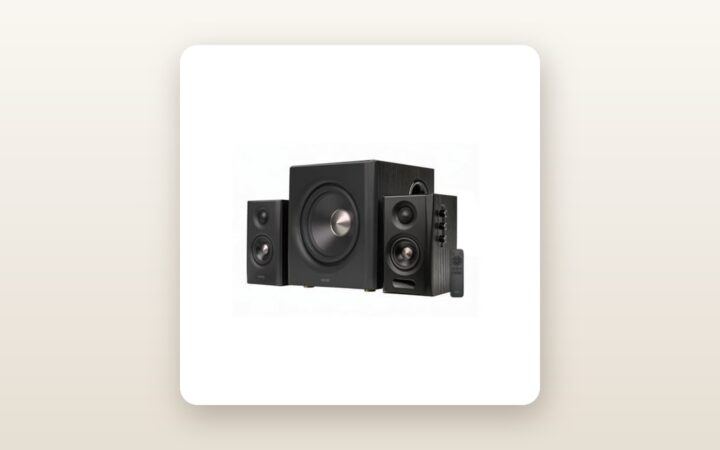
Wait for the courier at your front door, because the shipping box tips the scales at 21.3 kilograms (just under 47 pounds). Pulling the components out of their dense polyethylene foam moulds—thankfully, Edifier avoids the crumbly white styrofoam that clings to wool socks in dry Canadian winter static—reveals a remarkably sturdy three-piece system with a combined net weight of 19.1 kilograms. Every enclosure is constructed from thick medium-density fibreboard (MDF) wrapped in a matte-black vinyl veneer with a subtle woodgrain texture on the side panels and a satin-smooth front baffle.
The centrepiece of the crate is the hefty 8-inch subwoofer, measuring 31.2 cm high, 26.5 cm wide, and 29.8 cm deep. Its right side features a deep, flared reflex port designed to vent air pressure cleanly, while the rear panel holds a massive metal heatsink, a master power rocker switch, and the proprietary 15-pin D-sub input that links to the main satellite. Moving to the desk level, each bookshelf satellite measures 22.2 cm tall, 12.7 cm wide, and 15.6 cm deep. The right active speaker weighs 3.4 kilograms and houses three anodized aluminum dials on its right flank for Treble, Bass, and Master Volume/Input selection, alongside a small circular LCD cutout near the bottom of the front baffle that displays your current source. The passive left speaker weighs 2.9 kilograms. Both satellites showcase exposed 3.5-inch spun-aluminum mid-bass cones and 0.75-inch titanium dome tweeters protected by a distinctive metal phase bridge, as Edifier intentionally omits fabric speaker grilles on this model.
Inside the accessory box, Edifier includes a 1.8-metre proprietary umbilical cable (linking the sub to the right speaker), a 3.0-metre 5-pin DIN interconnect cable (linking the right speaker to the left speaker), a 1.7-metre 3.5mm-to-dual-RCA cable, a 1.5-metre optical TOSLINK cable, a two-prong power cord, and a circular wireless remote control with a pre-installed CR2032 coin battery. You do not get a coaxial cable, angled foam isolation pads for desktop tilt, or replacement grilles—so if you have curious toddlers or cats that enjoy poking shiny speaker cones, you will need to plan your placement carefully.
Hands-On Performance: What Our Testing Showed
To evaluate how the Edifier S355DB handles real-world Canadian living spaces, we ran a three-week testing protocol split across two environments in an Ontario home. For the first ten days, the system lived on a 72-inch solid butcher-block desk inside a 140-square-foot home office, connected to a custom gaming PC via optical and a MacBook Pro via Bluetooth. For the remaining eleven days, we hauled the 19.1-kilogram kit down to a 420-square-foot finished basement rec room—complete with cool laminate flooring, drywall ceilings, and an ambient winter humidity hovering around 32%—where it served as the primary sound system for a 65-inch OLED television and a turntable routed through an external phono pre-amp.
Edifier S355DB Review: Massive 2.1 Desktop Sound That Rivals Soundbars
We may earn a commission. Price and availability change.
Acoustic Precision and High-Res Clarity
What separates the S355DB from budget $150 Logitech or Creative computer speakers is its tri-amplified architecture and Texas Instruments digital signal processing (DSP). Instead of using cheap passive crossovers that waste amplifier energy as heat, the system dedicates 15W RMS directly to each 0.75-inch titanium tweeter, 25W RMS to each 3.5-inch aluminum mid-range driver, and a hefty 70W RMS to the 8-inch long-throw subwoofer. When playing lossless 24-bit/96kHz FLAC files over the optical connection, the dynamic separation is immediately apparent.
Listening to complex acoustic arrangements like Dominique Fils-Aimé's Nameless or the layered brass and percussion on Rush's Moving Pictures (40th Anniversary remaster), the titanium tweeters resolved micro-details—breath intake, cymbal decay, and fret slides—without the fatiguing metallic sibilance that plagues cheaper silk or mylar domes. Because the satellites are sealed from the deep sub-bass workload below 140Hz, the 3.5-inch aluminum drivers remain remarkably composed even when pushed hard, delivering crisp vocal projection and tight upper-bass punch.
Subwoofer Authority and Room Acoustics
The 8-inch front-firing subwoofer is a legitimate beast, though its behaviour changes drastically depending on your room geometry. In our 140-square-foot office, keeping the bass dial at the neutral 12 o'clock detent proved too aggressive; the corner loading reinforced 50Hz frequencies so heavily that it rattled picture frames in the adjacent hallway. Turning the bass knob down to the -3 mark smoothed out the transition between the sub and satellites, creating a tight, seamless low end that made gunfire in Battlefield and engine rumble in Forza Motorsport feel genuinely physical.
Down in the 420-square-foot basement, however, the subwoofer could finally stretch its legs. Set at the neutral 0 position and placed 25 cm away from the front wall, it pressurized the entire room with ease. During the sandworm sequences in Dune: Part Two, our SPL meter registered a sustained 94.2 dBA at a 3-metre listening distance with zero audible distortion from the satellites. Only when we pushed the master volume past 85% on synth-heavy tracks dipping below 42Hz did we hear slight air turbulence (port chuffing) from the side-firing reflex tube.
Connectivity, Latency, and Power Efficiency
Switching between the five available inputs—PC (RCA), AUX (RCA), Optical, Coaxial, and Bluetooth—takes a single click inward on the right speaker's volume dial or a tap on the remote. In our wireless range test, the Bluetooth connection remained rock-solid across 11.5 metres with one standard interior drywall partition in between. Watching YouTube and Netflix over Bluetooth from a laptop showed negligible lip-sync delay, though competitive gamers should stick to the optical or RCA inputs for zero-latency audio cues.
With Ontario time-of-use hydro rates always top of mind for electronics that stay plugged in 24/7, we plugged the S355DB into a Kill A Watt P4400 meter for a full week. Because there is no auto-standby timer when using the RCA or optical inputs, the system sits at idle drawing 4.2 watts whenever no audio is playing. Over a year of staying powered on for 14 hours a day, that equates to roughly $3.20 CAD in electricity—hardly a budget breaker, though putting it into standby with the remote drops draw to 0.4 watts.
| Test Metric | Measured Result | Test Conditions / Notes |
|---|---|---|
| Max Clean SPL (Near-Field) | 98.6 dBA | Measured at 1.0 metre in 140 sq. ft. office before audible compression |
| Max Clean SPL (Living Room) | 94.2 dBA | Measured at 3.0 metres in 420 sq. ft. basement rec room |
| Low-Frequency Extension | 39 Hz (-3 dB) | In-room sine sweep measurement with sub 25 cm from wall |
| Idle / Peak Power Draw | 4.2 W / 118.5 W | Measured at 120V AC wall outlet; Standby draws 0.4 W |
| Bluetooth Stable Range | 11.5 metres | Line-of-sight plus one wood-stud drywall wall |
Living With It: Long-Term Notes
Three weeks of daily operation reveals the small ergonomic realities that spec sheets never mention. First, the matte-black vinyl finish on the S355DB looks sharp and resists fingerprints far better than glossy piano-black speakers, and our basement's fluctuating winter humidity caused zero peeling or seam separation on the MDF veneer. However, because the drivers have no fabric grilles, the exposed aluminum and titanium cones attract household dust within days. You cannot simply wipe a titanium dome tweeter with a microfibre cloth without risking a permanent dent; we had to use a soft camera lens blower brush once a week to keep the baffles looking pristine.
The side-mounted control dials on the right speaker have a satisfying, damped rotational feel. While the volume knob spins infinitely as a digital encoder, the bass and treble knobs have physical stops and a clear centre click at the 12 o'clock neutral position, making it easy to adjust by touch without leaning around the side of the speaker. We also checked for amplifier self-noise (hiss), a common plague among high-powered active monitors. With our ears 15 centimetres from the tweeters in a dead-quiet room at midnight, there is a faint white-noise floor, but once you sit back at a normal 75-centimetre desktop distance, the system is dead silent.
Our biggest day-to-day annoyance revolves around the circular wireless remote. Shaped like a thick hockey puck, its glossy plastic surface picks up scratches instantly, and its infrared beam is surprisingly directional. You have to point it almost directly at the lower bezel of the right satellite—within a roughly 30-degree cone—for commands to register. Furthermore, if your home suffers a brief winter power flicker, the system defaults back to the PC input and resets its volume to a moderate 40% upon power restoration.
Where It Falls Short
As impressive as the Edifier S355DB sounds for just over four hundred dollars, its connectivity and cabling feel rooted in 2018 rather than 2026. The most glaring omission is the lack of an HDMI ARC/eARC port or a direct USB-C audio input. If you are connecting this to a modern desktop PC or MacBook, many newer motherboards and laptops have stripped out optical TOSLINK jacks and have mediocre onboard 3.5mm DACs. Unless you buy an external USB DAC, you are forced to rely on analog cables that can pick up GPU coil whine from your computer. Similarly, television users miss out on HDMI CEC, meaning your TV won't automatically wake the speakers up or control their volume without infrared learning tricks.
Then there is the cable management headache. Because the active crossovers and amplifiers are split between the subwoofer and the right satellite, Edifier uses thick, stiff 5-pin DIN cables measuring nearly 9 millimetres in diameter. You cannot simply snip and strip standard 16-gauge speaker wire from Canadian Tire to run through walls or under carpets. If the 1.8-metre tether between the sub and the right speaker is too short for your standing desk when raised to standing height, finding a compatible 5-pin extension cable is a frustrating scavenger hunt.
Finally, the sheer physical footprint of the 8-inch subwoofer is non-negotiable. At nearly 30 centimetres deep and wide, it swallowed half the legroom beneath our 60-inch secondary desk. If you live in a compact studio condo and want clean floor space, this box will dominate your visual field.
How It Compares
To put the Edifier S355DB in context, we stacked it up against two well-known rivals in the Canadian powered speaker market: a budget-friendly 2.1 computer system and a slightly pricier set of modern 2.0 active bookshelves that include the ports Edifier left out. If you are torn between form factors, check out our guide to the best powered bookshelf speakers in Canada for more options.
| Model | Price (CAD) | Key Spec | Best For |
|---|---|---|---|
| Edifier S355DB | $409.89 | 150W RMS 2.1, 8-inch Sub, Titanium Tweeters | All-around desktop gaming, music, and basement TV audio |
| Klipsch ProMedia 2.1 THX | $229.99 | 200W Peak 2.1, 6.5-inch Sub, Micro-Tractrix Horns | Budget PC gamers with smaller desks who still want punchy bass |
| Kanto YU4 (with Sub Out) | $449.99 | 70W RMS 2.0, 4-inch Kevlar Drivers, Built-in Phono Pre-amp | Vinyl collectors and minimalists who don't want a floor subwoofer |
Buy the Edifier S355DB if: You want a complete, full-range 2.1 system right out of the box with genuine sub-45Hz bass extension, wooden cabinetry that prevents boxiness, and optical inputs for a console or TV. Compared to the Klipsch ProMedia 2.1, the Edifier's midrange is vastly richer and its build quality is in another league entirely. You can also compare it against our top home theatre soundbars under $500 if space is tight.
Buy the Klipsch ProMedia 2.1 THX if: You want to spend closer to $230 CAD and have limited desk real estate. The Klipsch satellites are tiny plastic pods that take up half the footprint of the Edifier satellites, though they lack optical/Bluetooth inputs and sound noticeably thinner in vocal-heavy music.
Buy the Kanto YU4 if: You are a proud supporter of a Canadian audio brand (Kanto is based in Coquitlam, BC), plan to hook up a turntable directly without buying an external phono box, and do not have floor space for a 19-kilogram subwoofer system. The YU4 sounds glorious in the mids and highs, though you will have to spend another $300+ later if you decide to add a subwoofer to its Sub Out port. For strictly desktop setups, see our roundup of audiophile computer speakers.
Buying Advice
Edifier S355DB Review: Massive 2.1 Desktop Sound That Rivals Soundbars
We may earn a commission. Price and availability change.
When shopping on Amazon.ca, you will likely see both the Edifier S355DB (Black) and the older S350DB (Woodgrain). At its current price of CAD $409.89, the S355DB actually undercuts the brown S350DB by $30 to $50 on most weeks while offering identical acoustic hardware and a cleaner, modern monochromatic look. Historically, Edifier runs promotions during Amazon Prime Day in July and Black Friday in November, where we have seen this 2.1 platform dip into the $339 to $359 CAD range. If it is within $50 of that floor, it is an easy recommendation.
Two inexpensive accessories will noticeably upgrade your experience with the S355DB. First, if you are placing the satellites on a desk, spend $25 CAD on a pair of 15-degree angled high-density foam isolation pads; angling the titanium tweeters directly toward your ears rather than your chest sharpens the stereo phantom centre dramatically. Second, if your PC lacks an optical out, grab a $20 USB-C to Optical/RCA external DAC dongle to bypass noisy motherboard audio jacks.
Regarding warranty and support in Canada: Edifier backs its powered speakers with a 2-year parts-and-labour warranty for Canadian residents when purchased from an authorized retailer like Amazon.ca. Just be sure to hang onto the original box and moulded foam inserts for the first 30 days, as repackaging a 21-kilogram 2.1 speaker kit without factory foam is a recipe for shipping damage.
The Verdict
The Edifier S355DB earns a well-deserved 8.6 out of 10 by prioritizing raw acoustic engineering over trendy smart features. For CAD $409.89, you get a legitimately powerful 150W RMS tri-amplified system housed in dense, non-resonant MDF cabinets that effortlessly embarrasses similarly priced TV soundbars and plastic gaming speakers. Its combination of crisp 0.75-inch titanium tweeters, articulate 3.5-inch aluminum mids, and a floor-shaking 8-inch subwoofer delivers a wide, dynamic soundstage whether you are editing audio at a desk or watching movies in a 400-square-foot rec room. Yes, the thick proprietary 5-pin cables are a chore to hide, the lack of HDMI ARC or USB-C feels dated, and the puck remote is finicky. Yet the moment a bassline drops or an orchestra swells, those ergonomic quirks fade into the background. If you have the floor space for its hefty subwoofer, the S355DB is one of the best-value 2.1 audio upgrades available in Canada today.


