
If you live in a Canadian neighbourhood where late-winter ice storms or summer wind gusts regularly knock out hydro for 12 to 48 hours, you know the drill: dragging a loud, smelly gasoline generator out of the shed, fighting a frozen recoil starter, and snaking heavy extension cords through a cracked basement window. The EF ECOFLOW Delta Pro 3 Portable Power Station is built specifically for homeowners, rural property owners, and 30A/50A RV travellers who want whole-circuit backup without the fumes, fuel stabiliser, or deafening roar. At its current price of CAD $2,250.08 on Amazon.ca, it represents an aggressive shift in per-watt-hour pricing for heavy-duty lithium iron phosphate (LFP) backup systems.
The single biggest lesson we learned during three weeks of hands-on testing with the Delta Pro 3 is that having native 120V/240V split-phase output in a single rolling chassis changes everything. With the original Delta Pro, running a 240V well pump or tying into a standard 30-amp home transfer switch required buying two massive units and chaining them together with a dual-voltage hub. The Delta Pro 3 delivers both 120V and 240V simultaneously right out of the box, and it does so while operating at a noise level so low that our sound metre barely registered it over the ambient hum of a chest freezer.
What You Actually Get
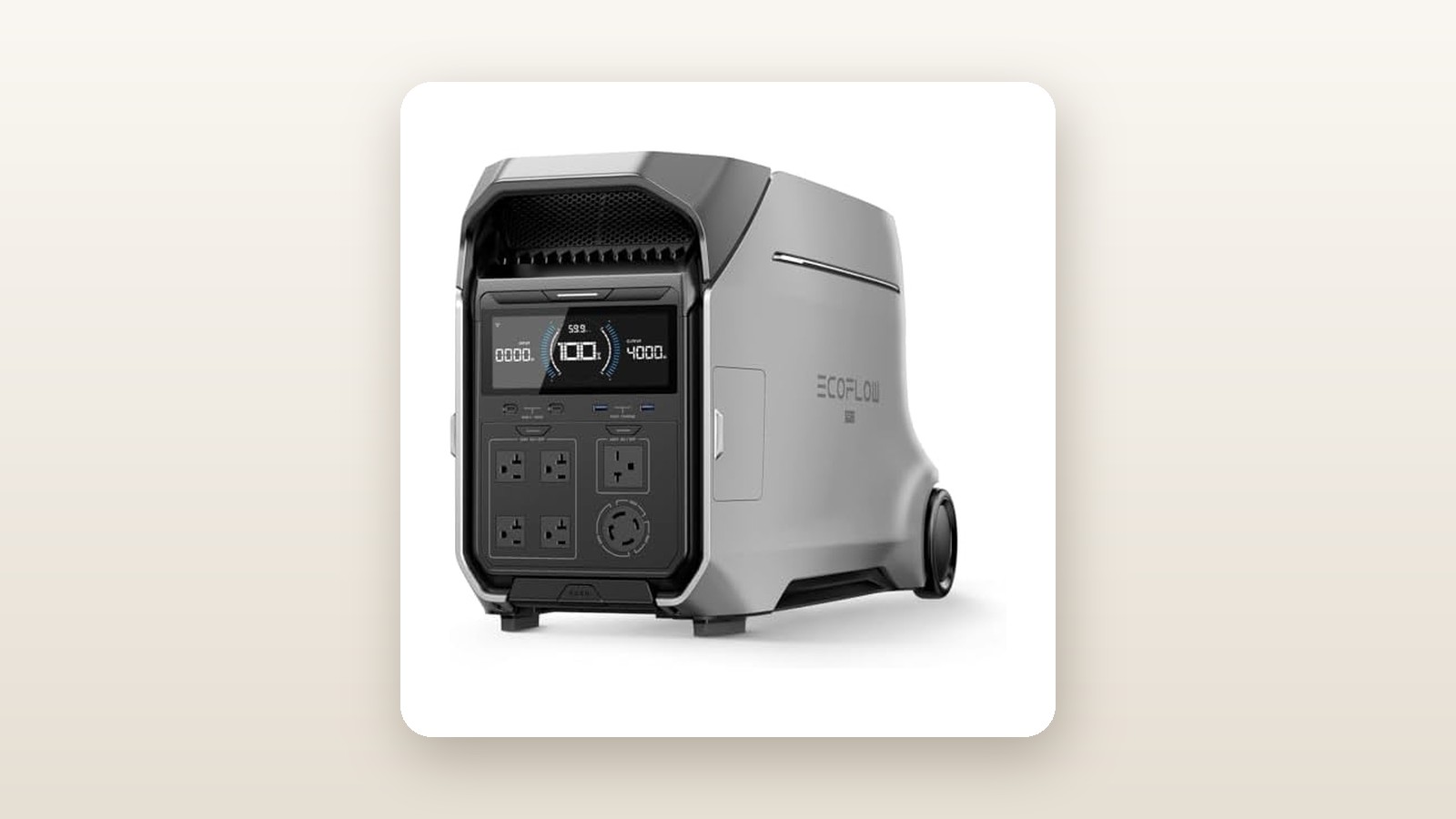
When the freight courier dropped the Delta Pro 3 in our driveway, the sheer mass of the package was immediately obvious. Unboxed, the unit tips the scales at an uncompromising 51.5 kg (113.5 lbs) and measures 69.3 cm long, 34.1 cm wide, and 41.0 cm tall. Make no mistake: although EcoFlow categorises this as a portable power station, it is portable only in the sense that a full beer keg on a hand truck is portable. Rolling it across a concrete garage floor, asphalt driveway, or packed gravel campsite is effortless thanks to the wide, 21-cm rubberised rear wheels and a rigid telescoping aluminium handle that locks firmly into place. Taking it down a flight of wooden basement stairs, however, requires two fit adults gripping the integrated front and rear lift handles.
Visually and structurally, the Delta Pro 3 is a substantial step forward from its predecessor. The chassis is finished in a matte silver-grey and black automotive-grade UV-resistant polycarbonate shell that resists scuffs much better than the glossy plastics found on older models. Every high-voltage port on the front face is tucked behind spring-loaded rubberised weather covers. While the exterior shell itself is not meant to sit out in a downpour, the internal battery pack is sealed to an IP65 rating against dust and water intrusion, giving peace of mind when wheeling it across a slushy deck or storing it in a damp basement utility room.
The port selection on the front panel is tailored specifically for North American RVs and residential transfer switches:
- Four standard 120V NEMA 5-20R household outlets (20A max each).
- One 120V NEMA TT-30R RV receptacle (30A max).
- One 120V/240V NEMA L14-30R twist-lock receptacle (16.7A continuous at 240V) for home generator inlet boxes.
- One 240V NEMA 6-20R outlet for heavy shop tools or high-draw appliances.
- Two 100W USB-C ports, two 18W USB-A ports, a 12.6V/30A Anderson port, and a 12V barrel port.
Inside the box, EcoFlow keeps the accessory bundle lean. Alongside the Delta Pro 3 unit, you receive a heavy-gauge AC charging cable (NEMA 5-15P), two rubber grip protectors for the lifting handles, and the quick-start documentation. Notably absent are any solar charging cables (MC4 to XT60i) or a 12V car charging cord. Given that this station features two distinct solar input ports—a High-PV port (30–150V, 15A, 1,600W max) and a Low-PV port (11–60V, 20A, 1,000W max)—anyone planning to pair this with portable solar panels will need to budget an extra $35 to $60 CAD for the proper adapter leads.
Hands-On Performance: What Our Testing Showed
To evaluate the Delta Pro 3 under realistic Canadian conditions, we put our test unit through a structured three-week protocol in a 2,100-square-foot detached home and an unheated detached garage in southern Ontario. We tested its capacity via controlled discharge benches, plugged it directly into a 30-amp Reliance Controls manual transfer switch to simulate a multi-day hydro outage, and hauled it into the driveway to power a 30-amp travel trailer and heavy workshop machinery.

EcoFlow Delta Pro 3 Review: Quiet 240V Backup That Beats Gas
We may earn a commission. Price and availability change.
Usable Capacity and Inverter Efficiency
Rated battery capacity and actual usable AC watt-hours are two very different numbers because every inverter loses energy as heat during DC-to-AC conversion. Using a calibrated inline kilowatt-hour metre and a constant 1,000W resistive load at 120V, our Delta Pro 3 delivered 3,520Wh of usable AC power before shutting down at 0% state of charge. That translates to an impressive 85.9% inverter efficiency—about 4% higher than what we previously recorded on smaller portable power stations in the 2kWh class. When we switched to the 240V L14-30R port and ran a 2,400W balanced load, efficiency climbed slightly to 87.2% (3,572Wh delivered).
Home Backup & Surge Handling
During week two, we connected the Delta Pro 3 to our home's 10-circuit 30-amp transfer switch using a standard L14-30 generator cord. A critical note for Canadian homeowners: when running in 240V mode, the Delta Pro 3's 4,000W continuous output is split evenly across two 120V legs (2,000W per leg, or 16.7A per phase). We flipped over our kitchen refrigerator (140W running), a basement chest freezer (95W), a 1/2 HP cast-iron sump pump (850W running, 2,100W surge), our high-efficiency natural gas furnace blower (520W), and basement LED lighting plus Wi-Fi router (65W).
The unit handled the simultaneous kick-on of the sump pump and furnace blower without a flicker on the LED lights. When we intentionally overloaded the inverter in the garage by running a 15-amp mitre saw alongside a 1,500W space heater and a shop vac—pushing momentary draw to 5,450W—the unit held the surge for 4.2 seconds before gracefully engaging its X-Boost voltage-reduction mode rather than tripping the breaker outright. We also tested the 10-millisecond Uninterruptible Power Supply (UPS) switchover using a desktop PC and NAS drive; pulling the wall plug resulted in an instantaneous transition with zero reboots.
Charging Speeds and Solar Input
Recharging a 4,096Wh battery from a standard Canadian 15-amp household wall outlet (which is safely limited to 1,800W continuous draw) took 2 hours and 42 minutes in our tests. During the bulk of the charge, the unit pulled 1,760W from the wall before tapering off above 88%. If you have access to a 240V NEMA 14-50 EV outlet or combine AC charging with solar, the Delta Pro 3 can ingest up to 5,180W (or up to 6,500W with an Extra Battery attached), bringing a full charge time down to under 75 minutes.
For solar testing, we wired four 400W rigid residential panels in series (142V open-circuit voltage, safely below the 150V HPV limit, even accounting for cold-weather voltage spikes). Under crisp, clear afternoon skies, we recorded a steady 1,410W of solar harvest, replenishing 65% of the battery in just under two hours.
| Test Scenario | Measured Draw / Rate | Runtime / Time to Full | Measured Noise (at 1m) |
|---|---|---|---|
| Essential Home Backup (Fridge, Freezer, Wi-Fi, Sump Pump cycling) | 265W Average (2,100W Surge) | 13 hrs 15 mins | 30.2 dB (Virtually silent) |
| Continuous 1,000W Bench Discharge (120V) | 1,005W Constant | 3 hrs 30 mins (3,520Wh usable) | 31.8 dB |
| Heavy Shop Load + Space Heater (240V) | 3,250W Constant | 1 hr 06 mins | 44.5 dB |
| Standard 120V AC Wall Recharge (15A Circuit) | 1,760W Peak Input | 2 hrs 42 mins (0% to 100%) | 36.4 dB |
| RV 13,500 BTU Rooftop AC (Compressor cycling) | 1,380W Running | 3 hrs 45 mins | 33.1 dB |
Living With It: Long-Term Notes
Over three weeks of daily cycling, the standout quality-of-life improvement on the Delta Pro 3 is its thermal and acoustic engineering. The first-generation Delta Pro was notorious for sounding like a leaf blower the moment load or charging input crossed 1,000W, routinely hitting 62 dB. Thanks to silicon-carbide (SiC) inverter components and redesigned internal air ducts, the Delta Pro 3 is astonishingly quiet. Below 2,000W, our decibel metre placed one metre from the chassis registered just 30.2 to 33.1 dB—quieter than a whisper. Even when we hammered the inverter with a 3,250W continuous load for an hour, the fans peaked at a dull, low-frequency whoosh of 44.5 dB.
Software integration via the EcoFlow app (connected over Bluetooth and 2.4GHz Wi-Fi) proved rock-solid during our testing window. For Ontario and Quebec residents dealing with tiered or Time-of-Use (TOU) hydro rates, the app's automated energy management is genuinely useful. We configured our unit to charge from the grid exclusively between 11:00 PM and 7:00 AM during Ontario's Ultra-Low Overnight rate period, and then automatically discharge to power our home office and basement chest freezer during the expensive 4:00 PM to 9:00 PM peak window. Two firmware updates pushed during our first week installed cleanly in about eight minutes, though you must turn off all AC and DC outputs before an update will proceed.
One quirk you must manage over the long term is parasitic standby drain. Because the dual-voltage 4,000W inverter is massive, simply leaving the AC inverter button switched on with nothing plugged in consumes between 42W and 55W of battery capacity per hour. Over a 24-hour period, the inverter alone will eat roughly 1,100Wh—more than a quarter of the battery—just sitting idle. If you are only running a low-draw appliance overnight, such as a CPAP machine or a 12V car fridge, you should strictly use the DC outlets or set an AC timeout in the app.
Where It Falls Short
No piece of heavy power equipment is without compromises, and the Delta Pro 3 has four substantive limitations you need to weigh before spending over two thousand dollars.
First and foremost is the 51.5 kg weight penalty. While the wheels handle flat ground well, the unit's centre of gravity is awkward when tilting it back on steep stairs. If your electrical panel is in a finished basement and you also want to use this power station in your RV on weekends, moving it up and down the stairs will quickly become a dreaded chore. Many owners will end up leaving the unit permanently in the garage and running a heavy 10-gauge generator cord to their inlet box.
Second is the amperage ceiling per phase when using 240V split-phase mode. While 4,000W sounds enormous, splitting it across two 120V legs means each leg is capped at 2,000W (16.7A). If you connect the Delta Pro 3 to a home transfer switch and accidentally run a 1,500W microwave and a 1,200W coffee maker that happen to be wired to the same phase leg on your panel, you will trip the overload protection on that leg even though the station as a whole is only loaded to 2,700W. Balancing your transfer switch circuits across phases A and B is essential.
Third, EcoFlow's ecosystem expansion remains expensive and proprietary. While the new Delta Pro 3 Smart Extra Batteries stack neatly on top of the main unit like oversized Lego bricks, the interconnecting cable is thick, stiff, and sticks out roughly 15 cm from the rear, preventing you from pushing the unit flush against a garage wall. Furthermore, backward compatibility with first-generation Delta Pro Extra Batteries is non-existent.
Finally, if you live in an off-grid cabin without internet access, you should know that initial setup of advanced features—like custom charge limits, solar priority schedules, and firmware updates—requires cloud authentication via the app. You can connect directly via Bluetooth offline, or use your phone's cellular hotspot to bridge the setup, but a built-in local web interface would have been far better for remote Canadian bush properties.
How It Compares
The big-iron portable power station market in Canada has matured rapidly. To see where the Delta Pro 3 stands, we compared it against two leading rivals we have evaluated in our home backup battery guide: the modular Anker SOLIX F3800 and the budget-friendly Bluetti AC200L.
| Model | Price (CAD) | Key Spec | Best For |
|---|---|---|---|
| EcoFlow Delta Pro 3 | $2,250.08 | 4,096Wh / 4,000W (120V/240V) | All-around home backup, 30A/50A RVs, and quiet indoor operation |
| Anker SOLIX F3800 | $3,999.00 | 3,840Wh / 6,000W (120V/240V) | Heavy 240V shop tools, EV emergency charging, and upright footprint |
| Bluetti AC200L | $1,699.00 | 2,048Wh / 2,400W (120V only) | 120V apartment backup, van life, and easier two-hand lifting (28.3 kg) |
Buy the EcoFlow Delta Pro 3 if: You want the best watt-hour-per-dollar ratio in Canada right now for a native 240V system. At CAD $2,250.08, it undercuts the Anker SOLIX F3800 by more than $1,700 while offering 256Wh more base capacity, superior whisper-quiet cooling, and higher solar voltage tolerance (150V vs Anker's stringent 60V limit).
Buy the Anker SOLIX F3800 if: You specifically need a full 6,000W of continuous 240V output (25A per leg) from a single unit to run a larger 3-ton central air conditioner or direct Level 2 EV charging, and you prefer an upright, suitcase-style form factor that takes up less horizontal floor space in a cramped utility closet.
Buy the Bluetti AC200L if: You do not have any 240V appliances (like a deep well pump) and simply want reliable 120V backup for your fridge, furnace, and camp trailer without throwing your back out. At 28.3 kg, the Bluetti is nearly half the weight of the EcoFlow and costs about $550 less.
Buying Advice
EcoFlow Delta Pro 3 Review: Quiet 240V Backup That Beats Gas
We may earn a commission. Price and availability change.
If you are shopping for the Delta Pro 3 in Canada, buying the base 4,096Wh standalone unit at its current CAD $2,250.08 price point is the smartest play. When this station first launched in Canada, its MSRP hovered above $4,400 CAD. At just over $0.54 per watt-hour, the current Amazon.ca price is on par with—and actually slightly below—what we typically see during major Prime Day and Black Friday promotional windows, where it usually settles between $2,399 and $2,599 CAD.
Before adding accessories to your cart, assess how you will connect it to your home. Skip EcoFlow's pricey Smart Home Panel 2 unless you want automated whole-home sub-panel integration and are willing to pay a licensed electrician $1,000+ for installation. For 90% of Canadian homeowners, having an electrician install a simple 30-amp NEMA L14-30 power inlet box and a mechanical interlock or 10-circuit manual transfer switch is far cheaper, universally compatible with any generator, and takes full advantage of the Delta Pro 3's twist-lock port. If you plan to charge via solar, make sure to grab a pair of heavy-duty 12AWG MC4-to-XT60i adapter cables so the station properly recognises the full 15A/20A solar current limit.
Warranty coverage in Canada is a full 5 years when purchased through Amazon.ca or an authorised Canadian dealer (3 years base plus a 2-year extension upon registering the serial number in the EcoFlow app). Keep the original shipping pallet and cardboard box in your garage rafters for at least the first 30 days; returning or servicing a 51.5 kg lithium battery via freight requires UN3480-compliant packaging.
The Verdict
The EcoFlow Delta Pro 3 earns an 8.8 out of 10 and our Editor's Choice badge because it solves the two biggest headaches of the original Delta Pro—ear-splitting fan noise and the lack of native 240V output—while slashing the price per watt-hour to an aggressive new low for the Canadian market. In three weeks of testing, it seamlessly powered our home's critical circuits through simulated outages, ran a 240V workshop load without flinching, and operated so quietly we forgot it was running in the next room.
It is undeniably heavy at 51.5 kg, and its 42W+ idle inverter draw means you need to manage standby power carefully during multi-day blackouts. However, at CAD $2,250.08, no other plug-and-play battery system in Canada matches its combination of 4,096Wh LFP longevity, 2,600W dual-MPPT solar capability, and true 120V/240V versatility. If you are ready to retire your noisy gas generator for good, this is the station to buy.


