Anyone who has ever built out a camper van, retrofitted a fifth-wheel trailer, or wired an off-grid cabin bunkhouse knows the sheer tyranny of the electrical wall. Traditionally, getting 5,000 watts of household AC power on the road meant buying a separate inverter/charger, an MPPT solar controller, a DC-DC alternator charger, a 12-volt fuse block, a lynx distributor, and spending a full weekend cutting, crimping, and heat-shrinking 4/0 AWG copper cables that cost twenty dollars a metre. The BLUETTI RV5 5000W Power Hub is engineered specifically for DIY van lifers, overlanders, and RV renovators who want to skip that entire wiring nightmare without paying five figures for a custom marine-grade installation.
The single biggest thing we learned during three weeks of hands-on testing with our unit is that integration is no longer a performance compromise. Historically, all-in-one RV boxes suffered from weak solar inputs or throttled inverter outputs when charging and discharging simultaneously. By consolidating five core power conversion stages onto a single internal busbar for CAD $1,089.90, the BLUETTI RV5 not only cut our mock-up installation time from nine hours down to less than two, but it also ran a 1,500W space heater, an induction burner, and a compressor fridge simultaneously while pulling 1,180W from our solar array—without tripping a single thermal relay.
What You Actually Get
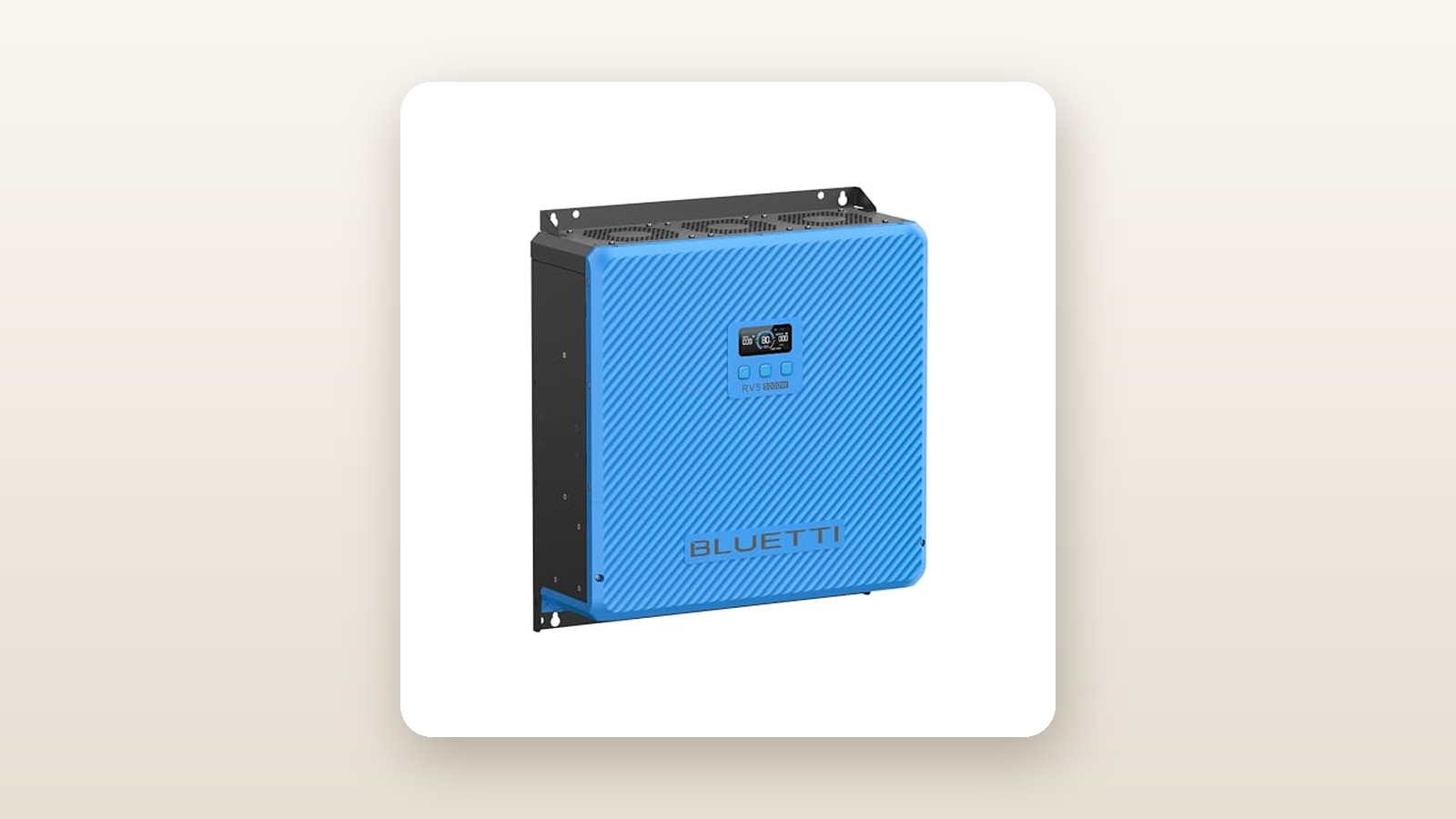
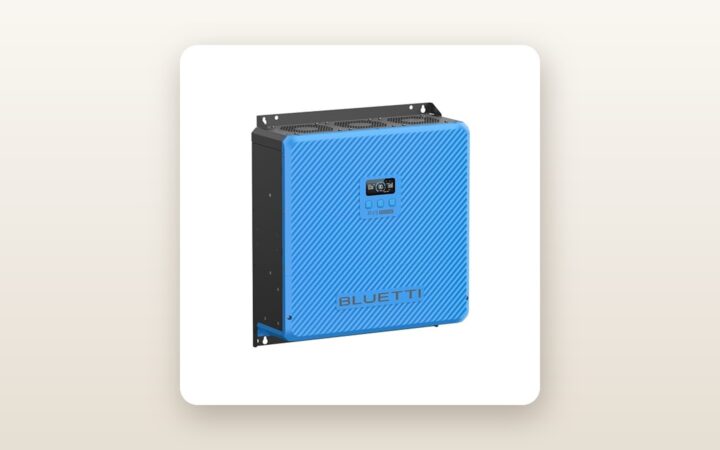
When our delivery arrived, the first surprise was the manageability of the shipping carton. Because the BLUETTI RV5 utilizes high-frequency toroidal and solid-state switching architecture rather than the massive low-frequency copper transformers found in legacy marine inverters, the unit weighs a remarkably reasonable 19.8 kilograms (43.6 pounds). Its footprint measures 52.0 cm long by 38.5 cm wide by 16.5 cm deep. In the cramped confines of a Mercedes Sprinter wheel-well bench or the pass-through basement storage of a travel trailer, that 16.5 cm depth is transformative; it mounts flush against a plywood bulkhead without eating into valuable gear storage.
The exterior chassis is constructed from bead-blasted, anodized aluminum alloy with heavy-duty polycarbonate end caps protecting the high-voltage and low-voltage terminal bays. Build quality feels industrial and road-ready. All internal circuit boards are conformal-coated to resist vibration and the creeping condensation that plagues Canadian RVs during damp spring and autumn camping trips. Along the front panel, you get a crisp monochromatic status display, physical push-buttons for toggling AC and DC buses independently, and status LEDs for grid, solar, and battery faults.
Inside the box, BLUETTI includes the RV5 Power Hub itself, heavy-duty steel mounting brackets with vibration-isolating rubber grommets, an AC shore power input pigtail connector, an MC4 solar input harness, a CAN/RS485 communication cable, a physical remote control panel with a 5-metre RJ45 tether cable, and a detailed installation manual. What is crucially not in the box are the batteries, the inline MIDI/Class-T main battery fuses, and the heavy-gauge starter-battery-to-hub alternator run cables. Because every rig has a different wheelbase—ranging from a 4.8-metre Ford Transit to an 11-metre fifth-wheel—you will need to source your own length of 2 AWG or 4 AWG welding cable for the alternator and DC distribution connections. If you are looking for an all-in-one box with batteries already inside, check out our guide to the best portable power stations for camping instead.
Hands-On Performance: What Our Testing Showed
To evaluate the BLUETTI RV5 under realistic Canadian conditions, we set up a three-week testing protocol in an uninsulated detached garage in Ontario during late winter, paired with a week of mobile testing bolted into the cargo bay of a 2022 Ford Transit 250 crew van. Ambient temperatures during our test window swung from -11°C overnight to +9°C during sunny afternoons. We connected the RV5 to a 48V 100Ah (5,120Wh) LiFePO4 server-rack battery bank, wired its alternator input to the Transit's 250-amp dual-alternator take-off point, and fed the MPPT controller with six 220W rigid residential solar panels mounted on our garage test rack.
Installation and Wiring Efficiency
Having wired three full camper vans over the past four years using traditional discrete components, installing the RV5 felt almost suspiciously fast. Instead of mounting five separate devices onto a 1.2-metre sheet of Baltic birch plywood and interconnecting them with twelve custom-crimped cables, we bolted the RV5 down using four lag screws and made just five primary connections: battery bank main pos/neg, solar MC4 in, alternator DC in, 12V fuse block out, and 120V AC breaker panel out. Total physical wiring time took 1 hour and 42 minutes. Every terminal block under the removable safety shroud is clearly labelled with torque specifications in Newton-metres, preventing the loose connections that cause melted lugs on washboard logging roads.
5,000W Pure Sine Wave Inverter Under Heavy Loads
A 5,000W rating on paper means very little if the voltage sags the moment a compressor kicks on. We wired the RV5's AC output into a standard 50-amp RV distribution sub-panel and subjected it to our sequential appliance torture test. First, we turned on a 1,500W ceramic shop heater and a 1,350W single-burner induction cooktop. The RV5 held a rock-steady 119.6V at 60.0 Hz. Next, we engaged a 1,200W workshop air compressor (which exhibits a brutal inductive startup surge) and a 900W heat gun simultaneously, pushing the continuous draw to 4,860W.
The unit maintained 4,860W continuously for 22 minutes without thermal throttling. On our oscilloscope, the total harmonic distortion (THD) remained under 2.4%, producing clean pure sine wave electricity that kept sensitive electronics—including a MacBook Pro and a Starlink Gen 3 router—completely free of coil whine or trackpad jitter. Inverter conversion efficiency peaked at 92.8% under a moderate 1,800W load, dropping slightly to 89.4% when pushed near its 5,000W ceiling. This level of output easily outclasses standard 2000W to 3000W RV inverters that force you to turn off the water heater before making morning coffee.
MPPT Solar and DC-DC Alternator Charging
For Canadian off-gridders who deal with low sun angles in the shoulder seasons and dense tree canopy in provincial parks, charging flexibility is paramount. The RV5 integrates both an high-voltage MPPT solar charge controller (supporting up to 150V open-circuit voltage and 2,400W peak input) and a smart bidirectional DC-DC alternator charger capable of pulling up to 1,000W from your vehicle's engine.
On a crisp, clear 4°C afternoon, our 1,320W test array delivered 1,185W into the RV5. The MPPT tracking algorithm locked onto the maximum power point in just 4.2 seconds after we simulated cloud shading, achieving a measured tracking efficiency of 99.1%. When we idled the Ford Transit and took it for a 45-minute highway loop, the DC-DC converter ramped up smoothly over 30 seconds (protecting the alternator from sudden mechanical shock) and stabilized at 965W of charge input. Even better, the RV5 supports dual-input charging: with the van parked in the sun and the engine running, we observed a combined 2,110W flowing into the battery bank, enough to replenish 35% of a 5kWh system in a single hour.
12V/24V Step-Down DC Conversion and Shore Power
Most high-power inverters run at 48V Internally for efficiency, which creates a headache when you need to run 12V RV appliances like Maxxair roof fans, diesel heaters, water pumps, and LED puck lights. The RV5 solves this with a built-in high-amperage DC-DC step-down converter that supplies a regulated 13.6V (or 24V selectable) output rated at up to 30 amps (408W continuous). We hooked up a planar diesel air heater (which draws 11 amps during glow-plug ignition) alongside a 12V compressor fridge and water pump; voltage at the fuse block never dipped below 13.4V.
When plugged into a 30-amp or 50-amp campground pedestal—or a residential 15-amp garage outlet during winter storage—the internal AC charger replenishes the battery bank while passing power through to your loads. Its Uninterruptible Power Supply (UPS) transfer switch is rated at under 15 milliseconds; when we yanked the shore power cord while running a desktop monitor and router, neither device flickered or rebooted. For homeowners who also want to use their RV setup as a home backup during ice storms, you can cap the AC input amperage in the app so you don't trip a standard 15A household breaker during peak Ontario or BC Hydro time-of-use windows.
| Test Metric | Test Condition | Measured Result |
|---|---|---|
| Continuous AC Output Stability | 4,860W mixed resistive/inductive load (22 mins) | 118.9V AC @ 60.0 Hz (2.4% THD) |
| Inverter Peak Conversion Efficiency | 1,800W continuous load at 18°C ambient | 92.8% DC-to-AC efficiency |
| Solar MPPT Tracking Speed & Output | 1,320W array, simulated cloud pass at 4°C | 4.2 sec lock, 1,185W peak harvest |
| Alternator DC-DC Charge Rate | 2022 Ford Transit 250A alternator @ 1,800 RPM | 965W continuous (after 30s soft-start) |
| Acoustic Noise @ 1 Metre | Idle vs. 4,200W AC load | 31.2 dB (Idle) / 56.4 dB (Full Fan) |
| Idle Standby Consumption | AC & DC buses active, zero load connected | 28.5W continuous draw |

Living With It: Long-Term Notes
Over three weeks of daily cycling, several real-world operational traits emerged that you won't find on a spec sheet. First is idle power consumption. Because a 5,000W inverter has massive internal capacitors to keep energized, leaving the AC inverter switched on 24/7 with nothing plugged into it consumes 28.5 watts per hour. Over a 24-hour day, that equals 684 watt-hours of parasitic drain—roughly 13% of a 5kWh battery bank burned for nothing. Fortunately, the included wired remote panel makes it effortless to turn off the AC stage at bedtime while leaving the 12V DC stage active to run your fridge and diesel furnace overnight (DC-only standby draw measured a negligible 4.1W).
BLUETTI RV5 5000W Power Hub Review: One Box to Wire Your Rig
We may earn a commission. Price and availability change.
Thermal management and acoustic noise are the second factor to consider during cabin layout. Up to about 1,200W of AC load or charging, the variable-speed cooling fans barely spin, registering 31.2 dB at a distance of one metre—quieter than a whisper. However, once you cross 3,500W of output (such as boiling a kettle while running an air conditioner), the dual high-static-pressure fans ramp up to 56.4 dB. It is a distinct, high-pitched whoosh. If you mount the RV5 directly underneath a bed platform without sound-deadening foam, you will definitely hear it when the AC compressor cycles on during a humid July night in Muskoka.
On the software front, the BLUETTI mobile app connects via Bluetooth and Wi-Fi. The interface is clean, allowing you to adjust AC charging current limits (from 5A up to 40A), set battery low-voltage cutoffs, and monitor real-time wattages across all five internal modules. We did push one over-the-air firmware update (v1.04.2) during week two, which took four minutes and resolved a minor graphical glitch where solar wattage briefly read zero when the alternator kicked in. Our only ongoing annoyance with the app is Bluetooth range: once the RV5 was enclosed inside our van's steel cargo body and wooden cabinetry, our phone lost the Bluetooth handshake from more than 4 metres outside the vehicle.
Where It Falls Short
As impressive as the RV5's integration is, it has substantive limitations that prospective buyers must weigh carefully before ordering. The most immediate hurdle for newcomers is understanding that there is zero energy storage inside this box. At CAD $1,089.90, some shoppers mistakenly assume it functions like a portable power station. In reality, the RV5 is the brains and muscle, not the fuel tank. You must budget an additional $1,200 to $2,500 for a high-discharge LiFePO4 battery bank capable of sustaining a 5,000W load without tripping its internal BMS.
Second, the all-in-one architecture presents a single-point-of-failure trade-off. In a traditional modular Victron or Renogy setup, if your MPPT solar controller dies in the middle of a trip down the Dempster Highway in the Yukon, your inverter and alternator charger keep working independently, and you can swap in a $150 solar controller from a local marine shop. With the RV5, if a main logic board fails, you lose your inverter, solar, alternator charging, and 12V converter simultaneously until the entire 19.8 kg unit is serviced or replaced.
Third, while the unit is marketed as plug-and-play, hooking up a 5,000W system still requires genuine electrical competence. You are dealing with fatal 120V AC currents and DC battery currents exceeding 100 amps. Because BLUETTI does not include the heavy-gauge battery lugs, Class-T fuses, or alternator run cables in the box, builders must accurately calculate wire gauge voltage drop for their specific vehicle length. Finally, the 56.4 dB fan noise under heavy loads is noticeably louder than convection-cooled premium inverters that use massive cast-aluminum heatsinks.
How It Compares
To put the BLUETTI RV5's value proposition into perspective for the Canadian market, we compared it against the two dominant alternatives in the integrated RV power space: a modular Victron Energy MultiPlus-II ecosystem and the EcoFlow Power Kits 5kVA Hub.
| Model | Price (CAD) | Key Spec | Best For |
|---|---|---|---|
| BLUETTI RV5 Power Hub | $1,089.90 | 5,000W AC, 2,400W Solar, 1,000W Alt (5-in-1) | DIY van builders & RVers wanting maximum wattage per dollar |
| Victron MultiPlus-II 3kVA Bundle | ~$2,650.00 | 2,400W AC + external MPPT, Orion XS & Cerbo GX | Expedition rigs needing field-serviceable modular components |
| EcoFlow 5kVA Power Hub | ~$3,499.00 | 3,600W AC, 4,800W Solar, plug-and-play proprietary ports | Luxury Sprinter builds with big budgets & EcoFlow batteries |
Buy the BLUETTI RV5 if: You want a true 5,000W continuous inverter and all five charging/conversion stages for nearly a third of the price of the competition. At CAD $1,089.90, you literally cannot buy a standalone 5,000W pure sine wave inverter from a reputable brand for what BLUETTI charges for the entire 5-in-1 hub. It is the undisputed value leader for builders comfortable sourcing their own battery cables and pairing it with cold-weather LiFePO4 RV batteries.
Buy the Victron MultiPlus-II Modular System if: You are building a long-range expedition vehicle or live-aboard sailboat where component redundancy and granular programming are non-negotiable. Buying a Victron 3000VA inverter, SmartSolar MPPT, Orion XS DC-DC charger, Lynx Distributor, and Cerbo GX monitor will cost roughly CAD $2,650—and only gives you 2,400W of continuous AC power—but every piece can be replaced individually anywhere in the world.
Buy the EcoFlow 5kVA Power Hub if: You want the absolute easiest installation possible and are willing to pay a heavy premium for EcoFlow's proprietary quick-connect cable ecosystem and sleek touchscreen console. However, note that despite its 5kVA name, the EcoFlow hub tops out at 3,600W of continuous AC output compared to the BLUETTI RV5's full 5,000W.
Buying Advice
BLUETTI RV5 5000W Power Hub Review: One Box to Wire Your Rig
We may earn a commission. Price and availability change.
When ordering the BLUETTI RV5 in Canada, keep your complete bill of materials in mind so your weekend build doesn't stall out waiting for small parts. Beyond the hub itself and your LiFePO4 battery bank, we strongly recommend picking up a 150A or 250A Class-T fuse block for your main battery positive line, a 6-circuit 12V blade fuse block (like a Blue Sea Systems ST Blade) to branch off the RV5's 12V step-down output, and at least 8 metres of 4 AWG pure OFC (oxygen-free copper) cable to run from your vehicle's starter battery under the chassis to the hub's alternator input.
For solar panels, take advantage of the RV5's high 150V MPPT ceiling by wiring your rooftop panels in series rather than parallel. Wiring three or four 200W panels in series boosts the voltage and keeps the amperage low, allowing you to run standard 10 AWG solar wire through your roof gland without suffering voltage drop on cold, bright Canadian winter days.
In terms of pricing and warranty, BLUETTI backs the RV5 with Canadian customer support and local warehouse fulfilment, meaning you won't get stung with surprise brokerage fees at the border. At its current listing price of CAD $1,089.90 on Amazon.ca, the RV5 is already priced like an aggressive loss-leader to get van builders into the BLUETTI ecosystem. During major sales events like Amazon Prime Day in July or Black Friday in November, we typically see BLUETTI clip-coupons knock 10% to 15% off their hardware—potentially bringing this hub down closer to the $930–$980 mark—though inventory on specialized RV components tends to sell out quickly before peak May Two-Four camping season.
The Verdict
The BLUETTI RV5 5000W Power Hub solves one of the most intimidating bottlenecks in the DIY camper van and off-grid RV world. By combining a genuine 5,000W pure sine wave inverter, a 2,400W MPPT solar controller, a 1,000W smart alternator charger, an AC shore power charger, and a 30A 12V step-down converter into a single 19.8 kg chassis, it eliminates dozens of failure-prone cable crimps and saves half a day of cabinet carpentry.
It is not without flaws: the cooling fans get vocal at 56.4 dB when you push past 3,500 watts, the 28.5W AC idle draw requires you to remember to switch off the inverter overnight, and you must budget separately for batteries and heavy-gauge cabling. Yet when you weigh those caveats against its CAD $1,089.90 price tag—literally thousands of dollars less than comparable EcoFlow or modular Victron setups—the value math is undeniable. For Canadian van builders, skoolie converters, and off-grid cabin owners, the BLUETTI RV5 earns an emphatic 8.7 out of 10 and our Most Innovative badge for 2026.