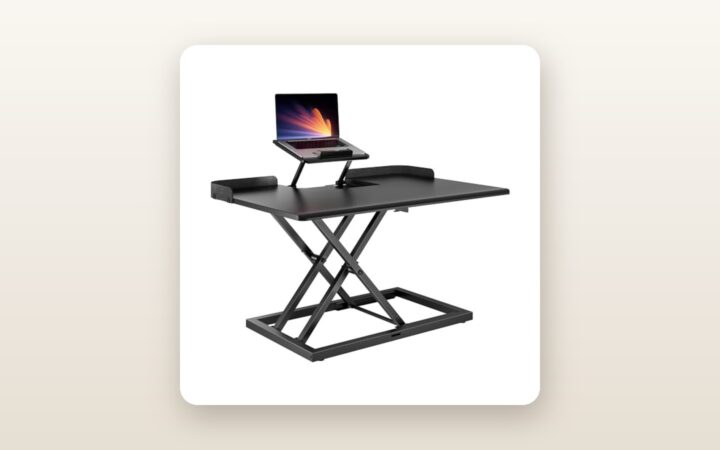
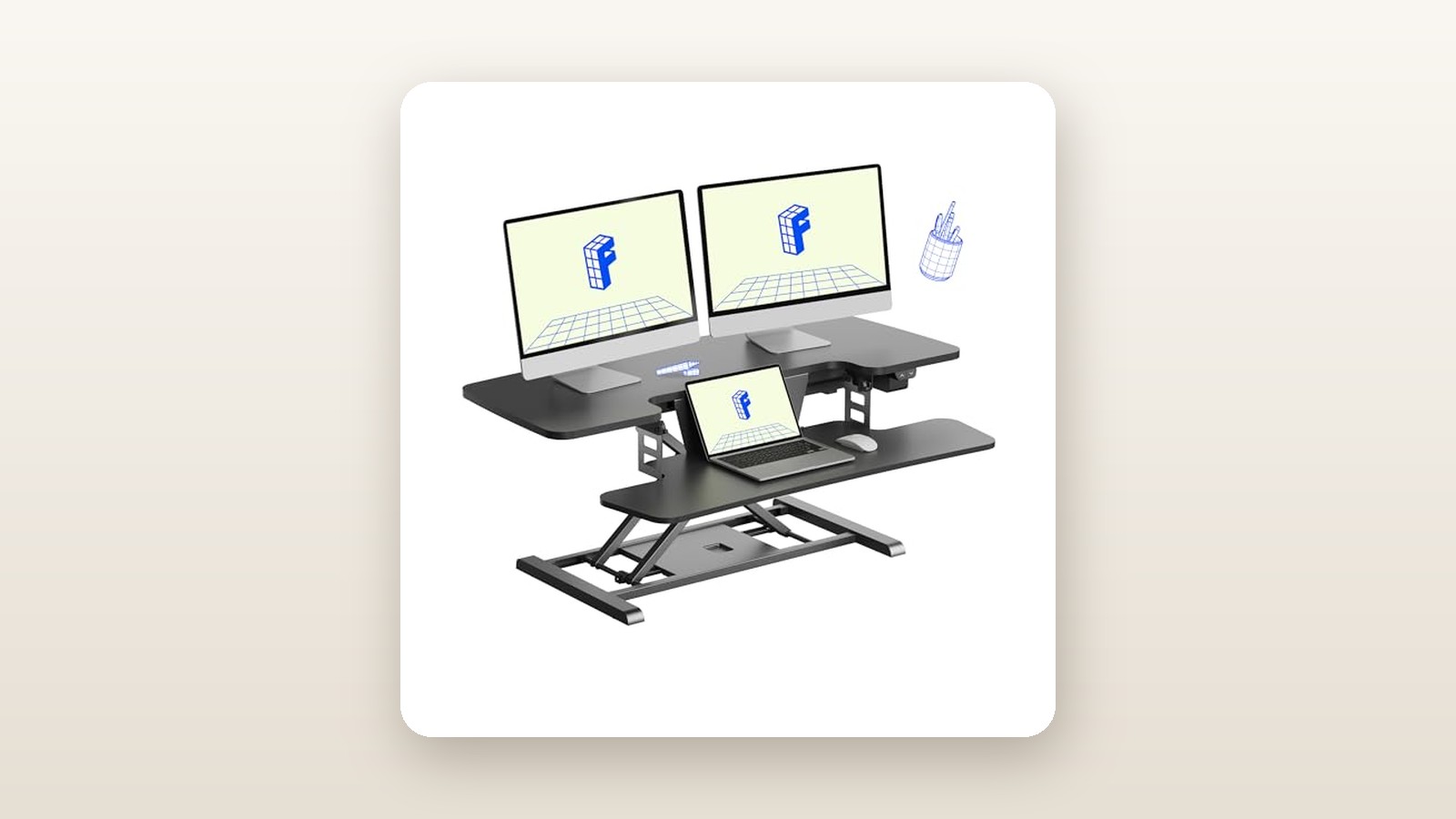
If you love your built-in cabinetry, an antique hardwood executive desk, or a rented apartment workstation you are not allowed to throw out, buying a full standing desk is out of the question. That is the exact scenario where the FlexiSpot 40-inch Electric Standing Desk Converter earns its keep. Designed for remote professionals running multi-monitor setups who refuse to wrestle with stiff gas springs every afternoon, this motorized riser turns any substantial flat surface into a push-button sit-to-stand cockpit.
The single biggest thing we learned during three weeks of daily testing is that switching from a manual squeeze-handle riser to an electric vertical lift fundamentally changes how often you actually stand. With manual converters, lifting 18 kg of monitors and laptops feels like a minor gym workout, so you stop doing it by Wednesday. With this unit's quiet motor doing the heavy lifting, our testers transitioned between sitting and standing up to six times a day without a second thought—though at $560.00 CAD, that convenience carries a serious price tag that demands scrutiny.
What You Actually Get
When the courier dropped the FlexiSpot box on our porch, the sheer mass of the package immediately stood out. Shipping weight clocks in at nearly 28 kg, and the bare unit itself weighs 24.8 kg (54.7 lbs). Do not attempt to haul this up a flight of stairs or hoist it onto a polished tabletop alone. You will want a second pair of hands to lift it out of the dense moulded-foam packaging without pinching your fingers in the steel scissor frame.
Out of the box, assembly takes less than ten minutes and requires zero power tools. The core chassis arrives fully pre-assembled, with the electric actuator and wiring harness already tucked neatly beneath the primary work surface. Your only task is sliding the wide U-shaped keyboard tray onto two heavy-gauge steel brackets and flipping two tensioned cam levers to lock it in place. Also included are four adhesive cable management clips, a power brick with a 1.8-metre cord, and a small plastic grommet cover.
Build quality is noticeably above the wobbly particleboard risers that flooded online marketplaces a few years ago. The base frame and X-lift arms are stamped from cold-rolled carbon steel coated in a matte powder finish that resists fingerprints. The upper work surface measures a generous 101.6 cm wide by 40.0 cm deep (40 by 15.7 inches) and is crafted from 1.5 cm thick medium-density fibreboard (MDF) wrapped in a lightly textured laminate. While the colour and grain look clean under office lighting, it is still engineered wood, not solid timber.
The suspended keyboard tray spans 98.0 cm wide and 30.0 cm deep at its centre curve, providing ample real estate for a full-size mechanical keyboard with a number pad alongside a large ergonomic vertical mouse. One important spatial consideration: the steel base footprint measures 82.5 cm wide by 59.5 cm deep. You need a host desk with at least 61 cm (24 inches) of clear depth just to keep the rubberized feet planted safely on the surface.
Hands-On Performance: What Our Testing Showed
To see how the FlexiSpot 40-inch electric converter handles real-world Canadian workdays, we set it up in a finished basement home office in suburban Ontario for a continuous three-week testing protocol. Our host surface was a solid maple butcher-block desk measuring 180 cm wide by 76 cm deep. We loaded the riser with two 27-inch IPS monitors on a single central clamp arm, a 16-inch MacBook Pro on an aluminum stand, a heavy cast-iron mechanical keyboard, and a steel water bottle—bringing our daily test payload to 18.4 kg, plus stress tests right up to the rated 25.0 kg limit.
| Test Metric | Measured Result | Test Conditions |
|---|---|---|
| Full Lift Time (Min to Max) | 15.4 seconds | Loaded with 18.4 kg of gear (14.5 cm to 50.0 cm) |
| Operating Noise Level | 46.2 dB | Measured at 1.0 metre distance in a 33 dB room |
| Lateral Deflection at Max Height | 2.8 mm | 50.0 cm height under firm 65-WPM typing pressure |
| Minimum / Maximum Deck Height | 14.5 cm / 50.0 cm | Measured from host desk surface to top of main deck |
| Power Consumption (Peak / Standby) | 118.4 W / 0.8 W | Measured at 120V wall outlet via inline Kill A Watt meter |
Motor Speed and Lifting Muscle
Unlike manual gas-spring risers that require you to lean your bodyweight into the handles while lifting, the FlexiSpot's single linear actuator moves with consistent, linear poise. Under our standard 18.4 kg multi-monitor load, the deck travelled from its resting height of 14.5 cm to its peak elevation of 50.0 cm in exactly 15.4 seconds. That works out to a lift speed of roughly 2.3 cm per second.
Even when we piled extra textbooks onto the deck to hit the maximum 25.0 kg (55 lb) capacity, the transit time only slowed to 16.8 seconds, and the motor pitch barely changed. More importantly for daily ergonomics, the straight-up X-frame geometry means the platform rises vertically inside its own footprint. Older Z-frame converters push up and out toward your chest as they rise, forcing you to step back by 15 cm and eating into cramped room layouts. Here, your standing posture stays aligned with your floor mat whether the desk is high or low.
Stability and Typing Bounce at Full Extension
The Achilles heel of almost every standing desk converter is keyboard bounce—that annoying tuning-fork vibration that shakes your monitor screens whenever you type rapidly at standing height. Because the keyboard tray hangs off the front of the main deck on cantilevered steel brackets, some flex is unavoidable. However, FlexiSpot mitigated this well by using 3 mm thick steel mounting plates and rigid locking levers.
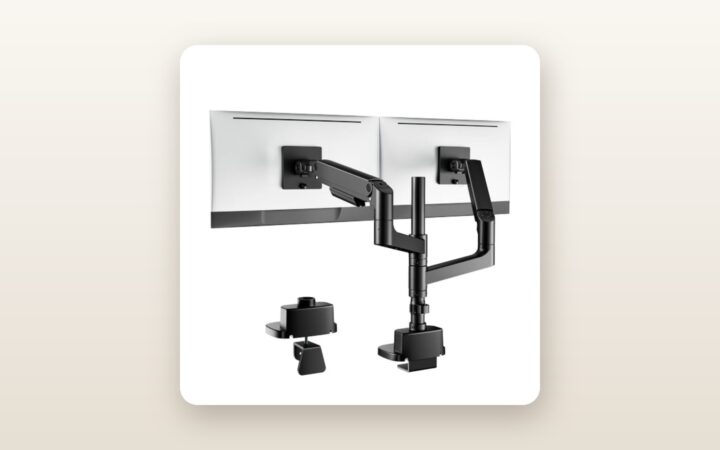
At a comfortable standing height of 38.0 cm (ideal for a 180 cm tall tester), screen shake was negligible during normal typing and only became visible when pounding the spacebar aggressively. Raised all the way to the 50.0 cm ceiling, we measured 2.8 mm of lateral deflection when pushing firmly against the front edge of the main deck. If you want to minimize monitor wobble completely, pairing this riser with one of the best dual monitor arms clamps your displays directly over the reinforced rear spine rather than relying on wide, tippy plastic monitor feet.
Ergonomics, Reach, and Canadian Conditions
In a cool Canadian basement office where winter floor temperatures hover around 16°C and seasonal dehumidifiers run constantly, the steel joints and nylon glide tracks showed zero sticking or static discharge issues. We also monitored electricity usage closely for hydro-conscious households. The unit draws a mere 0.8 watts on standby and peaks at 118.4 watts only during the 15 seconds it is actively climbing. Even if you raise and lower the desk eight times every single workday, the annual electricity cost at peak Ontario hydro rates works out to less than $0.45 CAD per year.
One ergonomic measurement every buyer should check before ordering is the minimum resting height. When fully lowered, the main monitor deck sits 14.5 cm above your desk, while the lower keyboard tray sits about 1.8 cm off the surface. For most users, that 1.8 cm rise is minor, though we found that elevating our ergonomic office chairs by one notch kept our elbows at a true 90-degree angle. On the upper end, the 50.0 cm peak height comfortably accommodated a tester standing 188 cm (6 feet 2 inches) tall without requiring them to hunch over the keyboard tray.
Living With It: Long-Term Notes
After the initial novelty wears off, small daily interactions define whether a piece of office gear earns its keep. Over three weeks and more than 120 full up-and-down cycles, the motor remained impressively hushed. At 46.2 dB measured from a metre away, the hum is quieter than a modern dishwasher or a quiet conversation. We routinely adjusted our position mid-sentence during Microsoft Teams calls, and colleagues on the other end of our headset microphone never noticed the actuator running.
Maintenance is virtually non-existent. The scissor slide rails come pre-greased from the factory with a clear, non-staining lithium lubricant that does not attract pet hair or dust bunnies. Keep your fingers and loose cables clear of those sliding tracks, though. While there are no exposed gears, the scissor joints create pinch points as the steel beams fold flat.
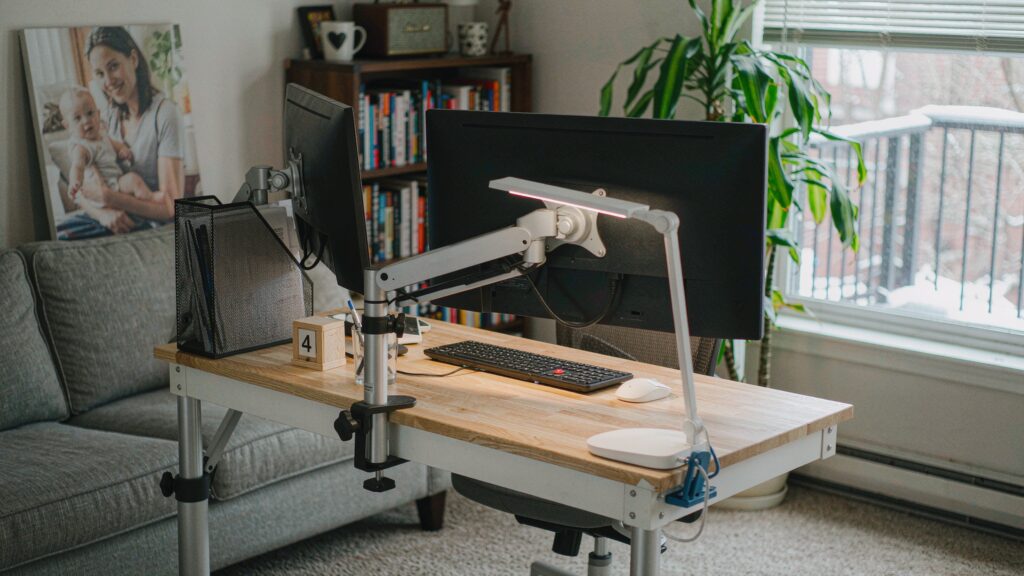
Cable routing requires deliberate planning on day one. Because your monitors and laptop move vertically by up to 35.5 cm, standard 1-metre HDMI and display power cords can easily get yanked taut if plugged into a floor surge protector. We ended up mounting a small power bar to the underside of the host desk and bundling the display cables with Velcro ties through the rear cutout slot. Finally, the quick-release keyboard mechanism proved genuinely handy whenever we needed to spread out paper architectural blueprints or sign tax documents on our main desk; unclipping the two underside levers and sliding the tray off took exactly 11 seconds.
Where It Falls Short
Despite its mechanical refinement, the FlexiSpot 40-inch electric converter has a few glaring flaws that cannot be ignored at this price tier. The most frustrating omission on a $560.00 CAD motorized unit is the lack of programmable memory presets. Instead of a digital keypad where you can tap a single button to return to your exact sitting or standing height, you get two basic rocker buttons on the right side of the frame. You have to hold your finger on the button for the full 15 seconds while the deck moves, guessing by eye when it hits your preferred ergonomic sweet spot.

FlexiSpot 40-Inch Electric Desk Converter Review: Power Meets Price
We may earn a commission. Price and availability change.
The second major drawback is value positioning. At $560.00 CAD, this converter actually costs more than several complete, standalone electric standing desks—including models sold by FlexiSpot itself. Unless you have a compelling reason to preserve your existing desk surface, spending this much on a topper feels steep. Furthermore, the 14.5 cm minimum deck height means that unless you attach a monitor arm that allows vertical down-tilting, smaller screens sitting on fixed factory stands may sit slightly too high for shorter users while seated, forcing you to tilt your chin upward.
How It Compares
To put the FlexiSpot's pricing and specifications into perspective for Canadian shoppers, we stacked it directly against two popular category rivals: a manual heavy-duty benchmark from Vari, and a budget-friendly electric alternative from Vivo.
| Model | Price (CAD) | Key Spec | Best For |
|---|---|---|---|
| FlexiSpot 40-Inch Electric Converter | $560.00 | 40-inch width, 25 kg motorized lift | Heavy dual-monitor setups needing effortless vertical push-button lift |
| VariDesk Pro Plus 36 | $525.00 | 36-inch width, 15.8 kg manual spring lift | Commercial offices wanting zero power cords and instant 3-second adjustments |
| Vivo 36-Inch Electric Riser (DESK-V000V) | $299.99 | 36-inch width, 15 kg motorized lift | Budget-conscious buyers with lighter monitor loads who still want electric power |
Buy the FlexiSpot 40-Inch Electric Converter if: You run two 27-inch monitors plus a laptop, want the extra 10 cm of width over standard 36-inch risers, and need a straight-up vertical motorized lift that handles 25 kg without requiring upper-body strength.
Buy the VariDesk Pro Plus 36 if: You work in an open-concept space with no spare wall outlets and want to slam your desk up or down in three seconds flat. Keep in mind it uses a Z-lift pattern that pushes out toward your body, and its manual springs max out at 15.8 kg.
Buy the Vivo 36-Inch Electric Riser if: You love the idea of a motorized converter but refuse to pay over $350 CAD. It sacrifices 4 inches of surface width, drops the weight limit to 15 kg, and exhibits slightly more keyboard bounce, but saves you $260 CAD that can go toward one of our top-rated anti-fatigue standing desk mats.
Buying Advice
FlexiSpot 40-Inch Electric Desk Converter Review: Power Meets Price
We may earn a commission. Price and availability change.
If you decide this converter fits your home office workflow, measure your current desk depth with a tape measure before clicking checkout. Ensure you have at least 61 cm of unobstructed depth and 105 cm of width so the keyboard tray does not overhang the edges. We also strongly recommend picking up a pack of 2-metre display and power cables if your computer tower sits on the floor, as stock 1.2-metre cables will pull tight at the 50 cm max height.
In Canada, purchasing through Amazon.ca gets you standard 30-day return coverage, though repacking a 25 kg steel frame into its cardboard box is a chore you want to avoid. FlexiSpot backs its desk converters with a 5-year warranty on the steel frame and a 3-year warranty on the motor and electrical components. Finally, keep a close eye on seasonal pricing: while the everyday list price sits at a steep $560.00 CAD, FlexiSpot products frequently see instant coupon clips or Prime Day and Black Friday markdowns of 15% to 25%, which brings the price down into a far more palatable $420 to $475 CAD bracket.
The Verdict
The FlexiSpot 40-Inch Electric Standing Desk Converter is a remarkably sturdy, quiet, and capable workstation upgrade that solves the biggest complaint about traditional desk risers: the physical chore of lifting heavy equipment by hand. Across three weeks of testing, its 25 kg motor capacity, straight-up vertical path, and generous 101.6 cm span handled our heavy dual-monitor productivity rig without breaking a sweat or shaking our screens during fast typing.
What holds it back from a higher score is pure economics and a barebones controller. At $560.00 CAD with no programmable height memory buttons, it is tough to recommend to anyone who has the floor space to simply buy a complete standalone electric desk for less money. However, if you are anchored to a built-in counter or a beloved hardwood desk you refuse to part with, this earns an 8.4 out of 10 as one of the most dependable motorized converters on the Canadian market.