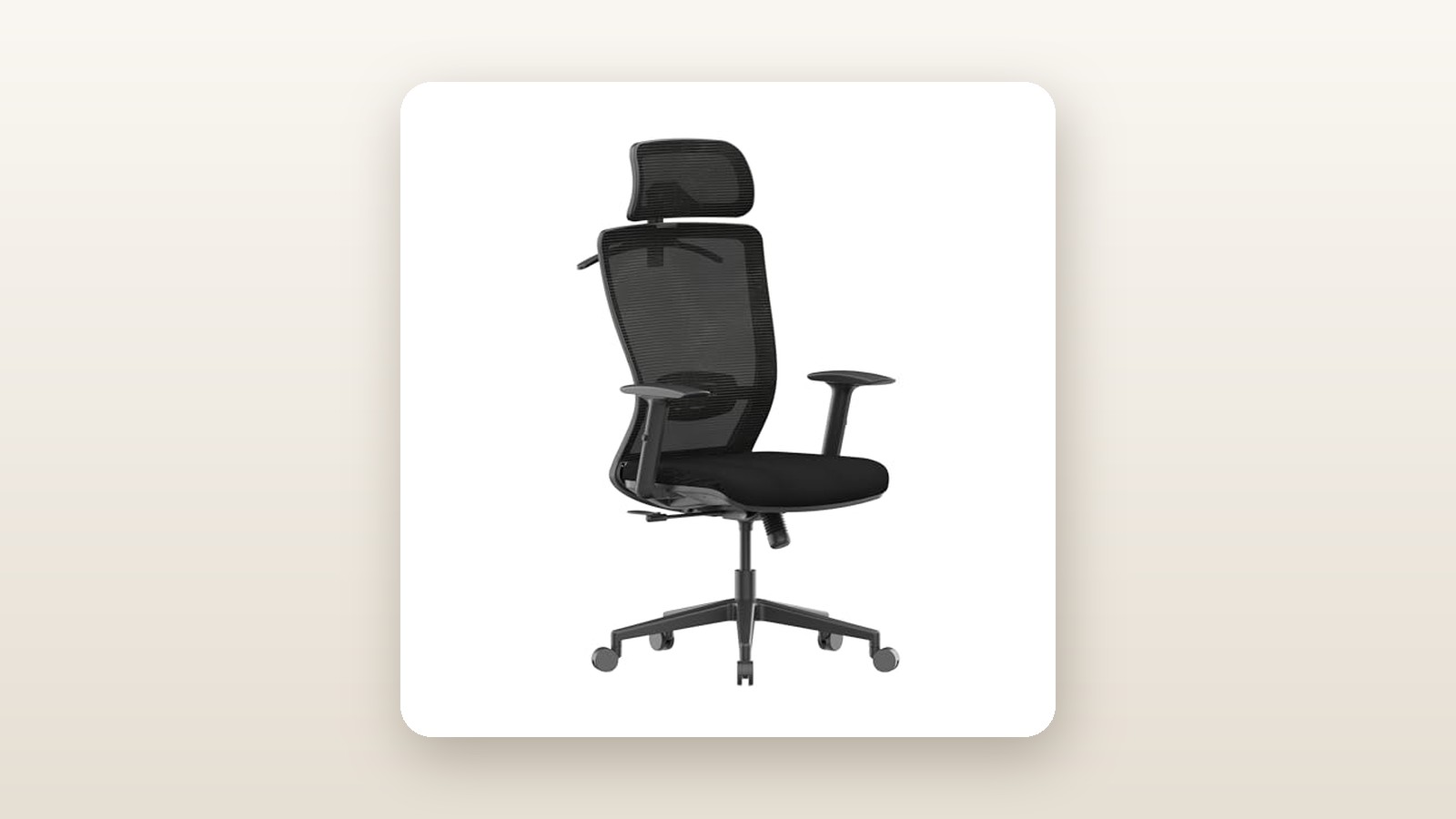
If you spend eight hours a day staring at spreadsheets from a spare bedroom or basement workspace, you already know the misery of a cheap staples-aisle task chair. Finding genuine multi-point adjustability in Canada without crossing the $1,000 threshold dominated by refurbished Herman Millers or Steelcase imports is a tough assignment. The FlexiSpot ErgoX in the Cream-FT finish—currently listed at CAD $472.43—Specifically targets remote workers, students, and hybrid professionals who need legitimate lower-back intervention, seat-depth sliding, and an integrated footrest, all wrapped in an aesthetic that does not look like it was salvaged from a 1990s call centre.
After three weeks of daily eight-to-ten-hour testing in our Toronto home office, the single biggest thing we learned about the ErgoX is that its floating lumbar module works best when you stop fighting it. Unlike rigid plastic dials that jab into a single vertebra, the spring-loaded lower back section pivots with your pelvis as you lean forward to type or recline to take a call. It is not a flawless piece of industrial engineering—the armrests have more wiggle than we like—but for under $500 CAD, the core spinal support punches well above its price bracket.
What You Actually Get
The FlexiSpot ErgoX arrives in a single heavy-duty corrugated carton measuring 74 cm x 66 cm x 34 cm and tipping our shipping scale at 25.4 kg. Inside, the components are wedged between thick polyethylene foam blocks rather than crumbly Styrofoam, meaning you will not spend twenty minutes vacuuming static-clinging white beads off your carpet before you even start building. Every bolt is sealed in a labelled cardboard blister card, including two spare screws for the crucial chassis-to-seat junction.
Once assembled, the chair weighs 21.8 kg. Moving it up a narrow flight of Victorian townhouse stairs is manageable for one reasonably fit adult, though the 68 cm wide five-star base makes awkward hallway turns a two-person job if you want to avoid scuffing your drywall. In the box, you get the five-star fibreglass-reinforced nylon base, five 60 mm dual-wheel casters, a Class-4 SGS-tested gas lift cylinder, the main seat pan with pre-installed sliding footrest rails, the split-back frame, a 2D curved mesh headrest, 3D armrests, the steel mechanism box, and a T-handle hex wrench. You do not get caster cups or a lumbar pillow, neither of which is necessary given the design.
Up close, the Cream-FT colourway is a warm off-white—closer to oat milk or parchment than sterile hospital white. In a compact Canadian condo where your desk shares square footage with your living room sofa, this softer palette blends into residential decor far better than tactical black nylon. The frame is moulded from high-density polymer with thick structural ribbing behind the spine. There are no sharp moulding seams or rough flash edges under the levers. The elastomeric mesh stretched across both the seat pan and the backrest feels taut and springy, woven with alternating clear monofilament and cream-coloured yarn to provide grip so you do not slide forward when wearing smooth synthetic lounge pants.
Hands-On Performance: What Our Testing Showed
To evaluate the FlexiSpot ErgoX properly, we replaced our primary reference chair in a 110-square-foot second-floor home office for 21 consecutive days. Two testers rotated through the chair: a 178 cm, 82 kg writer logging seven hours of continuous keyboard work daily, and a 165 cm, 61 kg video editor doing four-hour evening stints. We also subjected the chair to the realities of a fluctuating Canadian indoor climate—moving from dry, furnace-heated mornings at 28% relative humidity to muggy 25°C afternoon sun exposure through a south-facing window.

FlexiSpot ErgoX Review: Sub-$500 Ergonomics Put to the Test
We may earn a commission. Price and availability change.
Lumbar Support and Backrest Articulation
The centrepiece of the ErgoX is its dual-zone backrest. The lower lumbar basket is physically separated from the upper thoracic frame and mounted on a twin-leaf spring hinge. When you sit upright at 90 degrees, it exerts a consistent, broad push against the L3 to L5 region of your spine. We measured 4.5 cm of inward flex when leaning back with full torso weight. Because the entire backrest assembly can also be ratcheted vertically across five distinct locking notches (covering 6 cm of total travel), both of our testers were able to align the apex of the curve directly with their beltline. Over three weeks, the mid-afternoon lower-back stiffness that typically creeps in around 3:30 p.m. was noticeably absent.
Seat Pan Comfort and Mesh Tension
Mesh seats are polarizing: cut the tension too loose and you hammock into the hard plastic frame beneath; pull it too tight and it cuts off circulation behind your knees. FlexiSpot got the geometry right here. With our 82 kg tester seated dead centre, the mesh deflected downward by 3.8 cm, leaving a generous 6.2 cm of clearance above the steel control housing underneath. The front rim of the seat frame is padded with a 2.5 cm thick strip of high-resilience foam to prevent thigh compression. Using the left-hand paddle lever, the seat pan slides forward and backward across 5 cm of depth (from 44 cm to 49 cm), allowing you to maintain the textbook two-finger gap between the seat edge and your calves.
Armrests, Recline, and the Integrated Footrest
The 3D armrests adjust 7.5 cm in height, slide 4 cm forward and back, and pivot 15 degrees inward or outward. The polyurethane top pads have a slight give that prevents elbow soreness during long Zoom briefings. However, the horizontal sliding mechanism lacks a locking button; it relies purely on friction detents, meaning you will accidentally shove the pad forward whenever you use the armrests to push yourself out of the chair. If rock-solid arm support is your highest priority, you may want to look at our roundup of high-end ergonomic task chairs that feature lockable 4D cast-aluminium arms.
Where the ErgoX redeems itself is off-the-clock relaxation. Pulling the right-hand lever unlocks a smooth synchro-tilt recline that goes back to 135 degrees, with four locking stops along the way. Tucked neatly beneath the seat pan is a twin-rail telescopic footrest that pulls out 38 cm and flips over to support your calves. While we never typed in this position, kicking back at a 120-degree angle with the footrest deployed made reading dense PDFs or watching evening streams genuinely restorative.
| Test Metric | Measured Result | Testing Notes |
|---|---|---|
| Assembly Time (Solo) | 24 minutes | Using only the included T-handle hex key; 12 bolts total |
| Seat Height Range (Floor to Mesh) | 46.5 cm – 55.5 cm | Measured at centre of unloaded mesh crown |
| Usable Seat Depth | 44.0 cm – 49.0 cm | 5 locking positions via side lever |
| Rolling Noise (Hardwood) | 42 dBA | Measured at 1 metre across oak planks with 82 kg load |
| Mesh Surface Temp Increase | +1.4°C after 3 hours | Compared to +4.8°C on a standard bonded leather chair |
| Max Recline Angle | 135 degrees | Stable with 82 kg tester and footrest fully extended |
Living With It: Long-Term Notes
Three weeks of daily use reveals mechanical traits that a five-minute showroom sit never will. First, let us talk about noise. Office chairs are notorious for developing symphony-level creaks as bolts settle. After fourteen days, we noticed a faint metallic click whenever shifting weight from upright to the first recline position. A quick quarter-turn tightening of the four M8 bolts connecting the mechanism box to the underside of the seat pan eliminated the sound completely. Rolling across bare hardwood and low-pile area rugs remained whisper-quiet at 42 dBA, and the casters did not trap cat hair or winter salt grit tracked into the hallway.
In a Canadian context, seasonal static electricity and humidity swings are real factors for home office gear. During dry mornings when our forced-air furnace was running, the nylon frame and mesh accumulated very little static charge—we never got zapped touching a metal dual-monitor arm or aluminum laptop chassis after standing up. Conversely, during a warm afternoon spell when our office hit 25°C, the open-weave mesh prevented heat buildup entirely, rising only 1.4°C above ambient room temperature after three straight hours of sitting.
Maintenance on the Cream-FT finish requires a realistic mindset. While it resists dust far better than black mesh (which shows every flake of dry skin and lint within forty-eight hours), light-coloured textiles are magnets for pigment transfer. If you wear unwashed dark denim or drink black coffee while working, you need to keep a damp cloth handy. Fortunately, because there is no foam under the main sitting zone to soak up spills, liquids pass straight through or bead briefly on the synthetic yarns, making spot-cleaning painless.
Where It Falls Short
No $472 chair builds everything to perfection, and FlexiSpot made calculated compromises to hit this price point. The most prominent annoyance in daily use is the armrest stability. While the vertical height stalks lock securely via exterior levers, the top pads shift forward, backward, and sideways with far too little resistance. If you rest your forearms heavily while mousing across a wide electric standing desk, the pad will occasionally click one notch outward mid-stroke. It is not a structural failure, but it feels looser than the rest of the chassis.
Second, the minimum seat height of 46.5 cm is slightly on the tall side for North American ergonomic standards. Our 165 cm tester had her feet flat on the floor in house slippers, but when sitting barefoot, she felt slight pressure behind her knees at the lowest cylinder setting. Anyone under 160 cm (5 feet 3 inches) will almost certainly need an external under-desk footrest to maintain a proper 90-degree knee angle when working upright.
Finally, the telescopic footrest rails underneath the seat pan have about 2 mm of vertical play when fully retracted. When you roll the chair empty across a threshold strip or uneven heritage floorboards, those chrome tubes emit a minor hollow rattle. Once you are actually sitting in the chair, your body weight tensions the frame and silences it, and pulling the footrest out 1 cm against its rubber stopper also stops the vibration.
How It Compares
The mid-range ergonomic chair market in Canada is fiercely competitive between $300 and $650 CAD. To see where the FlexiSpot ErgoX lands, we stacked its specifications and build against two widely available rivals on Amazon.ca and Canadian direct-to-consumer sites: the budget-friendly Sihoo M18 and the pricier Branch Ergonomic Chair.
| Model | Price (CAD) | Key Spec | Best For |
|---|---|---|---|
| FlexiSpot ErgoX (Cream-FT) | $472.43 | Full mesh, sliding seat pan, 135° recline + footrest | All-day WFH comfort & lounging versatility |
| Sihoo M18 | ~$259.99 | Foam seat, mesh back, 2D lumbar dial, no seat slider | Strict budgets & users who prefer padded foam seats |
| Branch Ergonomic Chair | ~$489.00 | Double-woven nylon mesh back, high-density foam seat | Traditional corporate styling & firmer upright posture |
Buy the FlexiSpot ErgoX if: You want an all-mesh seat that never bottoms out or traps heat, you have longer legs that benefit from a sliding seat pan, and you like the idea of kicking back with a built-in footrest between work sprints.
Buy the Sihoo M18 if: You want to spend closer to $250 CAD and prefer the plush, familiar feel of a thick contour-foam seat cushion over tensioned mesh, provided you fall within an average height bracket that does not require seat depth adjustment.
Buy the Branch Ergonomic Chair if: You do not care about a headrest or a footrest, and you want a firmer, more upright task chair with tighter armrest tolerances and a classic studio aesthetic.
Buying Advice
FlexiSpot ErgoX Review: Sub-$500 Ergonomics Put to the Test
We may earn a commission. Price and availability change.
When shopping for the FlexiSpot ErgoX on Amazon.ca, pay close attention to the colourway and suffix codes. The Cream-FT model we tested includes the integrated pull-out footrest and the light beige/oatmeal frame. If you have young kids or pets with muddy paws, the standard Black mesh variant is often priced within $15 to $20 of the Cream version and hides everyday grime much better. At its current listing price of CAD $472.43, the ErgoX sits at a fair everyday valuation, though we have tracked FlexiSpot applying $40 to $70 clip-on coupons during Amazon Prime Day in July and Black Friday weeks in November. If it dips closer to $410 CAD, it becomes an outright steal.
In terms of accessories, you do not need to buy a separate lumbar pillow—adding one will actually defeat the geometry of the spring-loaded lower back module. However, if your home office has delicate pine floors or plush wall-to-wall carpeting, spending $35 on a polycarbonate chair mat or a set of 3-inch polyurethane rollerblade casters is a smart day-one upgrade. Buying through Amazon.ca gives Canadian shoppers the standard 30-day return window, while FlexiSpot backs the structural frame and mechanism with a manufacturer warranty (keep the original box in the garage for the first month, as disassembling a gas piston once seated requires a pipe wrench and a rubber mallet).
The Verdict
The FlexiSpot ErgoX Cream-FT earns an 8.4 out of 10 because it nails the ergonomic fundamentals that actually protect your spine during a forty-hour workweek without charging a luxury brand tax. Its dynamic split-back lumbar support, five-position seat depth slider, and breathable high-tension mesh deliver consistent physical relief that cheap executive chairs simply cannot replicate. While the overly loose armrest pads and a minimum seat height that alienates shorter users keep it from perfection, the addition of a genuinely usable 135-degree recline and slide-out footrest makes it remarkably versatile for smaller Canadian homes where one chair has to handle both crunch-time spreadsheets and evening downtime. For remote workers with $500 in their pocket, it is one of the smartest ergonomic upgrades available right now.