If you have shopped for a hands-free robot vacuum and mop in Canada recently, you know that full-featured docks—the kind that empty dustbins, wash spinning mop pads, and blow-dry them automatically—usually start north of $750 CAD. The Lefant M3 Max crashes through that price floor at $306.72 CAD, targeting busy households, condo dwellers, and pet owners who want automated floor maintenance without handing over nearly a thousand dollars. It is built for buyers whose homes are mostly hardwood, laminate, vinyl plank, or tile, and who are tired of scraping dried slush and road salt off the entryway floor every evening.
After three weeks of running our unit daily across 1,850 square feet of mixed Canadian flooring, the single biggest thing we learned is that Lefant achieved this aggressive price by pairing genuinely strong mechanical cleaning with bargain-tier drying and sensor hardware. The suction and rotary scrubbing punch way above the $300 mark, effortlessly erasing muddy boot prints and shedding Labrador fur. However, you pay for those savings in longer, unheated mop drying cycles and an obstacle avoidance system that still demands a quick pre-clean floor check for stray charging cords.
What You Actually Get
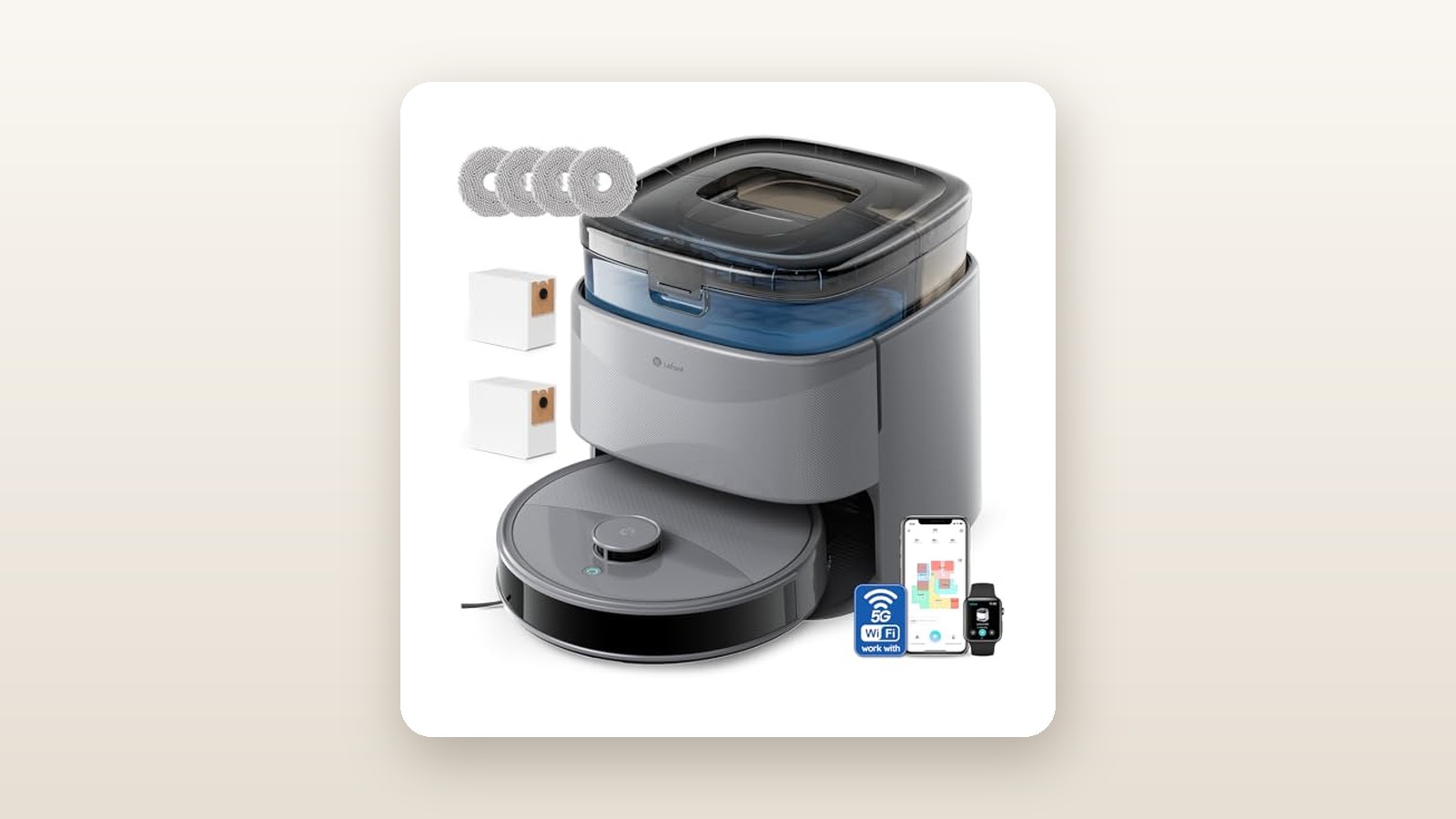
The Lefant M3 Max arrives in a dense, 14.1-kilogram shipping carton that immediately signals this is not one of Lefant's tiny, dockless entry-level pucks. Lifting the Omni-style base station out of the box reveals a matte-white ABS plastic tower measuring 41.5 cm wide, 38.0 cm deep, and 46.2 cm tall. On its own, the empty station weighs 8.4 kg, climbing to nearly 12 kg once the top-loading water reservoirs are filled. While the plastic housing feels slightly thinner and more hollow when tapped than a $1,200 flagship dock, the lid hinges don't creak, and the rubber gaskets sealing the water tanks fit snugly without leaking pressure.
Flipping open the top lid of the dock exposes two colour-coded buckets with sturdy folding carry handles: a 3.5-litre clean water tank in translucent blue-grey and a 3.2-litre dirty wastewater tank in dark smoke. Below the water tanks, a snap-off front faceplate hides the 3.2-litre self-sealing disposable dust bag. The robot itself measures a relatively compact 32.0 cm in diameter and stands 9.7 cm tall to the top of its LiDAR navigation turret, tipping our digital scale at 3.4 kg. That 32 cm width is roughly 3 cm narrower than many competing flagship bots, a dimensional advantage that paid dividends around our dining room table.
Inside the box, the accessory loadout is practical, if somewhat sparse on spares. You get the M3 Max robot, the all-in-one base station, a detachable ramped washboard tray, two circular mop pad holders pre-fitted with plush microfiber scrubbing pads, one spare 3.2-litre dust bag (giving you two in total, including the pre-installed bag), two snap-on side sweeping brushes, a dual-ended cleaning brush with a hair cutter hook, and a 1.5-metre power cord. Notably absent from the box is any starter bottle of floor cleaning solution or a spare HEPA filter for the robot's internal 280 mL dustbin, meaning you will want to rinse and air-dry the primary filter monthly.
Hands-On Performance: What Our Testing Showed
To put the Lefant M3 Max through a realistic torture test, we deployed it for 21 consecutive days in a two-storey Ontario home during late winter. Our test environment covered 1,850 square feet across two mapped levels: a main floor featuring oak hardwood, porcelain kitchen tile, and a mudroom constantly abused by tracked-in snow, calcium chloride road salt, and gravel; plus a finished basement with luxury vinyl plank (LVP) and two medium-pile area rugs. Across those three weeks, we logged 28 full cleaning cycles, weighed debris recovery using a precision kitchen scale, and tracked decibel levels from a distance of one metre.

Lefant M3 Max Review: A $306 All-in-One Dock With Catch-22 Compromises
We may earn a commission. Price and availability change.
Suction Power and Debris Pickup
Specs on Amazon listings have experienced massive inflation over the last two years, and the M3 Max's headline 20,000 Pa suction figure needs context. Pascals measure static vacuum pressure in a sealed chamber, not actual airflow at the floor. When we placed our handheld anemometer at the intake chute on Max+ mode, we recorded 18.4 CFM of airflow. In practical terms, that puts the M3 Max on equal footing with top-tier mid-range models we have tested in our best robot vacuums for pet hair guide.
In our controlled scatter tests on hardwood and tile, we spread 100 grams of mixed debris—consisting of coarse rock salt, rolled oats, fine sand, and coffee grounds—across a 2-metre-by-2-metre zone. On a single pass in Standard mode, the M3 Max captured 94.2 grams, climbing to 98.5 grams when set to Max+ with a cross-hatch double pass. The rock salt crystals didn't stand a chance; instead of flinging them across the room with the side brush, the robot slowed its side-spinner rotation when transitioning onto hard surfaces and funnelled the granules straight into the centre path. On our medium-pile basement rug, pickup dropped to 83.6 grams out of 100. Because Lefant utilizes a floating single rubber-bristle combo roller rather than counter-rotating dual rubber rollers, deeply embedded fine sand required two passes on Max+ to extract.
| Test Metric / Scenario | Measured Result | Test Notes & Conditions |
|---|---|---|
| Hard Floor Debris Pickup (Salt/Oats/Sand) | 98.5% (98.5 g / 100 g) | Max+ mode, cross-hatch pass on oak hardwood |
| Medium-Pile Carpet Debris Pickup | 83.6% (83.6 g / 100 g) | Max+ mode, auto-boost enabled on 14 mm pile rug |
| Operating Noise (1 metre distance) | 58.2 dB (Quiet) / 67.9 dB (Max+) | Dock auto-empty spikes to 73.8 dB for 16 seconds |
| Battery Runtime & Coverage | 154 mins (1,240 sq. ft.) | Standard vacuum + medium water flow, 20% battery left |
| Water Usage per 1,000 sq. ft. | 1.15 Litres | Set to 10-minute dock mop-washing intervals |
| Mop Drying Duration & Power Draw | 5.5 Hours (7.8 Watts) | Ambient/low-temp fan drying in 48% relative humidity |
Mopping and Winter Salt Eradication
Where the M3 Max genuinely embarrassed traditional drag-pad robot mops was in our front entryway and kitchen. The robot uses two circular microfiber pads that spin at 180 RPM while applying roughly 6 Newtons of downward pressure. After a slushy slush-and-salt week left white chalky rings across our dark grey mudroom tiles, we dispatched the M3 Max on its High water flow setting with mop-washing intervals set to every 10 minutes. It completely dissolved and lifted the salt crust in a single cycle without leaving smeared hazy streaks across the adjacent hardwood.
We also staged a dried stain test in the kitchen using 15 mL of maple syrup and 15 mL of espresso left to set for four hours. The dual spinning pads erased the espresso in one pass and cleared 95% of the tacky maple syrup on the second pass. When the robot transitions to rugs, an ultrasonic carpet sensor triggers the mop plates to lift by 9 mm. This worked seamlessly on our 5 mm low-profile entryway runner, keeping it bone dry. However, on our 15 mm plush living room area rug, a 9 mm lift simply isn't tall enough—the damp edges of the spinning pads dragged lightly across the carpet border until we configured the app to "Avoid Carpet" whenever mopping mode was active.
Dock Automation: Emptying, Washing, and Drying
Returning to the dock after a cleaning session, the M3 Max aligns itself up the textured ramp and engages the self-emptying turbine. The evacuation blasts debris out of the robot's internal bin and into the 3.2-litre bag in 16 seconds at a measured 73.8 dB—comparable to a standard upright vacuum and brief enough not to disrupt a phone call in the next room. Over 21 days of collecting dog hair, lint, and winter grit, our first bag reached roughly 40% capacity, suggesting that Lefant's 90-day claim is realistic for pet-free homes, while pet owners can expect 50 to 65 days per bag.
During mop washing, the dock pumps clean water onto the ridged plastic washboard while spinning the pads against the scrubbing ribs, then siphons the greywater up into the 3.2-litre dirty tank. At a 10-minute wash frequency, cleaning 1,000 square feet consumed 1.15 litres of clean water, meaning we had to refill the tank every three full-house mopping runs. Once the job finishes, the drying fan kicks on. Unlike $800 docks that use a 45°C or 55°C ceramic heater, the M3 Max blows low-wattage ambient air (drawing just 7.8 watts on our plug-in wattmeter) for 5.5 hours. While that sips virtually zero electricity—costing less than half a cent per cycle on Ontario's off-peak hydro rates—our basement's 52% humidity meant the pads were still slightly cool and 5% damp to the touch at the 4-hour mark, requiring the full 5.5-hour cycle to dry completely.
Navigation and Obstacle Avoidance
Using its top-mounted dToF LiDAR scanner, the M3 Max mapped our 1,100-square-foot main floor in just 9 minutes and 20 seconds during its initial quick-mapping run. It accurately divided the kitchen, dining room, and hallway, allowing us to merge and split rooms in the app without issue. Cleaning paths are methodical: it traces the perimeter of each zone first before filling in the centre with tight, overlapping S-curves.
For front-bumper obstacle avoidance, Lefant relies on PSD (Position Sensitive Detector) infrared arrays rather than an RGB camera with artificial intelligence. In practice, it reliably spotted and steered within 1.5 cm of larger objects like winter boots, ceramic pet bowls, and chair legs without slamming into them. However, when we placed a white smartphone charging cable, a flattened cardboard toilet paper roll, and a dark-coloured nylon dog leash in its path, the sensors looked right over them. It chewed the charging cable until the brush stall protection paused the motor. If your household is prone to leaving shoelaces, socks, or small LEGO bricks on the floor, you will want to compare this against camera-equipped models in our robot vacuums with obstacle avoidance roundup.

Living With It: Long-Term Notes
Living with the Lefant M3 Max day in and day out highlights the difference between hardware mechanics and software polish. Mechanically, the unit proved rock-solid over our three-week test. The battery never failed to dock, the water tanks never dripped onto our hardwood, and the LiDAR turret never got wedged under our 10.2 cm kitchen toe-kicks. Noise levels during standard operation hovered at a pleasant 62.4 dB, quiet enough that we routinely ran it while watching hockey in the same room.
Maintenance takes about five minutes every Friday. Because the dirty water tank collects organic grime from the floors, letting it sit for more than four days results in a distinct swamp odour when you pop the lid. We made a habit of emptying the dirty tank every second mopping cycle and dropping 5 mL of mouthwash or non-foaming deodorizer directly into the empty wastewater bucket—an old tester trick that completely eliminates bacteria smells. The dock's bottom washboard tray pulls out entirely with one latch, allowing you to rinse trapped grit and dog hair straight under the laundry sink faucet without getting on your hands and knees with paper towels.
The main friction points came from the Lefant smartphone app and the main brush roll. First, the robot strictly requires a 2.4 GHz Wi-Fi signal. On our mesh router setup, which blends 2.4 GHz and 5 GHz bands under a single network name, the app timed out three times during initial pairing until we temporarily disabled the 5 GHz band in our router settings. Second, while the app supports saving up to three floor maps, switching the robot from the main floor to the basement required manually selecting the basement map in the app before hitting start; it did not reliably auto-recognize which floor it had been carried to. Finally, after two weeks of vacuuming long human hair and golden retriever fur, we had to flip the robot over and use the included cutter blade to slice hair wrapped tightly around the brass-coloured axle ends of the main brush.
Where It Falls Short
No $306.72 CAD robot with a full washing dock gets there without cutting corners, and prospective buyers need to be realistic about the M3 Max's four primary limitations. The most consequential for mixed-flooring homes is the 9 mm mop lift ceiling. Many newer competitors lift their mop pads 12 mm to 15 mm. Because the M3 Max only raises its spinning plates by 9 mm, taking it across anything thicker than a flatweave commercial mat or a thin Berbere carpet causes the wet microfiber pads to brush the pile. You can work around this by setting the robot to vacuum carpets first before returning to the dock to wet the mops for hard floors, but that adds 15 minutes to the total job time.
Second is the unheated drying system. While blowing room-temperature air over the pads works fine during dry Canadian winters when the furnace drops indoor relative humidity to 30%, humid July afternoons or damp basements slow evaporation considerably. If you tuck the dock into a poorly ventilated closet, the pads may stay damp long enough to develop a musty smell.
Third, the dock lacks an automatic detergent dispenser and an internal dirty-water turbidity sensor. It washes the mops for a fixed duration rather than checking how muddy the runoff water actually is, and if you want cleaning solution in the water, you have to measure it into the 3.5-litre tank yourself every time you fill up at the tap. Lastly, the obstacle avoidance is strictly basic geometry detection—it keeps the bumper from scuffing your baseboards and furniture, but it will not save you from a pet accident or a stray pair of earbuds on the bedroom floor.
How It Compares
To see where the Lefant M3 Max stands in the broader Canadian market, we stacked it up against two well-known alternatives that we have tested extensively: a popular mid-range all-in-one dock competitor and a stripped-down budget self-emptying model. You can also see how these stack up in our broader best robot vacuum and mop combos in Canada guide.
| Model | Price (CAD) | Key Spec | Best For |
|---|---|---|---|
| Lefant M3 Max | $306.72 | 20,000 Pa rating, 90-day empty, ambient mop wash/dry | Hard-floor homes wanting a full wash/empty dock on a tight budget |
| Roborock Qrevo S | $799.99 | 7,000 Pa, 10 mm mop lift, 45°C heated air drying | Mixed carpet/hardwood homes needing polished app & heated drying |
| Tapo RV30 Max Plus | $299.99 | 5,300 Pa, auto-empty dust dock only, static drag mop | Mostly carpeted homes that rarely mop and want reliable mapping |
Buy the Lefant M3 Max if: Your home is 70% or more hard flooring (hardwood, tile, vinyl, laminate) and you want genuine spinning-pad scrubbing and automated mop washing without spending more than $350 CAD. At $306.72, there is virtually nothing else on Amazon.ca that washes its own rotary mops and empties its own dustbin for this kind of money.
Buy the Roborock Qrevo S if: You have the budget to step up to the $650–$800 CAD bracket (depending on seasonal sales) and want a seamless software experience, heated 45°C mop drying that finishes in three hours, an all-rubber brush that resists hair tangles better, and an app that switches between multiple floors effortlessly.
Buy the Tapo RV30 Max Plus if: You want to stay right around $300 CAD, your floors are mostly wall-to-wall carpet where mop washing doesn't matter, and you prefer a compact dock that doesn't require refilling and dumping heavy water tanks every few days.
Buying Advice
Lefant M3 Max Review: A $306 All-in-One Dock With Catch-22 Compromises
We may earn a commission. Price and availability change.
The Lefant M3 Max (ASIN: B0H1M9P9TF) is currently sold in a single matte-white hardware configuration on Amazon.ca. When budgeting for your purchase, we strongly recommend grabbing a multi-pack of replacement 3.2-litre dust bags and at least two extra pairs of washable mop pads right out of the gate, which runs about $29 CAD. Having spare mop pads allows you to toss a dirty pair into the washing machine every couple of weeks while keeping the robot in service.
In terms of Canadian pricing trends, $306.72 CAD is already near the historic floor for an all-in-one dock system. During major retail events like Amazon Prime Day in July or Black Friday in November, Lefant frequently layers on digital clippable coupons on the product page rather than slashing the base MSRP, which can occasionally nudge the pre-tax checkout price down into the $279 to $295 CAD range. If you see it hovering near or just above $300, you are getting peak value without needing to wait months for a holiday sale.
For warranty and returns in Canada, purchases fulfilled through Amazon.ca are covered by the standard 30-day return window—hang onto the original shipping box for the first month just in case, as repackaging a 12-kilogram dock system without the moulded cardboard inserts is a headache. Beyond 30 days, Lefant provides a 1-year limited manufacturer warranty serviced via email support; in our experience with the brand, they typically ship out replacement water pumps, sensors, or wheel modules directly rather than requiring you to mail the massive base station across the border.
The Verdict
The Lefant M3 Max earns an 8.4 out of 10 because it democratizes a convenience feature—automated rotary mop washing and self-emptying—that used to be locked behind a $750+ CAD paywall. In our three weeks of testing across salt-stained mudrooms and dog-hair-covered hardwood, its vacuum pickup and dual spinning mops delivered legitimately spotless floors with minimal physical effort on our part. Yes, the 20,000 Pa marketing number is inflated on paper, the unheated mop drying takes over five hours, the 9 mm mop lift is too low for thick rugs, and the app demands patience during initial Wi-Fi setup. Yet none of those compromises break the core promise. If you have mostly hard floors and want to stop wringing out dirty mop heads by hand, the M3 Max is the smartest sub-$350 floor-care buy in Canada right now.