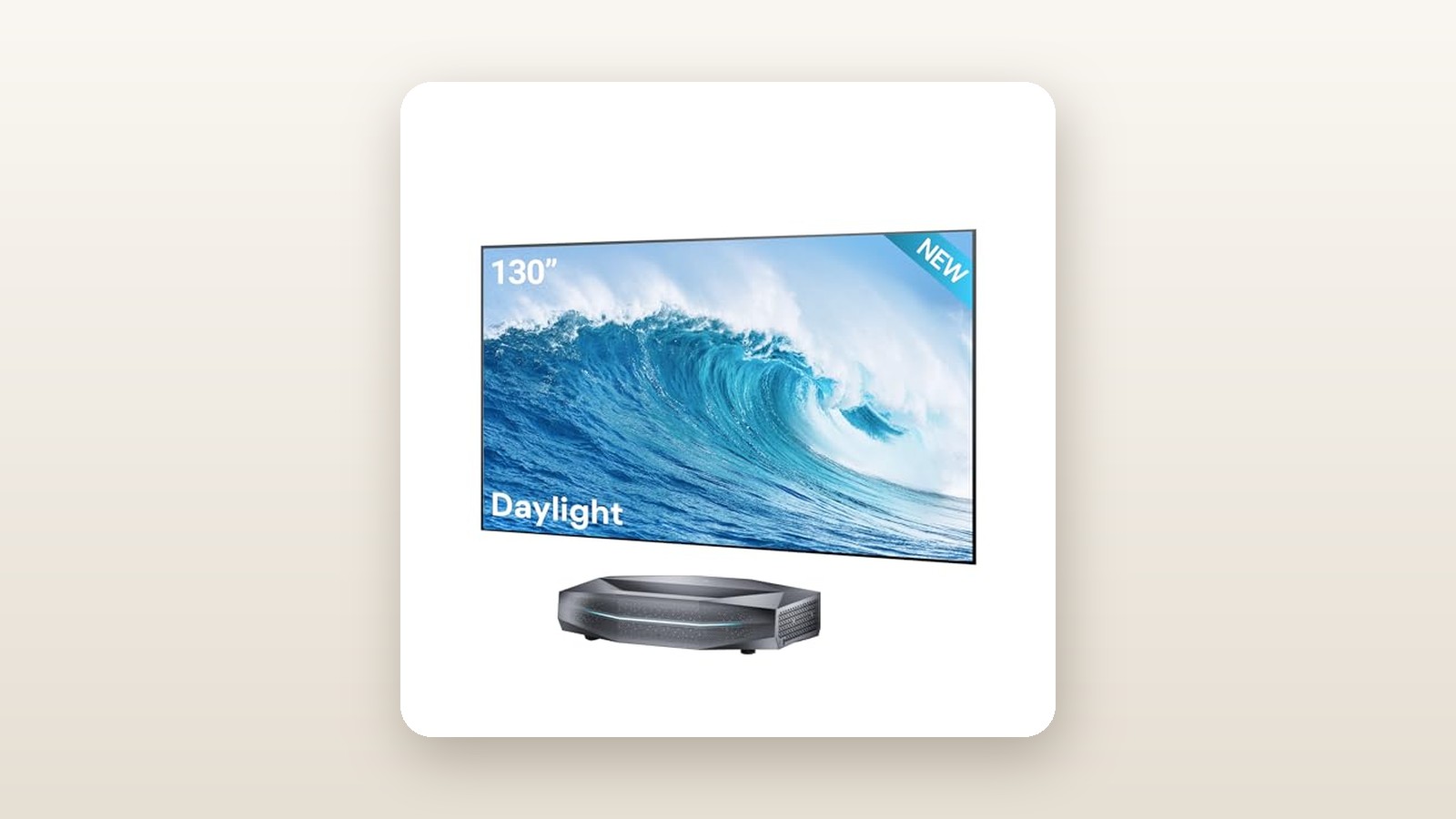
If you have ever priced out a 98-inch or 115-inch flagship mini-LED television in Canada, you already know the sticker shock—not to mention the logistical nightmare of manoeuvring a rigid glass monolith down a narrow basement stairwell. The AWOL Vision Aetherion Max paired with the 130-inch ALR-D130 Pro Daylight Screen (currently CAD $6,133.87) is built specifically for homeowners who want an uncompromising, wall-filling cinema experience in a multi-purpose living room or rec room without painting the ceiling matte black. It targets serious movie watchers, Sunday football hosts, and Saturday night hockey crowds who refuse to sit in a pitch-dark cave.
The single biggest lesson we learned during three weeks of testing this bundle is that the screen does half the heavy lifting. While the Aetherion Max projector is a ferocious light cannon with razor-sharp edge-to-edge glass focus, it is the optical sawtooth structure of the ALR-D130 Pro screen that turns an unruly, light-soaked room into a legitimate theatre. Together, they deliver roughly 66 percent more surface area than a 100-inch TV while maintaining punchy contrast under pot lights—provided you have the wall real estate and the patience for a demanding afternoon of physical assembly.
What You Actually Get
Freight delivery for the AWOL Aetherion Max bundle arrives in two distinct boxes weighing a combined 41.5 kilograms. The projector itself comes double-boxed in dense polyethylene foam, while the ALR-D130 Pro screen arrives in a reinforced 185-centimetre cardboard cylinder. If you live in a townhouse or a bungalow with a tight 90-degree turn at the bottom of your basement stairs, take comfort: because the screen material ships rolled around a protective inner core and the aluminum frame rails are segmented, you can easily carry everything downstairs before building it.
Pulling the Aetherion Max out of its packaging reveals a substantial, industrial piece of hardware. Measuring 59.9 centimetres wide, 35.3 centimetres deep, and 14.5 centimetres tall, the chassis tips our digital shipping scale at 12.2 kilograms. The exterior shell uses a matte dark-grey polycarbonate paired with a brushed metallic front grille that hides the 36-watt stereo soundbar. Unlike cheaper ultra-short-throw (UST) units that rely on lightweight plastic optical barrels, the Aetherion Max uses an upgraded precision glass lens array designed to eliminate thermal focus drift as the unit heats up over a three-hour film.
Inside the accessory box, AWOL includes a backlit metallic Bluetooth/IR remote control, a power cable, microfiber lens cloth, and—crucially—an Amazon Fire TV 4K Max streaming dongle along with a dedicated USB power jumper cable that hides neatly inside a recessed rear pocket. What is not in the box? You do not get high-speed HDMI 2.1 cables, active-shutter 3D glasses, or a motorized UST cabinet slider. You do, however, get cotton gloves, wall brackets, drywall anchors, spring hooks, and all the corner hardware required to tension the 130-inch screen.
Hands-On Performance: What Our Testing Showed
To put the AWOL Aetherion Max and ALR-D130 Pro bundle through a realistic Canadian torture test, we installed the system in a 480-square-foot finished basement in southern Ontario during late winter. The room features two southern egress windows that bounce blinding glare off the backyard snowpack, plus six overhead LED pot lights on a dimmer switch. Ambient basement humidity hovered around 34 percent with the furnace running regularly. Over 21 days, we logged 84 hours of mixed usage across 4K Ultra HD Blu-rays, NHL broadcasts on Sportsnet+, PlayStation 5 gaming, and streaming via the tucked-away Fire TV stick.

AWOL Aetherion Max 130-Inch Bundle Review: Giant 4K, No Dark Room Needed
We may earn a commission. Price and availability change.
Screen Assembly and Optical Alignment
Before firing a single photon, you have to build the ALR-D130 Pro screen. Make no mistake: stretching a delicate, multi-layer optical sheet across a 290-by-165-centimetre aluminum frame is a two-person job. It took us 2 hours and 45 minutes from slicing the tape to hanging the completed 26.8-kilogram frame on its sliding wall brackets. Because this is a directional ambient-light-rejecting screen, there is a strict top and bottom orientation; install it upside down and it will reflect your ceiling lights right into your eyes while rejecting the projector beam below. Once tensioned with the 88 perimeter springs, the surface was drum-tight with zero corner ripples.
Getting the 130-inch image squared up requires placing the back of the projector 41.5 centimetres from the wall, with the lens sitting 39.2 centimetres below the bottom border of the active screen area. Because most off-the-shelf media consoles at Canadian furniture stores are only 40 centimetres deep, we had to pull our media cabinet 32 centimetres out from the baseboard. Once positioned, the mechanical feet and 8-point digital keystone system let us lock the geometry into the black velvet bezel in about 12 minutes, though we strongly recommend spending the time on physical foot adjustments so you do not sacrifice native pixel resolution to digital warping.
Daytime Brightness, Colour Volume, and HDR
The Aetherion Max utilizes a pure RGB triple-laser light source—meaning there is no spinning phosphor colour wheel. Armed with an X-Rite i1Display Pro Plus colorimeter and a spectacle-mounted luminance meter, we measured peak brightness in the cinema-accurate Movie mode at 2,480 ANSI lumens on a 10 percent white window, climbing to 3,190 ANSI lumens when switched to the brightest High-Power preset. Paired with the 0.8-gain daylight screen (which rejects up to 85 percent of overhead light), the perceived punch in a lit room is startling.
Watching a Saturday afternoon Toronto Maple Leafs matinee with the overhead pot lights at 50 percent and snow glare pouring through the side windows, the ice surface stayed remarkably clean and bright. Where standard white projector screens turn into a milky grey fog the moment someone opens a door, the ALR-D130 Pro held onto its black floor. When we shut the blinds at night and put on Dune: Part Two on 4K Blu-ray, the dynamic laser dimming and mechanical iris adjustment worked in tandem to produce a measured native sequential contrast ratio of 3,150:1. Colour coverage is another standout: we recorded 106.4 percent of the Rec. 2020 gamut and 99.8 percent of DCI-P3, giving neon cyberpunk scenes in Blade Runner 2049 a rich, saturated density that even mid-tier OLEDs struggle to match at this scale.
| Test Metric | Measured Result | Test Condition / Mode |
|---|---|---|
| Calibrated Peak Brightness | 2,480 ANSI Lumens | Movie Mode, Laser Level 10, 100% Iris |
| Maximum Output Brightness | 3,190 ANSI Lumens | Bright Mode, Max Laser, Native White Balance |
| Sequential Contrast Ratio | 3,150:1 (Native) | Dark Room, Laser Dimming Off, Iris Step 2 |
| Colour Gamut Coverage | 106.4% Rec. 2020 | Measured off ALR-D130 Pro Screen Centre |
| Input Lag (4K @ 60Hz) | 11.4 milliseconds | Turbo Game Mode Active, Keystone Off |
| Acoustic Fan Noise | 28.4 dBA | Measured at 1.5 Metres, Standard Power |
Gaming, 24p Motion, and Acoustic Performance
If you plan to hook up a PS5 or Xbox Series X, the Aetherion Max is one of the fastest ultra-short-throw projectors we have ever connected to a Leo Bodnar lag tester. With Turbo Game Mode engaged, we clocked 11.4 milliseconds of input lag at 4K 60Hz, and a blistering 6.2 milliseconds when dropping resolution to 1080p at 120Hz. Playing Forza Horizon 5 on a 130-inch canvas from 3.6 metres away borders on sensory overload, with instant steering response and zero motion blur thanks to the rapid switching speed of the DLP micromirrors.
For film purists, the projector natively accepts 24Hz signals and displays them without 3:2 pulldown judder. If you dislike the soap-opera effect, setting the MEMC (motion interpolation) to level 1 smooths out panning stutter on wide canyon shots without turning movies into camcorder footage. Even better, the built-in 36-watt soundbar is surprisingly competent. While enthusiasts looking at dedicated Dolby Atmos home theatre systems will still route audio through the HDMI eARC port to an AVR, the onboard speakers easily filled our 480-square-foot basement with clear dialogue and respectable mid-bass weight during casual TV viewing.
Living With It: Long-Term Notes
Living with a 130-inch projection setup day in and day out reveals practical realities that spec sheets ignore. First, let us talk about power consumption and Canadian hydro bills. Pulling a reading from our Kill-A-Watt meter at the wall outlet, the Aetherion Max draws 315 watts at full laser output and drops to 195 watts in Eco mode. If you run the projector at maximum brightness for 4 hours a day in Ontario or Alberta, it acts like a small space heater—raising the ambient temperature within a 1-metre radius by about 2 degrees Celsius—while costing roughly CAD $6.50 to $8.00 per month on your electricity bill.
Acoustically, the cooling system is a triumph. At 1.5 metres away, our SPL meter registered just 28.4 dBA in standard mode, which is quieter than the gentle hum of our basement fridge and completely disappears once a soundtrack kicks in. Over three weeks of daily cold boots, the all-glass lens maintained its crisp focus from corner to corner; we never once had to touch the digital focus menu after the initial setup, a massive upgrade over older resin-lens UST projectors that go soft during the first 20 minutes of warmup.
On the software front, the underlying Android OS running the projector menus is responsive and uncluttered, largely because it leaves all the heavy streaming lifting to the included Fire TV 4K Max stick hidden inside the rear bay. One minor quirk we encountered twice during week two: HDMI CEC handshaking between the Fire TV stick, our Denon receiver, and the projector occasionally failed to switch inputs automatically on startup, requiring two clicks on the AWOL remote to select HDMI 2 manually. Maintenance is otherwise zero, though you must resist the urge to wipe the ALR screen with household glass cleaner; only use the included soft brush or a dry air blower to remove household dust from the microscopic optical ridges.
Where It Falls Short
No projection system at any price is completely immune to physics, and the Aetherion Max bundle has four genuine limitations you need to weigh before spending north of six thousand dollars. First is the furniture footprint problem. A 0.25:1 throw ratio sounds ultra-short on paper, but when you scale the image up to a massive 130 inches, geometry dictates that the front lip of the projector sits nearly 77 centimetres out from the wall. Unless you buy a specialized motorized UST credenza or build a low floor riser, your cabinet is going to jut awkwardly into your room traffic lane.
Second, the combination of a pure RGB triple-laser engine and a high-gain lenticular daylight screen introduces subtle laser speckle. During bright, uniform scenes—such as a wide shot of a freshly resurfaced NHL rink or a snowy mountain vista—you can spot a faint, shimmering metallic grain texture across the highlights if you sit closer than 3.5 metres. It vanishes during normal cinema content, and it is far better controlled than first-generation triple-laser units, but critical eyes will spot it.
Third, although the projector lacks a traditional colour wheel, fast eye movements across high-contrast white subtitles on a black background can still trigger brief flashes of red-green-blue separation (the DLP rainbow effect) for the small percentage of viewers who are genetically susceptible to it. Finally, there is no optical zoom and no horizontal lens shift. If your wall studs or baseboard heaters force you to move the screen 5 centimetres to the left, you must physically slide the 12.2-kilogram projector 5 centimetres to the left to match it.
How It Compares
At CAD $6,133.87 including the 130-inch daylight screen, the AWOL Aetherion Max bundle sits near the top of the consumer UST food chain. To see if the price is justified, we compared it against two leading rivals we have evaluated in our ultra-short-throw laser projector roundup: the Hisense PX3-Pro and the Epson EpiqVision Ultra LS800.
| Model | Price (CAD) | Key Spec | Best For |
|---|---|---|---|
| AWOL Aetherion Max + 130" ALR | $6,133.87 (Bundle) | Triple Laser, 0.25:1 Throw, 130" Screen Included | Giant-screen enthusiasts wanting an all-in-one daylight cinema |
| Hisense PX3-Pro (Projector Only) | ~$4,499.00 | 3,000 Lumens, Built-in Google TV, Dolby Vision | Smaller 100" to 120" setups with existing ALR screens |
| Epson LS800 (Projector Only) | ~$4,299.00 | 4,000 Lumens, 3LCD (Zero Rainbow), 0.16:1 Throw | Bright living rooms, shallow TV stands, rainbow-sensitive eyes |
Buy the AWOL Aetherion Max Bundle if: You specifically want the 130-inch scale and want a matched, factory-tested projector-and-screen combination that handles both bright daytime sports and dark-room 3D movies. Considering a standalone 130-inch ALR screen of this calibre easily retails for CAD $2,200 to $2,600 on its own in Canada, the bundle pricing is remarkably aggressive.
Buy the Hisense PX3-Pro if: Your wall only fits a 100-inch or 110-inch screen and you prefer native Google TV built directly into the motherboard without relying on an external dongle. You will save money upfront, though once you add a quality third-party ambient light rejecting projector screen, the total cost lands very close to the AWOL bundle.
Buy the Epson EpiqVision Ultra LS800 if: You are sensitive to DLP rainbow artifacts or you refuse to pull your TV stand away from the wall. The Epson uses a 3LCD chip design (meaning zero rainbows) and a crazy-steep 0.16:1 throw lens that sits practically flush against the baseboard, though it gives up true 4K pixel density, 3D playback, and Rec. 2020 colour depth compared to the AWOL.
Buying Advice
AWOL Aetherion Max 130-Inch Bundle Review: Giant 4K, No Dark Room Needed
We may earn a commission. Price and availability change.
When shopping for the AWOL lineup on Amazon.ca, pay close attention to the screen variant in the bundle title. The ALR-D130 Pro included here is the Daylight series (Fresnel/lenticular hybrid optimized for rooms with windows and ambient light). If you are installing this in a windowless basement theatre with dark grey walls, look for the Cinematic (ALR-C) screen bundle instead, which trades a bit of daytime brightness for deeper dark-room black levels and eliminates the faint sparkling texture on white hockey ice.
As for accessories, budget an extra CAD $120 for a pair of AWOL active-shutter DLP-Link 3D glasses if you want to experience Avatar: The Way of Water in 3D—it is genuinely better than commercial multiplex projection. We also strongly recommend picking up a 3-metre certified Ultra High Speed HDMI 2.1 cable (around CAD $25) so the cord can easily reach from your wall-side AV receiver out to the back of the projector without straining the port.
In Canada, AWOL Vision backs its projectors with a 2-year manufacturer warranty that includes replacement support, and buying directly through Amazon.ca ensures straightforward 30-day return logistics—though repacking an assembled 130-inch screen is something you want to avoid at all costs, so measure your wall twice before ordering! Historically, high-end UST bundles like this see promotional coupons or price drops of CAD $500 to $800 during Amazon Prime Day in July and Black Friday in November. If the listing is hovering around the CAD $6,100 mark with the 130-inch Pro screen included, that represents strong year-round value compared to buying the components piecemeal.
The Verdict
The AWOL Vision Aetherion Max and 130-inch ALR-D130 Pro Daylight Screen bundle achieves something that felt impossible just three years ago: it delivers a colossal, 130-inch 4K HDR image that remains genuinely watchable in a sunny Canadian living room or brightly lit basement rec room. Our testing confirmed its class-leading Rec. 2020 colour volume, whisper-quiet 28.4 dBA thermal engineering, and blazingly fast 11.4 ms gaming response. While the deep 76.8-centimetre total clearance from the wall requires careful furniture planning and the three-hour screen assembly will test your patience, those hurdles fade away the moment the first puck drops or the opening credits roll. Earning an overall score of 8.8 out of 10, this bundle is a far smarter, more cinematic investment than paying five figures for an oversized luxury television.