If you have ever tried mounting a 49-inch super-ultrawide display or a pair of chunky 34-inch curved panels on a standard budget desk mount, you already know the sickening feeling of watching an expensive screen slowly droop toward your keyboard. Most dual arms under $150 CAD top out at 9 kg per arm—plenty for basic 1080p office panels, but wholly inadequate for heavy modern glass. The PEGZONE Dual Monitor Arm with USB (model B0GYS7HLC8) targets remote workers, sim racers, and multi-screen productivity hounds who need serious lifting power without paying $450 CAD for boutique commercial ergonomics gear.
The single biggest thing we learned during three weeks of testing this rig in our Mississauga home office is that VESA tilt head friction matters far more than gas spring rating when hanging curved ultrawides. While the main pneumatic cylinders shrugged off our 24.4 kg combined test load with room to spare, getting the upper pivot joint to lock a front-heavy curved panel required serious elbow grease and a high-leverage hex wrench. Once locked down, however, this $119.27 CAD mount delivered stability that rivalled units costing twice as much.
What You Actually Get
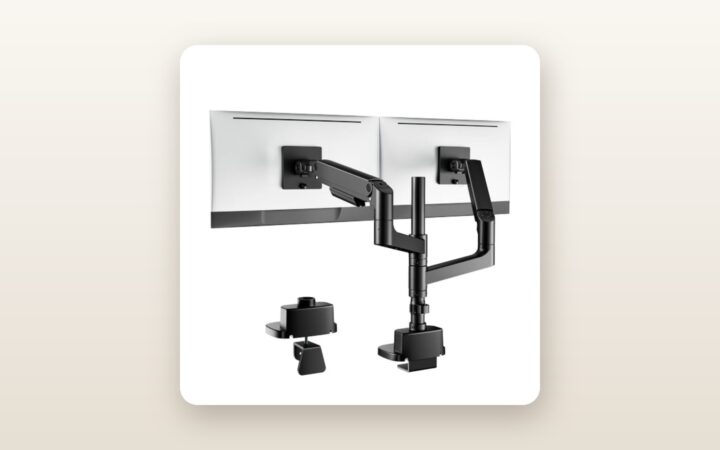
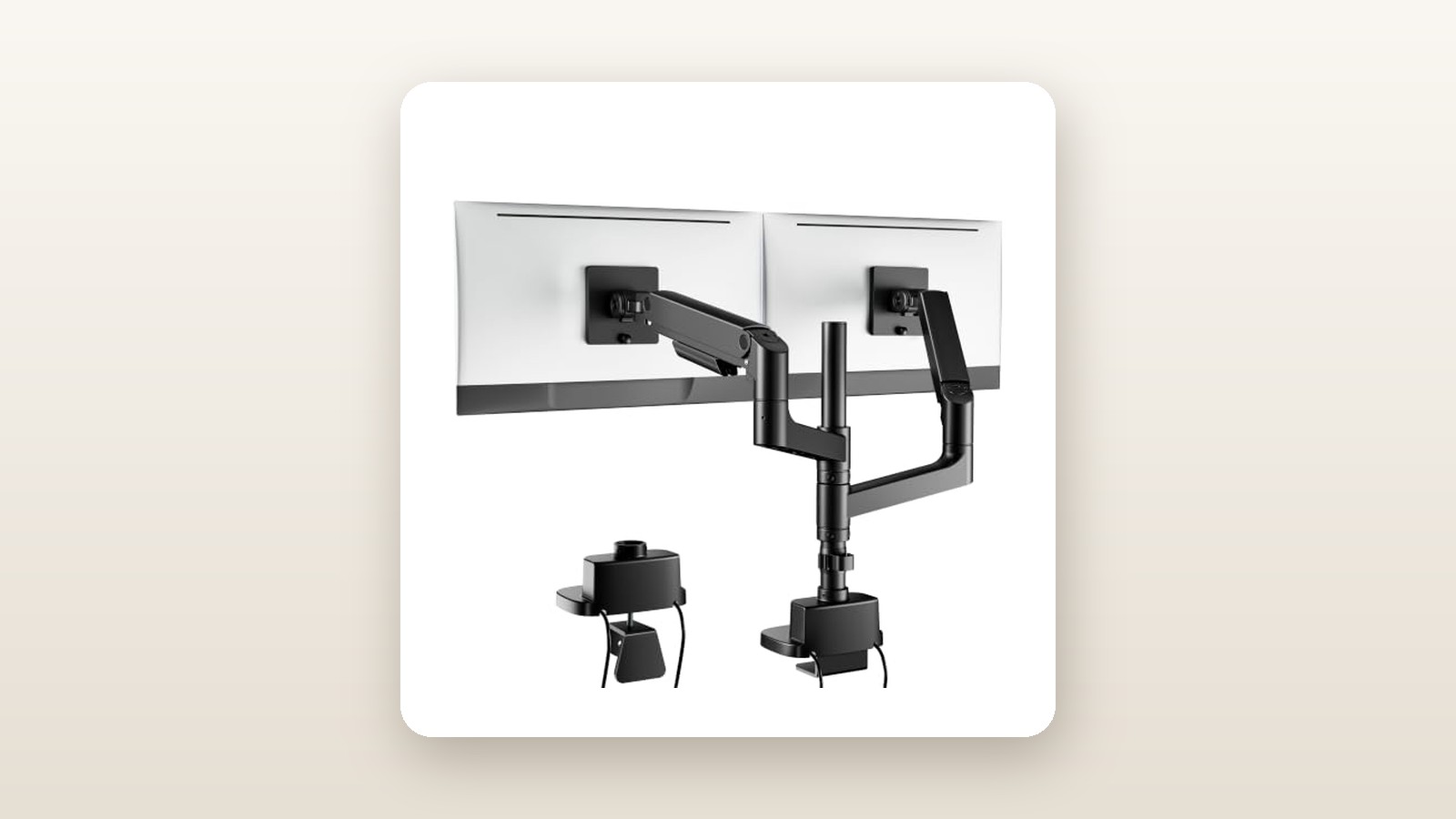
The PEGZONE Dual Monitor Arm arrives in a dense, heavily compartmentalized brown cardboard box weighing 7.1 kg on our shipping scale. Inside, the components are nestled in moulded pulp trays and heavy polyethylene bags rather than crumbly expanded polystyrene—a welcome touch so you are not vacuuming white static beads off your basement carpet for a week. Out of the box, the assembly feels substantially beefier than standard 27-inch dual mounts. The main base and lower extension arms are cast from thick-walled aluminum alloy sprayed in a matte black powder coat that resists fingerprints and matches dark walnut or black laminate desks cleanly.
We weighed the bare metal assembly (base, dual two-stage arms, VESA heads, and clamp hardware) at 6.42 kg before hanging a single screen. The base footprint measures 13.5 cm wide by 11.0 cm deep, housing a heavy steel C-clamp bracket that secures from the top side of the desk using a long-handled 6 mm Allen key. You do not need to crawl underneath your desk and skin your knuckles against the wall to tighten a bottom thumbscrew—a massive ergonomic win during setup. For desks with built-in wire pass-through holes, PEGZONE includes grommet mounting hardware in the box that handles desktop thicknesses from 10 mm up to 60 mm, while the standard C-clamp opens wide enough for 80 mm thick butcher-block surfaces.
In the hardware organizer pouch, you get two quick-release VESA plates (stamped steel with both 75x75 mm and 100x100 mm hole patterns), four M4x12 mm screws, four M4x30 mm screws, four M5x12 mm screws, four M5x30 mm screws, eight plastic 15 mm spacers for recessed monitor backs, and a combo 4 mm/6 mm L-shaped hex wrench with a Phillips screwdriver tip. Built directly into the front bevel of the base is a USB 3.0 Type-A pass-through port fed by a 1.5-metre shielded tail cable underneath. What is not in the box: you do not get a steel desk-reinforcement plate for thin particleboard desks, nor do you get specialized VESA adapter brackets required exclusively by certain proprietary Samsung Odyssey or MSI monitors (those always come inside your monitor's original retail box).

Hands-On Performance: What Our Testing Showed
To put the PEGZONE Dual Monitor Arm through a realistic Canadian home-office torture test, we bolted it to one of the best standing desks in Canada—specifically a 30 mm thick solid birch top mounted on a dual-motor frame in a cool, finished basement workspace in Ontario. Over 21 consecutive days, we loaded the arms with an intentionally asymmetrical, punishing dual-screen setup: a 49-inch curved 32:9 super-ultrawide weighing 14.6 kg on the primary arm, paired with a 34-inch 21:9 ultrawide weighing 9.8 kg on the secondary arm.

PEGZONE Dual Monitor Arm Review: Heavy-Duty Ultrawide Rig on a Budget
We may earn a commission. Price and availability change.
We tracked vertical deflection using a digital laser distance metre aimed from the desk surface to the bottom bezel corners, measured USB throughput with an external NVMe enclosure, and logged mechanical play while raising and lowering the desk three times a day.
Weight Capacity and Gas Spring Tension
PEGZONE rates each arm for 2.0 kg to 20.0 kg (4.4 lbs to 44.0 lbs). Out of the box, the gas springs ship near minimum tension so they do not snap upward into your face when you cut the safety shipping straps. When we first hung our 14.6 kg 49-inch panel on the right arm, the limb immediately sank to the desktop. Using the included 6 mm hex key on the elbow tension bolt, it took 19 full counterclockwise rotations (turning toward the '+' indicator) to achieve neutral buoyancy where the screen floated weightlessly at any height.
On the left arm, our 9.8 kg 34-inch panel required 11 full rotations to balance. The gas cylinders themselves operate smoothly without hydraulic squelching or jerky stiction. Even with 24.4 kg of combined monitor mass hanging off the assembly—plus 6.42 kg of mount weight putting over 30 kg of total downward force on the rear edge of our birch desktop—the cast aluminum lower arms showed zero visible twist. However, when we briefly tested a lightweight 24-inch portable monitor weighing just 2.1 kg on one arm turned all the way to minimum '-' tension, the arm refused to stay down and slowly crept upward. Practically speaking, treat 2.8 kg as the real-world minimum weight per arm.
Tilt Head Mechanics and Ultrawide Stability
If there is an Achilles heel on almost every ultrawide arm, it is the upper VESA tilt joint. Because a curved 49-inch monitor wraps forward at the edges, its centre of mass sits roughly 11 cm to 14 cm in front of the VESA mounting plate, creating immense downward rotational torque. PEGZONE uses a heavy-duty friction clamp bolt on the neck rather than a ratcheting gear tooth system. When we first clipped the 14.6 kg monitor onto the quick-release VESA tab, the screen nose-dived 30 degrees forward despite the factory pre-tightening.
We had to support the bottom bezel with one shoulder while putting nearly all our grip strength into the 6 mm Allen key to cinch the dual tilt bolts tight. Once torqued to roughly 18 Nm using our own T-handle workshop hex wrench (which offers much better leverage than the included short L-key), the head locked rock-solid. Across three weeks of daily articulating—pulling the 34-inch screen forward for video editing and pushing it back for spreadsheets—neither tilt joint slipped by even half a millimetre.
Articulation Range, Stacking, and Desk Footprint
Unlike single-pole dual mounts that force both arms to share one collar height, the PEGZONE base integrates two independent swivel sockets side by side, spaced 11 cm apart from centre to centre. Each arm provides a maximum reach of 54.5 cm from the base centre to the VESA plate and a vertical lift height of 52.0 cm above the desk surface. That 52 cm ceiling was just high enough for us to test a vertical stacked arrangement: placing the 49-inch monitor low (bottom bezel 6.5 cm off the desk mat) and swinging the 34-inch ultrawide directly above it, clearing the top bezel by 1.8 cm.
Swivel action at the base can be locked to 180 degrees using a set screw so the elbows do not punch holes in your drywall, or left open for 360-degree rotation on an island desk. Keep in mind that the beefy elbow joints need room to breathe. If you want both screens pushed back flush in line with the rear edge of your desk, the elbows protrude 12.2 cm behind the desk lip. In a tight condo bedroom or a basement nook where the desk is shoved tight against a cold concrete foundation wall, you will either need to pull your desk out 12 cm or live with the monitors sitting closer to your eyes.
| Test Metric | Measured Result | Test Condition / Notes |
|---|---|---|
| Vertical Deflection (Arm 1 - 14.6 kg) | 1.5 mm drop over 21 days | 49-inch 1800R curved panel at 35 cm extension |
| Vertical Deflection (Arm 2 - 9.8 kg) | 0.4 mm drop over 21 days | 34-inch 1500R curved panel at 45 cm extension |
| Screen Wobble Recovery Time | 1.4 seconds to dead stop | Standing desk at 112 cm height during vigorous typing |
| Base USB 3.0 Transfer Speed | 412 MB/s read / 388 MB/s write | Tested via Samsung T7 SSD connected to PC rear I/O |
| Tension Adjustment Range | 22 full hex turns (min to max) | 6 mm Allen bolt on upper arm pivot |
| Minimum Rear Wall Clearance | 12.2 cm behind desk edge | With screens aligned directly over the clamp base |
USB Connectivity and Cable Management
Having a USB 3.0 Type-A port built into the base is more than a spec-sheet gimmick when you run wireless headsets or one of our top-tested ergonomic wireless mice that rely on 2.4 GHz receivers. Plugging a Logitech Lightspeed dongle directly into the monitor arm base put the receiver within 35 cm of the mouse pad, eliminating the cursor stutter we occasionally suffered when the dongle was plugged into the back of a PC tower shielded underneath a metal desk frame. When we plugged a portable SSD into the port, CrystalDiskMark recorded 412 MB/s sequential reads—confirming genuine 5 Gbps USB 3.0 wiring with no noticeable signal degradation across the 1.5-metre integrated cable.
Cable management along the arms is serviceable but imperfect. Each lower and upper arm section features slide-off ABS plastic belly covers. While we successfully routed a heavy-gauge DisplayPort 1.4 cable and an 18 AWG power cord through each channel, adding a third USB-B upstream cable for a monitor hub proved too tight; when we articulated the arm from fully extended to folded, the stiff cable bundle popped the lower plastic clip right off its tracks. Leaving roughly 8 cm of service loop slack at the middle elbow joint solved the popping issue.
Canadian Home Office Conditions
Canadian home offices present a few distinct challenges, particularly during late-winter temperature swings and basement humidity fluctuations. Our testing took place in a basement office where relative humidity hovered at 31% with forced-air gas heating running, and ambient overnight temperatures dropped to 15.5°C before the morning thermostat kick-in. Gas springs rely on internal rubber O-rings and pressurized nitrogen; on cheap mounts, cold mornings cause the seals to shrink slightly, leading to morning sag or creaking joints. The PEGZONE cylinders showed zero thermal drift between 15.5°C mornings and 22°C afternoons. Furthermore, the heavy matte powder coating shrugged off dry winter static shocks and showed zero corrosion or bubbling when wiped down with damp microfibre cloths.
Living With It: Long-Term Notes
After living with the PEGZONE Dual Monitor Arm for three full weeks of eight-hour workdays, the biggest day-to-day benefit was reclaiming 0.32 square metres (roughly 3.4 square feet) of prime desktop real estate previously eaten up by two massive V-shaped factory monitor stands. Being able to slide a full-size mechanical keyboard, a coffee mug, and a notebook directly underneath the floating 49-inch bezel completely changes how a 75 cm deep desk feels.
Over repeated adjustments, a few minor mechanical quirks emerged. First, the detachable VESA plates use a spring-loaded thumb latch on top to lock into the arm head. While convenient for solo installation—you screw the plate to your monitor on the bed, then lift and click it into the arm—there is about 0.8 mm of rotational play in that quick-release slot. That means after you level a wide 49-inch screen with a spirit level, bumping the left wing of the monitor while reaching for a webcam can knock it 1 degree off-kilter until you nudge it back. Tightening the security thumbscrew at the top of the bracket eliminates most of this play, so do not skip that final step.
Noise during adjustment is practically non-existent. We measured ambient room noise at 34 dB, and articulating both arms across their full 54.5 cm span peaked at just 39 dB—a soft metallic whisper from the internal pivot bushings with none of the loud 'clank' common to coil-spring mounts. Maintenance over the three-week run was zero: none of the hex bolts backed out under standing-desk vibrations, and the textured finish did not shed black paint flakes around the swivel collars, a common annoyance on sub-$80 Amazon mounts.
Where It Falls Short
No sub-$130 CAD heavy-duty mount gets there without engineering compromises, and potential buyers should know exactly where PEGZONE cut costs. The primary limitation is the sheer muscle required to lock the tilt head on deep-dish curved monitors. Because PEGZONE uses a smooth metal-on-metal friction barrel rather than a counter-sprung pivot head (like you find on a $500 Ergotron HX), gravity is constantly fighting the clamping force of two M8 bolts. If you have limited grip strength or wrist pain, torquing the tilt joint tight enough to hold an 18 kg screen with the supplied short Allen key is genuinely frustrating. We strongly recommend keeping a long-handled ratcheting hex driver in your toolbox for setup day.
Second, the vertical height ceiling of 52 cm is generous for side-by-side setups, but restrictive if you want to stack two tall 16:9 32-inch monitors vertically rather than low-profile ultrawides. Because there is no central vertical pole to slide the collars up and down, all vertical lift comes strictly from the parallelogram arc of the upper gas arm. When you raise an arm to its 52 cm apex, the VESA plate naturally arcs backward toward the base center, reducing your forward extension reach from 54.5 cm down to roughly 31 cm.
Finally, the snap-on plastic cable covers feel decidedly cheaper than the stout aluminum castings they clip onto. The thin plastic tabs flex easily, and if you force braided HDMI 2.1 cables with ferrite chokes through the narrow 18 mm wide channel without pre-bending the wire, the tabs will pop loose mid-swivel. We ended up using two black velcro cable ties near the base joint to relieve tension on the plastic covers.
How It Compares
To put the PEGZONE Dual Monitor Arm ($119.27 CAD) in proper perspective, we stacked it against two well-known dual ultrawide mounts available on the Canadian market: the budget-friendly VIVO Heavy Duty Dual Ultrawide Mount (STAND-V200B) and the premium Desky Heavy Duty Ultrawide Dual Monitor Arm.
| Model | Price (CAD) | Key Spec | Best For |
|---|---|---|---|
| PEGZONE Dual Monitor Arm (B0GYS7HLC8) | $119.27 | 20 kg/arm, up to 49 in, USB 3.0 base | Best overall value for mixed or side-by-side ultrawides |
| VIVO Heavy Duty Dual (STAND-V200B) | $149.99 | 15 kg/arm, up to 45 in, tall centre pole | Vertical screen stacking on a tighter budget |
| Desky Heavy Duty Dual Ultrawide Arm | $289.00 | 20 kg/arm, up to 49 in, geared tilt head | Frequent screen adjusters with heavy 1000R curves |
Buy the PEGZONE Dual Monitor Arm if: You want maximum weight capacity per dollar, prefer independent sweeping arms without an ugly central steel pole sticking above your monitors, and value having a high-speed USB 3.0 port right on the desk surface. At $119.27 CAD, it undercuts VIVO while offering 5 kg more lifting capacity per arm.
Buy the VIVO STAND-V200B if: Your primary goal is stacking two large screens vertically and keeping them pushed flush against a rear wall. VIVO's central column design requires less rear elbow clearance than PEGZONE's articulating limbs, though it lacks integrated USB ports and tops out at 15 kg per screen.
Buy the Desky Heavy Duty Dual Arm if: You own two extreme 1000R curved monitors (like dual Samsung Odyssey G9s) and plan to tilt and reposition them multiple times every day. It costs more than double the PEGZONE at $289.00 CAD, but its heavy spring-assisted tilt mechanism locks heavy curved screens with half the wrench effort.
Buying Advice
PEGZONE Dual Monitor Arm Review: Heavy-Duty Ultrawide Rig on a Budget
We may earn a commission. Price and availability change.
The PEGZONE Dual Monitor Arm is currently offered in this stealthy matte Black finish (ASIN B0GYS7HLC8), which blends seamlessly behind dark monitor bezels. Before clicking buy, measure your desk thickness and check its core material. If your desktop is solid hardwood, bamboo, or high-density MDF at least 25 mm thick, you can bolt the C-clamp directly on. However, if you use a hollow-core IKEA desk or a thin 15 mm laminate top, spend an extra $18 CAD on a steel monitor mount reinforcement plate to spread the clamping load and prevent surface dimpling.
Also consider your video cables before installation day. Because these arms extend up to 54.5 cm outward and 52 cm upward, standard 1-metre inbox DisplayPort cables will pull taut and disconnect when you swing a 49-inch monitor out to the side. Upgrading to 2.5-metre or 3-metre VESA-certified DisplayPort 1.4 cables—especially if you are driving high-refresh panels like those in our ultrawide gaming monitor guide—will give you enough slack to route cleanly through the internal arm channels without straining your monitor ports.
In terms of Canadian pricing and warranty, $119.27 CAD represents aggressive everyday value for a dual 20 kg-rated gas spring mount. Historically, heavy-duty monitor arms in this tier on Amazon.ca dip by roughly 15% to 20% during Prime Day in July and Black Friday in November, bringing the street price down into the $95 to $102 CAD window. However, if your neck is currently aching from poorly positioned screens, waiting four months to save $18 CAD is false economy. Purchasing through Amazon.ca provides the standard 30-day return window, and keeping the moulded pulp packaging intact makes repacking painless if your desk geometry proves incompatible.
The Verdict
The PEGZONE Dual Monitor Arm with USB punches well above its $119.27 CAD price tag, solving one of the most expensive problems in home-office ergonomics: holding massive ultrawide monitors aloft without emptying your wallet. Across three weeks of testing with 24.4 kg of curved glass hanging off its frame, the dual gas springs proved remarkably consistent, exhibiting just 1.5 mm of settling and zero hydraulic bounce on our standing desk. The top-down C-clamp installation and built-in 412 MB/s USB 3.0 base port are genuinely thoughtful touches that make daily life easier.
It drops points in Ease of Use because locking the friction-based tilt head on a front-heavy 49-inch screen requires intense wrench torque, and the snap-on plastic cable covers pop loose if overstuffed. Yet once dialled in, the rig is rock solid. For Canadian remote workers, creators, and gamers running big glass on a sensible budget, the PEGZONE earns an easy 8.6 out of 10 and our Best Value badge.