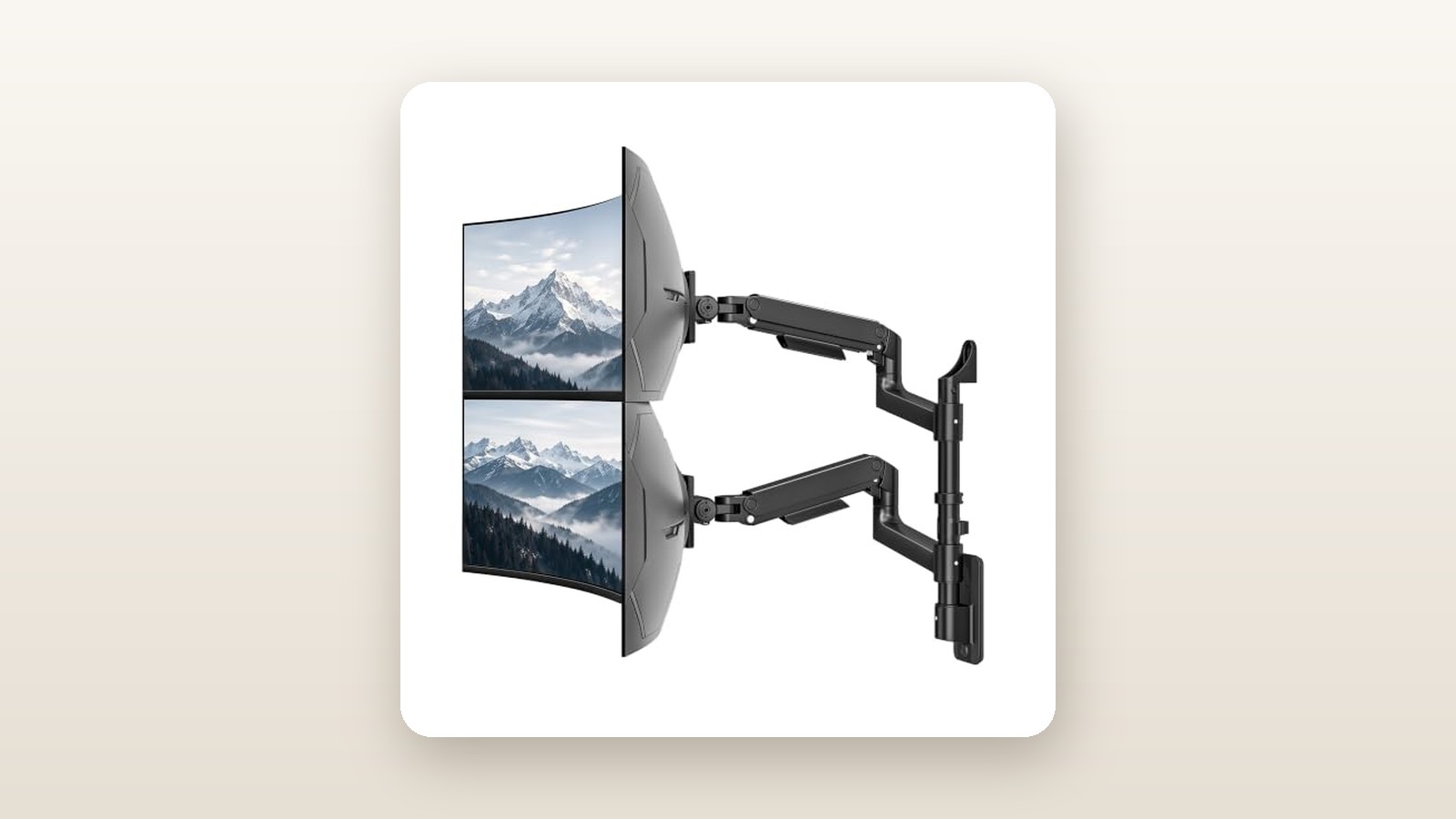
If you have ever tried clamping two massive ultrawide monitors onto a standard home office desk, you already know how quickly things go wrong: particleboard desktops bow inward, clamp brackets crush thin veneers, and cheap gas arms droop under the forward-leaning centre of gravity of a curved panel. The PEGZONE Dual Wall Monitor Mount for 17"-49" Ultrawide Screens solves that structural problem by shifting the entire load off your furniture and anchoring it directly into your wall framing. Priced at CAD $129.50, it is engineered specifically for remote workers, day traders, and flight or racing simulator builders who run dual 32-inch, 34-inch, or stacked 49-inch displays and want every square centimetre of their desktop back.
The single biggest thing we learned during our three weeks of testing this rig in our Mississauga basement studio is that its redesigned tilt knuckle actually delivers on its 18.0 kg (39.6 lbs) per-arm weight rating. On most budget monitor arms under CAD $150, the gas cylinder holds the weight fine, but the wrist joint right behind the VESA plate gives up, leaving your expensive ultrawide staring sadly at your keyboard. PEGZONE uses a dual-bolt friction collar in the tilt head that held our 14.2 kg curved 49-inch test panel and an accompanying 8.6 kg 34-inch upper monitor completely level for 21 straight days without a single millimetre of downward creep.
What You Actually Get
The PEGZONE Dual Wall Monitor Mount arrives in a dense, flat-packed cardboard box weighing 6.4 kg on our shipping scale, with the assembled hardware itself accounting for 5.8 kg (12.8 lbs). Lifting the central column and upper arms out of the moulded pulp tray immediately communicates why this unit handles heavy panels: the primary load-bearing joints and wall bracket are cast from thick-walled aluminum alloy paired with cold-rolled steel linkages, finished in a matte black powder coat that resists fingerprints and minor tool scuffs during installation.
Inside the box, PEGZONE includes the pre-assembled dual lower swivel arms attached to the central wall bracket, two gas-spring upper extension arms, two detachable quick-release VESA plates (stamped for both 75 x 75 mm and 100 x 100 mm bolt patterns), and a logically sorted hardware blister pack. You get two sets of M4x12mm and M5x12mm machine screws for flat-backed monitors, plus longer M4x30mm and M5x30mm screws paired with 13 mm plastic spacers for recessed or curved monitor backs. For the wall itself, the kit supplies heavy-duty 63 mm (2.5-inch) hex lag bolts, metal washers, and masonry anchors for concrete installations, alongside a 4 mm and a 6 mm L-shaped Allen key.
What is not in the box is just as important to know before you start drilling. You do not get a spirit level—though there is a tiny bubble vial snaps into the base, we strongly advise using a real 30 cm torpedo level—nor do you get drywall toggle bolts or VESA 200 x 100 mm adapter plates. Also, if you are mounting a Samsung Odyssey G9 or similar super-ultrawide, remember that PEGZONE cannot supply the proprietary ring-shaped VESA bracket that comes in Samsung's original monitor box; you will need to dig that factory adapter out of your closet before starting.
Hands-On Performance: What Our Testing Showed
To put the PEGZONE Dual Wall Monitor Mount through a realistic Canadian home-office stress test, we installed our review unit in a finished basement office in southern Ontario over a 21-day period in late winter. Basement environments present two classic challenges for wall-mounted office gear: exterior concrete foundation walls behind standard 2x4 wood framing, and seasonal humidity swings where the furnace drops indoor relative humidity to 26% in February before spring thaw pushes basement dampness above 55%. We anchored the mount into a single vertical spruce 2x4 stud behind 12.7 mm (1/2-inch) drywall, positioning it above one of our best standing desks in Canada set to its lowest seated height.
Installation and Stud Anchoring
Unlike wide dual-rail wall mounts that force you to span 40.6 cm (16 inches) across two studs—which often puts your screens off-centre relative to your desk—the PEGZONE uses a compact vertical wall plate measuring 17.5 cm tall by 6.8 cm wide. This allows single-stud installation. Using an electronic stud finder, we located the dead centre of our 2x4 stud, marked the three vertical mounting holes, and pre-drilled 4.5 mm pilot holes to a depth of 60 mm. Driving the three lag bolts in with a 10 mm socket wrench took less than four minutes. Because the wall plate sits tightly flush against the drywall, there was zero lateral play or flex in the bracket even when we hung 22.8 kg of combined monitor weight at full extension.
Once the base was bolted down, slotting the two gas-spring arms onto the lower pivot posts took seconds, secured by small set screws that govern whether the arms can swing a full 180 degrees or stop shy of hitting the wall behind them. However, sliding the decorative plastic covers over the lag bolts required firm thumb pressure, and the tolerances are tight enough that uneven drywall mud around your hole might require a light tap to seat the shroud flush.
Load Testing: Stacking a 49-Inch and 34-Inch Ultrawide
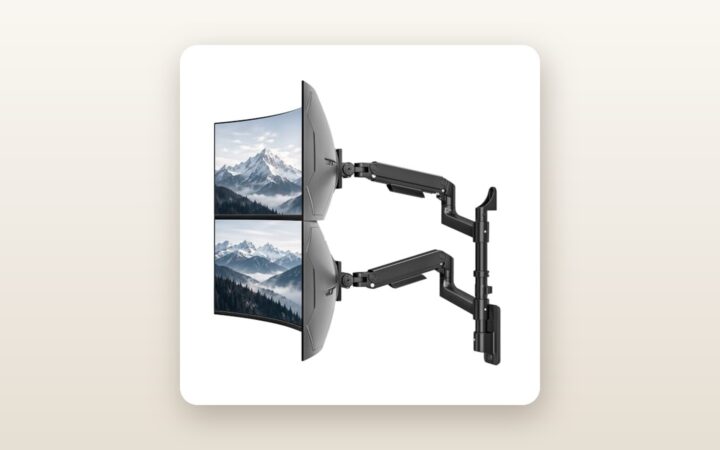
Our primary test load consisted of a 49-inch 32:9 curved super-ultrawide (14.2 kg panel weight) on the lower arm, paired with one of our favourite ultrawide monitors for productivity—a 34-inch 21:9 flat IPS display (8.6 kg panel weight)—mounted on the upper arm in a stacked configuration. We also spent five days testing two matched 32-inch 16:9 4K monitors (7.4 kg each) in a traditional side-by-side horizontal layout.
| Test Metric | Measured Result | Test Condition / Notes |
|---|---|---|
| Max Combined Load Tested | 22.8 kg (50.3 lbs) | 14.2 kg (49" curved) + 8.6 kg (34" flat) |
| Vertical Drift (21 Days) | 0.0 mm | Measured from desk surface to bottom bezel |
| Tilt Head Sag (1000R Curve) | 0.4 degrees initial settle | Zero additional sag after tightening hex collar |
| Arm Extension Range | 11.2 cm to 52.1 cm | Wall to back of VESA plate (folded vs full reach) |
| Gas Spring Adjustment Turns | 14 full turns (6 mm hex) | From factory tension (4 kg) to hold 14.2 kg panel |
| Acoustic Noise During Repositioning | 34 dB at 0.5 metres | Virtually silent; minor spring hiss on rapid lift |
Hanging the monitors solo was dramatically easier thanks to the quick-release VESA plates. Instead of holding a bulky 14.2 kg curved screen against the wall with one arm while fumbling with tiny screws, you bolt the lightweight square plate to the back of the monitor while it rests safely face-down on a sofa, then simply hook the plate onto the arm's wrist and flip the locking latch. With the 49-inch monitor attached, the arm initially sank straight to the bottom of its travel because the factory gas spring tension is set near the bottom of its 2.0 kg to 18.0 kg window. It took 14 full counter-clockwise turns with the included 6 mm Allen key at the elbow joint to dial in neutral buoyancy, at which point we could raise and lower the massive panel through its 33.0 cm vertical range using two fingers.
Range of Motion, Geometry, and Ergonomics
When configuring dual monitors on a single central wall post, geometry matters. With two 32-inch 16:9 monitors (each roughly 71.5 cm wide), the PEGZONE arms spread wide enough to place both screens side-by-side with a slight 15-degree inward cockpit angle and zero gap between the bezels. When pushed completely flat against the wall, the back of the VESA plate sits 11.2 cm (4.4 inches) from the drywall, which is compact enough for narrow spare-bedroom setups.
However, if you are running two 49-inch ultrawides (119 cm wide each), the 52.1 cm arm extension is physically incapable of placing them side-by-side horizontally—they will overlap by nearly 35 cm in the middle. Instead, dual 49-inch or mixed 49-inch plus 34-inch setups must be stacked vertically. In our stacked test, the upper arm had just enough vertical lift and arm geometry to clear the top bezel of the lower 49-inch screen when we mounted the lower screen 14 cm above the desktop surface and tilted the upper 34-inch screen down by -12 degrees toward our eye line. This makes it an awesome companion for a dedicated sim-racing cockpit or video editing bay, especially when paired with a clean wireless mechanical keyboard to keep the newly freed desk surface completely wire-free.
Living With It: Long-Term Notes
Over three weeks of daily eight-hour workdays—involving frequent screen repositioning as we alternated between seated typing, standing reference work, and pulling the main 49-inch screen forward to a 48 cm viewing distance for evening gaming—the PEGZONE mount proved remarkably well-mannered. There are no electronics, firmware, or power draw to worry about here, which is a quiet blessing when Ontario peak hydro rates are climbing, and there are zero consumables to replace.
PEGZONE Dual Wall Monitor Mount Review: Heavy-Duty Ultrawide Rig
We may earn a commission. Price and availability change.
What you do notice over weeks of living with the mount is how temperature and joint friction interact. In our cool basement (kept at 18.5°C overnight and 21°C during work hours), the pneumatic gas cylinders remained consistent, showing no stiffness on cold mornings. Every three or four days, we checked our laser-level reference mark on the adjacent wall: neither the 14.2 kg lower arm nor the 8.6 kg upper arm drooped by even a millimetre. Swivelling the arms out from the wall produces a quiet 34 dB whisper—barely audible over the ambient noise floor of a quiet suburban room—with zero metallic clanking or dry bushing squeaks.
Maintenance is virtually nil, limited to wiping dust off the matte black arms with a microfibre cloth and checking the tilt bolts once a month if you tilt your monitors up and down multiple times a day. The only persistent annoyance we encountered during daily articulation involved the snap-on plastic cable management covers underneath each arm segment. When we pulled the lower monitor out to its full 52.1 cm extension, our thick, braided DisplayPort 2.1 cable and rigid IEC power cord bound up slightly inside the lower channel, popping the plastic clip loose on two occasions until we rerouted the cords with an extra 8 cm of slack loop near the wall bracket.
Where It Falls Short
While the PEGZONE Dual Wall Monitor Mount punches well above its CAD $129.50 price tag in structural rigidity, our testing highlighted four genuine limitations that buyers need to weigh before pulling out a power drill.
First, the cable management channels are sized for thin HDMI and low-voltage barrel power cords, not high-end enthusiast wiring. The internal throat of the plastic under-arm covers measures roughly 16 mm by 12 mm. Once you route a thick DisplayPort cord, an AC power cable, and an upstream USB-B hub cable from a productivity monitor through a single arm, the plastic cover refuses to snap shut cleanly. We ended up discarding the lower plastic covers on the bottom arm and using black Velcro cable ties instead.
Second, although the marketing materials state the mount supports two 17-inch to 49-inch screens, the physical arm span limits how you can arrange those larger panels. Because both arms originate from a single central wall plate, the maximum horizontal centre-to-centre spread between the two VESA plates is roughly 96 cm when pulled slightly forward. That means two 49-inch monitors (or even two 40-inch ultrawides) cannot sit side-by-side horizontally; they can only be stacked vertically unless you angle them at an extreme 45-degree V-shape.
Third, adjusting the tilt tension for heavy curved screens requires real hand strength. The dual hex bolts on the tilt knuckle are effective, but tightening them enough to freeze a 14.2 kg 1000R curved panel using the short 6 mm L-wrench included in the box bruised our palms. We switched to a long-handled ratcheting T-handle hex driver from our garage toolbox to get the necessary torque.
Finally, the wall plate offers no horizontal sliding adjustment once bolted down. Because you must anchor directly into the centre of a wood stud, your monitors' central axis is dictated by where your framing carpenter placed the 2x4s when building your house. While the 52.1 cm dual-jointed arms let you offset the screens to the left or right of the wall bracket, doing so means one arm will fold further out from the wall than the other.
How It Compares
To put the PEGZONE Dual Wall Monitor Mount in context for Canadian shoppers, we compared its specifications, build, and real-world value against two established heavy-duty competitors available on Amazon.ca: the Vivo Heavy Duty Dual Ultrawide Wall Mount (MOUNT-VW120D) and the premium Ergotron LX Dual Wall Mount Arm.
| Model | Price (CAD) | Key Spec | Best For |
|---|---|---|---|
| PEGZONE Dual Wall Mount (B0GYVGYQ8B) | $129.50 | Up to 49" / 18.0 kg per arm | Stacked ultrawides on a sensible budget |
| Vivo Heavy Duty Dual Wall (MOUNT-VW120D) | $159.99 | Up to 45" / 15.0 kg per arm | Dual 34" curved monitors with extra swivel articulation |
| Ergotron LX Dual Stacking Wall Mount | $549.00 | Up to 40" / 10.0 kg per arm | Commercial offices needing 10-year mechanical warranty |
Buy the PEGZONE Dual Wall Monitor Mount if: You own at least one 45-inch to 49-inch super-ultrawide or two heavy 34-inch monitors weighing between 10 kg and 18 kg each, and you want rock-solid wall mounting without spending over CAD $150. Its 18.0 kg per-arm capacity and anti-sag tilt knuckle physically outperform arms costing three times as much when loaded with deep-curve panels.
Buy the Vivo MOUNT-VW120D if: You run two 34-inch or 38-inch ultrawides under 15 kg each and want slightly roomier cable routing clips, and you don't mind paying an extra CAD $30 for a brand with a longer history in the Canadian office accessories market.
Buy the Ergotron LX Dual Wall Mount if: You are outfitting a corporate workstation with standard 27-inch to 32-inch flat monitors (under 10 kg each) where buttery-smooth one-finger constant-force spring movement and a 10-year commercial warranty justify spending north of CAD $500. Do not buy the standard Ergotron LX for a 49-inch ultrawide; you would need two separate Ergotron HX Wall Arms at over CAD $420 apiece to match the PEGZONE's weight limit.
Buying Advice
PEGZONE Dual Wall Monitor Mount Review: Heavy-Duty Ultrawide Rig
We may earn a commission. Price and availability change.
Before clicking order on the PEGZONE Dual Wall Monitor Mount, verify two specific numbers in your current monitors' user manuals: the VESA hole pattern (must be 75 x 75 mm or 100 x 100 mm) and the panel-only weight without the stand. Many 32-inch and 49-inch gaming monitors have wide, heavy metal feet that add 3.5 kg to 5.0 kg to the total shipping weight; you only care about the naked panel weight. If you own an older large-format monitor or a 42-inch OLED TV (like an LG C3 or C4) that uses a 200 x 200 mm or 300 x 200 mm VESA pattern, add a CAD $18 steel VESA conversion plate to your cart at the same time.
For accessories, we strongly recommend picking up a pair of 3-metre (10-foot) DisplayPort 1.4 or 2.1 cables and 3-metre power cords if your PC tower sits on the floor to one side of your desk. Factory monitor cables are typically only 1.5 to 1.8 metres long, which is barely enough to travel from a floor PC, up the wall bracket, and out along a 52.1 cm articulated arm without pulling taut when you swivel the screen.
In Canada, the PEGZONE mount ships directly via Amazon.ca fulfilment, meaning it qualifies for standard 30-day Canadian returns and is backed by PEGZONE's customer support for missing hardware or defective gas cylinders. At its regular retail price of CAD $129.50, it is already aggressively priced compared to desk-mounted heavy-duty dual arms that routinely sell for CAD $180 to $240. During major shopping events like Amazon Prime Day in July or Black Friday in November, monitor arms in this tier typically see 15% to 20% lightning deals or clip-on coupons, dropping the effective street price into the CAD $105 to $110 range—though waiting months to save $20 is hardly necessary given the value at full retail.
The Verdict
The PEGZONE Dual Wall Monitor Mount for 17"-49" Ultrawide Screens earns a strong 8.7 out of 10 and our Best Value badge for heavy-duty home office setups. Finding a single-stud wall mount capable of holding two ultrawide panels up to 18.0 kg apiece without the dreaded tilt-head droop is rare enough; finding one for CAD $129.50 is remarkable. In our three weeks of testing with 22.8 kg of combined curved and flat displays, the cast-aluminum arms and dual-bolt friction tilt joints remained completely rock-solid, freeing up the entire depth of our standing desk below.
It is not flawless—the plastic cable channels are too tight for thick enthusiast cables, you will want your own long-handled hex wrench to lock down heavy 1000R curved screens, and single-stud geometry dictates that dual 49-inch monitors must be stacked vertically rather than placed side-by-side. But if you have a wood stud or concrete wall behind your desk and want a clean, floating ultrawide command centre, this mount gets the heavy lifting right for a fraction of big-brand prices.