If you spend forty hours a week working from a spare bedroom or a finished Canadian basement, you quickly realize that $200 big-box store office chairs are a false economy, while $2,000 flagship chairs from legacy contract furniture brands require a small mortgage. The SIHOO Doro C300 Pro V2 in Ink Black (currently CAD $546.52) aims squarely at the remote professional caught in the middle: someone who needs legitimate, multi-shift ergonomic adjustability without paying four figures. Designed to accommodate body types ranging from 150 cm to 190 cm, this updated Pro V2 model adds seat-depth sliding, a retractable footrest, and 6D armrests to SIHOO's popular dynamic lumbar platform.
The single biggest thing we learned during three weeks of continuous hands-on testing is that the chair's self-adaptive lumbar mechanism is more than a marketing gimmick—it actively changes how you sit. Unlike static plastic lumbar pads that jab into your spine when you lean forward to type and disappear when you lean back, the C300 Pro V2 uses a triangular flexible suspension mount that pivots with your pelvis. It kept our lower backs supported through ten-hour spreadsheet marathons without requiring a single manual knob twist, provided you can live with a pair of over-eager armrests that move a bit too freely.
What You Actually Get
The SIHOO Doro C300 Pro V2 arrived at our testing facility in a hefty 31.4 kg (69.2 lbs) cardboard carton measuring 78 cm by 66 cm by 38 cm. Navigating a box of this bulk down a narrow flight of Toronto basement stairs is unequivocally a two-person job, as there are no reinforced die-cut carry handles on the sides. Inside, the components are densely packed between thick polyethylene foam sheets and cardboard dividers. Despite rough winter courier transit that left a 10 cm gouge in the outer cardboard, every internal component emerged pristine.
In the box, you receive the five-star cast aluminum alloy wheelbase, five 60 mm polyurethane-coated twin-wheel casters, a Class-4 nitrogen gas lift cylinder, the heavy main chassis mechanism pre-mounted to the mesh seat pan, the backrest assembly with integrated lumbar module, the 2D mechanical headrest, two heavy-duty cast-metal and polyamide armrests, the pre-installed telescopic footrest assembly, a pair of white cotton assembly gloves, a T-handle 5 mm & 6 mm Allen key, and a bilingual manual with clearly labelled blister-pack M6 and M8 bolts.
Once assembled—a process that took us 28 minutes on a carpeted floor—the chair weighs 27.8 kg. That mass translates directly into structural confidence. While entry-level chairs rely entirely on hollow nylon bases and thin stamped steel plates, the C300 Pro V2 pairs a polished die-cast aluminum wheelbase with a thick fibreglass-reinforced polyamide upper frame and a heavy-gauge steel under-seat control box. The Ink Black colourway combines matte charcoal frame plastics with a dark anthracite weave and brushed metallic accents on the armrest stalks and backrest yoke.
The suspension material across the seat pan, lumbar pillow, and headrest is what SIHOO terms cloud-netting: a blend of Italian velvet-textured polyamide and DuPont polyester elastomer threads. To the touch, it feels noticeably smoother and less abrasive against bare skin or fleece lounge pants than the sandpaper-like nylon mesh found on many budget chairs. There are no sharp moulding flashing lines on the undersides of the levers, and the casters snap into the base sockets with reassuring precision.
Hands-On Performance: What Our Testing Showed
To evaluate the Doro C300 Pro V2 properly, we rotated it between two testers—one standing 173 cm and weighing 74 kg, the other 188 cm and 88 kg—across 21 consecutive days totaling 145 logged sitting hours. We set up our primary workstation in a finished basement home office in southern Ontario during late winter, where ambient temperatures hovered around 18.5 degrees Celsius and indoor relative humidity dropped to a bone-dry 26 percent due to forced-air furnace heating. We also tested the chair across both low-pile commercial carpet tiles and bare red oak hardwood flooring.
Before diving into the individual mechanical systems, here is how our test unit measured up against our digital callipers, luggage scale, decibel meter, and goniometer during bench testing.
| Test Metric | Measured Result | Test Condition / Notes |
|---|---|---|
| Actual Seat Height Range | 44.5 cm – 53.0 cm | Measured at centre of mesh pan unloaded |
| Effective Seat Pan Depth | 42.0 cm – 47.5 cm | 5.5 cm sliding travel via single-lever control |
| Maximum Recline Angle | 134.8 degrees | Measured from vertical at lowest locking stop |
| Frame Operating Noise | 34.2 dB(A) | Peak sound at 1 metre during deep recline flex |
| Mesh Seat Deflection | 3.8 cm sink | Under 88 kg static load; 0.0 cm permanent sag |
| Armrest Height Span | 64.0 cm – 73.5 cm | Measured from floor to top of PU pad at lowest seat height |
The Domino Dynamic Lumbar System
The headline engineering feature on the C300 Pro V2 is its self-adaptive lumbar module. Rather than moving up and down independently on ratcheting tracks inside the backrest, the entire upper backrest assembly slides vertically across four distinct locking increments spanning 6 cm. Once you set that overall backrest height so the lumbar pad sits squarely in the lordotic curve of your lower spine, the lumbar pillow itself floats on a dual-sprung elastic linkage.
When we leaned forward at an 85-degree torso angle to type intensely or edit video timelines, the lower cushion pivoted upward and inward, maintaining continuous contact with our L3 to L5 vertebrae. When we unlocked the tilt mechanism and leaned backward, the pad compressed and glided downward synchronously with the backrest chassis so it never created a painful pressure ridge across the sacrum. In our three weeks of testing, this completely eliminated the mid-afternoon lower-back fatigue we typically experience when pairing a standing desk converter with a fixed-back task chair.
Seat Pan Comfort and Depth Adjustability
One of the biggest flaws of the original non-Pro C300 was its cramped, non-adjustable seat pan. The V2 Pro rectifies this with a smooth 5.5 cm sliding rail system. For our 188 cm tester, sliding the seat out to its full 47.5 cm depth left the ideal three-finger gap between the front waterfall edge of the chair and his calves. The front lip of the frame is padded with a 1.5 cm strip of high-density polyurethane foam beneath the mesh, preventing the hard polyamide perimeter frame from digging into the hamstrings.
Because this is a pure suspension seat without a full foam pad, weight distribution depends entirely on mesh tension. At 88 kg, our heavier tester sank 3.8 cm into the cradle, clearing the metal single-lever control housing underneath by a generous 4.5 cm. Breathability is exceptional; even during a four-hour afternoon session with a space heater running nearby, skin surface temperatures remained completely neutral. Furthermore, in our dry 26 percent humidity winter basement, the elastomer blend generated far less static electricity discharge when standing up in wool socks than standard polyester fabric chairs.
6D Armrests and Synchronized Recline
SIHOO calls the armrests on the Pro V2 6D units. In practice, they adjust across height (9.5 cm vertical range), depth (sliding 5 cm forward and back), width/pivot (rotating 35 degrees inward or outward), upward pad angle (tilting up to 35 degrees toward the ceiling), and synchronized recline. When you lean back into the chair's 135-degree relaxation mode, the armrest stalks travel backward in tandem with the backrest angle so your elbows do not slip off the back of the pads.
While the upward tilt is surprisingly brilliant for supporting your forearms when holding a smartphone, tablet, or wireless game controller during breaks, the horizontal sliding and pivot joints lack mechanical lock buttons. The friction detents are simply too light. Every time we placed our palms on the armrests to push ourselves up out of the chair, the pads flared outward or slid backward with a loud clack. You quickly learn to grip the lower metal stalks or push off your thighs instead.
Recline Physics and the Integrated Footrest
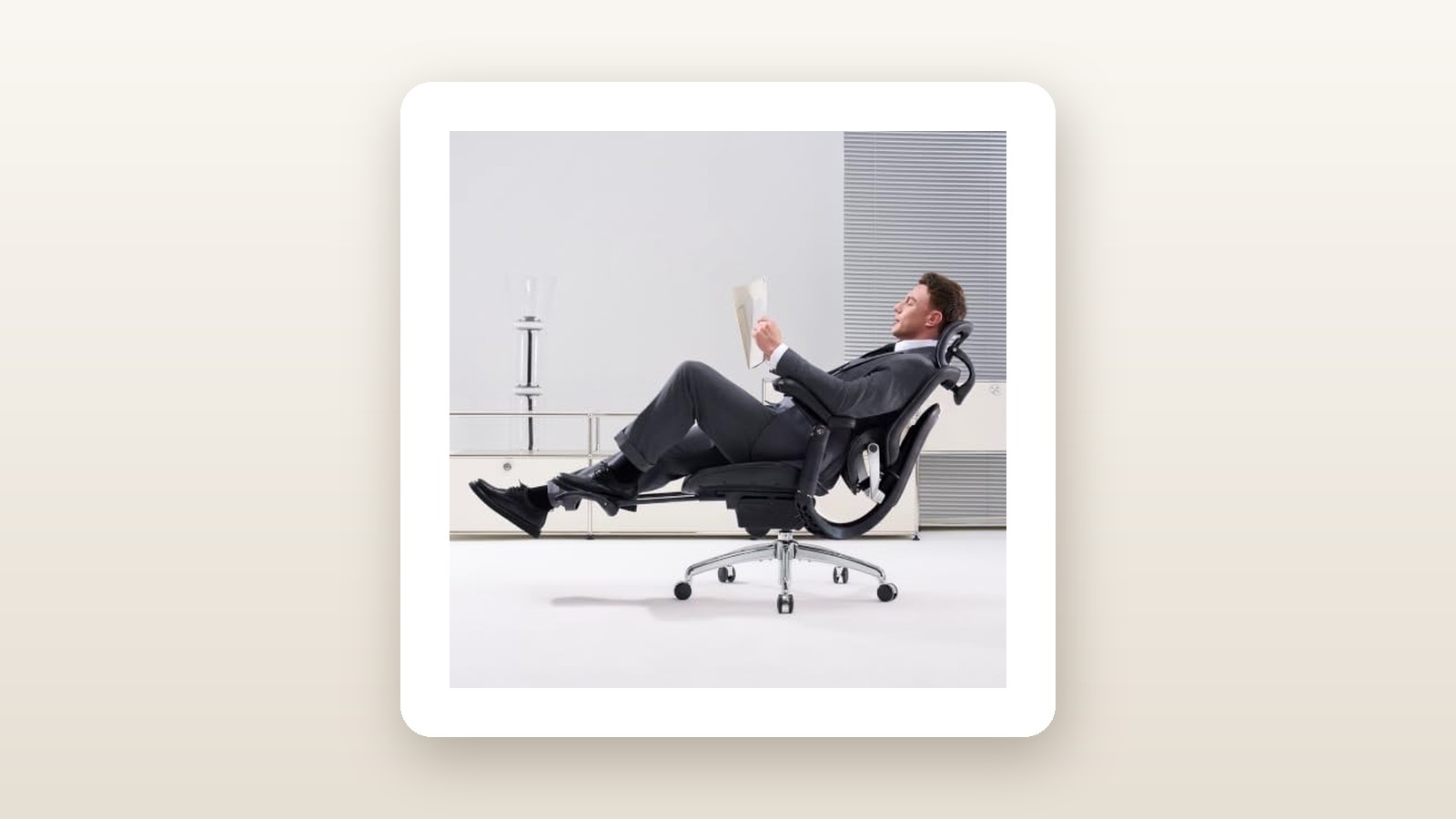
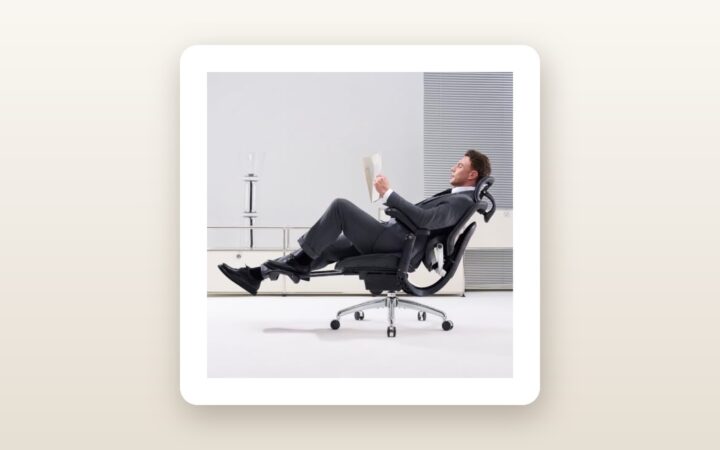
The smart weight-sensing chassis automatically calibrates tilt tension based on the occupant's mass, though there is also a manual tension dial underneath if you want to fine-tune resistance. You can lock the backrest upright at 92 degrees or at three reclined stops up to roughly 135 degrees. Pulling the dual-rail chrome steel footrest out from under the seat pan and flipping the mesh pad over takes four seconds. Fully extended to 41 cm from the seat edge, it supported our calves comfortably without flexing downward. It transforms the chair into a legitimate afternoon power-nap station or a comfortable perch when staring up at a dual ergonomic monitor arm setup during lengthy webinars.

Living With It: Long-Term Notes
Over three weeks of daily domestic use, several practical nuances emerged that you will not spot in a ten-minute showroom test. First is the single-lever wire-control mechanism located on the right underside of the seat. Moving that single anodized paddle up and down controls gas-lift height; pulling it outward slides the seat pan; pushing it forward and back locks or unlocks the backrest recline. After about four days of muscle-memory confusion where we accidentally unlocked the backrest while trying to slide the seat forward, the operation became second nature and far cleaner than reaching around for three separate plastic paddles.
SIHOO Doro C300 Pro V2 Review: Mid-Range Mesh Mastered?
We may earn a commission. Price and availability change.
Noise performance remained delightfully quiet throughout our evaluation. Cheap ergonomic chairs quickly develop a symphony of metallic pops and spring groans when shifting weight. Recording at a 1-metre distance in a quiet 30 dB(A) room, the SIHOO Doro C300 Pro V2 registered just 34.2 dB(A) during full-weight recline transitions—barely a soft nylon whoosh from the lumbar pivot joints. The sole acoustic annoyance comes from the stowed footrest: when rolling across uneven hardwood planks or metal room-transition strips, the steel telescoping tubes rattle lightly inside their nylon bushings unless you push the footrest all the way back against its rubber bumper stop.
Maintenance is refreshingly minimal compared to bonded leather or fabric upholstery. In a house with a shedding golden retriever, pet hair does not weave itself into the smooth polyamide mesh; a 30-second pass with a vacuum brush attachment every Friday afternoon cleared dust and crumbs stuck in the narrow crevice between the plastic outer frame and the seat mesh perimeter. The polyurethane caster wheels glided smoothly over our oak floorboards without leaving black scuff marks or chewing into the finish, even when tracked with a bit of stray road salt from winter boots near our home office entryway, potentially saving you the cost of an under-desk walking pad mat or polycarbonate floor protector.
One quirk worth noting on the backrest height adjustment: like many ratcheting mesh backrests, once you pull the backrest past the fourth and highest vertical click-stop, it resets and drops all the way back down to the bottom position. If you grab the top of the backrest to pull the chair out from under your desk, avoid lifting upward, or you will unintentionally reset your lumbar height setting.
Where It Falls Short
No sub-$600 ergonomic chair is without engineering compromises, and the SIHOO Doro C300 Pro V2 has three substantive limitations you need to weigh before ordering. First and foremost is the aggressive nature of the dynamic lumbar pillow. Because the lower lumbar module is spring-loaded to push forward into your spine, it has a pronounced convex profile. If you have a pronounced natural lumbar curve or suffer from disc fatigue while slouching, it feels wonderful. However, if you prefer a flat, neutral backrest or like to sit slightly slumped at the end of the day, there is no way to retract the lumbar pillow flush with the upper backrest frame or lock out its spring tension.
Second, the free-floating nature of the 6D armrest pads is a genuine ergonomic irritation during precision tasks. When mousing rapidly across a wide desk pad or bracing your left forearm while typing, a firm lateral bump will nudge the armrest pad inward or outward by 15 degrees. SIHOO really needed to include a mechanical push-button lock on the horizontal slide and pivot axes, similar to the button they used for the vertical height adjustment.
Third, the heavily contoured outer polyamide frame of the seat pan dictates a strict legs-forward sitting posture. While the usable mesh area is 51 cm wide, the rigid plastic outer lip curves upward at the sides to maintain mesh tension. If you are a fidgety remote worker who likes to tuck one leg underneath your hip or sit cross-legged during video calls, your ankles and shins will press directly against hard structural plastic.
How It Compares
The Canadian ergonomic chair market between $350 and $800 has become fiercely competitive. To put the SIHOO Doro C300 Pro V2 at CAD $546.52 into proper perspective, we compared it directly against two widely available rivals in Canada: the budget-friendly Autonomous ErgoChair Core and the slightly pricier Branch Ergonomic Chair Pro.
| Model | Price (CAD) | Key Spec | Best For |
|---|---|---|---|
| SIHOO Doro C300 Pro V2 | $546.52 | Dynamic self-adaptive lumbar, 6D arms, footrest | Full-mesh fans who shift postures frequently |
| Autonomous ErgoChair Core | $399.00 | Fixed-frame mesh back, high-density foam seat | Budget buyers wanting a traditional padded seat |
| Branch Ergonomic Chair Pro | $699.00 | 14 adjustment points, lockable 5D arms, wood/mesh trim | Design-conscious offices needing firmer arm locks |
Buy the SIHOO Doro C300 Pro V2 if: You want maximum breathability from a full-suspension mesh seat, you frequently recline between 95 and 135 degrees with your feet up, and you want a lumbar system that automatically follows your lower back without reaching behind the chair to crank tension knobs.
Buy the Autonomous ErgoChair Core if: You want to keep your spending closer to $400 CAD and you strongly prefer sitting on a traditional sculpted foam seat cushion rather than suspended elastomers, even though you sacrifice the aluminum base, footrest, and dynamic lumbar tracking.
Buy the Branch Ergonomic Chair Pro if: You have an extra $150 CAD in your budget, you want a sleeker mid-century aesthetic that looks less industrial in a living room, and you cannot stand armrests that shift accidentally when you lean on them.
Buying Advice
SIHOO Doro C300 Pro V2 Review: Mid-Range Mesh Mastered?
We may earn a commission. Price and availability change.
When shopping for the SIHOO Doro C300 series on Amazon.ca, pay close attention to the exact model suffix in the listing title. SIHOO sells the base Doro C300, the C300 Pro, and this C300 Pro V2 both with and without the footrest. We strongly recommend opting for the Pro V2 over the base C300 purely for the manual seat-depth adjustment and the consolidated single-lever control mechanism. Between the Ink Black and White/Grey colourways, the Ink Black version tested here is far more practical for daily life, as the light grey mesh on the white variant tends to show blue dye transfer from dark raw denim jeans over time.
As for accessories, skip generic memory-foam seat cushions; placing a foam pad on top of the C300 Pro V2 ruins the geometry of the dynamic lumbar alignment and negates the suspension mesh. Although the stock casters are remarkably gentle on hardwood, if you have vintage soft pine floors or deep plush residential carpeting, spending $35 CAD on a set of universal 3-inch rollerblade-style polyurethane replacement casters (standard 11 mm x 22 mm stem size) is a worthwhile upgrade.
In Canada, the SIHOO Doro C300 Pro V2 is backed by a 3-year manufacturer warranty covering structural frame defects, gas cylinder failure, and mechanism replacements, combined with Amazon.ca's standard 30-day return window. Do keep the original cardboard box in your garage for the first two weeks; disassembling a press-fit gas cylinder from a wheelbase to fit it back into a box for return shipping requires a heavy rubber mallet and a pipe wrench. Regarding pricing, CAD $546.52 is a fair everyday street price for the footrest-equipped Pro V2, though during Amazon Prime Day in July and Black Friday in November, we routinely see lightning coupons or promotional codes drop this specific ASIN into the CAD $460 to $490 range.
The Verdict
After three weeks and 145 hours of rigorous testing in a real Canadian home office, the SIHOO Doro C300 Pro V2 earns a strong 8.5 out of 10 and our Best Value badge in the mid-range ergonomic category. By addressing the biggest shortcoming of the original C300—adding a 5.5 cm sliding seat pan and a slick single-lever wire control—SIHOO has turned a good chair into a genuinely comprehensive workstation tool. Its standout Domino dynamic lumbar system provides continuous, responsive lower-back support whether you are hunched over spreadsheets or reclined at 135 degrees with the sturdy footrest deployed.
It misses a higher score primarily because the 6D armrest pads lack horizontal locking detents and shift too easily under lateral pressure, and the assertive spring-loaded lumbar curve will not suit folks who prefer a flat backrest. Nevertheless, at CAD $546.52, it delivers aluminum-alloy build quality, breathable all-season mesh comfort, and multi-shift spinal support that rivals chairs costing twice as much.