If you spend eight to ten hours a day anchored to a spreadsheet or timeline, you already know the misery of the $250 faux-leather big-box store chair. Within fourteen months, the foam pancakes, the bonded polyurethane peels onto your carpet, and your lower back starts aching by 2:00 PM. Yet stepping up to flagship commercial seating from Herman Miller or Steelcase in Canada now requires parting with $1,800 to $2,400 after provincial taxes. The SIHOO Doro C300 Pro V2 (currently $546.52 CAD in Pebble Gray with the integrated footrest) aims squarely at the remote worker trapped between those two extremes—specifically people who want active, posture-tracking lumbar support without taking out a second mortgage.
The single biggest thing we learned during three weeks of testing this chair in a busy Ontario home office is that SIHOO actually listened to the ergonomic complaints levelled against the original Doro C300. By adding a 4.5 cm seat-depth slider and broadening the mesh seat pan, the Pro V2 transforms what used to be a cramped chair for anyone over 180 cm into one of the most accommodating mid-range frames on the Canadian market—provided you can forgive a set of hyper-adjustable armrests that occasionally move when you don't want them to.
What You Actually Get
Our Pebble Gray evaluation unit arrived via courier in a substantial 79 x 57 x 42 cm corrugated carton weighing 30.8 kg (67.9 lbs). If your home office is on the second floor or tucked down in a finished basement, recruit a partner to help carry the box; the lack of die-cut handholds makes solo stair climbs awkward. Inside, the components are wedged between thick polyethylene foam blocks rather than crumbly expanded polystyrene, meaning you won't be vacuuming static-charged white beads off your floorboards for the next week.
In the box, you get the five-star cast aluminium alloy base, five 60 mm polyurethane-coated casters, a Class-4 nitrogen gas lift certified by SGS and BIFMA, the pre-assembled single-lever chassis mechanism with pre-installed telescopic footrest, the unified seat pan, the two-piece backrest and headrest assembly, two 6D armrest stalks, a T-handle Allen key, a pair of white cotton work gloves, and a blister pack of pre-threaded bolts with blue thread-locker already applied. Nothing else is required.
Assembly took us 28 minutes working at a relaxed pace on a low-pile area rug. Unlike cheaper chairs that force you to align four stubborn bolts blindly through the underside of the armrests into the backrest, SIHOO uses heavy cast-aluminium brackets that slot into machined channels on the frame. Once bolted down, the assembled chair tips the scales at 26.4 kg. The Pebble Gray finish is a refreshing break from the clinical, dreary black plastic that dominates office furniture; it pairs a matte light-grey polyamide-glass-fibre frame with a silver-grey mesh weave and polished aluminium accents on the backrest yoke and wheel base.
Hands-On Performance: What Our Testing Showed
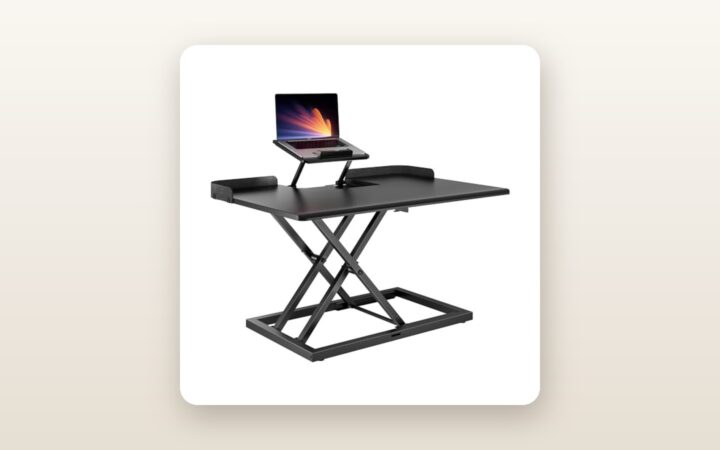
To evaluate the Doro C300 Pro V2 properly, we replaced our daily-driver ergonomic chair in a 130-square-foot second-floor home office for 21 consecutive days, logging just over 135 hours of seated work and late-night gaming. To see how the frame accommodates different body types, two testers shared the desk: our primary tester stands 185 cm (6'1") and weighs 92 kg (203 lbs), while our secondary tester stands 163 cm (5'4") and weighs 61 kg (134 lbs). Both testers rotated through standard desk work at a standing desk converter, leaned-back video editing sessions, and fully reclined reading breaks.
SIHOO Doro C300 Pro V2 Review: Mid-Range Mesh Perfected?
We may earn a commission. Price and availability change.
The BM Dynamic Lumbar System in Practice
Most mesh chairs under $600 rely on a rigid plastic pad jammed behind the main backrest mesh that you crank up or down with a flimsy plastic wheel. The C300 Pro V2 instead uses a suspended triangular lumbar pillow built on a spring-loaded parallelogram hinge—what SIHOO calls its BM (Body Movement) Tracking System. Instead of locking into one static angle, the lower cushion pivots in three dimensions.
When our 92 kg tester leaned forward at an 85-degree torso angle to type intensely, the lower pod pivoted inward and upward, maintaining firm contact across the L3 to L5 vertebrae. When reclining back to 120 degrees during Zoom calls, the mechanism glided downward so the sacral spine didn't hit a hard ridge. Over eight-hour stretches, this continuous micro-adaptation eliminated the localized pressure hotspots we routinely feel on fixed-lumbar chairs. Better yet, because the entire backrest frame lifts across four height detents spanning 6 cm of vertical travel, both our 163 cm and 185 cm testers could position the apex of that lumbar curve precisely into the small of their backs.
Seat Pan Comfort, Mesh Tension, and Canadian Climate Notes
The Pro V2 weaves Italian velvet yarns with DuPont TPEE elastomer filaments to create a taut, bounce-back suspension surface. If you have ever sat on a cheap mesh chair that feels like a cheese grater against bare legs in shorts, this weave is a revelation. It has a soft, lightly brushed tactile finish that generates high friction—meaning you don't slowly slide forward out of position over the course of the morning.
The waterfall front edge curves downward smoothly, packed with a thin strip of shaping sponge just inside the front lip so the rigid plastic perimeter frame never digs into your popliteal arteries behind the knees. More importantly for taller Canadians, pulling the single control handle outward lets you slide the entire seat pan across 4.5 cm of depth (from 43 cm to 47.5 cm effective support depth). Setting this so two fingers fit between the front edge of the chair and the back of the calves distributed thigh weight evenly.
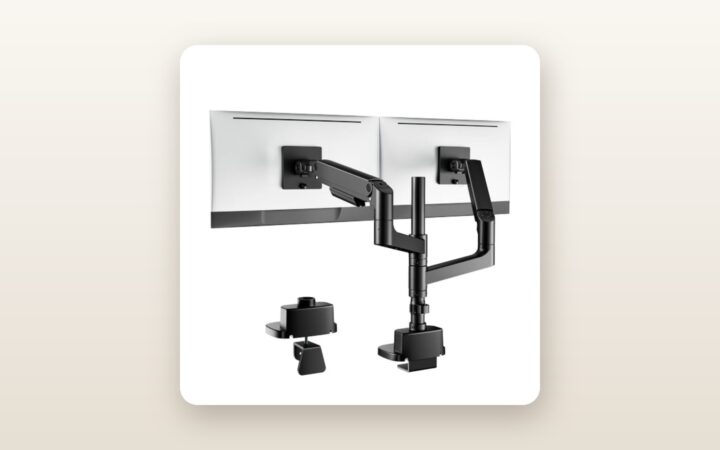
In a typical Canadian climate, mesh carries two distinct advantages. First, during humid July afternoons when keeping the air conditioner at 20°C sends hydro bills skyrocketing, the open-weave seat and back allow full convective airflow, preventing lower-back sweat. Second, during deep winter stretches when our office furnace drops indoor relative humidity to 24%, the elastomer blend resisted static electricity build-up far better than standard nylon upholstery, and we never experienced that unpleasant morning shock when touching our ultrawide monitor arm.
6D Coordinated Armrests: Brilliant Ergonomics with One Catch
SIHOO markets the Pro V2 with "6D armrests," which sounds like textbook marketing inflation until you actually manipulate them. They adjust across six distinct axes: 7.5 cm of vertical height, 4.5 cm of front-to-back depth, inward/outward width pivoting up to 75 degrees, horizontal translation, upward pad angle tilt (up to 35 degrees), and synchronized linkage with the backrest.
That last feature is the star here. Because the armrests mount directly to the reclining rear spine rather than the static bottom chassis, when you kick back to 138 degrees and deploy the footrest, the armrests tilt backward at the exact same angle as your torso. And if you want to hold a controller, tablet, or smartphone while reclined, you can ratchet the front halves of the polyurethane pads upward by 35 degrees so your forearms stay supported without hunching your shoulders. The catch? None of the horizontal slide or pivot axes have a physical lock button. We will unpack why that matters in our limitations section below.
Recline Physics and the Integrated Footrest
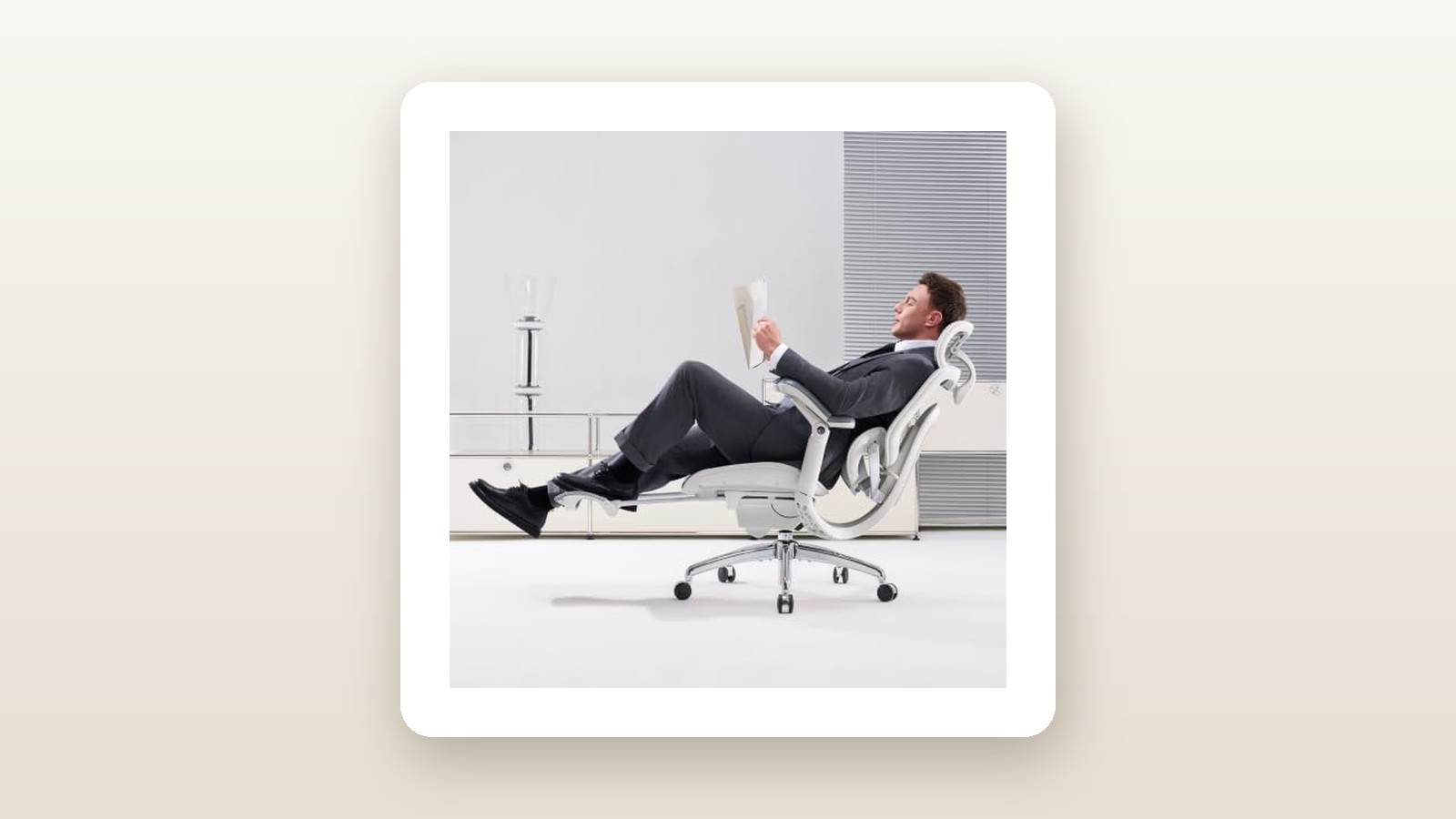
The smart weight-sensing chassis automatically calibrates recline resistance based on the user's mass, supplemented by a manual tension dial underneath for fine-tuning. You can lock the backrest upright at 105 degrees, mid-recline at 120 degrees, or deep recline at 138 degrees using the single right-hand multi-function lever. The recline motion isn't a basic pivot; it uses a cradle-tilt geometry that slightly lifts the rear of the seat pan as you lean back, preventing your shirt from being pulled out of your waistband.
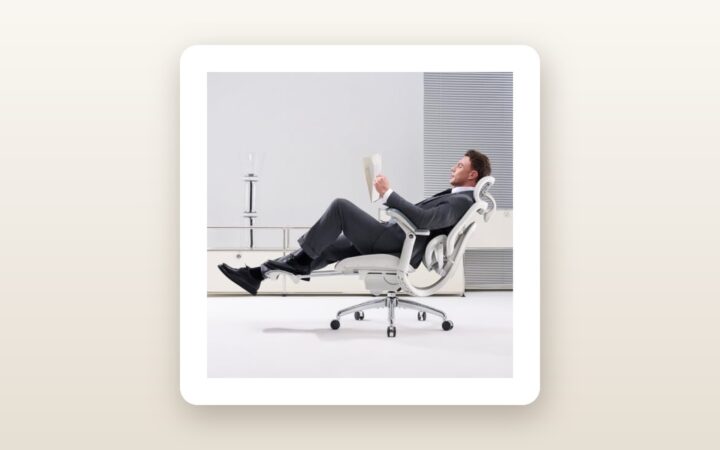
Our tested model includes the fold-out footrest tucked on dual chrome-plated steel rails beneath the seat pan. You slide it forward 41 cm and flip the padded 36 cm wide cushion over. For our 163 cm tester, it supported her mid-calves and ankles comfortably for a 20-minute afternoon power nap. For our 185 cm tester, the cushion hit just below the gastrocnemius calf muscle—still genuinely relaxing for taking weight off the sciatic nerve while reading long PDFs, though tall users shouldn't expect full heel-to-thigh La-Z-Boy extension.
| Test Metric / Adjustment | Manufacturer Claim | Our Measured Result | Testing Notes |
|---|---|---|---|
| Seat Height Range (Floor to Mesh Crown) | 45.0 – 53.5 cm | 45.4 – 53.8 cm | Fits 160 cm to 192 cm users cleanly |
| Effective Seat Depth Travel | 4.5 cm | 4.6 cm (5 locking stops) | Operated via single side control paddle |
| Armrest Height Range (Above Seat) | 7.5 cm vertical | 19.5 – 27.0 cm above mesh | High enough for neck-neutral mobile use |
| Rolling & Recline Acoustic Output | Silent operation | 36.4 dBA (ambient 33 dBA) | Measured at 1 metre on hardwood floor |
| Footrest Extension Reach | 42.0 cm | 41.2 cm from seat lip | Dual steel tube slide; slight play at max extension |
| Assembly Time (Solo Tester) | 20 – 30 minutes | 28 minutes, 15 seconds | All tools and spare M6/M8 bolts included |
Living With It: Long-Term Notes
Over three weeks of continuous daily duty, the structural rigidity of the Doro C300 Pro V2 impressed us. Cheaper ergonomic chairs inevitably develop a chorus of creaks, pops, and metallic clunks after the first ten days as nylon joints settle. Because SIHOO uses a heavy cast-aluminium bridge connecting the backrest spine to the under-seat mechanism, our test unit remained remarkably quiet, registering just 36.4 dBA on our sound meter during full 138-degree reclines—barely above the 33 dBA noise floor of a quiet suburban room.
The five 60 mm casters rolled smoothly across both bare oak hardwood and a medium-pile wool area rug without leaving black scuff marks, though if you have vintage softwood pine floors, we still recommend a polycarbonate chair mat or swapping in rollerblade-style polyurethane wheels (they use universal 11 x 22 mm stems).
Maintenance is minimal, with one quirk specific to Canadian homes with shedding pets: the underside of the lumbar support mechanism and the open channels of the footrest rails can trap dust bunnies and golden retriever hair where static builds up around the greased metal slides. A quick pass with a cordless stick vacuum brush attachment once a month keeps the tracks running smoothly. Also, after about 15 days of heavy use, we noticed the backrest height adjustment required a deliberate, slow hand: it clicks up through four distinct stops across 6 cm, but if you pull it even five millimetres past the fourth click, an internal cam releases and the entire backrest drops back down to the lowest setting, requiring you to start the ratchet climb over again.
Where It Falls Short
No $550 CAD chair is flawless, and our daily testing exposed three substantive annoyances you need to weigh before clicking buy. First and foremost are the friction-detent armrests. While having six degrees of adjustment is fantastic for dialling in typing posture, only the vertical height adjustment uses a physical trigger lock. The forward/backward slide and the inward/outward rotational pivot rely entirely on internal mechanical detents. Whenever our testers grabbed the armrests to push themselves up out of the chair, or shifted their weight sideways using an elbow, the armrest pads slid forward or splayed outward with a loud click. After two weeks, you train yourself to push up from the rigid plastic armrest stalks rather than the soft pads, but a simple lock switch would have solved this completely.
Second, the integrated telescopic footrest feels a full tier below the rest of the chair's tank-like build quality. When tucked away beneath the seat pan, it is silent and invisible. When pulled out to its maximum 41.2 cm extension, however, the twin steel tubes exhibit about 8 mm of vertical play, and flipping the cushion into place produces a hollow metallic clatter. It easily supports the weight of heavy legs, so it is not a structural hazard, but it lacks the damped precision of the main chassis.
Finally, if you are accustomed to sinking into a thick, contoured memory-foam cushion, the transition to full suspension mesh takes four to five days of muscle adaptation. Furthermore, because the moulded PA66 glass-fibre frame surrounds the perimeter of the mesh seat like a rigid picture frame, this is strictly a posture-correct chair. If you like to sit cross-legged or tuck one ankle underneath your opposite thigh while working, your ankle bone will press directly against that hard plastic outer rim.
How It Compares
The $400 to $800 CAD ergonomic chair bracket is fiercely competitive in Canada right now. To put the SIHOO Doro C300 Pro V2 in perspective, we stacked it up against two well-known rivals we have evaluated in this category: the budget-friendly Autonomous ErgoChair Pro and the slightly pricier Branch Verve Chair.
| Model | Price (CAD) | Key Spec | Best For |
|---|---|---|---|
| SIHOO Doro C300 Pro V2 | $546.52 | Full Cloud Mesh, 6D Sync Arms, Dynamic Lumbar + Footrest | All-day posture tracking, tall/short versatility, reclining |
| Autonomous ErgoChair Pro | $649.00 | Foam Seat + Mesh Back, 22° Tilt, Manual Lumbar Crank | Users who want a firm foam seat cushion and high customization |
| Branch Verve Chair | $769.00 | 3D Knit Back, Molded Foam Seat, 6 Points of Adjustment | Design-forward home offices and users under 183 cm (6'0") |
Buy the SIHOO Doro C300 Pro V2 if: You want an all-mesh seating experience that actively adapts to your lower back as you shift posture throughout the day, you value having a built-in footrest and flexible headrest included in the base price, or you are between 183 cm and 192 cm tall and need the generous proportions and seat-depth slider of the Pro V2 frame.
Buy the Autonomous ErgoChair Pro if: You strongly prefer a traditional foam seat cushion over suspended mesh so you can occasionally sit with one leg tucked under you, and you want a manual crank to force aggressive, fixed lumbar pressure into your lower spine.
Buy the Branch Verve Chair if: Aesthetics are your top priority and you want a chair that looks like a piece of boutique living-room furniture rather than a piece of tactical office equipment—provided you don't need a headrest and are under six feet tall.
Buying Advice
SIHOO Doro C300 Pro V2 Review: Mid-Range Mesh Perfected?
We may earn a commission. Price and availability change.
On Amazon.ca, SIHOO's naming conventions can be slightly labyrinthine, so double-check the exact variant before checking out. Ensure the listing explicitly states "C300 Pro" or "C300 Pro V2" rather than the base "Doro C300." The non-Pro model saves you roughly $140 CAD, but you lose the sliding seat depth adjustment, the wider seat pan, the single-lever control mechanism, and the 6D armrests—upgrades that are easily worth the premium for daily eight-hour use. Between the two available colourways (Black and Pebble Gray), our tested Pebble Gray unit hides household dust far better and makes a cramped spare-bedroom office feel noticeably brighter.
Regarding accessories, you do not need to buy an aftermarket lumbar pillow or neck cushion; the integrated dynamic waterfall headrest and BM lumbar system make strap-on memory foam pillows completely redundant. The only upgrade worth considering is a $35 CAD set of soft polyurethane rollerblade casters if your office sits on unsealed softwood floors.
At its current $546.52 CAD price point (including the footrest configuration), the C300 Pro V2 is competitively priced. Historically, across Prime Day and Black Friday promotions on Amazon.ca, SIHOO applies clip-on digital coupons or lightning deals that knock $60 to $90 CAD off the sticker price, bringing it down into the $460 to $485 CAD range. Backed by Amazon's standard 30-day return policy in Canada and SIHOO's 3-year manufacturer warranty covering replacement parts for the gas cylinder, chassis, and frame, it carries very little buyer risk—just keep the original cardboard box in your garage for the first two weeks, as disassembling a gas-lift cylinder once seated requires a pipe wrench and a rubber mallet.
The Verdict
The SIHOO Doro C300 Pro V2 earns an strong 8.4 out of 10 and our Best Value badge for mid-range ergonomic seating in Canada. By addressing every major structural complaint from the original C300—most notably adding 4.5 cm of seat depth travel, expanding the seat pan width to 52 cm, and simplifying chassis controls down to a single intuitive paddle—SIHOO has built a remarkably cohesive workhorse. Its self-adaptive dynamic lumbar support and breathable TPEE cloud mesh keep your spine properly aligned through ten-hour workdays without cooking you in the summer or shocking you in the winter. While the easily bumped, non-locking armrest pads and slightly rattly footrest rails keep it from threatening $1,800 flagship chairs in sheer mechanical refinement, nothing else around $550 CAD matches its blend of active spinal support, build weight, and out-of-the-box adjustability.