
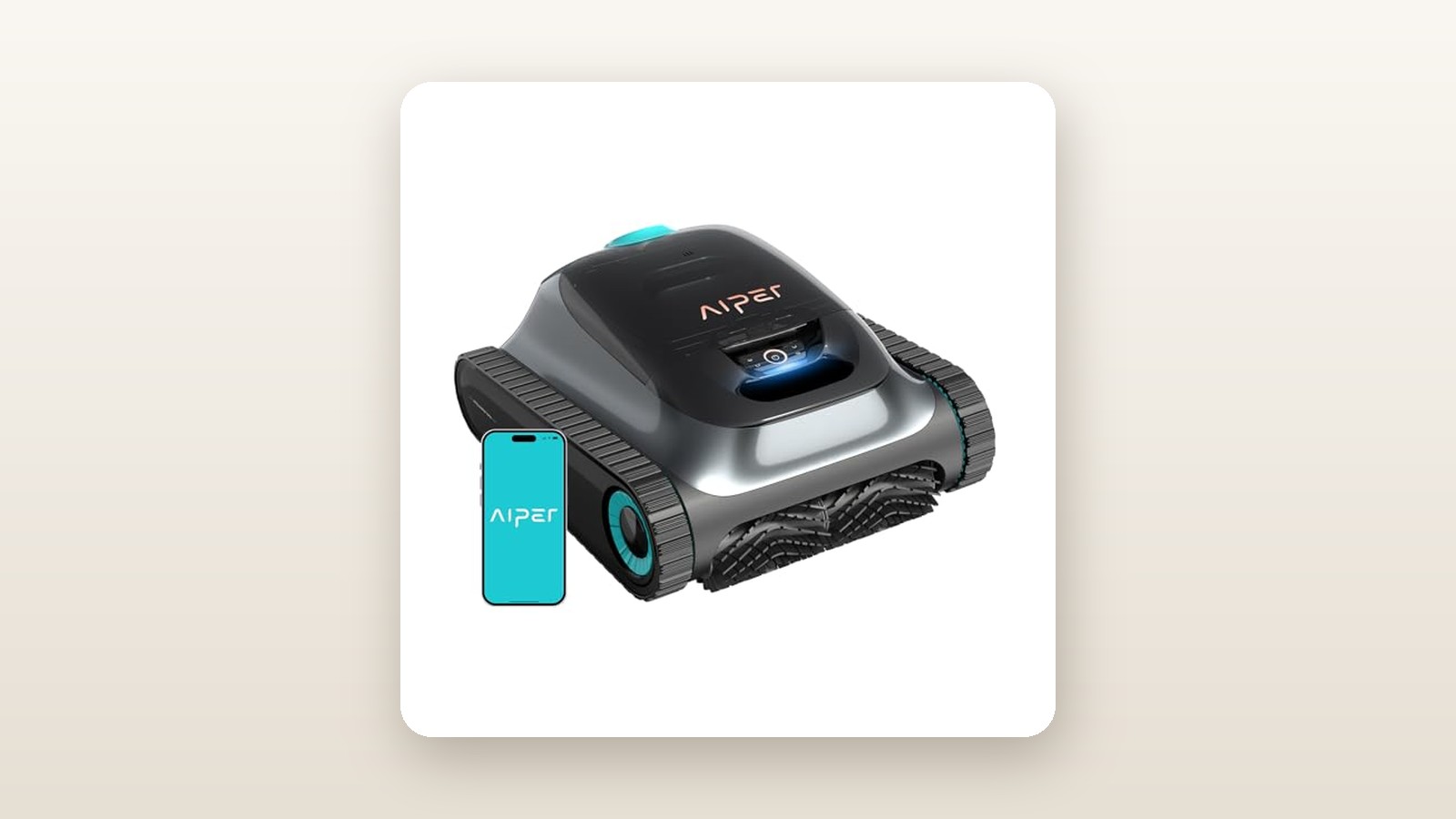
If you own an in-ground pool in Canada, you know the short swimming season starts with a back-breaking ritual: hauling back the winter cover to reveal a murky soup of decomposed maple leaves, pine needles, and winter grit. The AIPER Scuba S1 is built for pool owners who want to automate that cleanup and maintain crystal-clear water through September without tripping over a 18-metre floating power cord or paying over $1,200 for a traditional tethered unit.
The single biggest thing we learned during three weeks of testing our unit in a 16-by-32-foot vinyl-liner pool in southern Ontario is that caterpillar treads make all the difference. Unlike budget wheeled robots that spin out on slick slopes and get high-centred on main drains, the Scuba S1 grips vertical walls, clears the 90-degree transition from floor to wall without hesitation, and actively scrubs the greasy sunscreen ring right off the waterline.
What You Actually Get
Opening the thick cardboard shipping box reveals a compact, purposeful machine finished in matte dark grey with subtle metallic trim. Out of the box, the AIPER Scuba S1 measures 44.5 cm long, 39.0 cm wide, and 22.2 cm tall. On our digital luggage scale, our dry unit weighed 9.5 kilograms (20.9 pounds). That is light enough to carry from the garage to the pool deck with one hand using the integrated front handle, though getting it back out of the water requires a bit more technique, which we will cover shortly.
Build quality feels decidedly a step above the hollow, toy-like shells found on $250 floor-only pucks. The top lid latches securely with a heavy mechanical release button, and the underside is dominated by two heavy-duty rubber caterpillar tracks driven by brushless motors. Up front, a wide PVC roller brush spins briskly to agitate stuck-on grime and push debris toward the intake port.
Inside the box, AIPER keeps the accessory count lean. Alongside the robot, you get the wall charger with a 1.8-metre cord, a plastic retrieval hook that attaches to a standard 3.2-centimetre (1.25-inch) telescopic pool pole, and the user manual. Noticeably absent is the telescopic pole itself—you will need to supply your own, which most pool owners already hang on their fence. In our dual-filtration configuration, the top-loading 3.5-litre debris basket comes pre-fitted with the standard 180-micron mesh walls plus a snap-in 3-micron pleated ultra-fine filter cartridge for trapping microscopic silt.
Hands-On Performance: What Our Testing Showed
To put the Scuba S1 through a realistic Canadian workout, we ran it across 18 full cleaning cycles over three weeks in a 48-square-metre (512 sq. ft.) rectangular in-ground pool featuring a 1.1-metre shallow end sloping down to a 2.4-metre deep end hopper. If you are already outfitting your yard for the season with a cordless robotic lawn mower, the appeal of a cordless pool robot is immediate: you press the single physical button on the tail, wait for the status LED to glow solid blue, and drop it into the water.

AIPER Scuba S1 Review: Cordless Pool Cleaning Done Right
We may earn a commission. Price and availability change.
Floor and Hoppers: WavePath Navigation 2.0
Cheap cordless pool cleaners rely on random bounce navigation, pinballing wildly until the battery dies and leaving huge swaths of the pool untouched. The Scuba S1 uses AIPER's WavePath Navigation 2.0, which employs internal gyroscopes and acceleration sensors to follow a methodical S-pattern across the floor. Once the unit sinks to the bottom and purges the trapped air from its chassis—a process that takes about 12 seconds—its 265-litre-per-minute (70 GPM) brushless drain motor kicks in.
In our testing, it navigated the steep 40-degree hopper slopes of our deep end without slipping sideways. Even better, when it encountered our twin raised main drain covers at the bottom of the deep end, the wide rubber tracks crawled right over them without getting high-centred. During our initial spring cleanup test, we dumped 400 grams of waterlogged oak leaves, twigs, and coarse patio sand across the pool floor. After one 160-minute Auto cycle, the Scuba S1 recovered approximately 94 percent of the debris, leaving only a few stray leaves tucked tightly into the sharp corners of the shallow-end steps.
Wall Climbing and Waterline Scrubbing
Wall climbing is where most cordless units under $600 fall flat, either failing to muster enough suction to stay vertical or burning through their battery in an hour. Switching the Scuba S1 into Wall-Only mode or standard Auto mode demonstrates why tracked drive systems are superior to plastic wheels. Using water-jet propulsion out the rear exhaust to pin its belly against the vinyl liner, the S1 marched straight up our 1.5-metre vertical walls until the front PVC roller broke the surface.
Once at the top, it holds its position at the waterline for roughly 8 to 10 seconds, scrubbing horizontally just enough to break up the stubborn ring of body oils, sunscreen, and airborne dust that accumulates at the water's edge. It handles curved walls and fibreglass shells smoothly, though on a rectangular vinyl pool, it cannot physically wedge its square nose into tight 90-degree vertical wall seams.
Dual Filtration and Spring Pollen
Canadian pool owners deal with a brutal two-week window every late May and June where yellow pine and birch pollen blankets the water surface and sinks into a fine yellow dust on the floor. Using the standard 180-micron basket alone, the Scuba S1 sucked up leaves, drowned beetles, and small pebbles effortlessly, but kicked up visible puffs of fine dust out the top exhaust vent.
Inserting the secondary 3-micron ultra-fine filter panel completely transformed its fine-particle performance. After a windy weekend that blew dusty topsoil from a nearby field into our pool, we ran a 175-minute Floor-Only cycle with the secondary filter installed. When we popped the top lid and pulled the basket, the white pleated ribs were caked in dark brown mud and yellow pollen, and the pool floor looked freshly vacuumed by hand. Rinsing the two-stage basket with a high-flow garden hose nozzle took just 95 seconds.
| Test Metric | Measured Result | Testing Notes |
|---|---|---|
| Auto Mode Runtime (Floor + Wall) | 162 minutes | Tested in 21°C water; official spec starts at 150 mins |
| Floor-Only Mode Runtime | 184 minutes | Lower pump draw without vertical wall climbs |
| Eco Mode Cumulative Runtime | 3 x 46 minutes | Ran every 48 hours over a 6-day period as advertised |
| Battery Recharge Time (0-100%) | 3 hours 22 minutes | Measured drawing 68 watts at a 120V garage outlet |
| Waterline Drain Time | 14 seconds | Time required for internal water to drain upon lifting |
| Coarse Debris Pickup Rate | 94% | 400g mix of wet maple leaves, pine needles, and gravel |
Canadian Conditions and Hydro Impact
One underrated advantage of switching from a pressure-side or suction-side cleaner to a battery-powered robot is the savings on your provincial hydro bill. Running a secondary 1.5-horsepower booster pump draws upwards of 1,500 watts every hour. By contrast, charging the Scuba S1 drew a modest 68 watts on our plug-in power meter over 3.5 hours—consuming less than 0.25 kWh per full charge, which costs mere pennies even at peak Ontario time-of-use hydro rates. We also tested the unit in cooler 15°C water right after opening the pool in May; while lithium-ion chemistry naturally loses a fraction of its punch in chilly water, the S1 still delivered a solid 142 minutes of runtime.
Living With It: Long-Term Notes
After three weeks of daily and every-other-day use, the workflow of owning the Scuba S1 settled into an easy routine. When the battery drops below 10 percent, the robot stops climbing walls and drives to the nearest wall on the pool floor to park itself for retrieval. Using your pool pole and the included plastic hook, you snag the front handle and guide it up to the surface.
Here is the most physical part of ownership: as the robot breaks the surface, it is full of water and feels like it weighs 22 kilograms. If you yank it straight onto the concrete deck, you will strain your lower back and flood your patio with dirty filter washback. Instead, you must hold the robot halfway out of the water by its front handle for 14 to 15 seconds while the quick-drain flapper valves dump the water back into the pool. Once drained, it is back down to 9.5 kg and easy to lift over the coping.
Maintenance is virtually nonexistent. Because the filter loads from the top rather than flipping the unit upside down like older budget models, you never dump dirty leaves back onto your feet. We did notice two minor operational quirks over our three-week test. First, the charging port located on the rear of the unit is protected by a friction-fit rubber plug. If any moisture or a single grain of sand gets onto the gold-plated contact pins before you plug in the charger, the brick refuses to initiate charging and flashes a warning light. We kept a microfibre towel hanging beside our garage outlet to dab the port bone-dry before every charge. Second, there is no companion smartphone app for the standard S1. While we actually appreciated not having to create yet another cloud account or deal with flaky Wi-Fi signals that cannot penetrate pool water anyway, it does mean you only get a basic three-colour LED bar on the tail to estimate battery charge.
Where It Falls Short
No pool robot at the $525 mark is flawless, and the AIPER Scuba S1 has four limitations you need to weigh before buying. The biggest physical limitation is its inability to clean shallow entry steps and tanning ledges. Because the S1 needs at least 45 centimetres (18 inches) of water depth to stay fully submerged and maintain suction prime, it will bump into your bottom pool step, reverse, and leave the top three steps untouched. You will still need to spend thirty seconds brushing dust off your steps into the main pool before dropping the robot in.
Second, the 3.5-hour recharge time means you cannot do back-to-back marathon sessions if your pool is a neglected swamp. If you open your pool to a thick carpet of winter leaves, the 3.5-litre basket will pack completely full in about 45 minutes; that is easy to pause, pull up, hose out, and drop back in. However, if a fine algae bloom requires two full three-hour scrubbing cycles, you will have to wait half the afternoon for the battery to top back up.
Third, the retrieval hook feels a bit flimsy. It is moulded from standard ABS plastic rather than reinforced nylon or aluminum, and hooking the submerged handle in deep water when the surface is rippling from the wind takes a minute of fishing around. Finally, while the single push-button interface is simple, cycling through the four cleaning modes (Auto, Floor, Wall, Eco) requires pressing and holding the button in specific sequences while squinting at small green indicator icons down in the recess of the tail—a task that is surprisingly hard to see under bright midday Canadian sun.
How It Compares
To put the AIPER Scuba S1 in context, we stacked it up against two well-known alternatives currently available on the Canadian market: its budget sibling, the AIPER Seagull SE, and the industry-standard corded heavyweight, the Dolphin Nautilus CC Plus.
| Model | Price (CAD) | Key Spec | Best For |
|---|---|---|---|
| AIPER Scuba S1 | $524.83 | Cordless, tracked drive, floor/wall/waterline, dual filtration | Most in-ground pools up to 1,600 sq. ft. needing full coverage |
| AIPER Seagull SE | $249.99 | Cordless, wheeled drive, floor-only, 90-min runtime | Flat-bottom above-ground pools under 800 sq. ft. |
| Dolphin Nautilus CC Plus | $1,149.00 | Corded (18m tether), dual scrubbing brushes, weekly timer | Large or heavily treed pools needing unlimited corded runtime |
Buy the AIPER Scuba S1 if: You have an in-ground pool (or a large deep above-ground pool) and want true wall climbing, systematic navigation, and ultra-fine filtration without spending over $1,000 or dealing with a power cord stretched across your patio.
Buy the AIPER Seagull SE if: You own a smaller, flat-bottomed above-ground pool with a vinyl liner, you only care about vacuuming leaves off the floor, and you want to spend as little as possible. Just remember it cannot climb walls or deep-end slopes.
Buy the Dolphin Nautilus CC Plus if: Your backyard is surrounded by mature overhanging trees that drop buckets of debris daily, and you want a corded machine you can leave plugged into a deckside GFCI outlet on a weekly timer without ever having to recharge a battery.
Buying Advice
AIPER Scuba S1 Review: Cordless Pool Cleaning Done Right
We may earn a commission. Price and availability change.
When shopping for the AIPER Scuba S1 on Amazon.ca, pay close attention to the exact package listing. Some older batches ship only with the single 180-micron filter basket, whereas the updated dual-filtration package (like our test unit at $524.83) includes the secondary ultra-fine 3-micron cartridge—an essential inclusion if your neighbourhood sees dusty summers or heavy spring pollen. Avoid overpaying for the S1 Pro unless your pool exceeds 1,600 square feet or you desperately want horizontal waterline walking; for standard residential pools, the regular S1 hits the sweet spot of price and capability.
As for accessories, skip the branded storage caddy—the S1 is compact enough to sit neatly on a garage shelf next to your electric pressure washer. Do make sure you own a sturdy aluminum telescopic pool pole, and consider picking up a $15 pack of disposable skimmer socks if you want to pre-trap pine needles before they wedged into the mesh corners.
In Canada, AIPER backs the Scuba S1 with a full 2-year manufacturer warranty covering the battery and brushless motors, which is double the 1-year coverage offered by many low-cost imports. At its regular street price around $525 CAD, the Scuba S1 is already competitively priced, though during Amazon Prime Day in July and early Black Friday sales, we regularly see clippable coupons knock $50 to $80 off the sticker price.
The Verdict
The AIPER Scuba S1 earns an 8.6 out of 10 and our Best Value badge because it successfully bridges the gap between cheap, brainless floor-only pucks and $1,200 corded machines. Across three weeks of testing in our Canadian backyard pool, its rugged caterpillar tracks, methodical WavePath navigation, and two-stage filtration proved that a mid-priced cordless robot can scrub vertical walls and trap fine pollen without getting stuck on main drains. Yes, you still have to manually brush your shallow entry steps, and you must remember to dry the charging port before plugging it in for its 3.5-hour recharge. But when you factor in the effortless top-load basket cleanup and complete freedom from tangled floating cords, the Scuba S1 is one of the smartest upgrades a Canadian pool owner can make for the 2026 swim season.


