
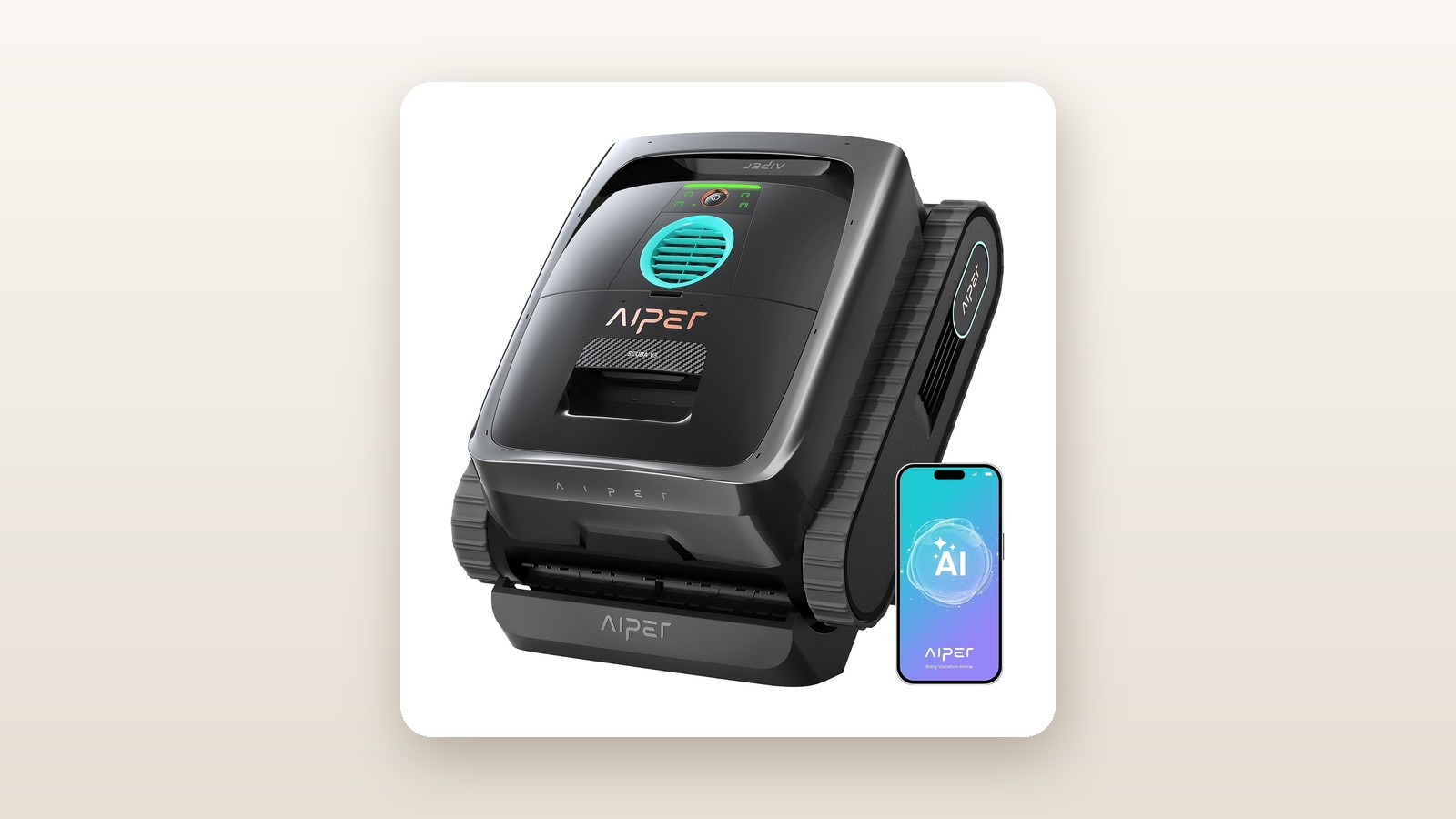
If you own an in-ground pool in Canada, your swimming season is precious and short—which makes spending Saturday mornings untangling hoses or untwisting floating power cords feel like a terrible trade-off. The 2026 AIPER Scuba V3 AI Vision Cordless Robotic Pool Cleaner (available at CAD $809.41) is built for homeowners who want to drop a machine into the deep end, walk away, and let optical object recognition handle the cleanup. Instead of blindly vacuuming every square centimetre of vinyl or concrete on a rigid timer, this unit uses a forward-facing camera to hunt down leaf clusters, sand piles, and sunken twigs.
After three weeks of testing our unit in a 16-by-32-foot (4.8-by-9.7-metre) salt-chlorinated vinyl-liner pool in southern Ontario, the single biggest lesson we learned is that AI Vision is a triumph for mid-week maintenance, not a miracle worker for neglect. When your water is clear and you only have a scattering of maple keys, dead June bugs, and wind-blown grit on the floor, the AI Patrol mode slashes cleaning time from three hours down to about 38 minutes—saving massive battery wear and letting the robot run multiple autonomous cycles on a single charge. Here is how it held up against cold spring water, pine needles, and daily use.
What You Actually Get
Out of the heavy-duty corrugated shipping box, the AIPER Scuba V3 feels considerably more substantial and refined than early-generation cordless units we have tested in our guide to the best robotic pool cleaners in Canada. The outer shell is moulded from UV-stabilized matte charcoal and slate-grey ABS plastic with a textured finish that resists dock rash and concrete scuffs. At the nose sits a recessed, scratch-resistant optical dome housing the AI vision sensor, flanked by dual LED illumination strips that automatically engage in deep water or overcast twilight conditions.
Measuring 46.5 cm long, 41.2 cm wide, and 26.8 cm tall, the Scuba V3 tips our digital luggage scale at 10.8 kg (23.8 lbs) bone dry. That makes it manageable to carry from a garage or pool shed using the wide, rubberized ergonomic front handle. Under the chassis, AIPER uses four high-traction PVC caterpillar treads driven by dual brushless traction motors, paired with dual sets of active silicone scrubbing rollers—one at the front and one at the rear—that spin counter to each other to agitate stubborn biofilm.
Popping the top latch reveals a top-loading 4.2-litre filter basket assembly. Rather than forcing you to swap between coarse and fine panels, AIPER nests a pleated 3-micron ultra-fine cartridge directly inside a 180-micron nylon mesh cage. Also in the box are a 145-watt wall charger with a 2.4-metre cord, a heavy-duty polymer retrieval hook that threads onto any standard 3.18 cm (1.25-inch) telescopic pool pole, two spare silicone scrubber flaps, and a multi-language manual with full English and French instructions. Notably absent is a storage caddy; at this price point, you get a dense foam resting pad in the box to keep the rubber tracks from flat-spotting during storage, rather than a wheeled cart.
Hands-On Performance: What Our Testing Showed
To put the Scuba V3 through a realistic Canadian torture test, we ran 24 full and partial cleaning cycles over three weeks across varying water temperatures and debris loads. Our test environment is bordered by two mature Norway maples and a white pine—trees notorious for dropping helicopters, sticky buds, and needles right into the skimmer path. We evaluated the robot across five specific operational metrics, logging battery drawdown, power consumption at the outlet, and debris capture percentages.

AIPER Scuba V3 AI Vision Review: Does Optical Mapping Actually Save Battery?
We may earn a commission. Price and availability change.
AI Vision vs. Standard Grid Navigation
The headline upgrade on the 2026 Scuba V3 is the optical AI camera paired with AIPER's onboard neural processing chip. In traditional cordless robots, the machine drives in a structured S-pattern across the floor regardless of whether the liner is spotless or buried under leaves. When we switched the Scuba V3 to its AI Patrol mode, its behaviour changed completely. Instead of creeping at its standard 18 centimetres per second, it cruises slightly faster while scanning a 1.5-metre cone ahead of its bumper. When the camera spots a dark contrast patch—like a clump of wet leaves or a strip of settled dirt along the cove seam—it steers directly toward the target, ramps the suction pump up to its maximum 320 litres per minute (85 GPM), and makes two localized passes before resuming its patrol.
We ran a controlled test using 250 grams of mixed debris (sinking oak leaves, waterlogged twigs, and 50 grams of play sand) scattered into four distinct zones of our pool. In Standard Floor mode, the Scuba V3 took 88 minutes to vacuum the entire floor, capturing 94% of the debris. In AI Hunting mode, it targeted those four clusters, picked up 91% of the debris in just 36 minutes, and parked itself by the shallow-end wall with 78% battery remaining. That efficiency is what allows the 24/7 Auto Cleaning feature to work: you can leave the robot in the pool for a long weekend in Muskoka, and it will wake up once every 24 hours, do a quick 30-minute visual sweep, and go back to sleep for up to four or five days on a single charge.
Wall Climbing and Waterline Scrubbing
Cordless pool cleaners often sacrifice vertical grip to preserve battery capacity, but the Scuba V3 pulls strongly against vertical surfaces. As it transitions from the floor cove up the wall, the pump audibly shifts gears, pinning the 10.8 kg chassis securely against our slick vinyl liner. It climbed cleanly up the 2.4-metre deep-end walls, crested the water surface, and moved laterally along the tile line for about 12 seconds per pass while the front silicone roller scrubbed away sunscreen oils and pollen rings.
It also navigated two main bottom drains and a curved fibreglass wedding-cake step edge without high-centring. The only geometry it refused to clean was our top two entry stairs, where the water depth was under 30 cm—shallow enough to trigger the unit's air-intake protection sensor and cause it to reverse back to the floor.
Filtration Efficiency: Leaves to Silt
During our second week of testing, a heavy spring windstorm dumped pine needles, cedar fronds, and fine agricultural dust across the neighbourhood. Running the Scuba V3 with both the 180-micron outer basket and the 3-micron inner pleated filter installed produced impressive clarity improvements. The outer mesh trapped all the pine needles and maple keys without letting them wrap around the impeller shaft, while the inner pleated media turned dark brown with fine clay silt and yellow pine pollen that would normally pass straight through a standard sand filter.
| Test Scenario | Cleaning Mode | Cycle Duration | Debris Recovery Rate | Battery Consumed |
|---|---|---|---|---|
| Spring Heavy Load (500g leaves, twigs, grit) | Standard Full (Floor + Wall) | 168 minutes | 96.4% | 92% |
| Mid-Week Touch-Up (120g scattered debris) | AI Patrol Mode | 38 minutes | 91.5% | 21% |
| Fine Silt & Pollen Test (100g masonry dust) | Floor Only (Dual Filter) | 95 minutes | 94.0% | 54% |
| Sunscreen & Waterline Ring Scrub | Wall & Waterline Only | 75 minutes | N/A (Visual Pass) | 46% |
| Cold Water Test (11.5°C Early Season) | Standard Full (Floor + Wall) | 132 minutes | 93.8% | 100% (Low-temp cutoff) |
Canadian Cold Water and Hydro Consumption
Pool testing in southern Florida does not tell Canadians how a lithium-ion battery behaves in May or late September. When we tested the Scuba V3 in unheated 11.5°C water right after opening the pool, maximum continuous runtime in Standard mode dropped from 172 minutes (measured later at 24°C) down to 132 minutes. That is normal physics for lithium chemistry, and 132 minutes was still plenty of time to clean our 512-square-foot pool floor twice over.
On the charging bench, our plug-in wattmeter recorded a steady draw of 142 watts from the wall brick, topping the depleted battery from 0% to 100% in 3 hours and 24 minutes (consuming roughly 0.46 kWh per full charge). Even if you charge the unit three times a week at Ontario's peak time-of-use hydro rates, your electricity cost works out to less than $3.50 for the entire four-month swimming season—a massive savings compared to running a 1.5-horsepower booster pump for a pressure-side cleaner.
Living With It: Long-Term Notes
Living with a cordless pool cleaner day-to-day comes down to two rituals: pulling it out of the water and rinsing the filter. When a cycle ends, the Scuba V3 always parks itself beside a wall rather than stranding itself in the middle of the 8-foot deep end. Using the included pole hook to snag the front handle is straightforward. As you lift the nose above the surface, a wide rear flap valve dumps internal water rapidly. If you yank it straight onto the deck, you are lifting roughly 16.5 kg; if you pause at the waterline for 8 seconds as instructed, it drains down to about 11.4 kg. While that is lighter than many corded flagships we have tested in our automatic pool maintenance equipment roundup, anyone with lower-back issues should brace their knees against the coping stone when hoisting it.
Cleaning the top-load basket takes about three minutes with a standard garden hose nozzle. Because the lid pops open with a single press-button and the basket lifts vertically, you never flip the machine upside down or dump dirty water back onto your interlocking patio stones. Removing the inner 3-micron pleated filter panels to hose out deeply embedded pollen takes another two minutes. One minor quirk we noticed by week three: tiny grains of masonry sand occasionally lodge in the magnetic charging port recess on the back of the unit. Because the charger uses exposed gold-plated contact pins rather than inductive wireless charging, you must wipe the port dry with a corner of your towel and blow out any stray grit before snapping the magnetic plug in place.
The AIPER companion app connects via Bluetooth and 2.4 GHz Wi-Fi while the robot is on the pool deck. You can toggle between five cleaning modes (Auto, Floor, Wall, Waterline, and AI Patrol), schedule recurring wake-up intervals for multi-day patrol, and push over-the-air firmware updates (our unit received one update during week two that smoothed out its corner-turning logic). However, because radio waves do not penetrate deep water, you lose live app connectivity the moment the Scuba V3 sinks below 30 cm. Do not expect to steer it like an RC boat from your patio chair while it is on the bottom.
Noise is virtually nonexistent. Underwater, the brushless motors are dead silent; when the robot breaches the surface to scrub the tile line, our sound meter registered a gentle 51 dB from two metres away—quieter than the gurgle of our pool skimmer weir.
Where It Falls Short
Despite its impressive tech sheet, the Scuba V3 has genuine physical and optical limitations you need to weigh before spending north of $800. First and foremost is the camera's reliance on clear water. During the first 48 hours of our spring opening, when dead algae and winter dust reduced visibility to less than a metre, the AI vision system could not distinguish debris from murky water. It defaulted to standard grid navigation, which works fine, but it means you cannot rely on the fast AI mode until your main filtration system clears the water.
Second, while the dual-stage filtration is awesome for water polishing, the 3-micron pleated paper cartridge is a consumable item. After three weeks of heavy pollen and leaf tannins, the pleats were stained and slightly frayed from high-pressure hosing. Expect to buy a replacement fine-filter pack (around CAD $55) once a season if you use the ultra-fine insert daily. You can easily pull the pleated insert out and run just the 180-micron mesh for everyday leaf duty to extend its life.
Finally, the lack of a water-surface skimming function means floating maple keys and dandelion fluff must still be handled by your built-in wall skimmer or a separate solar surface robot—which we cover in our solar pool skimmer reviews. And if your pool features wide Roman stairs or a shallow sun shelf under 35 cm deep, you will still need to spend two minutes brushing dirt off those shallow ledges toward the main floor before dropping the Scuba V3 in.

How It Compares
To put the AIPER Scuba V3's CAD $809.41 price tag in perspective, we stacked it up against two direct competitors readily available to Canadian buyers: AIPER's own workhorse step-down model, the Scuba S1, and the corded heavyweight standard, the Dolphin Nautilus CC Plus Wi-Fi.
| Model | Price (CAD) | Key Spec | Best For |
|---|---|---|---|
| AIPER Scuba V3 AI Vision | $809.41 | AI optical camera, 180-min runtime, 320 LPM suction, dual 180/3-micron filter | Tech-focused owners wanting fast mid-week touch-ups & multi-day auto patrol |
| AIPER Scuba S1 | $649.99 | WavePath 2.0 inertial navigation, 150-min runtime, 265 LPM suction | Budget-conscious pool owners with simple rectangular or kidney pools |
| Dolphin Nautilus CC Plus Wi-Fi | $1,299.00 | 18m swivel power cord, continuous power, dual scrubbing brushes | Large pools with heavy year-round leaf loads and owners who hate recharging |
Buy the AIPER Scuba V3 if: You want the freedom of a cordless cleaner but hate waiting three hours for a robot to blindly clean an already 85%-clean pool. The extra $160 over the Scuba S1 gets you noticeably stronger suction (320 LPM vs. 265 LPM), the 3-micron ultra-fine filter right in the box, and the AI Patrol mode that keeps a clean pool spotless across an entire week on a single battery charge.
Buy the AIPER Scuba S1 if: You only run your cleaner once or twice a week for a full floor-and-wall cycle and do not care if the cycle takes 2.5 hours. You give up optical debris targeting and multi-day auto-patrol, but you keep strong caterpillar-tread climbing and save roughly $160.
Buy the Dolphin Nautilus CC Plus Wi-Fi if: Your pool sits directly beneath a forest canopy where buckets of wet leaves fall daily, or you never want to think about battery charging cycles. You will have to deal with a floating 18-metre blue tether and plugging a power box into a GFCI outlet on your patio, and it costs nearly $500 more, but it never runs out of battery mid-clean.
Buying Advice
AIPER Scuba V3 AI Vision Review: Does Optical Mapping Actually Save Battery?
We may earn a commission. Price and availability change.
When shopping for the AIPER Scuba V3 on Amazon.ca, make sure you are looking at the 2026 AI Vision model (ASIN B0GTZ64MGS) rather than older refurbished generations. At its current listing price of CAD $809.41, it sits right in the middle of the mid-to-high-end cordless tier. Historically, AIPER is aggressive with seasonal promotional coupons in Canada; during Amazon Prime Day in July and early spring pool-opening events in May, we regularly see clip-on coupons or lightning deals knock $80 to $120 off the sticker price.
In terms of accessories, you do not need to buy anything on day one—assuming you already own a standard telescopic pool pole to attach the included retrieval hook. However, if your pool shed is more than 20 metres from the pool deck, picking up the optional AIPER universal wheeled caddy (around CAD $139) is a worthwhile upgrade to save your back. In Canada, the Scuba V3 is backed by a 2-year manufacturer warranty covering the motors, battery pack, and optical sensor module, with warranty returns serviced through Canadian logistics centres so you are not stuck paying cross-border shipping fees to the United States.
The Verdict
The 2026 AIPER Scuba V3 AI Vision earns a strong 8.4 out of 10 by solving the biggest annoyance of cordless robotic pool cleaners: wasted battery life on clean floors. By pairing a 320-litre-per-minute brushless suction system and dual 180/3-micron filtration with a genuine optical camera, it cleans smarter rather than just longer. While the camera cannot see through cloudy spring opening water and the 11.4 kg drained lift-out weight still requires a firm grip at the coping stone, its ability to hunt down scattered leaf clusters in under 40 minutes transforms day-to-day pool upkeep. For Canadian homeowners with medium-to-large in-ground pools who want crystal-clear water without tripping over floating power cords on the patio deck, the Scuba V3 is one of the smartest automated investments you can make this season.


