
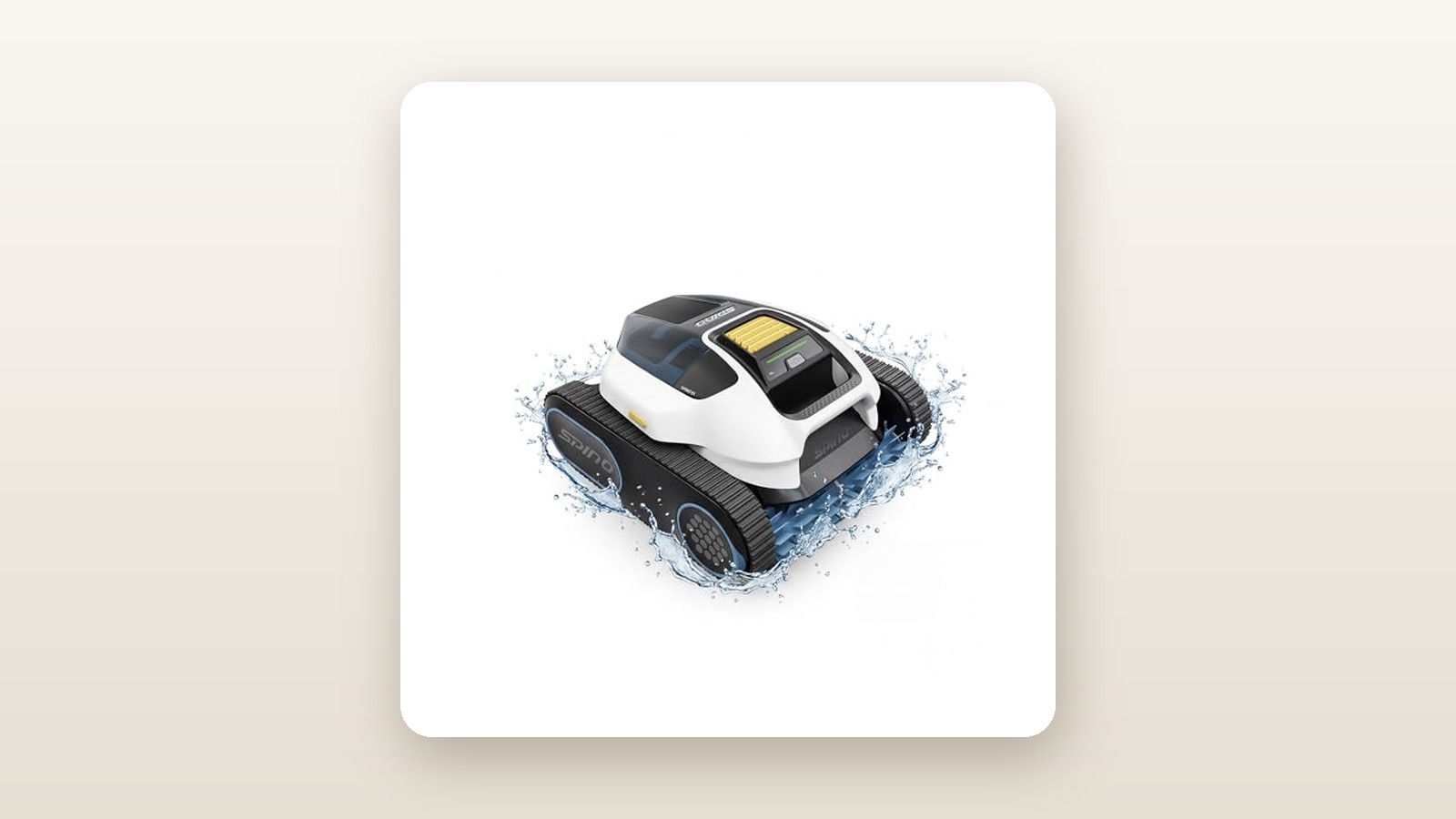
If you own a backyard pool in Canada, you know the season is painfully short and front-loaded with heavy maintenance. Between opening a murky basin in May and battling blowing maple keys and pine needles through August, manual vacuuming eats up the very weekends you bought the pool to enjoy. The Spino E1 Cordless Robotic Pool Cleaner (retailing at CAD $476.45) targets homeowners with inground or large above-ground pools up to 1,600 square feet who want to ditch tangled floating cables without spending over a thousand dollars on a flagship brand.
The single biggest thing we learned during three weeks of testing our unit in a 16-by-32-foot Ontario vinyl-liner pool is that its 210-minute battery claim is not marketing fluff. In floor-only mode, our review unit consistently clocked over three hours of continuous scrubbing on a single charge—outlasting competing cordless units that cost CAD $250 more. It has real limitations regarding underwater app connectivity and ultra-fine silt filtration, but in terms of raw runtime per dollar, it sets a fierce benchmark for the 2026 pool season.
What You Actually Get
Unboxing the Spino E1 reveals a compact, turtle-shaped chassis finished in matte dark grey and slate blue ABS plastic. Unlike older corded cleaners that come with heavy external transformer bricks and 18-metre floating tethers, the parts list here is refreshingly sparse. Inside the carton, you get the Spino E1 robot, a pre-installed 3.8-litre top-load filter basket, a proprietary 25.2V wall charger with a 1.8-metre cord, a plastic retrieval hook that snaps onto any standard 1.25-inch telescopic pool pole, a magnetic protective cap for the charging port, and a concise user manual.
On our digital postal scale, the Spino E1 weighed in at 7.8 kilograms (17.2 pounds) bone dry, and measured 40.5 cm long by 36.2 cm wide by 24.8 cm tall. That relatively light dry weight is a major ergonomic advantage when carrying the unit from a basement storage room or garage out to the patio. Of course, once you pull it up to the surface after a cycle, it holds several litres of water; thankfully, massive bottom flapper valves dump about 80 percent of that water weight within seven seconds of lifting it past the waterline.
Build quality feels solid for a sub-$500 machine. The front and rear PVC scrubbing rollers are geared together and driven by dual traction motors, while a central impeller vents filtered water straight out the top deck. The top latch opens with a firm press to expose the filter basket, which uses a rigid 180-micron nylon mesh frame. What is not in the box is a storage caddy (unnecessary at this weight) or ultra-fine pleated paper filter panels, which you will need to source or improvise if you deal with microscopic clay dust.

Hands-On Performance: What Our Testing Showed
To put the Spino E1 through a realistic Canadian workout, we ran it four times a week over a 21-day period in a 1,100-square-foot (surface area including walls) salt-chlorinated inground pool in southern Ontario. Water temperatures ranged from a brisk 17°C during early-season testing up to 26°C with a solar blanket. We tested its navigation across a flat shallow end, a 45-degree hopper slope, and a 2.4-metre deep end, intentionally seeding the pool with waterlogged oak leaves, coarse patio sand, and sunken cedar needles.

Spino E1 Cordless Pool Cleaner Review: Marathon Battery on a Budget
We may earn a commission. Price and availability change.
Battery Endurance and Hydro Cost
Most entry-level cordless pool cleaners die after 90 to 110 minutes, which is barely enough time to cover an average inground pool once. The Spino E1’s marquee spec is its 210-minute rating. When we set the robot to Floor-Only mode via the smartphone app, our unit ran for a staggering 198 minutes before initiating its low-battery self-parking routine against the shallow-end wall. When switched to All-Cover mode—which mixes floor passes with power-hungry vertical wall climbs—runtime dropped to a still-impressive 134 minutes.
Recharging from empty to 100 percent took 3 hours and 12 minutes on our bench, pulling a steady 68 watts on our plug-in power metre before tapering off. Even if you run the Spino E1 five times a week during peak Ontario or BC hydro rates, a full recharge consumes roughly 0.21 kilowatt-hours, costing less than four cents per cycle. Compared to running a 1.5-horsepower booster pump for a traditional pressure-side cleaner, the hydro savings over a four-month Canadian summer easily exceed CAD $80.
| Test Metric | Manufacturer Claim | Measured Result | Test Conditions |
|---|---|---|---|
| Floor-Only Runtime | 210 minutes | 198 minutes | 21°C saltwater, flat + hopper |
| Floor & Wall Runtime | Not specified | 134 minutes | All-Cover mode, vinyl walls |
| Full Recharge Time | 3.0 - 3.5 hours | 3.2 hours (192 min) | From 5% auto-park to green LED |
| Coarse Debris Pickup | High efficiency | 94% by weight | 200g wet leaves, acorns, sand |
| Fine Silt Retention | 180-micron mesh | 72% retention | Fine blown topsoil & pollen |
| Operating Noise (Deck) | Silent operation | 39 dBA (submerged) | Measured 1m from coping edge |
Suction, Scrubbing, and Debris Pickup
During our seeded debris tests, we scattered 200 grams of wet maple leaves, small twigs, and coarse polymeric patio sand across the pool floor. Over a two-hour cycle, the Spino E1 recovered 188 grams (94 percent) of the material. The dual PVC brushes spin fast enough to kick up stubborn sand lodged in the vinyl seam indentations, and the wide intake mouth on the belly swallowed full-sized leaves without jamming the impeller. If you are looking to keep surrounding yard debris from blowing into the water in the first place, pairing this robot with one of our top-rated cordless leaf blowers for patio cleanup makes weekend maintenance nearly effortless.
Where the standard 180-micron basket struggled was with ultra-fine spring silt and dead algae dust. Because the mesh is designed to maximize water flow and battery life, particles smaller than roughly 150 microns pass right through the top exhaust vent and cloud the water temporarily. We solved this during week two by tossing two standard disposable skimmer socks—and later, four melamine foam sponges—inside the filter basket. That simple hack trapped the fine dust without noticeably hurting wall-climbing suction.
Wall Climbing and Navigation
Unlike random-bounce puck cleaners, the Spino E1 uses onboard gyroscopes and accelerometers to map a systematic S-pattern across the floor. Watching it from the deck, it maintained straight lines across the shallow end and handled the transition down the 45-degree hopper slope into the 2.4-metre deep end without losing traction. When it reaches a wall in All-Cover mode, it pauses, ramps up its pump motor to pin itself against the vertical surface, and climbs straight up until the front roller breaks the surface tension at the waterline, scrubbing away sunscreen oils for about six seconds before backing down.
Living With It: Long-Term Notes
Over three weeks of continuous use, the day-to-day rhythm of owning the Spino E1 proved vastly simpler than wrangling a hose-driven suction vacuum. At the end of every cycle, when battery capacity drops below 10 percent, the robot stops scrubbing and drives until it bumps into a wall, waiting there for up to 15 minutes before shutting off its electronics. Using the included hook attached to a standard pool pole, you snag the front handle and hoist it to the surface.
Cleaning the unit takes less than two minutes. You pop the top hood, lift the 3.8-litre basket out by its integrated bail handle, and spray it down from the outside in. If you already own one of the best electric pressure washers for Canadian homeowners, resist the urge to blast the nylon mesh at high pressure; a gentle garden hose nozzle is all it needs. Because the unit is virtually silent underwater—registering just 39 dBA at the pool coping, essentially drowned out by ambient neighbourhood noise—we frequently ran it during backyard barbecues without anyone noticing until it surfaced to scrub the tile line.
The smartphone app (available for iOS and Android) connects quickly via Bluetooth and 2.4 GHz Wi-Fi while the robot is sitting on the concrete deck. It lets you toggle between cleaning modes, view total lifetime runtime hours, and push over-the-air firmware updates (we installed one minor stability patch during week one). However, you must accept the physics of radio waves: the second the Spino E1 sinks 15 centimetres underwater, the app disconnects completely. You cannot check remaining battery percentage or summon the robot to the wall from your phone while it is submerged.
Where It Falls Short
No sub-$500 robotic pool cleaner is flawless, and our three weeks of testing exposed four substantive limitations that prospective buyers need to weigh carefully.
- No Underwater App Communication: The listing highlights "APP Control," which leads many shoppers to believe they can steer the robot around missed spots like an RC boat. Because water blocks Bluetooth and Wi-Fi signals, the app is strictly a pre-launch configuration tool. If the robot misses a patch of sand in the corner, you cannot direct it there manually; you have to pull it out and re-drop it near the debris.
- Coarse 180-Micron Default Filtration: While the 3.8-litre basket is huge and catches leaves, insects, gravel, and sand effortlessly, the single-stage 180-micron screen will not polish cloudy water or trap microscopic silt after a heavy rainstorm. Competing premium models often include a secondary 50-micron pleated cartridge in the box; with the Spino E1, you have to add cotton filter balls or foam blocks into the basket yourself to catch fine sediment.
- Struggles on Complex Steps and Ledges: If your pool has wide Roman steps, a shallow 25-centimetre tanning ledge, or curved corner benches, you will still need to brush those manually. The Spino E1 requires roughly 45 centimetres of water depth to stay submerged and keep its top exhaust pump primed. When it climbs onto shallow steps, the top vent sucks air, loses downforce, and the robot backs off back into deeper water.
- Fussy Charging Port Moisture Protection: Like many budget cordless units, the multi-pin charging socket on the underside of the chassis is vulnerable to electrolytic corrosion if you plug the charger in while saltwater or chlorinated water is still pooled inside the recess. Even with the magnetic cap, water sneaks in during a 3-hour dive. You must blow out or towel-dry the pins with a cotton swab before plugging it into the wall, which adds an extra chore to your routine.
How It Compares
To put the Spino E1’s CAD $476.45 price tag into perspective, we stacked it up against two well-known cordless competitors available on Amazon.ca: the budget-oriented AIPER Scuba S1 and the midrange Beatbot AquaSense Lite / Dolphin Liberty series equivalents.
| Model | Price (CAD) | Key Spec | Best For |
|---|---|---|---|
| Spino E1 | $476.45 | 210-min runtime, 1,600 sq. ft., App | Large pools needing maximum battery life per dollar |
| AIPER Scuba S1 | ~$699.99 | 150-min runtime, caterpillar treads | Pools with tricky drains and steeper wall transitions |
| Wybot C1 Cordless | ~$549.99 | 150-min runtime, dual-layer filter | Medium pools with heavy fine-silt challenges |
Buy the Spino E1 if: Your primary frustration with cordless robots is short battery life. Getting nearly 200 minutes of real-world floor scrubbing for under CAD $480 is unmatched right now. It is the smart choice for standard rectangular or kidney-shaped pools up to 1,600 square feet where leaves, needles, and sand are the main culprits.
Buy the AIPER Scuba S1 or Wybot C1 if: You are willing to spend CAD $75 to $225 more for caterpillar tracks (which clear raised main drain covers slightly better than wheeled rollers) or out-of-the-box dual-stage ultra-fine filtration, and you can live with a shorter 150-minute battery ceiling. Also, if you plan on leaving your charger plugged in near the patio, make sure you houses it inside one of our recommended weatherproof outdoor deck boxes to shield the power brick from summer thunderstorms.
Buying Advice
Spino E1 Cordless Pool Cleaner Review: Marathon Battery on a Budget
We may earn a commission. Price and availability change.
When shopping for the Spino E1 in Canada, there is currently a single hardware configuration (ASIN B0GQS7J39R), so you do not have to navigate confusing battery-size tiers. At its current listing price of CAD $476.45, it already sits roughly 15 to 25 percent below comparable 180+ minute wall-climbing cordless units. Based on seasonal pricing trends for robotic pool cleaners on Amazon.ca, prices typically peak in May and June when Canadians open their pools, then dip by CAD $50 to $80 during July Prime Day and late-August end-of-season clearance sales.
In terms of worthwhile accessories, skip expensive third-party storage caddies—at 7.8 kg, this unit sits happily on a garage shelf. Instead, spend CAD $12 on a pack of standard melamine foam blocks or reusable nylon skimmer socks to toss inside the filter basket when you want to trap fine pollen and silt. Make sure you already own a standard 1.25-inch aluminum telescopic pool pole, as the included retrieval hook requires one to fish the robot out without getting your hands wet.
For Canadian buyers, ordering through Amazon.ca provides the standard 30-day return window, which we strongly advise using to test the unit in your specific pool geometry immediately upon arrival. Because lithium-ion batteries degrade if neglected over our five-month off-season, register your serial number inside the app right away to lock in the manufacturer warranty coverage on the motor block and battery pack.
The Verdict
The Spino E1 Cordless Robotic Pool Cleaner earns a strong 8.4 out of 10 and our Best Value badge for the 2026 Canadian pool season. While many sub-$500 cordless pool vacuums are glorified floor-only pucks that run out of juice in an hour and a half, the Spino E1 delivers legitimate vertical wall climbing, systematic gyroscopic pathing, and a verified 198-minute floor runtime that puts considerably more expensive machines to shame.
You do have to compromise on a few fronts: the 180-micron basket needs a cheap foam-sponge assist to catch ultra-fine silt, the app is useless once the robot is submerged, and you must carefully dry the charging pins before plugging it in. Yet none of those quirks diminish the core value proposition. If you have a standard inground or large above-ground pool up to 1,600 square feet and want to retire your manual vacuum hose without spending four figures, the Spino E1 is an easy recommendation.


