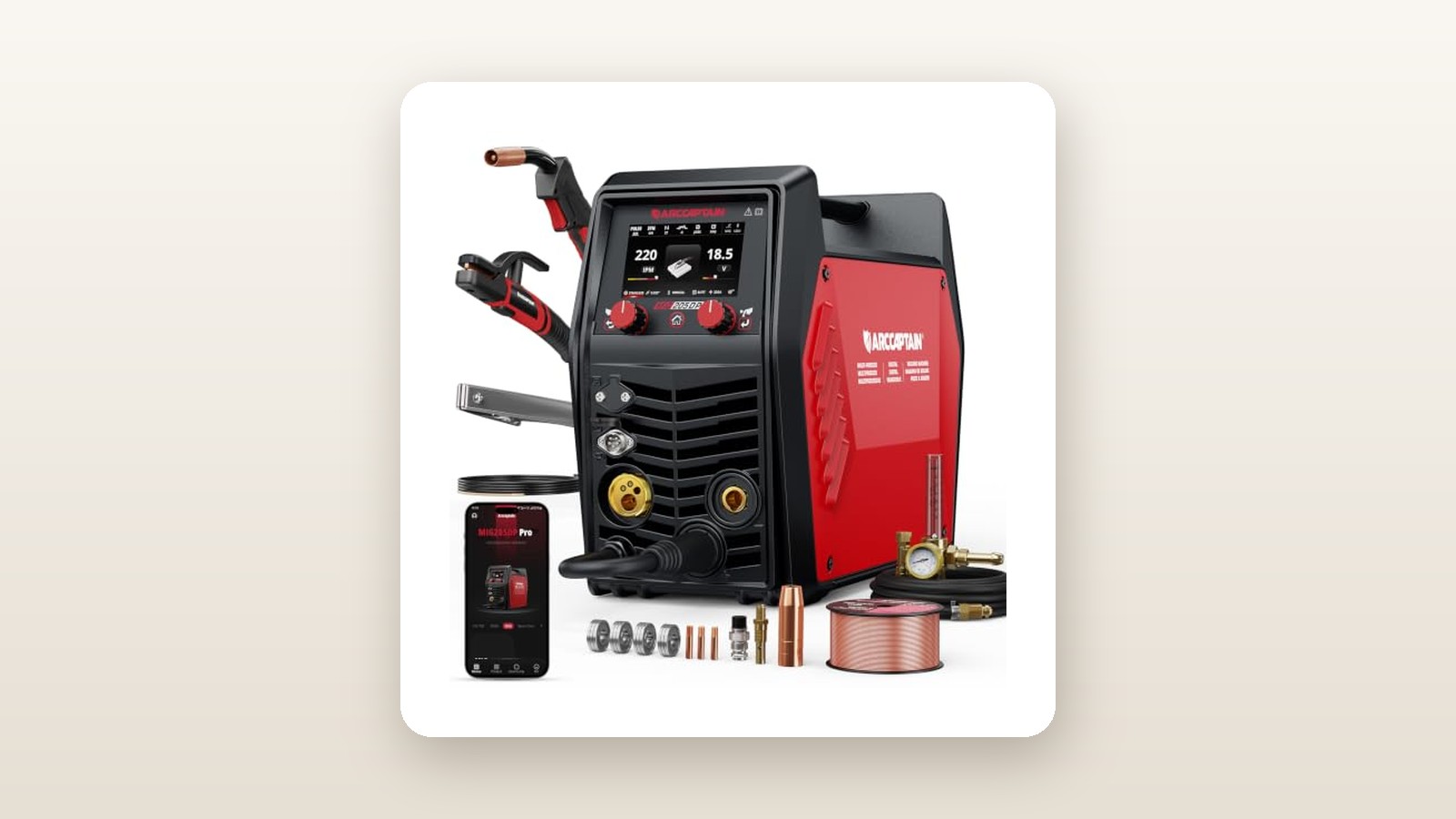
If you have ever tried to repair a cracked aluminum boat transom, fabricate an intercooler pipe, or patch a salt-rotted pickup rocker panel in a residential garage, you know the pricing wall in the welding world. Historically, getting true dual-pulse MIG capability—a process that lets you weld thin aluminum and stainless steel with minimal spatter and TIG-like ripples without buying a $1,200 AC/DC TIG rig or wrestling a clunky spool gun—meant spending upwards of $2,500 CAD on a blue or red industrial machine. The ARCCAPTAIN MIG205DP Pro lands on Amazon.ca at $534.03 CAD promising 205 amps of 8-in-1 multi-process power, including both single and dual-pulse MIG, straight out of a 12.8-kilogram inverter box. It is built squarely for serious home fabricators, rural acreage owners, and automotive restorers who need versatile metal-joining power without commercial three-phase shop wiring.
In three weeks of testing inside our unheated 450-square-foot Ontario workshop, the single biggest thing we learned is that the included graphene-lined push torch actually works as advertised on soft aluminum wire. We expected constant bird-nesting at the drive rolls when pushing 0.9-millimetre ER4043 wire through a 3-metre lead, yet our unit fed cleanly through four separate projects without requiring an external spool gun. While it cuts corners on accessory cable materials and fan noise to hit its aggressive price point, the underlying inverter arc control is shockingly refined.
What You Actually Get
Unboxing the ARCCAPTAIN MIG205DP Pro reveals a compact, thoughtfully armoured sheet-metal chassis flanked by heavy injection-moulded front and rear bumpers. The bare machine measures 46.5 by 21.8 by 36.2 centimetres and tipped our digital shipping scale at 12.8 kilograms (28.2 pounds) before loading a spool of wire. That makes it light enough to hoist onto a top workbench shelf or toss into the back of a half-ton truck using the top-mounted tubular polymer handle, though you will probably want to mount it on a dedicated rolling welding cart once you add a 4.5-kilogram spool of steel wire and an 80-cubic-foot argon cylinder.
Inside the side-hinged cabinet, the cast-aluminum wire feeder assembly is a step above the flimsy plastic drives we typically see on sub-$600 multi-process machines. The drive motor uses a quick-release tension arm with calibrated numerical markings from 1 to 5, and the spindle accommodates both 0.45-kilogram (1-pound) mini spools and standard 4.5-kilogram (10-pound) 200-millimetre rolls. Polarity switching between gas-shielded solid wire (DCEP) and gasless flux-core (DCEN) happens via a heavy brass twist-lock Dinse jumper cable located right beside the drive mechanism—no tiny brass nuts or wrenches to drop on the shop floor.
Included in the box are the following components:
- The MIG205DP Pro power source with a fixed 2.0-metre 240V NEMA 6-50P power cord
- A 120V NEMA 5-15P to 6-50R adapter pigtail for standard household outlets
- A 24KD-style 3.0-metre (10-foot) Euro-connect MIG torch pre-fitted with a red graphene liner for aluminum
- A separate steel spring liner for swapping back to carbon steel and flux-core wire
- A 3.0-metre electrode holder lead for Stick (MMA) welding
- A 2.1-metre work clamp (ground) lead
- A 2.5-metre braided gas hose with brass fittings
- Knurled V-groove drive rolls (for flux-core), smooth V-groove rolls (for solid steel), and U-groove rolls (for aluminum)
- Extra 0.8 mm, 0.9 mm, and 1.0 mm contact tips, plus a basic chip brush
Noticeably absent from the package is a gas regulator/flowmeter and a Lift TIG torch. While ARCCAPTAIN advertises this as an 8-in-1 machine, out of the box you can only perform six of those functions (Synergic MIG, Pulse MIG, Dual-Pulse MIG, Flux-Core, Spot MIG, and Stick). To use the Spool Gun mode or Lift TIG mode, you must purchase those torches separately, and you will need to supply your own CGA-580 argon regulator before striking a gas-shielded arc.
Hands-On Performance: What Our Testing Showed
To evaluate whether the MIG205DP Pro can handle real-world Canadian fabrication, we ran a strict 21-day testing protocol in our workshop. Ambient temperatures in the garage ranged from -4°C during early morning cold starts up to 16°C with our propane heater running. We tested the unit on both a standard 120V/20A garage GFCI circuit and a dedicated 240V/50A breaker, measuring actual amperage output with a calibrated clamp meter, duty cycle cut-offs with a stopwatch, and wire-feed consistency across 6.8 kilograms of consumable wire. Before laying a bead, we also made sure our bench was cleared and paired the unit with our favourite auto-darkening welding helmets to properly track the high-frequency pulse puddle.

ARCCAPTAIN MIG205DP Pro Review: Real Dual-Pulse Aluminum Under $550
We may earn a commission. Price and availability change.
Dual-Pulse and Single-Pulse Aluminum Welding
Aluminum is the ultimate stress test for a budget MIG welder because it conducts heat three times faster than steel and its oxide layer melts at a much higher temperature than the base metal. We installed the included U-groove drive roll, verified the red graphene liner was seated snugly against the diffuser, and loaded a 0.45-kilogram spool of 0.9-millimetre ER5356 aluminum wire hooked to a cylinder of 100% pure Argon flowing at 11.8 litres per minute (25 CFH).
Selecting the Dual-Pulse AlMg (5356) program on the digital front panel automatically dialled in a synergic baseline. When we selected 3.2-millimetre (1/8-inch) material thickness on 240V power, the welder set itself to 118 amps and 19.4 volts. Pulling the trigger produced a distinct, rhythmic humming sound—cycling between high and low pulse frequencies at roughly 2.5 Hz. Once we dialled the arc length (voltage trim) down to -1.5 and inductance to +2, the machine laid down bright, stacked dime-like ripples on 6061-T6 aluminum angle stock with almost zero black soot once brushed. Even more impressive was thin-gauge performance: dropping down to 1.6-millimetre (16-gauge) aluminum sheet in single-pulse mode at 62 amps allowed us to run continuous 15-centimetre lap joints without blowing holes through the edge—something that is nearly impossible with standard short-circuit MIG.
Synergic MIG and Flux-Core on Mild Steel
Switching from aluminum back to mild steel took us 11 minutes, as you have to pull the graphene liner out of the Euro torch cable, slide in the steel coiled liner, swap to the V-groove roller, and switch our gas bottle to a 75% Argon / 25% CO2 mix. On 4.8-millimetre (3/16-inch) hot-rolled steel plate, the Synergic MIG mode proved remarkably accurate. At 165 amps and 21.8 volts using 0.8-millimetre ER70S-6 wire, the arc was crisp and buttery, exhibiting minimal spatter and a flat bead crown with deep root penetration verified when we cut and etched a cross-section.
For outdoor driveway repairs where prairie or suburban wind blows shielding gas away, we flipped the internal polarity jumper to DCEN and loaded 0.9-millimetre E71T-GS gasless flux-core wire to repair a snowblower auger housing and a rusted utility trailer tongue. Even running on the 120V adapter plugged into a 20-amp wall receptacle, the machine pushed 125 amps cleanly without tripping our breaker. The Spot MIG timer function—adjustable from 0.5 to 10.0 seconds—also proved genuinely useful when plug-welding 18-gauge body patch panels, delivering identical heat input on every trigger pull.
Stick (MMA) and Cold-Weather Garage Behaviour
We hooked up the stinger lead and burned twenty 3.2-millimetre (1/8-inch) E7018 low-hydrogen and E6011 rods at 115 to 130 amps on 9.5-millimetre rusty steel channel. The built-in Hot Start and Arc Force adjustments (tunable from 0 to 10) prevented the 7018 electrodes from sticking on cold starts, and the VRD (Voltage Reduction Device) kept open-circuit voltage safely down at 14.2V until we struck the plate. When firing the unit up at -4°C after sitting overnight in a cold garage, the LED display showed zero lag, and the inverter capacitors charged smoothly. Considering Ontario time-of-use hydro rates, the high 85% inverter efficiency kept power draw modest, pulling just 42 watts at idle and peaking at 6.1 kW under a 200-amp load.
| Process & Wire / Rod | Input Voltage | Material Tested | Set Current / Voltage | Measured Current (Clamp) | Continuous Run Time to Thermal Cut-Off (at 18°C) |
|---|---|---|---|---|---|
| Dual-Pulse MIG (0.9 mm ER5356) | 240V | 3.2 mm 6061 Aluminum | 118A / 19.4V | 121A | No trip (100% duty cycle across 15 mins) |
| Single-Pulse MIG (1.0 mm ER4043) | 240V | 6.3 mm Aluminum Plate | 195A / 23.6V | 191A | 4 mins 48 secs (48% effective duty cycle) |
| Synergic MIG (0.8 mm ER70S-6) | 240V | 6.3 mm Mild Steel | 205A / 24.5V | 202A | 4 mins 12 secs (42% effective duty cycle) |
| Flux-Core Gasless (0.9 mm E71T-GS) | 120V (20A circuit) | 3.2 mm Rusted Steel | 125A / 18.2V | 123A | 6 mins 35 secs (65% effective duty cycle) |
| Stick MMA (3.2 mm E7018 Rod) | 240V | 9.5 mm Structural Angle | 125A / 25.0V | 127A | 7 mins 50 secs (78% effective duty cycle) |
Living With It: Long-Term Notes
Over three weeks of daily shop use, a few day-to-day operational traits stood out. First is the cooling fan: the moment you flip the rear breaker-style power switch on, the high-velocity axial fan roars to life and stays on continuously. Using a digital sound level meter at a distance of 1 metre, we measured 68.4 dB. While it is completely drowned out once you start grinding or welding, the lack of a temperature-activated fan-on-demand circuit is annoying when you pause for 20 minutes to clamp up a tricky fabrication jig using your heavy-duty workbench vises and have to listen to the machine drone on.
On the positive side, the graphene liner held up far better than we anticipated. After feeding roughly 1.2 kilograms of aluminum wire, we inspected the tip and drive entry for aluminum shavings; a quick 5-second blast of compressed shop air was all it took to keep the channel clean. The machine also remembers your last-used settings when powered down, so you do not have to re-enter your inductance, burn-back time, or pre-flow/post-flow gas timers every morning. Consumables are another bright spot: the 24KD torch uses standard Binzel-style contact tips, nozzles, and gas diffusers that you can buy in 20-packs on Amazon.ca for under $18 CAD.
Where It Falls Short
No $534 CAD multi-process welder gets everything right, and ARCCAPTAIN made clear budget compromises in a few areas. The most obvious weak link is the included ground clamp and cable. At 2.1 metres (6.9 feet), it is noticeably shorter than the 3.0-metre MIG torch, forcing you to keep the welder parked close to your work table. Worse, the cable uses stiff insulation that gets borderline rigid in a 0°C Canadian garage, and the conductor is copper-clad aluminum (CCA) rather than pure fine-strand welding copper. The stamped-steel spring clamp works fine on clean mild steel, but when welding aluminum—where electrical resistance ruins pulse timing—we ended up swapping in our own heavy brass ground clamp to stop the arc from fluttering on initial strike.
Our second gripe is the secondary parameter menu interface. While the primary LED screen is bright and easy to read through a passive shade-3 lens, tuning advanced pulse parameters—like pre-flow gas time, post-flow gas time, crater-fill current, slow-wire feed speed, and pulse frequency—requires holding down the parameter knob to enter cryptic two-letter codes (such as 'Pr', 'Po', 'In', and 'bA'). Until you tape a cheat sheet to the side of the machine, you will need the paper manual within reach.
Finally, if you switch between steel and aluminum multiple times a week, swapping the internal liner inside the single included MIG torch gets tedious. Each swap wastes about a metre of wire and takes 10 minutes of uncoiling the cable across the floor. Serious mixed-metal fabricators should spend an extra $65 CAD on a second cheap Euro-connect MIG gun to keep permanently rigged with the steel liner.
How It Compares
To put the ARCCAPTAIN MIG205DP Pro in context, we compared it against two widely available competitors on the Canadian market: the entry-level YesWelder MIG-205DS Pro and the upmarket PrimeWeld MIG180, both of which frequently show up alongside our top picks for portable plasma cutters in home fabrication shops.
| Model | Price (CAD) | Key Spec | Best For |
|---|---|---|---|
| ARCCAPTAIN MIG205DP Pro | $534.03 | 205A, 8-in-1 with Dual-Pulse MIG & Graphene Liner | Fabricators wanting clean, spool-gun-free aluminum and thin sheet metal pulse |
| YesWelder MIG-205DS Pro | $439.99 | 205A, 6-in-1 Synergic MIG (No Pulse) | Budget DIYers welding exclusively mild steel and flux-core who need a lower price |
| PrimeWeld MIG180 | $749.00 | 180A, 3-in-1 with Included Spool Gun & Regulator | Buyers who prefer a dedicated mechanical spool gun and heavy-duty copper leads |
Buy the ARCCAPTAIN MIG205DP Pro if: You want the cleanest possible bead appearance and heat control on aluminum and stainless steel without paying over $700 CAD. The dual-pulse waveform is a genuine technological leap over standard short-circuit MIG, and the ability to run a 4.5-kilogram spool of aluminum inside the cabinet saves you money on expensive 0.45-kilogram spool-gun rolls.
Buy the YesWelder MIG-205DS Pro if: You have zero intention of welding aluminum or thin stainless steel and simply want a dependable 205-amp synergic steel and flux-core machine while keeping an extra $95 CAD in your pocket for shielding gas and wire.
Buy the PrimeWeld MIG180 if: You are willing to sacrifice pulse waveforms and 25 amps of peak output in exchange for an included dedicated spool gun, an included flowmeter regulator, and more flexible pure-copper ground leads right out of the box.
Buying Advice
ARCCAPTAIN MIG205DP Pro Review: Real Dual-Pulse Aluminum Under $550
We may earn a commission. Price and availability change.
When ordering the ARCCAPTAIN MIG205DP Pro in Canada, keep in mind that the base unit does not include a gas regulator. Do not buy a cheap dial-gauge regulator; instead, budget $38 to $45 CAD for a floating-ball argon flowmeter regulator (CGA-580 fitting), which gives far more accurate gas flow readings when tuning pulse aluminum. We also strongly recommend picking up a nozzle gel dip or anti-spatter spray and a dedicated stainless-steel wire brush exclusively for aluminum prep.
In terms of pricing history, the current Amazon.ca price of $534.03 CAD sits near its regular street baseline. During major retail events like Amazon Prime Day in July and Black Friday in November, ARCCAPTAIN typically applies a 10% to 15% clip-on coupon, bringing the landed price down into the $460 to $485 CAD bracket before provincial taxes. The machine is backed by a 30-day Amazon.ca return window and a 2-year manufacturer warranty; just be sure to register your serial number on the ARCCAPTAIN website within 30 days of delivery to lock in coverage.
The Verdict
At $534.03 CAD, the ARCCAPTAIN MIG205DP Pro delivers capabilities that were completely out of reach for home garage welders just three years ago. By pairing a responsive digital inverter with true single and dual-pulse waveforms and a clever graphene-lined Euro torch, it solves the headaches of pushing soft aluminum wire without forcing you to buy an expensive spool gun. Yes, the continuous 68 dB cooling fan is loud, the 2.1-metre ground cable begs for a $30 upgrade, and you will need to supply your own argon flowmeter. However, when you pull the trigger on 3.2-millimetre aluminum or 18-gauge auto body steel, the arc stability, penetration, and low-spatter bead profile rival machines costing three times as much. That combination of raw arc performance and multi-process flexibility easily earns it an 8.6 out of 10 and our Best Value badge for Canadian DIY fabricators.