
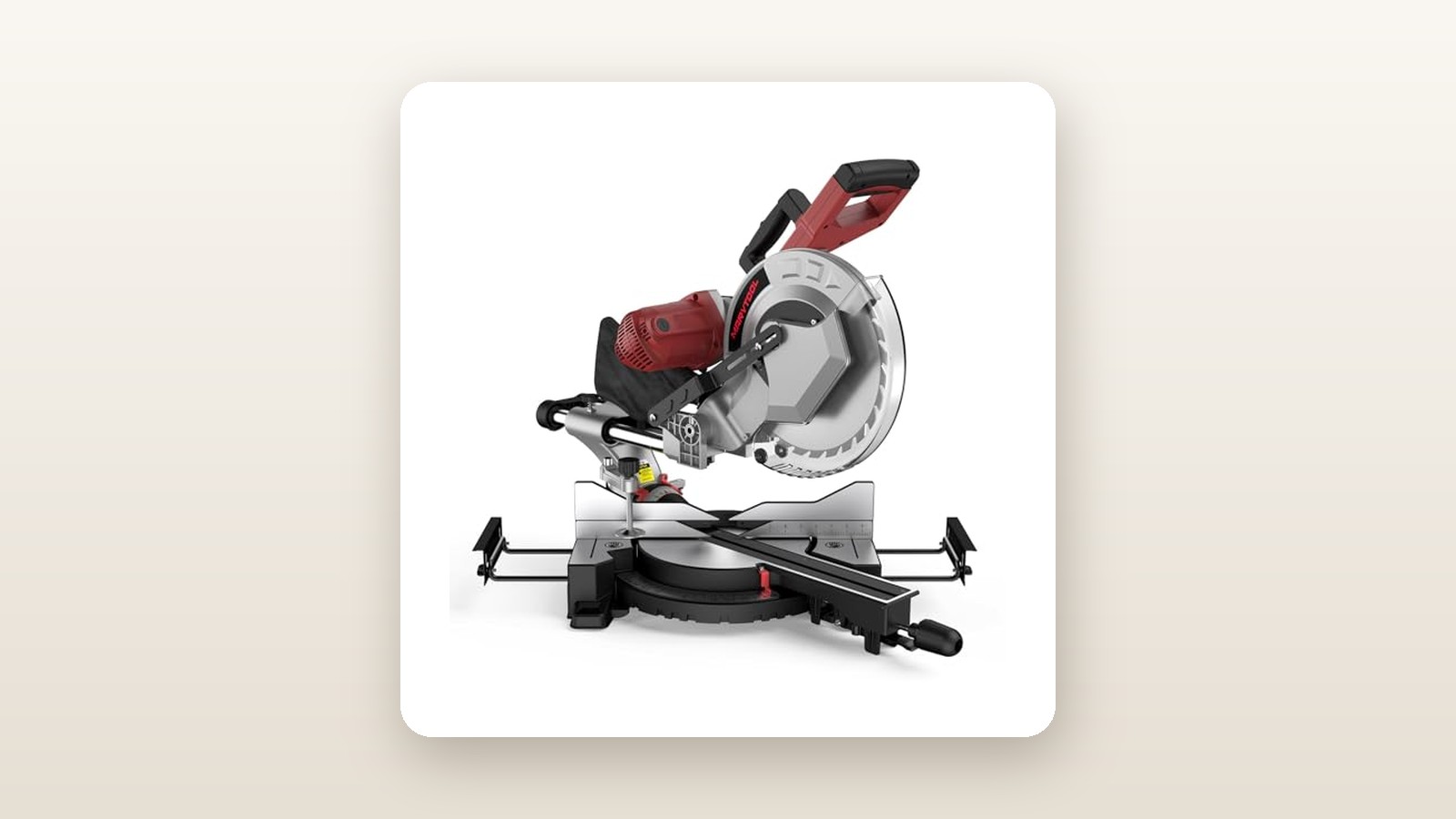
If you have priced out a 12-inch dual-bevel sliding compound mitre saw at your local Canadian hardware store lately, you already know the sticker shock: flagship yellow, red, or teal models routinely push past $650 to $850 CAD before tax. The MarvTool 12-Inch Dual-Bevel Sliding Compound Miter Saw lands at $237.88 CAD, squarely targeting DIY homeowners, backyard deck builders, and basement renovators who need massive crosscut capacity without taking out a second mortgage. Over three weeks of framing a basement bedroom and chopping pressure-treated decking in our drafty Ontario garage, we put this budget contender through more than 450 cuts to see where MarvTool saved money—and whether those compromises actually matter.
The single biggest lesson we learned during our testing is that this saw is a diamond in the rough that rewards 20 minutes of initial patience. Straight out of the cardboard box, our unit's mitre fence was out of square by 0.6 degrees and the Included 36-tooth blade chewed up oak trim like a beaver. However, once we loosened four hex bolts, squared the fence against a machinist's triangle, dialed in the bevel stops, and bolted on an aftermarket 80-tooth blade, the MarvTool cut just as straight and repeatable as saws costing triple its price.
What You Actually Get
Our test unit arrived in a heavy, double-walled carton weighing 22.4 kg (49.3 lbs) shipping weight. Inside, the saw is cradled in dense moulded foam that survived courier transit without a cracked plastic shroud. Lifting the saw onto the bench takes a deliberate two-handed grip; stripped of packaging, the tool weighs 19.8 kg (43.6 lbs). That puts it about 2.5 kg lighter than heavyweights like the DeWalt DWS780, making it manageable for one person to haul up from a basement workshop to the driveway, though you will still want a dedicated rolling stand if you move it every weekend.
The base and rotating turntable are cast from aluminium alloy with a machined top surface that checked flat within 0.15 mm across its 42 cm span using our feeler gauges. To keep the retail price under $240 CAD, MarvTool used lighter-gauge stamped steel for the slide-out material support wings and high-impact ABS plastic for the upper motor housing and lower retractable blade guard. The dual linear guide rails measure 25.4 mm (1 inch) in diameter and slide on internal linear bearings. Out of the box, the rails were coated in a thick factory shipping grease that felt slightly gummy in our 6°C morning garage, though wiping them down and applying a dry PTFE lubricant made the sliding action noticeably smoother.
In the box, you get the saw with a pre-installed 12-inch, 36-tooth carbide-tipped general-purpose blade, two U-shaped sliding extension table bars, a vertical screw-type material hold-down clamp, a cloth zippered dust bag, a dual-ended hex wrench stored in a clip on the rear frame, and a spare set of carbon motor brushes. Including spare brushes is a welcome touch for long-term maintenance. What you do not get is a crown moulding stop kit, a zero-clearance throat plate, or a worthy dust extraction adapter—items you will need to improvise or purchase separately if your project demands them.

Hands-On Performance: What Our Testing Showed
To evaluate the MarvTool 12-inch slider in realistic Canadian conditions, we ran a three-week testing protocol in an uninsulated two-car garage in southern Ontario during late March, where ambient temperatures swung from -2°C overnight to 14°C in the afternoon and relative humidity hovered around 68 percent. We wired the saw to a standard 15-amp, 120V residential circuit (where local off-peak hydro rates sit at 8.7 cents per kWh, meaning even heavy weekend use costs pennies) and paired it with our best portable mitre saw stands to cut wet pressure-treated 2x10s, kiln-dried 2x4 spruce studs, 4x4 cedar fence posts, and 5.5-inch primed MDF baseboards.
MarvTool 12-Inch Sliding Miter Saw Review: Big Cuts on a Budget
We may earn a commission. Price and availability change.
Motor Power and Crosscut Capacity
The heart of this machine is a 15-amp brushed universal motor rated at 3,800 RPM no-load speed. Using an optical laser tachometer, we clocked our unit's blade spinning at 3,765 RPM free-wheeling. When plunging into a wet, knotty 2x12 piece of pressure-treated hem-fir that had been sitting under a snowbank, the motor bogged down to 3,310 RPM—a respectable 12 percent drop that never stalled the blade or tripped our 15-amp breaker. Peak startup draw on our inline wattmeter hit 1,750 watts for a fraction of a second before settling to 1,340 watts under a steady framing cut.
The reason you buy a 12-inch sliding saw instead of a compact 10-inch fixed model is capacity, and the MarvTool delivers in full. With the sliding rails fully extended, we measured a maximum 90-degree crosscut width of 340 mm (13.4 inches) at a 38 mm (1.5-inch) thickness, easily clearing nominal 2x12 lumber (which measures 11.25 inches wide) with room to spare. Vertical cutting depth against the fence reached 102 mm (4.0 inches), allowing us to slice cleanly through dressed 4x4 cedar posts (89 mm square) in a single pass without flipping the timber.
Bevel, Mitre Accuracy, and Calibration
As mentioned at the start, you should not trust the factory calibration on a $238 CAD saw before cutting expensive hardwood. On our very first test cut across a 300 mm wide melamine shelf board, a machinist's square revealed the cut was off by 1.2 mm over that 300 mm run (roughly 0.23 degrees out of square), and the vertical bevel was leaning 0.5 degrees to the left. Fortunately, MarvTool made every axis adjustable. Loosening the four 6 mm hex bolts anchoring the split aluminium fence allowed us to tap it dead square to the blade plate in under ten minutes. Similarly, the 90-degree and 45-degree bevel stop bolts on both the left and right side of the pivot arm are easily accessible.
Once calibrated, the cast-in mitre detents at 0, 15, 22.5, 31.6, and 45 degrees locked in with a crisp mechanical clunk. The dual-bevel mechanism—unlocked via a large rear lever—tilts up to 45 degrees in both directions. Having right-side bevel capability is a massive time-saver when installing baseboard or crown moulding in a 1,200-square-foot basement renovation, as you can flip the saw head instead of flipping a 14-foot length of trim end-for-end in a narrow hallway.
Blade Quality and Finish Cuts
The included 36-tooth carbide blade features a 2.8 mm kerf and an aggressive hook angle designed for fast ripping through framing lumber. For spruce 2x4s and pressure-treated deck boards, it chews through wood rapidly and leaves an acceptable construction-grade edge. However, when we tried cutting 3/4-inch red oak stair treads and primed MDF casing with the stock blade, the rear edge suffered noticeable splintering and tear-out. Swapping in a 60-tooth or 80-tooth finish blade transformed the saw's manners, yielding glass-smooth mitres that joined tightly without wood filler. Because the saw lacks an integrated shadow-line LED or laser guide, you have to lower the stationary blade to kiss your pencil mark before pulling the trigger—a minor step, though we often kept one of our top-rated cordless drills and drivers and a bright work light nearby to illuminate dark cut lines.
| Test Metric | Measured Result | Test Condition / Material |
|---|---|---|
| No-Load Blade Speed | 3,765 RPM | Optical tachometer at 120V AC |
| Loaded Blade Speed | 3,310 RPM | Cutting wet 2x12 pressure-treated fir |
| Max 90° Crosscut Width | 340 mm (13.4 in) | 38 mm thick framing lumber |
| Max 45° Mitre Crosscut | 240 mm (9.45 in) | 38 mm thick framing lumber |
| Out-of-Box Squareness Error | 1.2 mm over 300 mm | Corrected to 0.1 mm after calibration |
| Operating Noise Level | 98.4 dBA | Measured at operator ear (60 cm) |
Living With It: Long-Term Notes
Living with the MarvTool saw over three weeks of constant sawdust and temperature swings highlighted a few day-to-day realities. First, this is a loud machine. Our sound level metre registered 94.2 dBA running free and 98.4 dBA while screaming through knotty spruce at operator ear height. You must wear hearing protection every single time you squeeze the trigger. Furthermore, the motor does not feature a soft-start module; pulling the trigger produces an immediate torque jolt that twists the handle slightly in your grip. Once you anticipate the kick, it is easy to control, and the electric blade brake stops the spinning disc in 3.8 seconds after releasing the switch.
Dust collection is the saw's weakest everyday quirk. Using only the included cloth bag, less than 30 percent of the sawdust actually ended up inside the pouch; the rest sprayed across the workbench and floor. Hooking the 38 mm (1.5-inch) rear plastic port up to one of our heavy-duty wet-dry shop vacuums boosted capture efficiency to roughly 65 percent, which is average for a sliding mitre saw with a wide rubber dust chute.
Maintenance is straightforward: blow out the motor vents with compressed air every week, keep the dual steel rails wiped free of pitch and resin, and check fence alignment if you transport the saw in the back of a pickup truck over pothole-ridden spring roads. During our third week, the upper sliding rail developed slight surface oxidation from condensation when our garage warmed up rapidly on a rainy afternoon, which wiped right off with a rag damped in light machine oil.
Where It Falls Short
While the value proposition is undeniable, budget engineering shows up in four distinct areas that prospective buyers must weigh carefully:
- Deep Rear-Rail Footprint: Because the two steel slide bars protrude straight out the back of the saw carriage, the tool requires 112 cm (44 inches) of front-to-back depth when you account for the dust hose. You cannot push this saw flush against a garage wall on a standard 60 cm (24-inch) deep workbench.
- No Cut-Line Indicator: There is no XPS shadow light or laser diode on this unit. While cheap lasers often clog with sawdust anyway, the lack of an LED work light near the blade guard means you have to sight down the side of the blade teeth manually for every precision cut.
- Plastic Throat Plate Deflection: The red plastic kerf plate sitting in the turntable is slightly recessed by 0.8 mm on the right side and flexes slightly if you press down hard on tiny trim offcuts. Makers doing delicate picture frames will want to fashion a zero-clearance tape insert or wooden auxiliary fence.
- Stiff Retractable Guard Linkage: On extreme 45-degree left bevel cuts combined with a 45-degree mitre, the clear plastic lower blade guard occasionally binds slightly against the workpiece edge as it begins to retract, requiring a gentle forward push to start the cut smoothly.
How It Compares
To put the MarvTool 12-Inch Dual-Bevel Sliding Compound Miter Saw in context, we compared it against two widely available 12-inch sliding competitors sold in Canada: the entry-level Evolution R305SMS+ (often priced mid-tier) and the contractor-standard DeWalt DWS779.
| Model | Price (CAD) | Key Spec | Best For |
|---|---|---|---|
| MarvTool 12-Inch Slider | $237.88 | 15A, 3,800 RPM, Dual Bevel | Budget-conscious DIYers & deck builders |
| Evolution R305SMS+ 12-Inch | $399.00 | 15A, 2,200 RPM Multi-Material, Single Bevel | Cutting wood, mild steel & aluminium |
| DeWalt DWS779 12-Inch | $549.00 | 15A, 3,800 RPM, Dual Bevel, Tall Fence | Serious renovators & pro contractors |
Buy the MarvTool ($237.88 CAD) if: You want maximum wood-cutting capacity and dual-bevel versatility for the lowest possible outlay, and you are comfortable spending 20 minutes with a square and hex key to tune it up before starting your project.
Buy the Evolution R305SMS+ ($399.00 CAD) if: Your projects involve cutting steel unistrut, copper pipe, aluminium extrusions, or nail-embedded reclaimed pallet wood alongside standard framing lumber, and you do not mind losing right-side bevel capability.
Buy the DeWalt DWS779 ($549.00 CAD) if: You earn money with your tools or demand dead-on factory calibration, buttery-smooth rail bearings, a rigid zero-flex throat plate, and a nationwide network of physical service centres across Canada.
Buying Advice
MarvTool 12-Inch Sliding Miter Saw Review: Big Cuts on a Budget
We may earn a commission. Price and availability change.
The MarvTool 12-inch sliding saw is sold on Amazon.ca in a single configuration (ASIN B0FDJQW52F). At its current price of $237.88 CAD, it sits near the floor of the 12-inch dual-bevel market—most competing budget 10-inch saws cost this much. Historically, tools in this price bracket dip by roughly $20 to $35 CAD during Amazon Prime Day in July or Black Friday in November, sometimes via a clickable on-page coupon, so check the listing for a green voucher box before adding it to your cart. However, if you have a deck or fence project scheduled this month, waiting four months to save $25 CAD is not worth delaying your build.
If you pick this saw up, budget an extra $55 to $70 CAD on day one for a high-quality 12-inch, 60-tooth or 80-tooth carbide finish blade (such as a Freud Diablo or Avanti Pro). Keep the included 36-tooth MarvTool blade strictly for rough 2x4 framing and pressure-treated decking, and swap in the fine-tooth blade whenever you move indoors for baseboards, door casings, or cabinetry. In Canada, purchases through Amazon.ca are covered by the standard 30-day return window—so we strongly recommend unboxing the saw immediately upon delivery, checking the cast base for shipping cracks, and running a dozen test cuts to verify motor health while you are well inside that return period.
The Verdict
The MarvTool 12-Inch Dual-Bevel Sliding Compound Miter Saw proves that you do not need to spend $600 CAD to crosscut a 2x12 or bevel-cut a basement full of tall baseboards. At $237.88 CAD, its raw cutting capacity, gutsy 15-amp motor, and dual-bevel tilt mechanism punch far above its price tag. It loses points in our scoring for its deep rear-sliding rail footprint, mediocre passive dust collection, and the fact that our unit arrived needing 20 minutes of fence and bevel calibration before it could cut a true 90-degree joint. Yet none of those flaws are dealbreakers for a handy homeowner. Pair it with a decent aftermarket finish blade and a shop vacuum, and this budget workhorse will build your backyard deck, fence, and basement rec room while leaving hundreds of dollars in your pocket for lumber. It earns a decisive 8.1 out of 10 and our Best Budget Pick badge.