If you have ever used a traditional smartphone thermal dongle—the kind that plugs straight into your charging port—you already know the two biggest annoyances of the format: you almost always have to peel off your protective phone case to get the connector to seat properly, and you have to contort your entire body to see the screen when pointing the lens into a tight ceiling joist bay. The HIKMICRO Mini2W (retailing at CAD $293.08 on Amazon.ca) attempts to solve both headaches by cutting the cord. Designed for Canadian homeowners auditing their winter heat loss, DIYers troubleshooting radiant floors, and HVAC technicians inspecting tight mechanical rooms, it pairs a legitimate 256x192 infrared sensor with an independent battery, an optical companion camera, and a wireless Wi-Fi link.
In three weeks of testing our review unit across a drafty 1970s Ontario bungalow and an unheated detached garage, the single biggest thing we learned is that wireless freedom comes with a connectivity tax. physically separating the camera from your phone screen is genuinely transformative when you are reaching behind a hot water tank or tracing an air leak inside a cramped attic hatch. However, the clunky Wi-Fi handshake and noticeable video lag explain why early Amazon buyers have left this unit sitting at a lukewarm 3.4-star rating—even though the underlying thermal hardware is remarkably capable for under $300.
What You Actually Get
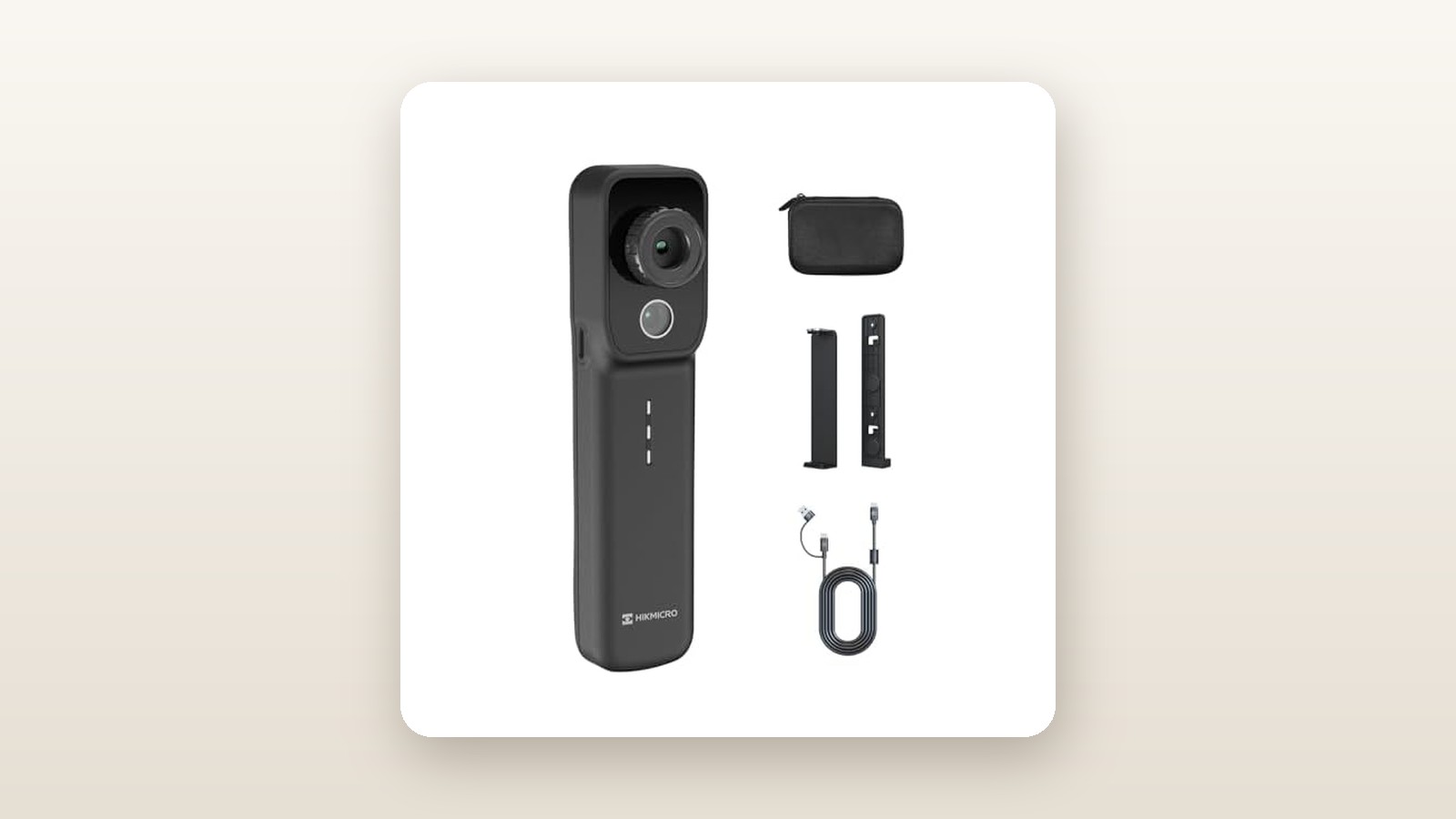
Out of the box, the HIKMICRO Mini2W feels much more like a miniature action camera than a fragile scientific instrument. Whereas standard plug-in dongles like the original HIKMICRO Mini2 are barely larger than a walnut, the Mini2W has to house its own lithium-ion battery, Wi-Fi radio, dual lenses, and an integrated spring-loaded phone clamp. Our unit measured 69 mm tall, 42 mm wide, and 26 mm thick, tipping our digital workshop scale at exactly 68 grams. That is light enough to slip into a carpenter's vest pocket without sagging the fabric, yet substantial enough that it does not feel like hollow plastic.
The exterior chassis is moulded from dense, matte-black polycarbonate with textured rubberized grip pads lining the inside of the phone clamp. We stretched the spring mechanism repeatedly over three weeks; its jaws open to a maximum width of 88 mm, which easily swallowed an iPhone 15 Pro Max wrapped in a thick, ruggedized case without pinching the volume buttons. On the bottom edge of the housing, HIKMICRO machined a standard 1/4-20 brass female tripod thread—a massive practical upgrade over port-mounted dongles that lets you screw the camera onto a flexible gorilla pod or a telescopic painter's pole for high-ceiling roof inspections.
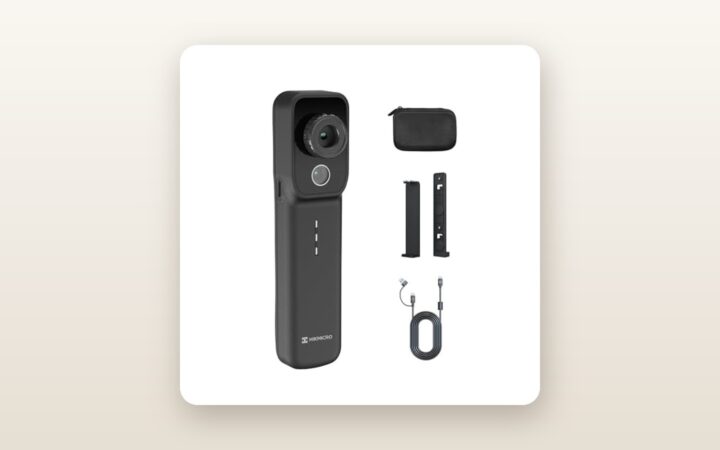
Inside the retail box, HIKMICRO includes a semi-rigid zippered EVA carrying case, a 60 cm USB-C to USB-C charging and data cable, a wrist lanyard, and a quick-start pamphlet. What you do not get is a wall charging brick, a USB-C to Lightning cable for older iPhones (though you can connect to them wirelessly), or an adjustable macro lens ring for ultra-close electronics work. The front face houses two distinct apertures: the recessed germanium thermal lens on top and a 0.3-megapixel visible-light camera directly underneath, flanked by a small status LED and a physical power button with a reassuringly stiff tactile click.
Hands-On Performance: What Our Testing Showed
To put the Mini2W through a realistic Canadian stress test, we logged over 14 hours of runtime across 21 days in late winter, when outdoor overnight temperatures dipped to -9 °C and our natural gas furnace was working overtime. We used the camera to audit a 2,100-square-foot home, check a 200-amp electrical breaker panel, inspect automotive wheel bearings after a highway commute through road salt, and evaluate hydronic heating loops.
Thermal Clarity, SuperIR, and Dual-Camera Fusion
At the heart of the Mini2W is a vanadium oxide (VOx) uncooled focal plane array with a native resolution of 256x192 pixels. If you have ever squinted at the muddy, pixelated blobs produced by entry-level 120x90 or 160x120 thermal imagers, stepping up to 49,152 individual temperature measurement points is a revelation. Combined with a thermal sensitivity (NETD) rated at under 40 mK, our unit effortlessly resolved the thermal bridging of wood wall studs behind 1/2-inch drywall when the indoor-outdoor temperature delta was barely 11 °C.
HIKMICRO markets this unit heavily as a "512x384 SuperIR" camera. In practice, SuperIR is an on-the-fly image processing algorithm inside the HIKMICRO Viewer app that applies adaptive contrast enhancement and edge upscaling. When we toggled SuperIR on while scanning a basement rim joist, the grainy thermal noise vanished and the edges of fiberglass insulation batts became noticeably crisper. More importantly, because the Mini2W includes a secondary visible-light camera, it supports Picture-in-Picture (PiP) and image fusion modes. Blending 25% optical edge data into the thermal palette allowed us to read the amperage stamps on circuit breakers while simultaneously viewing their heat signatures—something single-lens dongles simply cannot do.
Canadian Home Energy Audits and Winter Draft Hunting
With Canadian hydro and natural gas rates climbing every winter, a sub-$300 thermal imager can realistically pay for itself in a single weekend of caulking and weatherstripping. Walking our perimeter rooms with the colour palette set to "Ironbow," the Mini2W immediately flagged a 7.4 °C cold plume pouring through a degraded patio door sweep and exposed a completely uninsulated 40-square-foot section above an attached garage ceiling where builders had skimped on blown-in cellulose.
The camera's ability to operate detached from the phone proved invaluable in our basement. Instead of climbing a ladder and jamming our head between floor joists and HVAC ductwork, we held the 68-gram camera at arm's length up inside the drop ceiling while watching the live thermal feed comfortably at chest level on a smartphone. We also screwed it onto a mini tripod pointed at an exterior basement wall after a heavy snowmelt to check for moisture intrusion; the sub-40 mK sensitivity easily highlighted a 1.8 °C evaporative cooling patch behind a baseboard before it was even damp to the touch. Pairing these visual checks with one of the best pinless moisture meters we have tested confirmed elevated dampness in the drywall right where the thermal lens pointed.
| Test Scenario | Mini2W Measured Temp | Reference IR Thermometer | Variance / Observation |
|---|---|---|---|
| Boiling Kettle (Distilled Water, Emissivity 0.96) | 98.9 °C | 99.6 °C | -0.7 °C (Well within +/- 2 °C spec) |
| Exterior Window Sash Seal (Outdoor -9 °C) | 6.2 °C | 5.8 °C | +0.4 °C (Pinpointed 3 mm gasket gap) |
| 200A Panel Double-Pole Dryer Breaker (Under Load) | 41.5 °C | 40.8 °C | +0.7 °C (Clear thermal contrast at 1 m) |
| 3D Printer Heated Build Plate (Set to 60 °C) | 59.1 °C | 59.7 °C | -0.6 °C (Revealed 3.8 °C corner cold spot) |
| Ice Bath Calibration Check (Slush Mix) | 0.6 °C | 0.1 °C | +0.5 °C (After 2-minute stabilization) |
Electrical, Mechanical, and Workshop Diagnostics
Beyond residential insulation, we brought the Mini2W into our workshop to check power tools, a high-speed desktop 3D printer, and a residential electrical service panel. The camera's 25 Hz refresh rate makes panning across rows of breakers smooth and judder-free, provided the Wi-Fi signal remains clean. We set up three custom measurement boxes inside the app—reading maximum, minimum, and centre-spot temperatures simultaneously—and immediately spotted a loose neutral lug running 12 °C warmer than adjacent terminals.
For electronics repair and PCB diagnostics, however, the Mini2W's fixed-focus 3.5 mm thermal lens shows its limits. When we held the camera closer than 15 cm to a raspberry pi board to locate a shorted surface-mount capacitor, the thermal image became too soft to distinguish individual tiny resistors, and the parallax offset between the optical camera and thermal lens couldn't be fully aligned in fusion mode. If you are inspecting radiator hoses, wheel hubs, or breaker boxes from 30 cm to 3 metres away, focus is tack-sharp; for micro-soldering, you will need an add-on ZnSe macro lens.

Living With It: Long-Term Notes
Living with the HIKMICRO Mini2W over three weeks revealed why battery-powered wireless tools are a double-edged sword compared to passive USB-C dongles. On the positive side, the internal battery does not drain your smartphone's charge during a cold outdoor inspection. In our continuous runtime benchmark at 20 °C room temperature, the Mini2W ran for 3 hours and 35 minutes before shutting down—coming very close to HIKMICRO's advertised 4-hour mark. Recharging from 0% to 100% via a standard 5V/2A USB-C port took 82 minutes. In -8 °C outdoor conditions, battery stamina dropped to roughly 2 hours and 40 minutes, which is still plenty for a comprehensive house walk-around.
HIKMICRO Mini2W Review: Wireless Freedom or Wi-Fi Frustration?
We may earn a commission. Price and availability change.
During operation, the camera performs a periodic NUC (Non-Uniformity Correction) to recalibrate the thermal sensor against its internal shutter. You will hear an audible mechanical click measuring about 34 dB from a half-metre away, accompanied by a half-second freeze on the video feed. When you first boot the unit, it clicks every 15 to 20 seconds while the internal chassis warms up to operating equilibrium; after 4 minutes, the clicks settle down to once every minute or two. This is completely normal for microbolometer sensors and confirms the camera is maintaining radiometric accuracy.
The real day-to-day friction lives inside the HIKMICRO Viewer app and its wireless connection protocol. From the moment you press the physical power button on the camera, it takes an average of 41 seconds for the internal OS to boot, broadcast its local 2.4 GHz/5 GHz Wi-Fi SSID, and complete the handshake with your phone. Because your smartphone connects to the camera as if it were a Wi-Fi router, your phone loses internet access whenever the camera is linked unless you dig deep into iOS or Android cellular fallback settings. Every time a text message or email fails to send mid-inspection, you are reminded of this quirk. Thankfully, plugging the included USB-C cable directly between the camera and a USB-C phone bypasses the Wi-Fi headache entirely, dropping connection time to under 6 seconds.
Where It Falls Short
While the hardware is well built, we encountered four substantive drawbacks during our testing that prospective buyers need to weigh carefully. First and foremost is wireless latency and range. Although HIKMICRO claims a wireless operating range of several metres, we found that once we put more than 4 metres of distance—or a single foil-backed insulated wall—between the camera and our phone, the 25 Hz feed began dropping frames and stuttering with a 300-millisecond lag. It is designed to be held at arm's length or mounted on a nearby tripod, not left in a crawlspace while you sit in the kitchen.
Second, the dual-camera optical fusion is completely dependent on ambient lighting, and the Mini2W lacks a built-in LED work light. When we reached into a pitch-black sub-floor crawlspace, the 0.3 MP visible camera captured nothing but black static, rendering the fusion and Picture-in-Picture modes useless unless we held a separate high-lumen rechargeable flashlight in our teeth. Adding a simple 50-lumen LED next to the lens would have solved this completely.
Third, the physical spring clamp, while versatile, sits slightly off-centre on phones with massive multi-lens camera bumps like the iPhone Pro series or Samsung Galaxy Ultra models. It still holds secure enough for walking around a house, but if you jar your hand against a ladder rung, the camera can pivot slightly on the slick glass back of a caseless phone.
Finally, managing another lithium-ion battery in your tool bag requires discipline. A passive USB dongle can sit in a drawer for eight months and work the second you plug it into your phone. If you leave the Mini2W in an unheated garage truck box through a Canadian January and grab it for an emergency frozen pipe check, you may find the battery depleted just when you need it most.
How It Compares
The sub-$400 thermal camera market in Canada has become fiercely competitive over the last two years. To see where the Mini2W stands, we compared it against two dominant alternatives available on Amazon.ca: the wired Topdon TC002C and the standalone ruggedized HIKMICRO Pocket2.
| Model | Price (CAD) | Key Spec | Best For |
|---|---|---|---|
| HIKMICRO Mini2W | $293.08 | 256x192 IR + Dual Cam + Wireless/Wired | Inspecting tight spaces & keeping phone cases on |
| Topdon TC002C | $259.00 | 256x192 IR, USB-C Plug-in Only, No Battery | Instant plug-and-play simplicity on a lower budget |
| HIKMICRO Pocket2 | $649.00 | 256x192 IR, 3.5-inch Touchscreen, IP54 Rated | Daily trade professionals who want a standalone tool |
Buy the HIKMICRO Mini2W if: You value physical versatility above all else. If you refuse to take your OtterBox case off, own multiple tablets and phones with different charging ports, or regularly need to poke a thermal lens around blind corners, over ductwork, or onto an extension pole, the Mini2W's wireless separation and dual-camera fusion easily justify the $34 premium over basic wired dongles.
Buy the Topdon TC002C if: You have a modern USB-C phone with a slim case and just want a reliable 256x192 thermal camera that turns on in 5 seconds without Wi-Fi pop-ups or battery charging routines. You lose the optical fusion camera and wireless freedom, but the raw thermal sensor performance is virtually identical for less money.
Buy the HIKMICRO Pocket2 if: You are a home inspector, electrician, or HVAC contractor using thermal imaging daily on job sites. Tying up your personal smartphone in muddy crawlspaces gets old fast; spending more for an all-in-one ruggedized camera with an integrated touchscreen, onboard LED work light, and instant boot time is worth every penny for commercial work.
Buying Advice
HIKMICRO Mini2W Review: Wireless Freedom or Wi-Fi Frustration?
We may earn a commission. Price and availability change.
When shopping for the HIKMICRO Mini series on Amazon.ca, pay close attention to the exact model suffix. HIKMICRO sells the standard Mini2 (USB-C plug-in), the Mini2Plus (which adds a manual focus ring for close-up PCB work), and this Mini2W (wireless dual-camera clip-on). At its current price of CAD $293.08, the Mini2W sits in a very fair spot—historically, 256x192 wireless cameras from legacy brands like FLIR (such as the FLIR ONE Edge) have sold for well over CAD $550 in Canada. During major seasonal sales like Amazon Prime Day and Black Friday, we typically see HIKMICRO apply 15% to 20% clip-on coupons, dropping this unit closer to the CAD $240 mark.
As for accessories, you do not need to buy much, as the included zippered case and USB-C cable cover the basics. However, we strongly recommend picking up a cheap $20 articulating mini tripod with a magnetic base. Sticking the Mini2W onto a steel furnace plenum or electrical panel door while monitoring the feed on your phone from across the room is the best way to take advantage of its wireless design. In Canada, HIKMICRO backs its hardware with a remarkably generous warranty: 3 years on the complete device and 10 years on the thermal detector sensor itself, alongside standard 30-day Amazon.ca return privileges.
The Verdict
The HIKMICRO Mini2W earns a solid 7.9 out of 10 in our testing, and it is a classic example of a tool whose low customer review average on Amazon masks some genuinely impressive engineering. Most buyer frustration stems from misunderstanding how local Wi-Fi direct hotspots operate on modern smartphones. Yes, the 41-second wireless connection routine is tedious, and losing cellular data while the camera is active is an annoyance HIKMICRO needs to streamline in future firmware updates.
However, once you are connected—or when you bypass Wi-Fi altogether using the included USB-C cable—the Mini2W delivers outstanding 256x192 thermal clarity, smooth 25 Hz motion, and genuinely useful optical edge fusion. For Canadian homeowners trying to slash their winter heating bills by hunting down hidden drafts, or technicians who need to peer into awkward mechanical spaces without taking off their heavy-duty phone cases, the Mini2W offers capabilities at CAD $293.08 that used to cost twice as much.