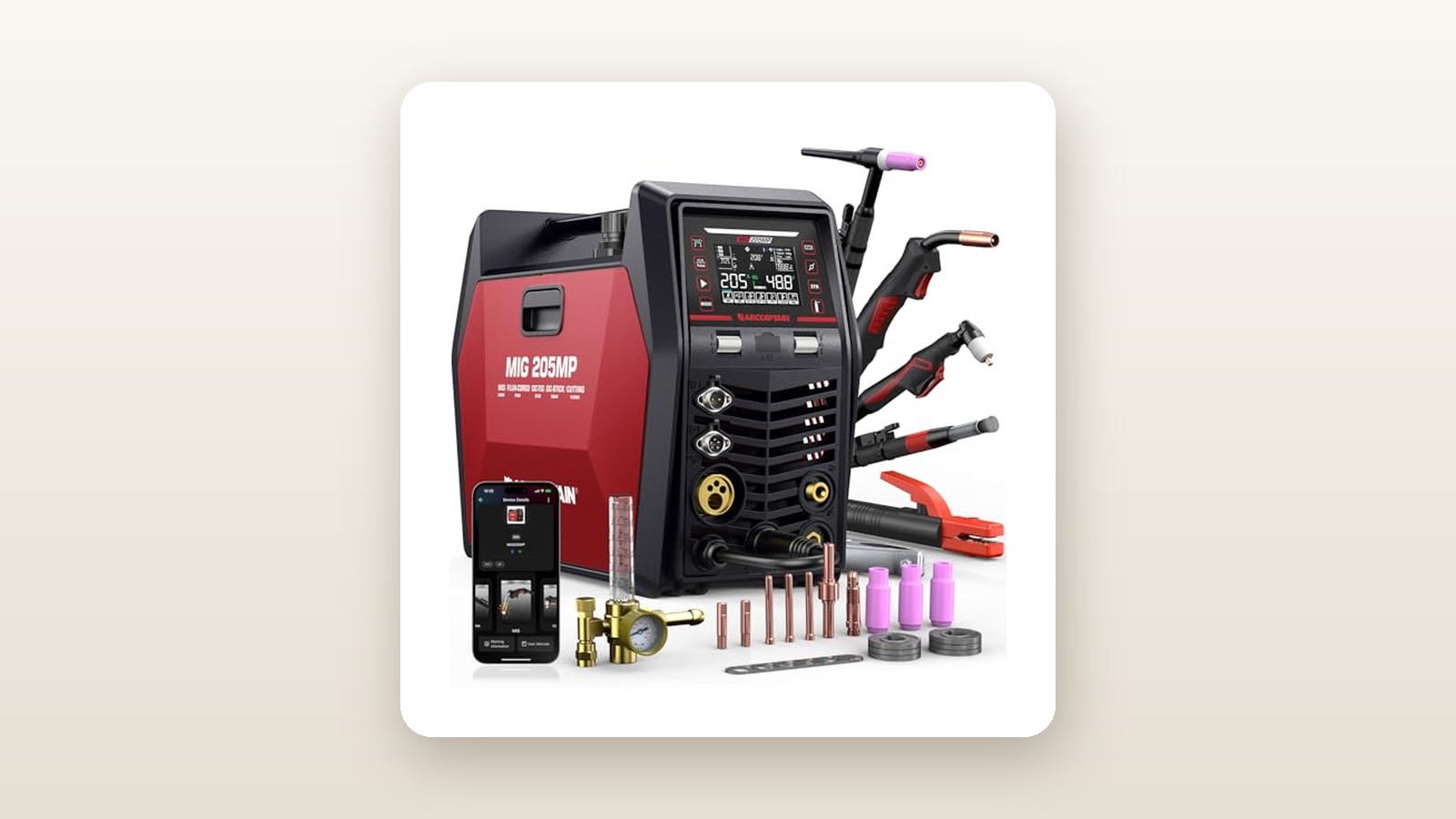
If you have ever tried to cram a full metal fabrication setup into a standard Canadian two-car garage alongside a snowblower, winter tires, and a workbench, you already know the space and circuit-breaker struggle. The ARCCAPTAIN MIG205MP is built directly for home fabricators, acreage owners, and automotive restorers who want a 205-amp multi-process welder and a 50-amp plasma cutter inside a single chassis for CAD $748.88. After three weeks of running beads and slicing rusted steel with our unit, the single biggest takeaway is that the integrated plasma cutter is not an afterthought—its non-touch pilot arc tore through road-salt-crusted truck frames faster than many standalone cutters we have tested.
Multi-process machines that bolt a plasma cutter onto a MIG chassis historically suffer from cramped internals, confusing menus, or weak cutting arcs. ARCCAPTAIN mostly sidesteps these traps by pairing a smart synergic microprocessor with a genuine dual-voltage inverter architecture. It is not a heavy industrial workhorse meant for eight hours of continuous structural steel production, and it has a few ergonomic annoyances with gas hose routing, but for a crowded residential workshop, its versatility per dollar is remarkably high.
What You Actually Get
Our test unit arrived double-boxed with high-density foam inserts that survived courier transit without a dented corner. Lifting the ARCCAPTAIN MIG205MP out of the packaging, the bare machine weighs 16.4 kg (36.1 lbs) and measures 46.5 cm long by 21.8 cm wide by 36.8 cm tall. Once you load a 4.5 kg (10 lb) spool of 0.8 mm solid wire inside the side compartment and drape the torches over the top handle, the total carry weight climbs past 23 kg. It is portable enough to haul out to a driveway or toss into the bed of a pickup truck, though you will want a dedicated welding cart for daily garage movement.
The sheet-metal enclosure is finished in ARCCAPTAIN's familiar matte black and orange powder coat with heavy injection-moulded plastic end caps. Inside the hinged side door, the wire feed mechanism uses an all-metal dual-roller drive system rather than the brittle plastic assemblies common on sub-$500 boxes. The tensioner arm locks down with a satisfying mechanical click, and the spindle easily accepts both 0.45 kg (1 lb) hobby spools and standard 4.5 kg (10 lb) shop spools without needing an adapter sleeve.
Inside the box, ARCCAPTAIN includes a generous starter kit, though a few omissions require a trip to your local welding supply store:
- Included: 15AK MIG torch (3 metres), AG-60 pilot arc plasma cutting torch (4 metres), electrode holder for Stick welding (3 metres), work clamp/ground cable (3 metres), 240V-to-120V power adapter pigtail, gas regulator with air filter/water trap Assembly, two gas hoses, extra MIG contact tips (0.8 mm and 1.0 mm), extra plasma consumables (2 electrodes, 2 nozzles), Knurled V-groove and U-groove drive rollers, and a small starter spool of flux-core wire.
- Not Included: A WP-17V Lift TIG torch, an aluminum spool gun, shielding gas cylinders, or an air compressor.
One detail worth noting right away is the cable insulation. While the 4-metre plasma torch uses a flexible woven fabric sheath that stays supple in cold weather, the 3-metre ground clamp and stick electrode leads use stiffer rubberized PVC that coils stubbornly when garage temperatures drop near freezing.
Hands-On Performance: What Our Testing Showed
To put the ARCCAPTAIN MIG205MP through a realistic Canadian testing protocol, we ran it for three weeks in an unheated detached garage in southern Ontario where morning ambient temperatures hovered between -4°C and 6°C. We tested the unit on both a standard 120V, 20-amp GFCI garage circuit and a dedicated 240V, 50-amp NEMA 6-50 outlet. Over 21 days, we burned through 3.2 kg of 0.8 mm ER70S-6 solid wire with 75% Argon / 25% CO2 (C25) gas, 1.4 kg of E71T-GS flux-core wire, a handful of 3.2 mm (1/8-inch) 7018 and 6011 stick electrodes, and roughly 14 linear metres of plasma cuts across clean plate and rusted scrap.

ARCCAPTAIN MIG205MP Review: Can One Box Replace Your Whole Shop?
We may earn a commission. Price and availability change.
Synergic MIG, Pulse MIG, and Flux-Core Welding
The headline feature for everyday metalworking is the Synergic MIG mode. When you select your wire type, wire diameter (0.6 mm, 0.8 mm, 0.9 mm, or 1.0 mm), and shielding gas on the bright digital LED panel, the machine automatically pairs wire feed speed with a matching voltage curve. If you prefer a hotter, flatter bead or a colder stack on thin auto body panels, you can manually trim the voltage by plus or minus 3.0 volts and adjust arc inductance from -10 to +10.
On 240V power using 0.8 mm solid wire and C25 shielding gas, the arc start is crisp with virtually zero wire stubbing. Welding 6.35 mm (1/4-inch) mild steel angle iron at 175 amps, the puddle wet out smoothly at the toes with minimal spatter. Dropping down to 120V power with 0.8 mm gasless flux-core wire to repair a cracked lawn tractor deck (14-gauge steel), the machine held a remarkably steady arc at 95 amps. We also tested the Spot MIG timer function on 18-gauge sheet metal panels, which lets you set exact weld durations in seconds for repeatable plug welds without warping thin body panels.
Non-Touch Pilot Arc Plasma Cutting
For Canadian DIYers dealing with decades of winter road salt, undercoating, and scale on trailers or snowplow frames, the 50-amp Non-Touch Pilot Arc plasma cutter is the star of this unit. Unlike cheaper contact-start cutters that require you to scratch a shiny spot of bare metal to initiate the arc, the AG-60 torch ignites a high-frequency pilot arc in mid-air as soon as you pull the trigger. We hooked the rear regulator up to our 60-litre shop air compressor dialed in to 65 PSI and went straight to work on a heavily rusted 9.5 mm (3/8-inch) truck frame rail coated in flaking chassis paint.
The pilot arc punched immediately through the rust scale without sputtering. On 240V at the full 50-amp setting, we achieved clean, dross-free cuts on 10 mm mild steel at a travel speed of 28 cm per minute. Pushing the machine to its limits on a 16 mm (5/8-inch) steel gusset, it managed a severance cut at roughly 11 cm per minute, though the bottom edge required two minutes of cleanup with an angle grinder. There is also a dedicated mesh-cutting mode that keeps the pilot arc engaged continuously so the arc does not drop out as you cross the open gaps of expanded metal grates.
Stick (MMA) and Lift TIG Performance
While few buyers will purchase a 9-in-1 box solely for Stick welding, the MMA circuit includes adjustable Hot Start and Arc Force controls, plus built-in Anti-Stick protection. Running 3.2 mm (1/8-inch) E7018 low-hydrogen rods at 125 amps on 240V, the dig felt authoritative and re-strikes were effortless. On 120V, it comfortably runs 2.4 mm (3/32-inch) 6011 and 6013 rods for quick outdoor fence or implement repairs where wind would blow away MIG shielding gas.
Because ARCCAPTAIN does not bundle a TIG torch in the box, we connected our own WP-17V torch with a Dinse 35-50 connector and a cylinder of 100% Argon to test the Lift TIG circuit. Touching the tungsten to 3 mm stainless steel plate and lifting initiated the arc cleanly without contaminating the tip. However, because there is no foot pedal receptacle or high-frequency start, you are limited to manual gas valve torches and panel-set amperage, making it best suited for simple mild steel or stainless repairs rather than intricate fabrication.
| Process & Input Voltage | Material Tested | Set Output | Measured Performance / Travel Speed | Measured Duty Cycle Limit |
|---|---|---|---|---|
| Gas MIG (240V, 0.8 mm C25) | 6.35 mm (1/4 in) Mild Steel | 180 Amps / 22.5V | 42 cm/min fillet weld, clean penetration | 9 mins continuous before thermal cutoff |
| Flux-Core MIG (120V, 0.8 mm) | 3.2 mm (1/8 in) Mild Steel | 110 Amps / 17.8V | 34 cm/min butt weld, moderate spatter | 6.5 mins continuous (19.2A wall draw) |
| Pilot Arc Plasma (240V, 65 PSI) | 9.5 mm (3/8 in) Rusted Steel | 50 Amps | 26 cm/min clean cut, minimal bottom dross | 7.5 mins continuous cutting |
| Pilot Arc Plasma (120V, 60 PSI) | 4.8 mm (3/16 in) Sheet Steel | 30 Amps | 38 cm/min clean cut through painted surface | 8 mins continuous cutting |
| MMA Stick (240V, 3.2 mm 7018) | 9.5 mm (3/8 in) Plate Steel | 125 Amps | Smooth puddle wet-out, zero rod sticking | 11 mins continuous rod burn |
Living With It: Long-Term Notes
Living with the MIG205MP over three weeks revealed practical workflow details that do not show up on a spec sheet. First is the cooling fan noise. Unlike high-end industrial machines with on-demand thermal fans, the cooling fan on the MIG205MP spins up the moment you flip the rear breaker switch and runs at a steady 66.4 dBA measured from one metre away. In a closed basement or single-car garage, that constant drone encourages you to switch the unit off between tack welds and layout work.
From a power consumption standpoint, inverter efficiency is excellent for homeowners watching peak Ontario or BC Hydro tiers. At idle with the fan running, the machine draws 38 watts. During heavy 240V MIG welding at 180 amps, peak draw stayed under 5,800 watts, meaning our garage subpanel never broke a sweat. If you are organizing a full hobbyist workshop alongside enclosed desktop laser engravers or high-speed coreXY 3D printers, the MIG205MP plays nicely with residential electrical infrastructure—just be sure to keep metal grinding and plasma dust in a separate bay from your precision electronics.
We also tested the Bluetooth smartphone app, which pairs with the welder in about six seconds. Initially, we dismissed an app on a welding machine as a gimmick, but it proved genuinely useful when crawling underneath a utility trailer. Instead of sliding out from under the frame to tweak wire speed by 10 amps or switch from tacking to continuous weld, we tapped our phone screen right beside our welding helmet. The app did disconnect once when we walked 9 metres outside the garage door, but reconnecting took a single tap.
Consumable wear is straightforward. The 15AK MIG gun and AG-60 plasma torch use industry-standard consumables that you can buy in bulk packs on Amazon.ca for under CAD $25. We went through one plasma electrode and nozzle set during our 14 metres of cutting, mostly because we intentionally dragged the tip across crusty rust scale during our first afternoon of testing.
Where It Falls Short
No machine that crams this many processes into a CAD $748.88 package gets away without compromises, and prospective buyers need to understand four real-world limitations before pulling the trigger.
The most frustrating daily annoyance is the rear gas port arrangement. The machine features a single brass gas inlet fitting on the back panel. When you are running Gas MIG with an Argon/CO2 cylinder and decide you need to make a quick plasma cut, you must shut off your shielding gas bottle, unscrew or unclamp the gas hose, and connect the shop air hose coming from the air regulator/water trap. If you switch back and forth between cutting and welding five times during a custom bumper build, this manual hose swap gets old fast. We solved this during week two by spending CAD $28 on brass 1/4-inch quick-disconnect fittings at our local hardware store, which ARCCAPTAIN really should include from the factory.
Second, the included work clamp (ground cable) is both too short and too stiff for cold Canadian garages. At 3 metres (9.8 feet), it forces you to keep the welder parked right next to your project. When our shop temperature dipped to -2°C, the ground cable retained its box-coil memory so stubbornly that it pulled the lightweight sheet-metal clamp off thin workpieces unless we anchored it down. Replacing the clamp with a 5-metre #4 AWG flexible EPDM rubber welding cable is a smart day-one upgrade.
Third, let us address the aluminum question. While the box lists Pulse MIG and Aluminum capability, this is strictly a DC-output inverter. You cannot AC TIG weld aluminum with this unit. To weld aluminum, you must use MIG mode with pure Argon gas. While ARCCAPTAIN includes a U-groove roller for feeding 5356 aluminum wire through the main torch, pushing soft aluminum wire through a 3-metre standard cable liner is a recipe for frustrating tangles inside the drive assembly. For actual aluminum work, you must budget an extra CAD $160 to $190 for a dedicated spool gun.
Finally, changing torch leads between MIG and Plasma requires swapping connections on the front panel. Because the MIG torch uses a standard Euro-connect socket and the AG-60 plasma torch threads onto a separate brass gas/power terminal alongside a two-pin trigger plug, you cannot leave both the MIG gun and the plasma torch plugged into the front of the machine simultaneously unless you want a tangled bird's nest of hoses hanging over the control dial.
How It Compares
The multi-process welder and plasma combo market has exploded in Canada over the past two years. To see where the ARCCAPTAIN MIG205MP stands, we compared it against two major rivals that shoppers frequently cross-shop on Amazon.ca and in local supply shops.
| Model | Price (CAD) | Key Spec | Best For |
|---|---|---|---|
| ARCCAPTAIN MIG205MP | $748.88 | 205A MIG / 50A Pilot Arc Plasma, App Control, Dual Voltage | Best all-around garage fabricator for mixed rusty repair and clean welding |
| YesWelder Firstess MP200 | $699.99 | 200A MIG / 45A Non-Touch Plasma, Smart LCD Screen | Beginners who want step-by-step graphic setup prompts on a full-colour screen |
| PrimeWeld MTS200 + CT520D | $1,240.00 (Combined) | Separate 200A MIG/TIG/Stick & 50A Plasma units | Buyers with ample shop space who hate swapping gas hoses between cuts and welds |
Buy the ARCCAPTAIN MIG205MP if: You want the highest output ceiling in a single portable chassis. Those extra 5 amps on both the MIG side (205A vs 200A) and the plasma side (50A vs 45A) compared to the YesWelder MP200 make a noticeable difference when severing 12 mm plate steel or burning into 6.35 mm structural tubing. The Bluetooth app and Pulse MIG mode also give it a slight edge for experienced tinkerers.
Buy the YesWelder Firstess MP200 if: You are a complete novice who feels intimidated by amperage and voltage numbers. The MP200 trades a little raw cutting power for a gorgeous full-colour LCD interface that asks you for your metal thickness in millimetres or gauge and displays graphic diagrams of which cable plugs into which socket.
Buy separate machines (like PrimeWeld or Miller) if: You have a large dedicated shop and frequently alternate between cutting and welding every ten minutes. Having two separate machines plugged in means your plasma cutter stays permanently hooked up to shop air and your MIG welder stays permanently hooked up to C25 shielding gas, eliminating turnover downtime entirely.
Buying Advice
ARCCAPTAIN MIG205MP Review: Can One Box Replace Your Whole Shop?
We may earn a commission. Price and availability change.
At its regular street price of CAD $748.88, the ARCCAPTAIN MIG205MP undercuts the cost of buying an equivalent 200A synergic MIG welder (typically CAD $520) and a standalone 50A non-touch pilot arc plasma cutter (typically CAD $380) by roughly CAD $150, while saving valuable shelf space. If your project timeline is flexible, we have tracked ARCCAPTAIN's pricing during Amazon Prime Day and Black Friday sales in Canada, where clippable on-page coupons or lightning deals frequently drop this unit into the CAD $630 to $675 range.
If you are picking up this machine, we recommend ordering three immediate accessories to maximize its potential: a set of 1/4-inch brass air quick-connect fittings (CAD $25) to speed up rear gas switching, a 10-pack of AG-60 plasma electrodes and tips (CAD $22) so a slipped torch does not halt your weekend project, and a sturdy 3-tier rolling welding cart (CAD $95) capable of holding both a shielding gas cylinder and your torches. Also, make sure your workshop safety kit is up to par alongside your heavy-duty cordless power tool kits; plasma cutting produces intense UV radiation and sparks, requiring a Shade 5 to 8 cutting setting on an auto-darkening helmet and leather welding gauntlets.
Regarding warranty and support in Canada, purchases fulfilled through Amazon.ca carry the standard 30-day return window, which is plenty of time to verify that both the inverter boards and plasma ignition circuit work properly on your home circuits. ARCCAPTAIN also provides a 2-year manufacturer warranty when you register the serial number on their website, though shipping a 16.4 kg welder back for post-window service can be slow, so test all modes thoroughly during your first two weeks.
The Verdict
The ARCCAPTAIN MIG205MP earns a well-deserved 8.6 out of 10 and our Best Value badge for Canadian home metalworkers. It succeeds where earlier combo machines stumbled by delivering both a genuinely smooth, low-spatter 205-amp MIG arc and a ferocious 50-amp non-touch pilot arc plasma cutter that laughs at northern rust and flaking paint. While we wish ARCCAPTAIN had installed dual rear gas solenoids to avoid swapping air and argon hoses manually, and the 3-metre ground lead feels stiff in a chilly garage, those are manageable trade-offs at CAD $748.88. If you are building off-road bumpers, patching rusted agricultural equipment, or fabricating brackets in a tight residential garage, this single orange-and-black box handles 95% of steel cutting and joining tasks without breaking your budget or your subpanel.