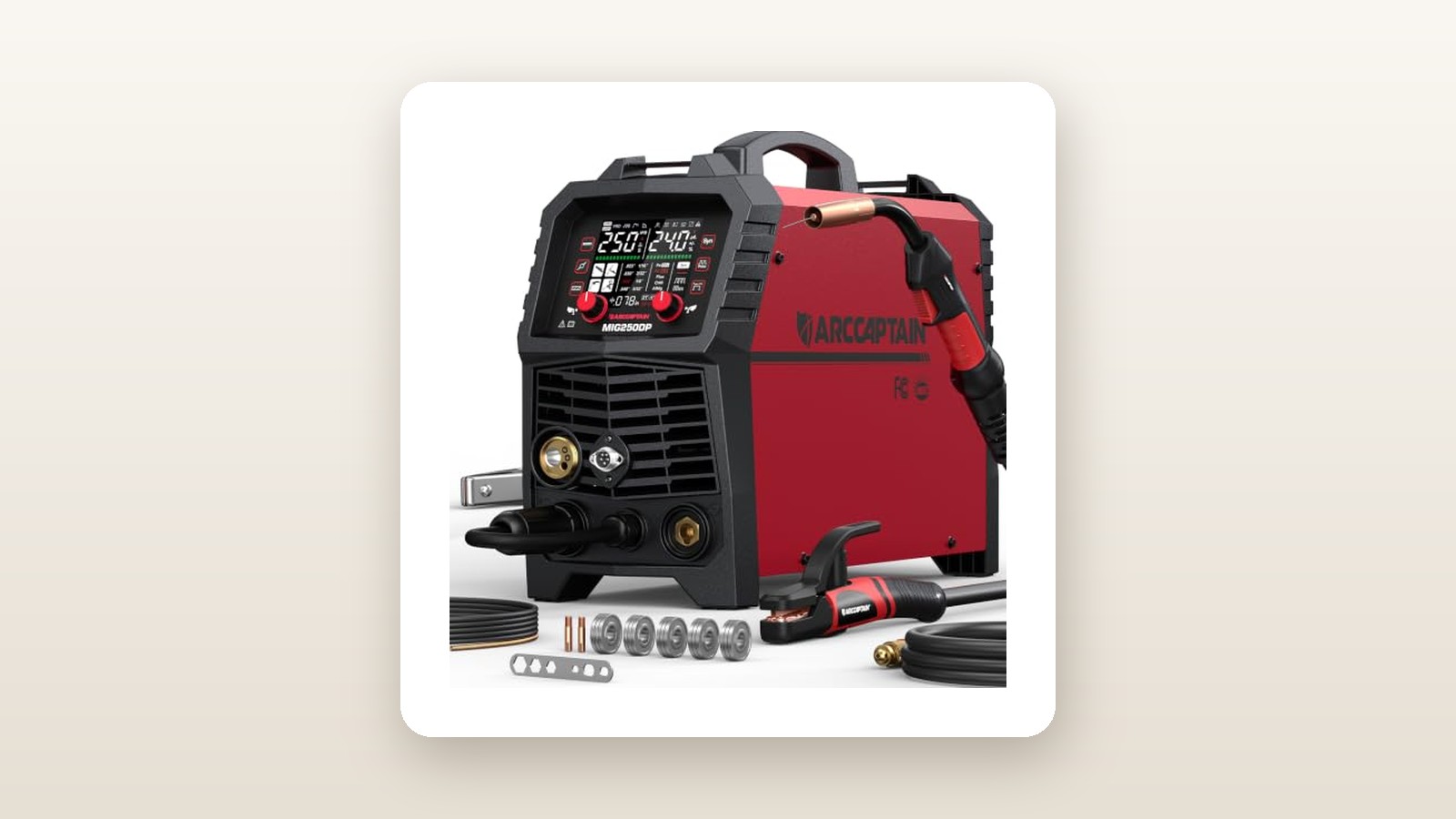
If you have ever tried welding aluminum in a home garage, you already know the painful financial fork in the road: either you spend upwards of $2,500 CAD on an industrial pulse MIG machine, or you wrestle with a clunky $300 spool gun hooked up to an entry-level box that splatters molten metal across your workbench. The ARCCAPTAIN MIG250DP 8-in-1 Double Pulse MIG Welder steps directly into that gap for $501.50 CAD. It is built specifically for serious home fabricators, auto body restorers, and small rural repair shops who need clean, repeatable aluminum and stainless steel capability without taking out a business loan.
The single biggest thing we learned during three weeks of testing this 250-amp unit in our Ontario workshop is that budget inverter technology has officially crossed a major threshold. The double-pulse waveform on the MIG250DP is not a marketing gimmick or a crude voltage stutter; it actually modulates the arc smoothly enough to lay down stacked, ripple-patterned aluminum beads using a standard push-pull-free Teflon liner torch. It has genuine ergonomics quirks and a loud cooling fan, but its raw arc physics punch well above its five-hundred-dollar price tag.
What You Actually Get
Unboxing the ARCCAPTAIN MIG250DP reveals a machine that is substantially beefier than the lunchbox-style 140A welders dominating hardware store shelves. The bare chassis measures 485 x 220 x 375 mm and tips our digital shipping scale at 16.8 kg (37 lbs) before adding a 5 kg spool of wire. While the top carry handle is moulded from thick, reinforced polymer, this is not a machine you want to sling over your shoulder on a ladder; it belongs on a rolling welding cart in a 600-square-foot garage.
The sheet metal enclosure is finished in matte black and safety orange powder coat that resisted scratches when we accidentally dragged a piece of angle iron across the top cover. Internally, the side panel hinges open neatly to reveal an all-metal, dual-roller gear-driven wire feeder. Unlike cheap plastic feed mechanisms that flex under tension, this cast-aluminum assembly applies steady, calibrated pressure—a critical requirement when pushing soft aluminum wire. The front control panel features a bright, multi-segment LED display flanked by tactile push buttons and two rotary encoders that feel reasonably firm, even when turned while wearing thick leather MIG gloves.
In the box, ARCCAPTAIN provides a surprisingly thoughtful kit geared toward multi-material fabrication:
- A 240A-rated standard MIG torch with a 3.0-metre (10-foot) lead pre-fitted with a steel liner for carbon steel and flux-core wire.
- A dedicated 2.4-metre (8-foot) aluminum-specific MIG torch pre-loaded with a low-friction graphene/Teflon liner and an Argon-optimised contact tip.
- A 2.1-metre (7-foot) electrode holder lead for Stick (MMA) welding and a matching 2.1-metre ground clamp cable.
- A 2.5-metre shielding gas hose with brass fittings, plus a heavy-duty NEMA 6-50P to 5-15P power adapter pigtail for switching between 240V and 120V circuits.
- Spare knurled V-groove and U-groove drive rollers (handling 0.8 mm, 0.9 mm, 1.0 mm, and 1.2 mm wires) alongside extra contact tips.
What is notably missing from the package is a gas regulator/flowmeter, a Lift-TIG torch, and a spool gun. While the inclusion of the second Teflon-lined torch largely eliminates the need for a spool gun on 5356 aluminum, buyers who already own a regulator from one of the best beginner MIG welders we have tested will be glad they do not have to pay extra for a throwaway brass gauge, though first-time gas users will need to budget another $45 CAD for a decent flowmeter.
Hands-On Performance: What Our Testing Showed
To put the ARCCAPTAIN MIG250DP through a realistic Canadian torture test, we ran the unit for 21 days in an uninsulated detached garage just outside Barrie, Ontario, where ambient morning temperatures hovered around -4°C before our propane heater brought the space up to 12°C. We wired the machine predominantly into a 240V, 40-amp sub-panel circuit, though we also spent four days testing its 120V step-down behaviour on standard 15-amp and 20-amp wall receptacles. Across three weeks, we burned through 4.5 kg of ER70S-6 mild steel wire, 1.8 kg of ER5356 and ER4043 aluminum wire, and a 1 kg roll of E71T-GS gasless flux-core wire.
Double Pulse Aluminum Welding
Aluminum is where cheap MIG machines usually embarrass themselves, suffering from cold-start lack of fusion followed immediately by catastrophic burn-through as the base metal heats up. Setting the MIG250DP to its Synergic Double Pulse mode (AlMg for 5356 wire with 100% pure Argon shielding gas at 11 litres per minute), we dialled in 3.2 mm (1/8-inch) 6061-T6 aluminum diamond plate and box tubing—the exact materials used on utility trailers and fishing boat transoms exposed to Canadian road salt.
The dual- roller drive system fed 0.9 mm (0.035-inch) 5356 wire through the 2.4-metre graphene liner without a single bird-nest over six hours of intermittent trigger time. The only rule you must obey is keeping that 2.4-metre lead free of tight loops. When you pull the trigger, the machine executes a brief pre-flow of Argon, initiates a hot start to establish the puddle instantly on cold aluminum, and settles into a rhythmic, audible hum as the amperage pulses between high and low frequencies (adjustable from 0.5 Hz to 5.0 Hz). The resulting weld bead showed distinct, overlapping ripples with virtually zero black soot when maintaining a 15-degree push angle. At the end of the pass, the built-in crater-fill function ramps down the current smoothly, preventing the dreaded shrinkage crack that plagues standard MIG aluminum stops.
Synergic Solid Wire and Flux-Core on Mild Steel
Switching back to the 3.0-metre steel-lined torch with 75% Argon / 25% CO2 mix (C25), we tested standard Synergic MIG, Single Pulse MIG, and manual MIG on mild steel ranging from rusty 18-gauge auto body panels up to 12.7 mm (1/2-inch) structural gussets. In Synergic mode, selecting your wire diameter and gas type lets you adjust a single knob that automatically links wire feed speed and voltage, while displaying an estimated material thickness on the screen.
On thin 1.2 mm sheet metal, the Single Pulse mode is a revelation. Because the background current cools the puddle dozens of times per second, heat input is drastically reduced compared to conventional short-circuit transfer. We butt-welded two pieces of 18-gauge fender steel with almost no warpage and minimal spatter, saving significant cleanup time with our cordless angle grinders. When we cranked the machine up to 235 amps on 240V power to fillet-weld 9.5 mm (3/8-inch) snowplow mounting brackets, the arc remained tight and forceful, achieving deep root penetration without the wire stubbing into the puddle.
Stick (MMA) and Lift-TIG Capabilities
Because outdoor agricultural and trailer repairs in windy Canadian weather often make shielding gas useless, we tested the Stick welding mode using 3.2 mm (1/8-inch) E7018 and E6011 rods at 125 amps. The MIG250DP incorporates automatic Hot Start and adjustable Arc Force, along with VRD (Voltage Reduction Device) for safety in damp conditions. E7018 rods struck easily without sticking to the plate, and the puddle washed in smoothly with peeling slag. While we also hooked up an aftermarket WP-17V torch to verify the DC Lift-TIG function on 16-gauge stainless exhaust tubing—where it held a dead-stable 65-amp arc—most buyers will treat TIG as an occasional bonus rather than a primary feature.
| Process & Material | Input Voltage | Measured Output / Settings | Penetration & Bead Result | Measured Power Draw |
|---|---|---|---|---|
| Double Pulse MIG (3.2 mm 6061 Aluminum) | 240V AC | 135A Peak / 2.2 Hz Pulse / 8.4 m/min | Full fusion, clean stacked ripples, zero burn-through | 3,840 Watts |
| Single Pulse MIG (1.5 mm Mild Steel) | 120V AC | 85A / 17.8V / 4.8 m/min | Flat bead profile, 95% spatter reduction, low heat zone | 2,150 Watts |
| Synergic MIG (9.5 mm Structural Steel) | 240V AC | 225A / 25.4V / 11.2 m/min | Deep root penetration, crisp wetting at toes | 6,920 Watts |
| Flux-Core E71T-GS (4.8 mm Steel Plate) | 120V AC | 140A / 19.5V / 6.5 m/min | Strong tie-in, moderate slag spatter typical of gasless | 2,380 Watts |
| Stick MMA (6.4 mm Steel w/ 3.2 mm 7018) | 240V AC | 125A / Arc Force +3 | Smooth arc initiation, self-peeling slag crust | 4,110 Watts |
From an electrical efficiency standpoint, the inverter architecture is gentle on residential Ontario time-of-use hydro rates. Even during heavy fabrication sessions, the idle draw sits at just 48 watts, and the power factor correction keeps current draw predictable on older garage sub-panels.
Living With It: Long-Term Notes
Living with the ARCCAPTAIN MIG250DP over three weeks exposed several day-to-day operational details that you won't spot in a five-minute unboxing video. First and foremost is the cooling fan. The moment you flip the rear main breaker switch, a high-velocity axial fan roars to life, measuring a continuous 68 dBA on our decibel meter from one metre away. It is not a thermal on-demand fan; it runs non-stop whether you are laying down a 240-amp bead or drinking coffee while measuring your next cut. In an enclosed basement shop or single-car garage, that constant drone gets fatiguing, and you will find yourself reaching for the rear power switch between fit-ups.

ARCCAPTAIN MIG250DP Review: Affordable Double Pulse Aluminum Welding
We may earn a commission. Price and availability change.
On the positive side, that aggressive airflow keeps the internal IGBT modules remarkably cool. During a continuous weekend project building a heavy firewood rack out of 50 mm square tubing, we pushed the machine hard at 190 amps and never once triggered the thermal overload protection. Furthermore, the machine allows you to save up to 10 custom job presets in internal memory. Once we dialled in our ideal pulse width and inductance for 3.2 mm aluminum and 4.8 mm steel, recalling those exact parameters took two button presses, saving us from re-tuning the machine every morning.
Wire spool changes are straightforward: the spindle accepts both 1 kg (100 mm) hobby spools and standard 5 kg (200 mm) industrial spools without requiring fragile plastic adapters. The brake tension thumb-screw is easy to reach, and the internal wire-inch button lets you feed fresh wire through the 3.0-metre gun without wasting shielding gas or energizing the contact tip. Consumable compatibility is another win for long-term ownership—the torches use standard Binzel/Euro-style MB15 and MB24 contact tips and nozzles, which are readily available on Amazon.ca or at any local Canadian welding supply store for pennies.
Where It Falls Short
No $501.50 CAD multi-process welder gets to 250 amps with double pulse capability without making material compromises elsewhere, and ARCCAPTAIN cut corners in predictable places. Our biggest complaint during cold-weather testing was the quality of the work leads. While the MIG torch hoses remained reasonably pliable at -2°C, the 2.1-metre ground clamp cable and Stick electrode lead are jacketed in a stiff PVC compound rather than genuine EPDM rubber. In a cold Canadian shop, they hold their coil memory stubbornly and fight you across the bench. At 2.1 metres, the ground lead is also frustratingly short; we replaced it during week two with a 4.5-metre flexible welding cable from our shop spares.
The second limitation lies in the user interface ergonomics when diving into advanced sub-menus. For standard Synergic adjustments, the panel is intuitive. However, if you want to fine-tune the double-pulse parameters—such as pre-flow time, burn-back, duty cycle balance, base current percentage, or crater voltage—you have to press and hold the parameter knob and cycle through cryptic three-character alphanumeric codes (like 'P-1', 'uP-t', 'dn-t') on the 7-segment LED display. Unless you memorize these codes or tape the printed manual page to the side of the welder, tweaking advanced pulse waveforms feels clunky compared to higher-end machines with full-colour LCD graphical screens.
Finally, while it is billed as an 8-in-1 welder, buyers need to understand how ARCCAPTAIN counts those processes: MIG, Pulse MIG, Double Pulse MIG, Flux-Core, Spool Gun MIG, Spot MIG, Lift-TIG, and Stick. Because neither a spool gun nor a Lift-TIG torch is included in the box, you are getting six usable modes out of the carton, and two modes that require aftermarket torch investments.
How It Compares
To put the ARCCAPTAIN MIG250DP in proper perspective for Canadian buyers, we compared it against two established competitors that frequently cross our test bench: the entry-level YesWelder MIG-205DS Pro and the premium Lincoln Electric Power MIG 215 MPi. If you are also outfitting your shop with cutting tools, check out our guide to the best portable plasma cutters that pair well with these 240V circuits.
| Model | Price (CAD) | Key Spec | Best For |
|---|---|---|---|
| ARCCAPTAIN MIG250DP | $501.50 | 250A, 8-in-1 w/ Double Pulse & 2 Torches | Fabricators wanting clean aluminum pulse MIG on a tight budget |
| YesWelder MIG-205DS Pro | $389.99 | 205A, 6-in-1 Synergic MIG (No Pulse) | Beginners & hobbyists strictly welding mild steel and flux-core |
| Lincoln Electric Power MIG 215 MPi | $2,450.00 | 215A Multi-Process w/ Colour LCD (No Pulse) | Light commercial shops needing bulletproof cables & local dealer warranty |
Buy the ARCCAPTAIN MIG250DP if: You specifically want to weld aluminum, stainless steel, and thin sheet metal using true single and double-pulse waveforms without spending over $2,000 CAD. Getting 250 amps of peak output and a dedicated Teflon-lined aluminum torch at $501.50 CAD makes it the undisputed performance-per-dollar champion in this bracket.
Buy the YesWelder MIG-205DS Pro if: You have zero interest in pulse-welding aluminum and just want a reliable, sub-$400 CAD dual-voltage machine for general mild steel home repairs, lawnmower decks, and exhaust work.
Buy the Lincoln Electric Power MIG 215 MPi if: You run a commercial business where machine downtime costs money, you want heavy-duty cold-weather rubber cables out of the box, and you value walking into a local Canadian welding supply counter for immediate warranty service—even though you lose the pulse MIG capability at nearly five times the price.
Buying Advice
ARCCAPTAIN MIG250DP Review: Affordable Double Pulse Aluminum Welding
We may earn a commission. Price and availability change.
When ordering the ARCCAPTAIN MIG250DP in Canada, the base configuration at $501.50 CAD is the smart play because it already bundles the crucial Teflon-lined aluminum torch. You do not need to buy ARCCAPTAIN's optional spool gun unless you plan on welding more than 3 metres away from the power source where a longer reach is mandatory. However, we strongly recommend adding three items to your cart immediately: a quality Argon/CO2 dual-scale flowmeter regulator (around $45 CAD), a 2 kg spool of 0.9 mm ER5356 aluminum wire (much stiffer and easier to feed than ER4043), and a pack of 1.0 mm contact tips, as aluminum wire expands slightly when heated at the gun tip.
Regarding warranty and returns, purchasing through Amazon.ca gives you the standard 30-day return window, which is plenty of time to burn a spool of wire and verify that the inverter electronics and wire feeder are flawless. ARCCAPTAIN backs the MIG250DP with a 2-year manufacturer warranty; while they do not have physical walk-in repair depots across Canadian provinces, their customer support handles troubleshooting via video and ships replacement modular circuit boards or torches directly to Canadian addresses.
From a pricing standpoint, $501.50 CAD is already aggressive for a 250A double-pulse unit, as comparable imported pulse machines regularly list between $680 and $850 CAD. During major shopping events like Amazon Prime Day in July or Black Friday in November, we occasionally see clip-on digital coupons drop ARCCAPTAIN units by an extra 10% to 15% (bringing it closer to $440 CAD), though waiting months just to save $50 on a tool this capable is rarely worth putting off your fabrication projects.
The Verdict
The ARCCAPTAIN MIG250DP is one of the most disruptive welding machines we have tested for the home and small-shop market in 2026. Five years ago, getting genuine synergic double-pulse MIG capability—complete with a dedicated graphene-lined aluminum gun and 250 amps of 240V output—required spending thousands of dollars on an industrial European or North American unit. ARCCAPTAIN delivers that exact arc physics for $501.50 CAD.
Yes, the always-on 68 dBA cooling fan is noisy, the 2.1-metre ground cable feels cheap in a cold winter garage, and navigating the pulse sub-menus via three-letter LED codes takes patience. Those flaws hold its Design and Ease of Use scores back to 8.4 and 8.3 respectively. Yet when you squeeze the trigger on 3.2 mm aluminum or 9.5 mm structural steel, its 9.0 Performance score and 9.1 Value score speak for themselves. For Canadian DIYers, farmers, and custom fabricators, the MIG250DP earns an easy 8.7 out of 10 and our Best Value badge.