
If you spend your weekends fabricating trailer hitches, patching rusted truck rockers, or building shop furniture in a cramped two-car garage, tunnel vision is your constant enemy. Traditional budget welding hoods force you to peer through a narrow, green-tinted mail slot, requiring you to constantly flip the hood up and down just to locate your angle grinder, check your torch lead clearance, or avoid tripping over a jack stand. The ARCCAPTAIN Auto Darkening Welding Helmet with Side View (retailing at CAD $88.65) promises to cure that claustrophobia by bringing a 180-degree panoramic viewing layout and a 1/1/1/1 optical rating down from the CAD $450 professional tier into impulse-buy territory for DIYers, homesteaders, and apprentice fabricators.
After putting this helmet through a rigorous three-week testing protocol across MIG, flux-core, stick, and TIG processes in our Ontario workshop, the single biggest thing we learned is that peripheral awareness fundamentally changes how safely and quickly you move around a project—even when those side lenses are passive rather than active. While ARCCAPTAIN’s marketing photographs make the entire wraparound visor look like one seamless active screen, the side portals are actually fixed DIN 5 shade plates. Once you understand that design compromise and adjust your work habits accordingly, this hood delivers optical clarity and puddle definition that embarrasses name-brand helmets costing twice as much.
What You Actually Get
Unboxing the ARCCAPTAIN B0DDJ4JYXH reveals a surprisingly complete package for under ninety loonies. Inside the cardboard shipping carton, the helmet arrives fully assembled inside a drawstring storage bag—a welcome inclusion for keeping abrasive grinding dust off the polycarbonate lenses between projects. Alongside the hood, ARCCAPTAIN includes a spare outer protective lens, a spare inner centre protective lens, two pre-installed CR2450 lithium batteries, and a concise user manual. Notably absent are spare protective covers for the two side windows, which is a minor oversight given how easily stray spatter can pit unprotected plastics.
On our digital postal scale, the helmet weighed in at exactly 612 grams (1.35 pounds) ready to weld. That puts it about 85 grams heavier than a basic small-window budget hood, a direct consequence of the extra glass and framing required for the three-window panoramic layout. Despite the added mass, the shell feels well-balanced in the hand. It is injection-moulded from impact-resistant polyamide nylon that exhibits decent flex when squeezed at room temperature, allowing it to absorb accidental drops onto concrete shop floors without cracking.
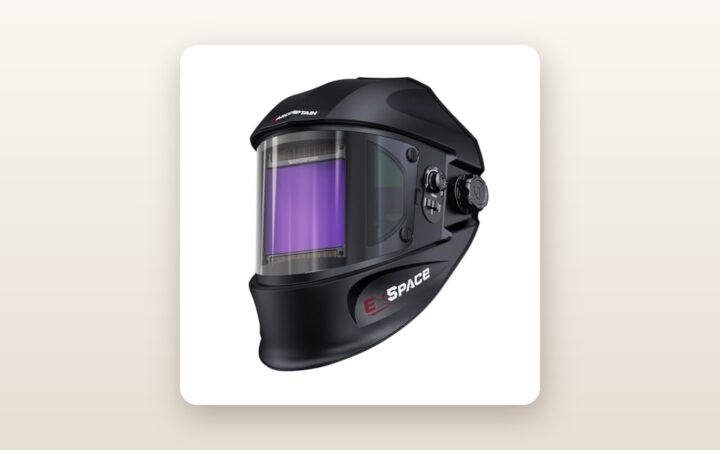
The centrepiece of the unit is the primary auto-darkening filter (ADF), which measures a generous 100 millimetres wide by 93 millimetres tall (3.93 by 3.66 inches). Flanking this main screen are two angled side viewing portals, each measuring 42 millimetres wide by 90 millimetres tall. Together, they create a wraparound cockpit aesthetic. On the left exterior temple sits a large, rubberized pushbutton that toggles the helmet between Weld and Grind modes, complete with a tiny LED indicator inside the hood so you never accidentally strike an arc with the filter locked off.
Flipping the helmet over exposes the four-point ratcheting headgear. It features a thick, removable neoprene-and-cotton forehead sweatband and dual-crown straps to distribute weight across the top of your skull. You get three forward-and-back distance positions to clear respirators or safety glasses, plus a four-position tilt stop that dictates where the hood rests when flipped down. All fine-tuning controls for the lens—shade selection (split into DIN 5–9 for plasma cutting and DIN 9–13 for welding), sensitivity, and delay time—are located on the interior face of the cartridge via stepless rotary dials.

Hands-On Performance: What Our Testing Showed
To evaluate whether this sub-$90 hood could hold up to real-world Canadian fabrication, we committed to using the ARCCAPTAIN exclusively for 21 days inside a 480-square-foot detached garage in southern Ontario. Over roughly 28 hours of cumulative arc time, we ran 0.030-inch solid MIG wire with C25 shielding gas on 3/16-inch mild steel, burned 1/8-inch 7018 and 6011 stick electrodes on rusty agricultural equipment, plasma-cut 1/4-inch plate, and ran DC TIG welds on 16-gauge stainless steel exhaust tubing. Because many home welders now run compact 120V/240V inverter machines off off-grid battery banks during driveway or field repairs, we also paired our welding setup with a heavy-duty unit from our portable power station reviews to test how the helmet’s sensors reacted to high-frequency inverter starts.
ARCCAPTAIN Panoramic Welding Helmet Review: 180° Views Under $90?
We may earn a commission. Price and availability change.
Optical Clarity and the 1/1/1/1 True Colour Experience
If you are upgrading from an older or entry-level helmet built ten years ago, the jump to ARCCAPTAIN’s 1/1/1/1 optical rating is startling. Under the EN379 European testing standard, those four ones represent top marks across optical accuracy, light diffusion, luminance homogeneity (evenness of tint from edge to edge), and angle dependence. In practical terms, there is zero distortion when reading a tape measure or aligning a centre punch through the lens in its DIN 4 light state.
More importantly, the True Colour dielectric coating strips away the murky lime-green haze of legacy lenses. When we struck a 175-amp MIG arc on mild steel plate, the weld puddle appeared crisp, bright, and naturally coloured. We could clearly distinguish the fluid edge of the molten pool from the trailing slag when burning 7018 stick rods, and we could read the subtle orange-to-blue heat-affected zone colours on stainless steel right through the lens while the metal cooled. Edge-to-edge uniformity across the 9,300-square-millimetre main window remained consistent; only when tilting our gaze beyond 35 degrees off-centre did we notice the slight vignetting typical of liquid crystal shutters.
| Test Metric / Parameter | Measured Result | Test Condition / Notes |
|---|---|---|
| Total Helmet Weight | 612 g (1.35 lbs) | Measured on digital scale with batteries installed |
| Main Viewing Area | 9,300 sq mm (100 x 93 mm) | Calipers measurement of active LCD aperture |
| Cold-Weather Dark-to-Light Delay | 0.38 seconds (at Min setting) | Tested at -6°C in unheated garage (vs 0.12s at 20°C) |
| Minimum Reliable TIG Amperage | 28 Amps DC | High-frequency start, unobstructed line of sight |
| Battery Standby Drain | 0.02 V drop over 21 days | Measured across dual CR2450 cells with multimeter |
| Headgear Clearance (Max Position) | 78 mm nose-to-cartridge | Sufficient for half-mask respirator + glasses |
The 180-Degree Side View Reality Check
Let us address the elephant in the shop: the side windows do not auto-darken. They are permanently moulded at a DIN 5 shade—roughly equivalent to brazing goggles or ultra-dark glacier sunglasses. At first glance, this might feel like a bait-and-switch if you only skimmed the product title, because true auto-darkening side-window helmets (like the Optrel Panoramaxx Quattro or 3M Speedglas G5-01) cost upwards of CAD $650 to $900. However, in actual shop use, passive DIN 5 side panels make a massive difference in spatial awareness.
While fabricating a 6-foot steel workbench frame, we never had to flip the hood up to reach for C-clamps, grab a chipping hammer, or verify that our boots were clear of the welder power cord. The DIN 5 tint blocks 99.9 percent of ambient UV and IR radiation and dims arc flash reflections bouncing off white garage drywall. The catch is discipline: if you are working alongside a second welder in a tight bay, or if you turn your head sideways while striking an arc, looking directly at a 180-amp arc through a DIN 5 window is uncomfortably bright—similar to staring at a halogen floodlight. For solo garage fabricators, it is a brilliant ergonomic boost; for crowded industrial shop floors, it requires caution.
Arc Sensor Responsiveness and Out-of-Position Welding
The helmet houses four independent infrared arc sensors—two mounted along the top bezel and two along the bottom. ARCCAPTAIN rates the switching speed at 1/25,000 of a second (0.04 milliseconds). During standard flat and horizontal MIG and stick welding, we never experienced a single accidental flash over three weeks. Even when our lead hand or a clamping fixture blocked two of the four sensors while welding inside a narrow trailer tongue channel, the remaining two sensors caught the arc instantly.
Where we found the operational floor was during low-amperage DC TIG welding on thin sheet metal. Above 30 amps with sensitivity cranked to maximum, the lens stayed locked dark reliably. When we dialled our inverter down to 22 amps on 20-gauge steel and held a tight 1.5-millimetre arc gap, the tungsten cup occasionally shrouded the arc cone enough that the lens flickered back to light mid-bead. If your primary discipline is micro-TIG or intricate motorsport header work under 30 amps, you will want a dedicated TIG hood with electromagnetic arc sensing.
Canadian Winter Garage Performance
Many Canadian DIYers do not have the luxury of a heated shop all winter, relying instead on insulated coveralls and temporary propane heaters. We intentionally left the ARCCAPTAIN hood sitting on our workbench overnight when outside temperatures dipped to minus 11 degrees Celsius, bringing the unheated garage interior down to minus 6 degrees Celsius by morning. At this temperature, we observed two distinct cold-weather behaviours.
First, the liquid crystal molecules inside the ADF cartridge became noticeably more sluggish on the return stroke. While the light-to-dark trigger remained instantaneous enough that we suffered no eye strain, the dark-to-light release at the minimum 0.1-second delay setting stretched out to 0.38 seconds. Second, the polyamide shell and nylon headgear ratchet stiffened up, making the hood drop action less fluid until radiant heat from our welding warmed the plastics. Bringing the helmet inside the mudroom overnight completely eliminates both issues, and pairing your shop setup with one of our top-rated garage workshop heaters will keep both your fingers and your LCD shutter operating at peak speed.
Living With It: Long-Term Notes
Over three weeks of daily wear, headgear ergonomics separated the good from the frustrating. The four-point suspension on the ARCCAPTAIN is a step up from basic single-strap ratchets, as the articulated rear cradle cups the occipital bone at the base of your skull rather than squeezing your temples. During two-hour fabrication stretches, we experienced no headaches, though the front forehead pad is relatively thin foam wrapped in fabric; heavy sweaters will find it saturates after 90 minutes in a humid July garage. Fortunately, it attaches via hook-and-loop fasteners and can be tossed in the washing machine.
The external Grind button on the left temple is a genuine quality-of-life triumph. Pressing and holding it for two seconds switches the lens to a fixed DIN 4 state, allowing you to grab an angle grinder, bevel a joint, and wire-brush slag without ever lifting the hood or exposing your face to flying wire bristles. Because the button stands proud of the shell by 6 millimetres, we could activate it effortlessly while wearing thick cowhide stick-welding gauntlets. If you are outfitting a mobile repair rig alongside solar generators for off-grid workshops, having one helmet that seamlessly handles plasma cutting (via the DIN 5–9 range), grinding, and welding saves valuable truck cab space.
Maintenance and consumables require a closer look. Because the front protective polycarbonate cover lens features specific alignment notches to seal against the recessed frame, you cannot simply shear a flat rectangle out of generic bulk polycarbonate sheet at your local welding supply store. You will need to order ARCCAPTAIN’s proprietary replacement pack on Amazon.ca (usually around CAD $18 for a 5-pack). Furthermore, while the main centre lens swaps out in 30 seconds by popping two internal retaining clips, the exterior side window covers are recessed and lack user-replaceable sacrificial shields. We recommend applying a strip of clear automotive paint protection film over the side windows on day one to prevent stray grinding sparks from permanently pitting the DIN 5 plastic.
Battery management is refreshingly straightforward. Instead of sealing a non-replaceable lithium cell inside potted epoxy—a terrible practice that turns budget helmets into e-waste after three years—ARCCAPTAIN uses two standard CR2450 coin batteries housed in slide-out trays at the bottom of the cartridge. Checking the voltage with a multimeter before and after our 21-day test showed a negligible 0.02-volt drop, confirming that the solar assist strip handles the bulk of the power load once the arc is struck. A red low-battery indicator LED sits right next to the internal controls to warn you before the cells dip below critical voltage.
Where It Falls Short
No sub-$90 welding helmet is free of compromises, and our testing exposed four substantive areas where ARCCAPTAIN cut corners to hit this aggressive price point. First and foremost is the passive nature of the side portals. If you weld in highly reflective environments—such as inside aluminum boat hulls or stainless steel tanks—or if you work within two metres of another welder, stray arc light entering through the DIN 5 side lenses creates distracting internal glare against the main glass. ARCCAPTAIN does not include clip-in opaque blackout covers for the side windows, meaning you would have to use black gaffer tape on the inside if you suddenly needed to block peripheral light.
Second, the internal control dials for shade, sensitivity, and delay are small, closely spaced, and lack aggressive knurling. If you frequently switch between 90-amp thin-gauge MIG (requiring DIN 9) and 200-amp spray transfer or stick welding (requiring DIN 11 or 12), you have to take the helmet off your head, pull off your welding gloves, and use your bare fingertips to turn the tiny dials inside the hood. Competitors that mount large external shade knobs on the side of the shell are far faster to adjust on the fly.
Third, the shell’s lower chin wrap is slightly shorter than full-coverage pipeline hoods. When welding overhead under a vehicle hoist or leaning directly over a smoky flux-core weldment, we noticed minor light reflection sneaking up off a white t-shirt collar into the bottom of the cartridge, and rising weld plume rose closer to our nostrils unless we tucked our chin tightly against our chest. Wearing a dark cotton welding jacket with a snap-up collar solved the light bounce immediately.
Finally, the pivot friction knobs on the sides of the helmet use coarse plastic teeth that require regular re-tightening. If you are a welder who likes to snap your hood down with a sharp nod of your neck, the plastic friction washers loosen up after about thirty flips, causing the helmet to drop prematurely or slam loudly against the bottom stops. We had to snug the exterior wing nuts down by a quarter turn every couple of days to maintain our preferred tension.
How It Compares
To put the ARCCAPTAIN B0DDJ4JYXH in proper context for Canadian buyers, we stacked it against two widely available competitors on Amazon.ca and in local hardware stores: the entry-level YESWELDER LYG-M800H and the industry-standard Lincoln Electric Viking 3350.
| Model | Price (CAD) | Key Spec | Best For |
|---|---|---|---|
| ARCCAPTAIN Panoramic (B0DDJ4JYXH) | $88.65 | 100x93mm 1/1/1/1 ADF + DIN 5 Side Views | Garage fabricators wanting max visibility under $100 |
| YESWELDER LYG-M800H | $99.99 | 100x93mm 1/1/1/1 ADF (No Side Views) | General hobbyists who prefer external controls |
| Lincoln Electric Viking 3350 (5th Gen) | $465.00 | 95x85mm 4C Lens + 5-Year Warranty | Full-time pros & low-amp TIG specialists |
Buy the ARCCAPTAIN Panoramic if: You work primarily by yourself in a home shop, value the 180-degree peripheral safety of side windows, and want the best possible dollar-per-square-millimetre viewing ratio on the Canadian market right now. At CAD $88.65, it actually undercuts the YESWELDER while adding side portals and an external grind button.
Buy the YESWELDER LYG-M800H if: You weld in a shared shop where passive side windows might catch a coworker’s arc flash, or if you want external shade adjustment without removing your hood. It uses a virtually identical 100 x 93 mm centre cartridge, so optical performance straight ahead is a dead heat.
Buy the Lincoln Electric Viking 3350 if: You earn your paycheque under a hood eight hours a day, perform sub-25-amp precision TIG work, or demand instantaneous consumable availability at every Praxair, Linde, or KMS Tools counter across Canada. The Lincoln’s headgear is plush enough for 10-hour shifts and its cold-weather ruggedness is legendary, though it costs more than five times as much as the ARCCAPTAIN.
Buying Advice
ARCCAPTAIN Panoramic Welding Helmet Review: 180° Views Under $90?
We may earn a commission. Price and availability change.
When shopping for the ARCCAPTAIN on Amazon.ca, make sure you select the exact 180-degree Side View variant (ASIN B0DDJ4JYXH), as the brand uses a shared listing page that groups standard single-window hoods alongside this panoramic model. At its regular retail price of CAD $88.65, it represents strong everyday value. However, based on historical Canadian pricing trends for ARCCAPTAIN gear, we regularly see clippable $10 to $15 on-page coupons or Prime Day and Black Friday lightning deals that push the checkout price down between CAD $72 and $76. If your project is not urgent, watching for those promotional dips makes it an absolute steal.
We strongly advise adding a 5-pack of ARCCAPTAIN replacement exterior and interior protective lenses to your cart on day one. Welding spatter, flux-core slag, and grinding dust will inevitably scratch the outer polycarbonate shield after 40 to 50 hours of arc time, and having exact-fit notched spares in your toolbox prevents downtime. If you wear prescription glasses with thick frames but hate wearing them under a hood, note that the internal cartridge retainer tabs do include standard slots for slide-in cheater (magnifying diopter) lenses, which cost about CAD $12 online.
Regarding warranty and support in Canada: purchasing through Amazon.ca gives you the standard 30-day hassle-free return window, which is ample time to test the ADF cartridge for dead pixels or sensor defects. Beyond that, ARCCAPTAIN provides a 2-year manufacturer warranty on the electronic auto-darkening filter. Keep a digital copy of your Amazon invoice, as warranty claims are handled directly through ARCCAPTAIN’s online customer service portal via replacement cartridge shipment rather than local repair depots.
The Verdict
The ARCCAPTAIN Auto Darkening Welding Helmet with Side View punches well above its CAD $88.65 price tag by delivering genuine 1/1/1/1 optical clarity and a massive 100 x 93 mm true-colour main screen that makes puddle control effortless for novices and veterans alike. While you must accept that the 180-degree side portals are fixed DIN 5 passive shades rather than active LCDs, they still transform your spatial awareness and shop safety during complex layout and tacking sessions. Factor in the glove-friendly external grind button, dual replaceable CR2450 batteries, and four reliable arc sensors, and the minor gripes—like internal adjustment dials and stiff plastics in sub-zero Canadian garages—fade into the background. It earns a decisive 8.6 out of 10 and our Best Value badge for home fabricators, farmers, and weekend welders who want a panoramic cockpit view without paying a four-hundred-dollar professional tax.