If you have ever watched a standard pan-tilt security camera get baited by a swaying cedar branch on the left side of your yard while a courier walks up the right side of your driveway completely unrecorded, you already understand who the Tapo C645D KIT is built for. Priced at CAD $142.14, this wireless solar kit is designed for Canadian homeowners with wide two-car driveways, corner lots or detached garages who need two pairs of eyes on the property without hiring an electrician to snake 120V wiring through insulated exterior walls.
The single biggest thing we learned during three weeks of testing the C645D KIT on a suburban Ontario home is that a secondary fixed lens completely fixes the fundamental flaw of motorized cameras. Because the upper wide-angle lens stays locked on your main choke point at all times, the lower motorized dome is free to pivot, zoom and chase a moving subject across a 360-degree arc without ever creating a blind spot at your front steps.
What You Actually Get
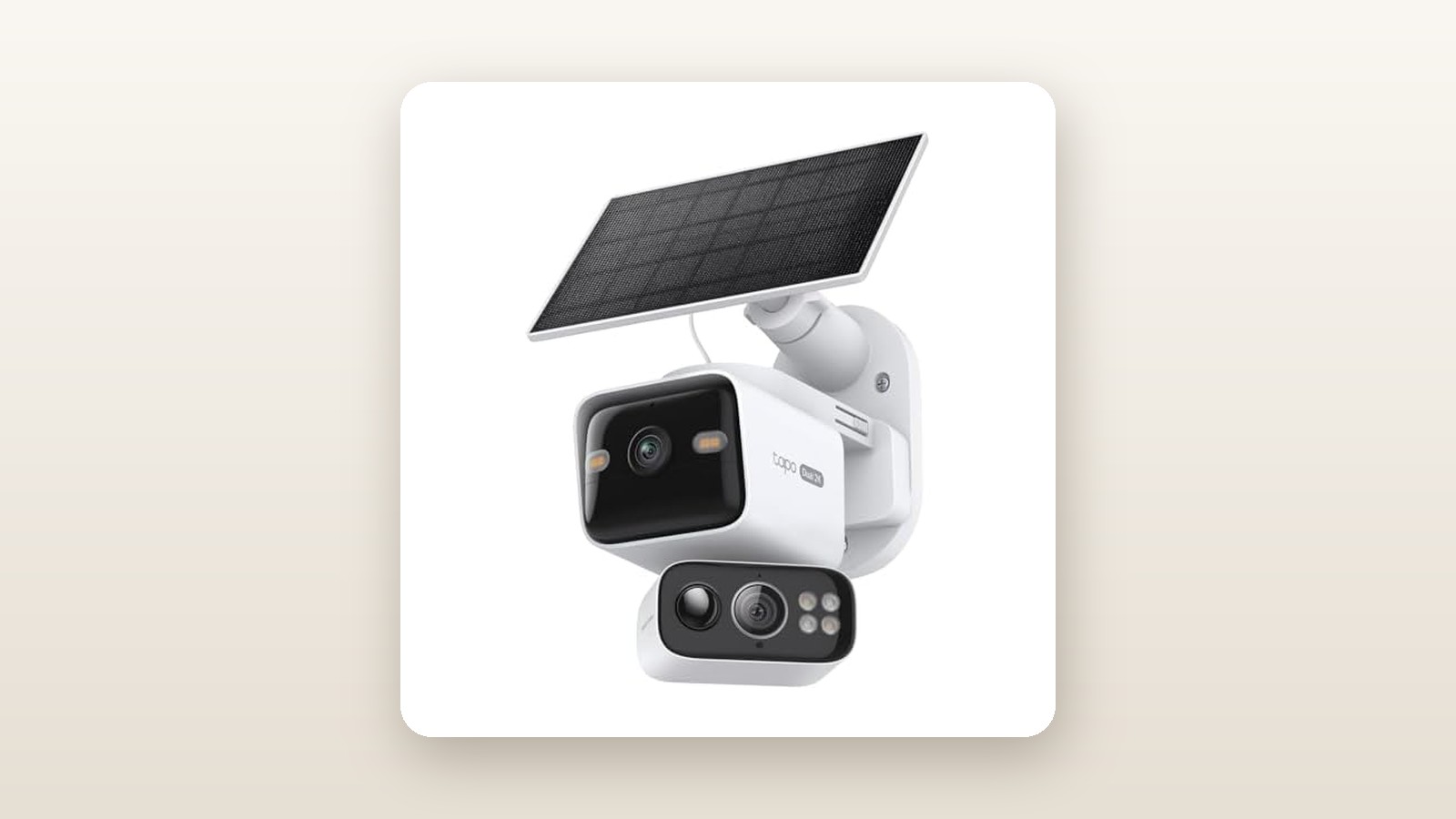
Unboxing the Tapo C645D KIT reveals a denser, more substantial piece of hardware than Tapo's budget indoor cameras. The main camera unit weighs 655 grams on our digital kitchen scale and measures 148 mm tall by 138 mm deep. The shell is moulded from UV-stabilized matte white polycarbonate with black lens surrounds that help cut down on infrared glare at night. Rather than stacking two identical barrels, Tapo puts the fixed 125-degree wide-angle lens in the upper stationary collar and suspends the pan-tilt orb underneath it, equipped with a tighter focal length for cleaner digital zoom on distant subjects.
Alongside the camera, the box contains a 2.5-watt monocrystalline solar panel measuring 173 mm by 120 mm, which adds 285 grams including its articulating knuckle mount. Crucially for northern installations where eaves and overhangs block high sun angles, Tapo includes a 4-metre hardwired USB-C cable with a multi-ribbed silicone gasket that seals tightly into the camera's charging port. You also get a heavy polymeric L-bracket for the camera, a drilling template sticker, six stainless steel mounting screws with masonry wall anchors, and a short USB-A to USB-C indoor charging lead for topping up the 10,000 mAh internal battery before you climb a ladder.
What is not in the box is a microSD card or a USB wall brick. Because the camera records two separate 2K (2560 x 1440 pixel) video streams for every motion event, it chews through storage roughly twice as fast as a single-lens unit. You should budget an extra $22 to $30 for a 128 GB or 256 GB High Endurance microSD card before installation day.
Hands-On Performance: What Our Testing Showed
To evaluate how the Tapo C645D KIT handles realistic Canadian conditions, we mounted our review unit at a height of 2.7 metres under the soffit of a detached two-car garage facing a 14-metre asphalt driveway and a 650-square-foot front yard. Over a 21-day period that included early spring sleet, -6°C overnight frosts, heavy rain and bright afternoon sun, we logged battery drain, solar recovery rates, Wi-Fi stability and motion detection accuracy across more than 420 recorded triggers.
Dual-Lens Tracking and Image Quality
The standout capability here is what Tapo calls Smart Dual-Lens Tracking. When our tester walked across the edge of the property line at 12 metres out, the upper fixed wide-angle lens detected the silhouette first and immediately handed the coordinates to the lower pan-tilt turret. Within 0.8 seconds, the lower gimbal rotated to centre the person in frame and tracked them smoothly all the way to the porch, while the upper lens stayed fixed on the street entrance.
Both sensors capture 2K QHD video at 15 frames per second. In daylight, colour rendition is natural and contrast holds up well even when low afternoon sun reflects off wet pavement or lingering snowbanks. Licence plates on parked cars were legible at 9.5 metres on the lower lens, compared to about 5.5 metres on the wider upper lens. At night, you can choose between discreet 850 nm infrared black-and-white vision or full-colour night vision powered by four integrated LED spotlights. Those spotlights draw extra battery power, so we kept them on smart mode, which only fires the white LEDs when a human or vehicle is confirmed.
| Test Metric | Measured Result | Test Conditions |
|---|---|---|
| Daylight Plate Legibility (Telephoto Pan Lens) | 9.5 metres | Overcast sky, stationary vehicle in driveway |
| Night Vision Effective Range (Infrared / Colour) | 14.0 m / 8.5 m | Unlit backyard, dark clothing subject |
| Cross-Lens Handoff Latency | 0.8 seconds | Subject walking at 5 km/h across 125° wide zone |
| Battery Drain (No Solar Input) | 0.9% per day | 22 motion clips/day, 15-second average length, 4°C ambient |
| Solar Recharge Rate (Full Sun) | 11% in 3.5 hours | South-facing panel at 45° tilt, 11:00 AM to 2:30 PM |
| Pan Motor Operating Noise | 41.2 dBA at 1 metre | Measured with sound meter during full 180° sweep |
Solar Harvesting and Cold-Weather Battery Life
For readers browsing our portable solar power guides, the math inside the C645D KIT is encouraging. Inside the sealed housing sits a 10,000 mAh lithium-ion pack—roughly double the 5,200 mAh cell found in entry-level wireless cams. Before attaching the solar panel, we ran the camera on battery alone for ten mostly cloudy days with an average of 22 motion events per day. The battery dropped from 100% to 91%, averaging less than 1% loss per 24 hours. And because the camera runs entirely off the sun, it adds zero load to your provincial hydro bill during peak time-of-use windows.
Once we connected the 2.5 W solar panel facing south at a 45-degree angle, a single sunny afternoon pushed the battery from 88% back to 99% in 3.5 hours. The critical caveat for Canadians is temperature. During three overnight dips to -6°C, the camera recorded motion and rotated its gimbal without hesitation, but the app correctly reported that solar charging was paused until mid-morning when the housing warmed above 1°C. If you live in Winnipeg, Edmonton or rural Quebec where January temperatures remain below freezing for weeks on end, the camera will survive on its large 10,000 mAh reserve, though you may need to bring it inside for a USB-C top-up once in mid-winter if your driveway sees heavy daily traffic.
Wi-Fi Reach and App Responsiveness
Because each live view pulls two simultaneous 2K streams over 2.4 GHz Wi-Fi, network throughput matters more here than on standard cameras. At our garage mounting point—16 metres and two insulated walls away from our main router, where signal strength measured -63 dBm—live streams loaded in 2.4 seconds. When we temporarily tested the unit on a back fence post at 28 metres (-74 dBm), the dual stream buffered frequently unless we stepped the stream quality down to 1080p mode in the settings. If you are covering a large rural lot, pairing this camera with one of the best mesh Wi-Fi systems for large Canadian homes will prevent frustrating loading spinners.

Living With It: Long-Term Notes
After the novelty of panning the camera around the neighbourhood wears off, day-to-day ownership comes down to alarm fatigue and maintenance. Over three weeks, the onboard AI proved impressively disciplined. We enabled Person and Vehicle detection while leaving general motion turned off. Out of 420 logged clips, we saw zero false alerts from wind-blown recycling bins or passing squirrels, and only four false vehicle triggers caused by headlights sweeping across our garage door from the street.

Tapo C645D KIT Review: Two Lenses, Zero Hydro Bill
We may earn a commission. Price and availability change.
A few minor quirks surfaced in week two. First, the pan-tilt servo motor is not silent; we measured 41.2 dBA at a distance of 1 metre. Mounted high under a garage peak, you will never hear it over street noise, but if you bolt it directly beside an outdoor patio chair or bedroom casement window, the robotic whir is noticeable when it tracks you at night. Second, while the IP65 gasket kept driving spring rain and road salt spray out of the internals, wet snow can accumulate on the flat upper ledge above the bottom dome. Brushing the solar panel clean with a broom once after a heavy snowfall is the only recurring chore required.
The Tapo app (tested on both iOS and Android) remains one of the cleanest interfaces in the security category. Unlike competitors that plaster six different cloud-upgrade banners across the home screen, Tapo lets you scrub through a unified timeline showing both the top and bottom camera recordings synchronously. A firmware update arrived ten days into our test, took four minutes to install over Wi-Fi, and improved the return-to-home calibration so the lower lens stopped drifting 2 degrees off-centre after rapid tracking sweeps.
Where It Falls Short
No CAD $142 camera is without compromises, and the C645D KIT has four concrete limitations you should weigh before buying. The most notable for Canadian buyers is the lithium charging floor at 0°C. While the camera discharges happily down to -20°C, the lack of an internal battery heater means solar harvesting goes dormant during deep cold snaps. Second, because this is a battery-powered device, it does not support 24/7 continuous recording or RTSP/ONVIF streaming to a home NAS; it wakes up solely for motion events (up to 120 seconds per clip) or live check-ins.
Third, the networking radio is strictly 2.4 GHz Wi-Fi 4. In congested townhouse complexes where dozens of neighbour routers crowd channels 1, 6 and 11, dual 2K bitrates can occasionally drop frames during playback. Finally, physical security is worth considering: the microSD card slot sits behind a rubberized flap with two tiny screws on the underside of the lower camera globe. If you mount the unit within easy arm's reach below 2 metres and an intruder rips the camera off the siding, your local footage leaves with them unless you subscribe to Tapo Care cloud storage.
How It Compares
To put the Tapo C645D KIT in context, we stacked it against two direct dual-lens solar competitors readily available on Amazon.ca and at Canadian electronics retailers. If you are also weighing hardwired floodlight options, check our roundup of outdoor security cameras tested for winter.
| Model | Price (CAD) | Key Spec | Best For |
|---|---|---|---|
| Tapo C645D KIT | $142.14 | Dual 2K (Wide + Pan-Tilt), 10,000 mAh, 512 GB microSD | Best overall value for wide driveways without monthly fees |
| Eufy SoloCam S340 | $259.99 | 3K Wide + 2K Telephoto Pan-Tilt, 8 GB built-in eMMC | Users who want sharper 3x optical zoom and integrated storage |
| Reolink TrackMix WiFi + Solar | $239.99 | 4K Wide + 1080p Pan-Tilt, Dual-Band Wi-Fi (2.4/5 GHz) | Power users needing 5 GHz Wi-Fi and RTSP/NVR compatibility |
Buy the Tapo C645D KIT if: You want simultaneous wide-angle and pan-tilt coverage for well under $150 CAD, you prefer expandable microSD storage up to 512 GB over small soldered memory, and you value having a 10,000 mAh battery that outlasts smaller 6,500 mAh cells during cloudy weeks.
Buy the Eufy SoloCam S340 if: You are willing to spend roughly $118 more for a sharper 3K primary sensor and a dedicated telephoto lens that resolves faces further down a long country lane, and you don't mind its non-expandable 8 GB internal storage unless you also buy a Eufy HomeBase S380.
Buy the Reolink TrackMix WiFi Solar Bundle if: Your home has heavy 2.4 GHz interference and requires 5 GHz Wi-Fi support, or you want to integrate your camera feeds into a Reolink NVR or Home Assistant setup.
Buying Advice
Tapo C645D KIT Review: Two Lenses, Zero Hydro Bill
We may earn a commission. Price and availability change.
The Tapo C645D KIT is sold as an all-in-one bundle (camera plus solar panel), so you do not need to hunt down compatible solar accessories separately. The one mandatory add-on is a microSD card. Avoid cheap desktop-grade cards that fail after a few hundred rewrite cycles in freezing weather; pick up a 128 GB or 256 GB Samsung PRO Endurance or SanDisk High Endurance card, which typically costs $24 to $38 on Amazon.ca. If you plan to mount the camera on a vinyl-sided wall, a $12 clip-on vinyl siding hook is also worth adding to your cart so you don't have to drill through your exterior vapour barrier.
TP-Link Canada backs the Tapo C645D KIT with a standard 1-year limited manufacturer warranty, and purchases through Amazon.ca include the standard 30-day return window. At its regular price of CAD $142.14, it is already aggressively priced for a dual-lens kit, though based on Tapo's historical Canadian pricing patterns during Prime Day and Black Friday, we expect promotional dips into the $114 to $125 range during major seasonal sales.
The Verdict
The Tapo C645D KIT earns a strong 8.6 out of 10 by bringing genuine dual-lens utility down to single-lens pricing. In three weeks of testing, the pairing of a stationary 125-degree upper camera with an automated 360-degree tracking turret proved far more reliable at capturing full driveway events than any single-lens pan-tilt camera we have tested. Its 10,000 mAh battery and 4-metre tethered solar panel make off-grid placement painless, and TP-Link deserves credit for keeping AI human and vehicle detection plus local microSD recording completely free of mandatory subscriptions. While extreme northern climates will still bump into the physics of 0°C lithium solar charging, and you need a respectable 2.4 GHz Wi-Fi signal at the mounting spot, no other solar camera under $150 CAD covers this much ground at once.