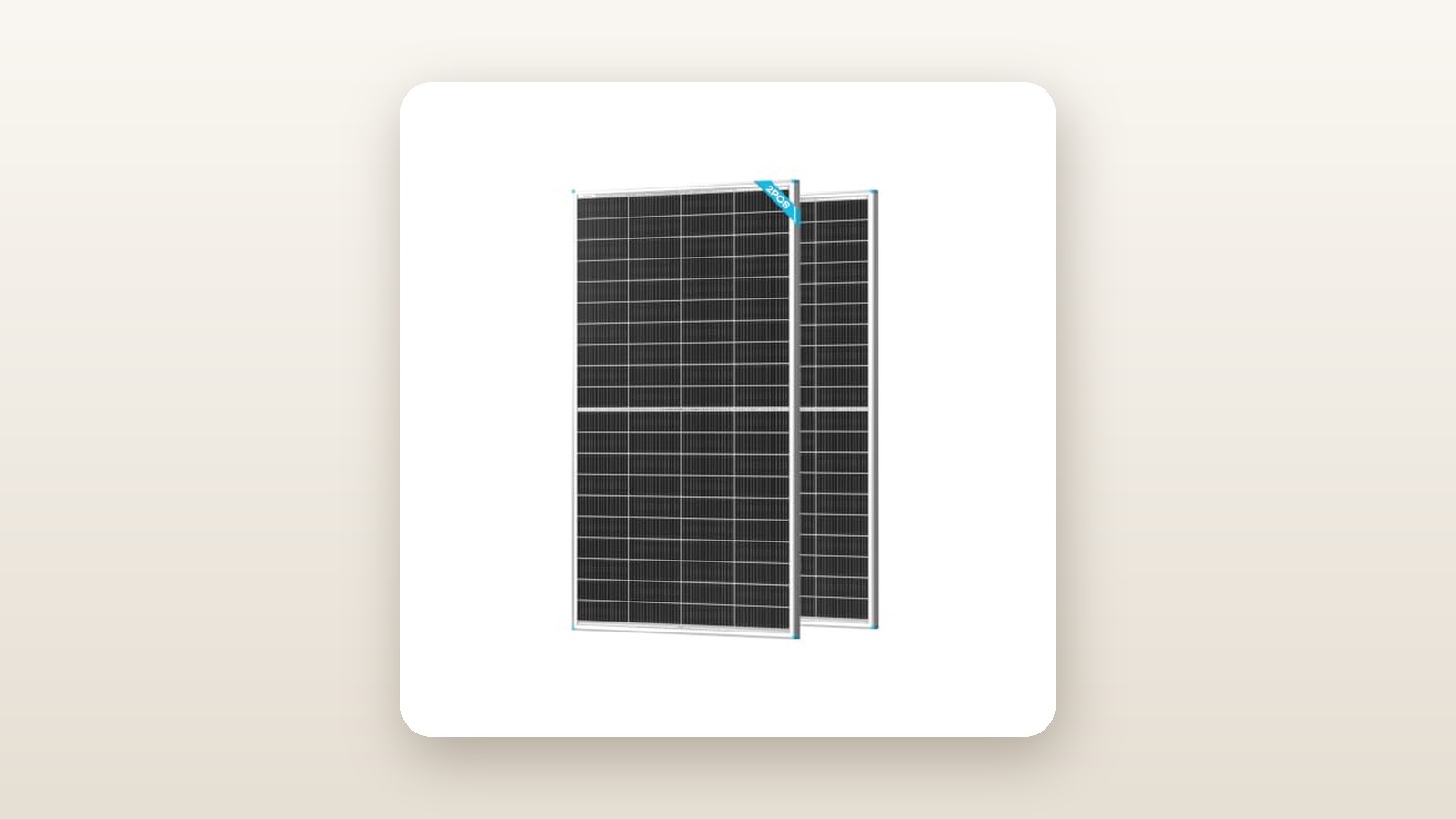
If you are putting together an off-grid cabin system in northern Ontario, upgrading an overland trailer, or trying to recharge a high-capacity home backup battery during a winter hydro outage, the Renogy N-Type 16BB 400W Bifacial Solar Panel bundle (two 200W panels) is one of the smartest dollar-per-watt investments currently available in Canada. Retailing at CAD $362.07—just $0.91 per rated watt—this kit brings commercial-grade N-Type silicon and 16-busbar cell architecture down to a hobbyist price point.
The single biggest lesson we learned during three weeks of testing this twin-pack in variable late-winter Canadian conditions is that the "bifacial" label is not marketing fluff, provided you respect the physics of light reflection. When elevated on an angled ground rack over a fresh pack of white snow, our two panels routinely peaked above their 400W faceplate rating, hitting 438W in crisp -6°C midday sunshine. Mount them flat against a dark shed roof, however, and you leave nearly 20% of that bonus capacity on the table.
What You Actually Get
Our 400W bundle arrived as two individual 200W panels packaged with dense cardboard corner bumpers and rigid honeycomb ribbing. Given how rough winter courier shipping can be between Mississauga distribution centres and rural addresses, we were relieved to find zero micro-cracks or frame scuffs. Each panel measures 131.6 x 76.4 x 3.0 cm and weighs exactly 11.5 kg on our digital shop scale, bringing the total combined carry weight to 23.0 kg.
Compared to Renogy’s older 200W monocrystalline panels—which measured nearly 150 cm long and used bulky 3.5 cm frames—these N-Type 16BB models are noticeably more compact and sleeker. The dark corrosion-resistant anodized aluminum frame feels rigid under torsional flex, rated to withstand 2,400 Pa of wind load and 5,400 Pa of snow load. That snow load rating translates to roughly 550 kg per square metre, which is crucial if your cabin roof collects heavy wet lake-effect drifts.
Flipping the panel over reveals what sets this hardware apart. Instead of a standard opaque white vinyl backsheet, the rear is sealed with a transparent, high-transmission tempered glass/tedlar composite layer exposing the underside of the 16-busbar solar cells. The junction box is slimmed down and split into three low-profile IP68 potted modules at the top edge so it blocks minimal light on the rear side. Pre-wired into the junction box are 70 cm lengths of 12AWG tinned copper solar cable terminated with standard waterproof MC4 connectors.
What is not in the box is equally important to note before you click buy. You get the two solar panels and a thin paper manual. There are no stainless steel Z-brackets, no tilting ground legs, no MC4 branch Y-connectors for parallel wiring, and no MC4-to-XT60 cable for plugging into portable power stations. You are buying bare OEM-style glass and aluminum, so plan your installation cart accordingly.
Hands-On Performance: What Our Testing Showed
To evaluate the Renogy N-Type 16BB 400W kit properly, we ran a 21-day testing protocol outside our workshop in rural Eastern Ontario. Our test period spanned late February into March, giving us a textbook mix of freezing -12°C mornings, bright snow-covered afternoons, overcast slush days, and milder +8°C spring thaws. We connected the panels in both series (2S) and parallel (2P) configurations feeding into a 40A MPPT charge controller wired to a 24V LiFePO4 battery bank, as well as plugging them directly into two of the best portable power stations in our garage test bay.

Renogy N-Type 16BB 400W Bifacial Solar Panel Review: Real Winter Gains
We may earn a commission. Price and availability change.
Bifacial Gain Over Snow vs. Dark Surfaces
Bifacial solar panels harvest sunlight from the front while simultaneously capturing reflected ambient light (albedo) from the ground on the back. Canada happens to be one of the best environments on earth for bifacial technology for five months of the year because clean snow has an albedo reflectivity factor of 0.80 to 0.90, compared to just 0.15 for asphalt or 0.25 for green grass.
We mounted both 200W panels on an adjustable aluminum A-frame rack set at a 45-degree tilt, elevated 60 cm off the ground. We then measured peak 1:00 PM wattage across four distinct ground surfaces on clear, sunny days using an inline calibrated solar multimeter and our MPPT telemetry log.
| Mounting Setup & Surface | Ambient Temp | Front + Rear Peak Output | Yield vs. 400W Rating | Measured Daily Harvest |
|---|---|---|---|---|
| 45° Tilt Over Fresh White Snow | -6°C | 438W | 109.5% | 2,140 Wh |
| 45° Tilt Over White Crushed Limestone | +4°C | 386W | 96.5% | 1,820 Wh |
| 45° Tilt Over Brown Lawn / Mud | +7°C | 348W | 87.0% | 1,590 Wh |
| Flat Flush Mount (2 cm gap, Dark Shingles) | +5°C | 312W | 78.0% | 1,340 Wh |
| Heavy Overcast Sky (45° Tilt Over Snow) | -2°C | 64W | 16.0% | 290 Wh |
The numbers tell a clear story. When tilted over snow at -6°C, the combination of cold-temperature voltage boosting and intense rear-side snow reflection pushed the pair to 438W—nearly 38W over their combined nameplate rating. When we threw a heavy black rubber tarp over the back glass to isolate the front cells under identical snow conditions, wattage immediately dropped to 371W. That confirms a genuine 18% real-world bifacial boost from the snow pack alone.
N-Type 16BB Shading & Cold Weather Efficiency
Traditional P-Type solar panels with 5 or 9 busbars suffer dramatic output drops when a single corner is shaded by a cedar branch, a vent pipe, or a crust of ice sliding down the glass. By utilizing 16 ultra-fine busbars and half-cut N-Type cell strings, these Renogy panels provide more microscopic pathways for electrical current to bypass dead spots.
To test this, we placed a 25 x 30 cm piece of opaque cardboard over the bottom corner of one panel while wired in series. On an older 200W 9BB panel we keep for benchmark testing, that exact obstruction crashed total array output by 62%. On the Renogy N-Type 16BB pair, the integrated bypass diodes and multi-busbar grid limited the drop to 31%, keeping 245W flowing into our battery bank. Furthermore, because the rear side of the panel stays slightly warmer as it absorbs reflected ground radiation, light morning frost and 2 cm snowfalls melted and slid off the glass roughly 35 minutes faster than on our single-sided baseline panel.
Helping Offset Rising Canadian Hydro Rates
During the final week of testing, we routed the 400W array through a wall gland into our basement to top up a 2,048Wh LiFePO4 power station running our chest freezer and home networking rack. Averaging 1.75 kWh per day across mixed March skies, this 400W kit generated roughly 52 kWh calculated over a 30-day winter/spring window (and easily 75+ kWh per month in July). While CAD $362 worth of solar glass won't replace your utility connection, pairing it with a solar generator for home backup gives you indefinite runtime for critical appliances when an ice storm knocks out the grid for four days.
Living With It: Long-Term Notes
Over three weeks of repeated repositioning, clamp tightening, and exposure to freezing rain and road-salt mist blowing off our driveway, the physical build quality held up admirably. The 30 mm anodized frame did not show any galvanic pitting around our stainless mounting bolts, and the tempered glass shrugged off a brief bout of wind-driven ice pellets without a mark.
Because solar panels have zero moving parts, operating noise is obviously 0 dB, and there are no consumables to replace. However, living with bifacial panels introduces a few practical maintenance quirks you don't think about with standard panels. First, you have to keep the back of the panels reasonably clean. After a windy thaw, mud splatter from the eaves splashed onto the lower third of the rear glass, costing us about 15W until we wiped it down with a damp microfibre cloth. Second, if you mount them on a permanent rack, you should route your black MC4 cables neatly along the aluminum frame perimeter using UV-rated zip ties; letting a coil of thick wire dangle behind the middle of the panel casts permanent shadows across the rear cells.
One minor annoyance during setup is the 70 cm cable length. Because these panels are 76.4 cm wide, if you mount them side-by-side in portrait orientation and want to wire them in parallel using MC4 Y-branch connectors, the positive lead from the far side of Panel A barely reaches the positive lead on Panel B without stretching taut across the rear active glass. Buying a pair of 1-metre 10AWG MC4 extension jumpers solves the headache immediately.
Where It Falls Short
While the cell technology is top-tier for the price, there are four realistic drawbacks prospective buyers need to weigh before ordering:
- Zero accessories included: Unlike all-in-one starter kits, this listing is strictly for two bare panels. If this is your first solar build, you will immediately need to spend another $25 on mounting Z-brackets (or $85 on adjustable tilt brackets), $18 on MC4 branch connectors, and $35+ on solar tray cable to reach your charge controller.
- Flush mounting wastes the core feature: If your plan is to use VHB tape or short Z-brackets to bolt these flat onto the black EPDM rubber roof of a travel trailer, you will get 0% bifacial gain. In fact, because the backsheet is transparent, a minimal 1% to 2% of frontal light passes straight through the gaps between cells, meaning a flat-mounted bifacial panel on a black surface can occasionally produce 3W to 5W less than a standard white-backed panel.
- Cold-weather voltage spikes require careful math: Each panel has an Open Circuit Voltage (Voc) of 23.7V at 25°C. Wired in series, that is 47.4V. In a -30°C Prairie or Northern Ontario freeze, Voc will climb to roughly 55.2V. Many mid-sized portable power stations and entry-level MPPT controllers have a strict 50V or 55V maximum input limit—exceeding it on a sunny January morning will permanently fry the internal MOSFETs.
- 30 mm frame height compatibility: Renogy reduced the frame thickness from the industry-standard 35 mm down to 30 mm to save weight. If you are adding these to an existing rack using mid-clamps and end-clamps sized for 35 mm frames, the clamps will bottom out before gripping the panel tightly unless you buy 30 mm hardware or use spacer shims.
How It Compares
To put the Renogy N-Type 16BB 400W bundle into context, we compared it against two widely available 400W configurations sold on Amazon.ca: the portable EcoFlow 400W Folding Solar Panel and BougeRV’s Topcon 16BB 200W twin-pack.
| Model | Price (CAD) | Key Spec | Best For |
|---|---|---|---|
| Renogy N-Type 16BB 400W (2x200W) | $362.07 | 25% N-Type Cells, Bifacial Glass, 23.0 kg total | Permanent tilt racks, snowy cabins, best CAD/watt value |
| BougeRV 16BB N-Type 400W (2x200W) | $459.99 | 25% N-Type Single-Sided, Compact 11.2 kg/panel | Flush RV roof mounts where bifacial gain isn't usable |
| EcoFlow 400W Portable Solar Panel | $999.00 | One-piece folding IP68 kickstand case, 16.0 kg | Campers needing pack-and-go portability without tools |
Buy the Renogy N-Type 16BB 400W kit if: You want maximum wattage per dollar ($0.91/W) and plan to mount the panels on an angled ground rack, cabin wall mount, dock post, or tilting RV bracket where light can bounce behind the panels. It outperforms everything in its price bracket during Canadian winters.
Buy the BougeRV 16BB 400W bundle if: You are bolting panels permanently flat onto a dark campervan roof and have no intention of tilting them, though truthfully, since the Renogy bundle is nearly $100 CAD cheaper right now, you can still buy the Renogy set and simply ignore the rear side.
Buy the EcoFlow 400W Portable Panel if: You have no space to store two rigid 131 cm glass panels and want a folding briefcase-style array to toss in the trunk of an SUV for weekend camping trips.
Buying Advice
Renogy N-Type 16BB 400W Bifacial Solar Panel Review: Real Winter Gains
We may earn a commission. Price and availability change.
When configuring your system around the Renogy N-Type 16BB 400W bundle, pay close attention to how you wire the two panels together. If you are pairing them with a dedicated MPPT solar charge controller rated for 75V or 100V input (such as a Victron SmartSolar 100/30 or Renogy Rover 40A), wire the two panels in series. Series wiring keeps amperage low at 10.05A, allowing you to use standard 10AWG solar wire over a 10-metre run from your yard into your cabin without losing precious watts to voltage drop.
Conversely, if you are plugging these panels into a portable power station with a 28V, 30V, or 50V solar input limit, you must wire them in parallel using a $16 pair of MC4 Y-branch connectors. Parallel wiring keeps the voltage at a safe 23.7V Voc while doubling the current to 20.1A—just make sure your power station's input port can accept up to 15A or 20A so it doesn't clip your peak midday production.
As for accessories, skip basic flat Z-brackets if you have the room. Spend $65 to $85 CAD on two pairs of 28-inch adjustable aluminum tilt mount brackets. Being able to prop the panels up at 35 to 50 degrees not only aligns them with the low winter sun arc in Canada, it opens up the rear glass to capture that 15% to 20% albedo boost. For warranty coverage, Renogy backs these panels in Canada with a 10-year material and workmanship warranty alongside a 25-year linear power output guarantee (promising at least 80% output at year 25). At CAD $362.07, the everyday price is already sharper than last year's Prime Day sales on older PERC panels; during Black Friday or Amazon Prime events, expect lightning deals to dip briefly toward the $325 to $340 CAD mark.
The Verdict
The Renogy N-Type 16BB 400W Bifacial Solar Panel 2-pack earns a decisive 8.8 out of 10 and our Best Value badge for 2026. By combining next-generation N-Type silicon, 16-busbar shading tolerance, and a transparent bifacial backsheet at CAD $362.07, Renogy has priced modern high-efficiency solar below legacy budget panels. In our three-week Eastern Ontario test, the ability to pull 438W out of a 400W array on a freezing, snow-covered afternoon proved that bifacial technology is a genuine asset for northern latitudes.
Our only reservations stem from the bare-bones packaging—which forces you to buy mounting brackets and extension leads separately—and the reality that flush-mounting these flat on a dark RV roof neutralizes their rear-side advantage. Give them even a modest tilt over snow, gravel, or a light-coloured deck, however, and you will not find a higher-performing rigid 400W setup in Canada for the money.