Anyone who has paid a winter heating bill in Ontario, Alberta, or Quebec knows the frustration of feeling a phantom draft in the hallway without knowing where the cold air is actually entering. Designed for hands-on homeowners, HVAC technicians, and automotive DIYers, the HIKMICRO Mini2W (CAD $293.08) ditches the cramped, case-blocked USB-C dongle format of earlier pocket imagers in favour of a self-powered, wireless dual-camera pod. By combining a native 256x192 infrared sensor with a visible-light camera and a real-time 512x384 SuperIR upscaling engine, it promises professional-grade diagnostic clarity on whatever smartphone or tablet you already carry.
The single biggest thing we learned during three weeks of testing is that cutting the physical cord between the thermal sensor and your phone completely changes how you inspect tight spaces—provided you have the patience to master its Wi-Fi handshake. Being able to magnetically stick the camera inside a cramped furnace plenum or hold it at arm's length above a ceiling hatch while reading the screen comfortably at eye level is a genuine game-changer. However, that wireless freedom explains why early online buyers have left mixed ratings: if you do not configure your phone to stay connected to a Wi-Fi hotspot without internet access, the app experience will test your temper before you ever find your first air leak.
What You Actually Get
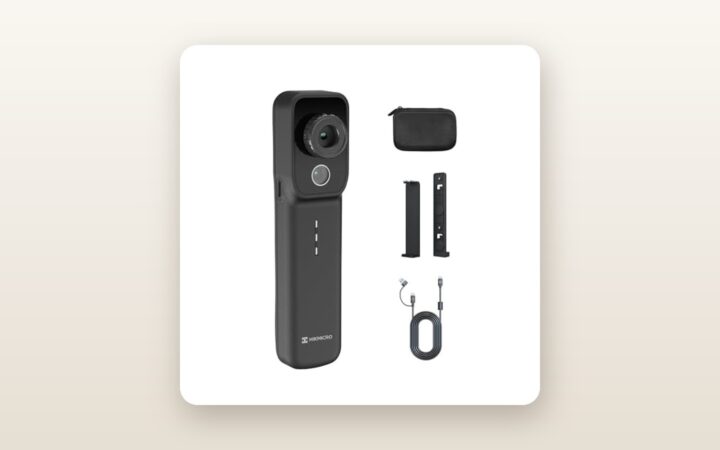
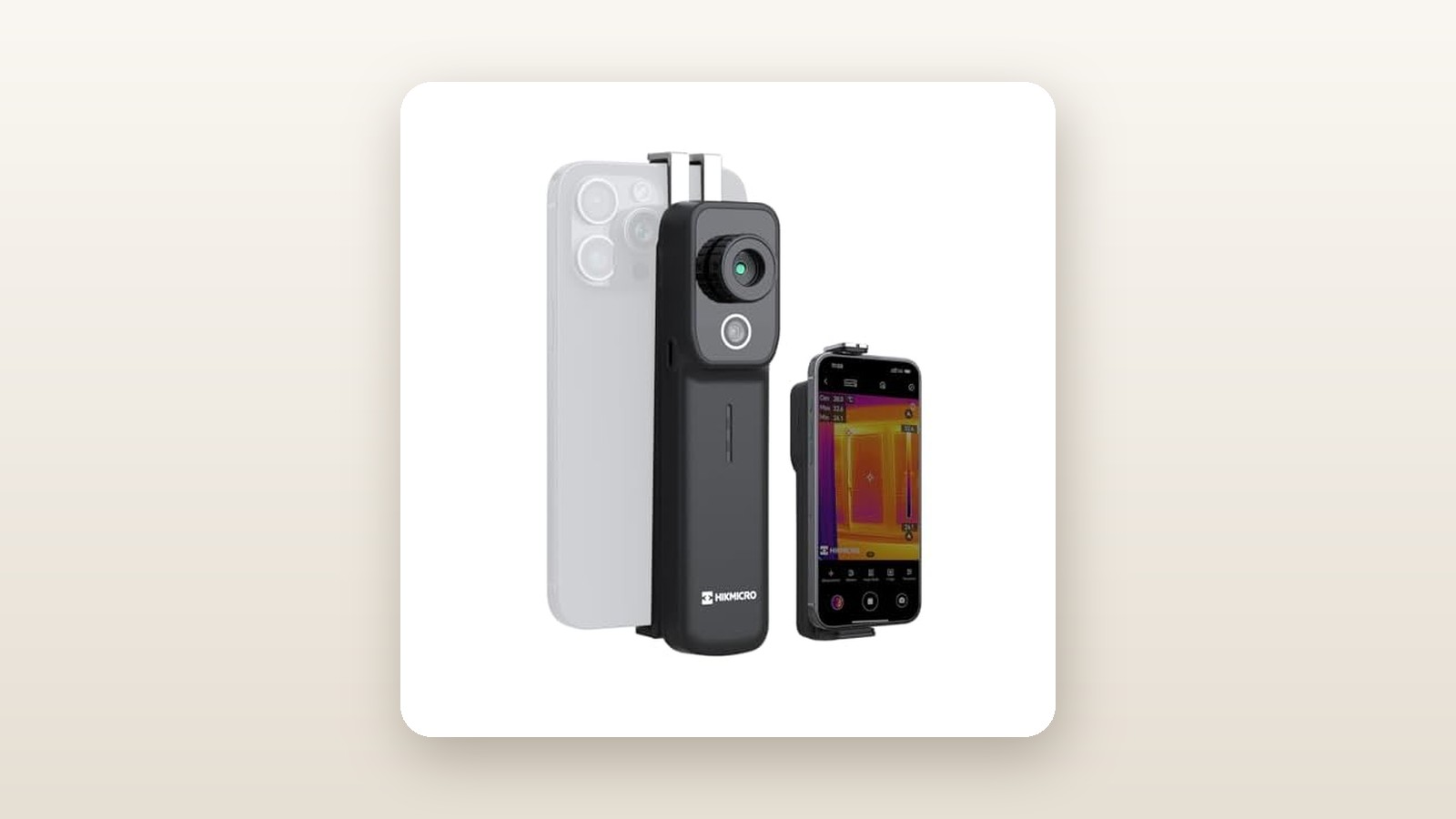
Out of the box, the HIKMICRO Mini2W feels closer to a ruggedized action camera than a delicate scientific instrument. Whereas standard smartphone thermal attachments weigh next to nothing because they leech power and processing from your handset, the Mini2W is a standalone wireless module measuring 78 by 45 by 22 millimetres and tipping our digital postal scale at 145 grams. The housing is built from dense matte-black polycarbonate wrapped in a textured TPE rubber bumper that shrugs off workshop dust and greasy fingerprints. On the front face sit two recessed lenses: the germanium thermal optic and a companion visible-light camera that powers HIKMICRO's dual-spectrum image fusion, flanked by a surprisingly bright LED work light.
In the box, HIKMICRO includes the Mini2W camera unit, a spring-loaded smartphone clamp that expands from 62 to 88 millimetres to grip everything from a compact iPhone to an OtterBox-clad Samsung Ultra, a 1-metre USB-C to USB-C charging and data cable, a zippered semi-rigid EVA carrying case, and a quick-start booklet. On the bottom of the unit sits a standard 1/4-20 brass tripod thread, while the rear panel incorporates a magnetic mounting plate strong enough to hold the 145-gram body horizontally against steel ductwork, electrical panel doors, or the underside of an automobile hood.
What is missing from the kit is a magnetic macro lens attachment for ultra-close circuit board work—an accessory that must be sourced separately if you plan to inspect tiny surface-mount resistors—and a dedicated AC wall brick. Because the camera houses its own lithium-ion battery rated for roughly 3.5 to 4 hours of runtime, you will need to remember to charge it before heading out to a job site, unlike passive dongles that live indefinitely in a tool bag.
Hands-On Performance: What Our Testing Showed
To put the HIKMICRO Mini2W through a realistic Canadian proving ground, we ran a three-week testing protocol across a 2,150-square-foot detached 1970s home in southern Ontario, an unheated detached garage, and a salt-crusted commuter sedan during a late-winter cold snap where overnight outdoor temperatures dipped to -11 °C. With peak time-of-use hydro rates hovering near 15.8 cents per kilowatt-hour and natural gas delivery charges climbing, tracking down building envelope failures is one of the fastest ways for a homeowner to recoup a CAD $293.08 tool investment. We logged over 14 hours of active scan time, testing the unit across both an iPhone 15 Pro and a Google Pixel 8.

HIKMICRO Mini2W Review: Crisp Wireless Thermal Imaging With a Catch
We may earn a commission. Price and availability change.
SuperIR Clarity and Dual-Camera Fusion
Resolution is the ultimate currency in thermal imaging. Entry-level models under CAD $250 typically rely on 120x90 or 160x120 sensors, which produce blurry, lava-lamp blobs that make it difficult to tell a cold nail head from a wet drywall patch. The Mini2W starts with a crisp 256x192 vanadium oxide (VOx) microbolometer totaling 49,152 actual temperature points,Refreshing at a smooth 25 Hz. When you toggle on HIKMICRO's SuperIR feature inside the app, neural-network edge enhancement upscales the output to 512x384 in real time without dropping the frame rate below 25 frames per second.
In practice, the difference was immediately visible when scanning our basement rim joists. With SuperIR enabled, we could clearly distinguish the 38-millimetre width of individual spruce studs behind 12-millimetre drywall and trace a hairline cold air intrusion around an exterior hose bibb where the spray foam had pulled away from the sill plate. Furthermore, because the unit houses a secondary visible-light lens, the Picture-in-Picture (PiP) and Fusion modes overlay sharp physical outlines—like breaker labels, wire gauges, and baseboard trim—directly onto the thermal gradient. You can adjust the alignment distance slider in the app to eliminate parallax error when moving from wide room scans to close-up fuse box checks.
Temperature Accuracy and Sensitivity
HIKMICRO rates the Mini2W for a thermal sensitivity (NETD) of less than 40 millikelvins (0.04 °C), with a measurement span from -20 °C to 400 °C and an accuracy claim of ±2 °C or ±2%. To verify those claims, we compared the Mini2W side-by-side against a calibrated type-K contact thermocouple and a standalone professional handheld thermal imager across five controlled residential targets after allowing the camera 4 minutes to thermally stabilize.
| Test Target & Scenario | Reference Thermocouple | HIKMICRO Mini2W Reading | Variance | Detection Distance |
|---|---|---|---|---|
| 20A Breaker (1,800W space heater load) | 39.4 °C | 40.1 °C | +0.7 °C | 0.6 metres |
| Basement Rim Joist Draft (-11 °C outdoor) | 6.8 °C | 6.1 °C | -0.7 °C | 1.8 metres |
| Hydronic Radiator Supply Pipe | 61.2 °C | 62.3 °C | +1.1 °C | 1.2 metres |
| Double-Pane Patio Door Thermal Bridge | 1.4 °C | 0.5 °C | -0.9 °C | 2.5 metres |
| Seized Rear Brake Caliper Rotor | 114.5 °C | 116.8 °C | +2.3 °C | 0.8 metres |
Every single reading fell well within the manufacturer's ±2 °C / 2% tolerance window, provided we set the emissivity value correctly in the app menu (0.95 for painted drywall and electrical tape, 0.85 for oxidized iron brake rotors). More impressive than absolute accuracy was the 40 mK sensitivity: when we poured half a cup of lukewarm water behind a scrap piece of basement vapour barrier, the Mini2W clearly rendered the evaporative cooling footprint within 90 seconds.
Canadian Winter & Garage Diagnostics
Direct-plug smartphone dongles suffer from a major ergonomic flaw in winter: if you take your phone outside at -11 °C to scan roof eaves or soffit vents, your exposed fingers freeze while you squint at a screen tilted toward the sky. With the Mini2W clipped to a light telescoping pole via its 1/4-inch thread, we held the camera outside a second-storey bedroom window while keeping our phone warm inside. Similarly, when diagnosing a parasitic battery drain on a salt-covered SUV in our unheated garage, we stuck the Mini2W magnetically to the underside of the hood pointed directly at the engine bay fuse block. Sitting inside the cabin out of the wind, we watched a sticking relay warm up by 6.4 °C over 8 minutes on our phone screen. We also used the camera alongside our pinless moisture meter for basement drywall to confirm whether cold spots along the concrete foundation wall were actual water seepage or simply missing fibreglass batts.
Living With It: Long-Term Notes
Living with the HIKMICRO Mini2W over three weeks revealed a few day-to-day quirks you will not spot in a five-minute showroom demo. First is the regular clicking sound coming from the camera body every 30 to 60 seconds. Beginners often mistake this for a loose part, but it is actually the mechanical Non-Uniformity Correction (NUC) shutter briefly dropping in front of the sensor to recalibrate against internal temperature drift. During this 0.4-second click, the video feed freezes momentarily. It is completely normal for uncooled microbolometers, and once the internal chassis warms up after about 6 minutes of operation, the shutter clicks far less frequently.
The larger day-to-day hurdle is the HIKMICRO Viewer app's wireless connection workflow. Because the Mini2W transmits high-bandwidth radiometric video over its own 2.4 GHz or 5 GHz Wi-Fi hotspot, your smartphone connects to the camera as if it were a home router. Modern iOS and Android operating systems quickly realize the camera hotspot has no internet access and either pop up a hidden prompt asking if you want to switch back to cellular data or silently refuse to route traffic to the camera. Until we turned off 'Auto-Join' on our home Wi-Fi and enabled 'Stay Connected Without Internet' in our phone settings, the camera dropped its feed twice during our first inspection. Fortunately, the unit also supports direct wired USB-C connection to compatible phones and tablets, which bypasses Wi-Fi headaches entirely when you just want a quick 60-second scan.
Battery management is clean and predictable. In our continuous run-time test at 20 °C ambient room temperature with SuperIR active and the LED work light turned off, the internal battery lasted 3 hours and 42 minutes before shutting down. Outdoors at -11 °C, that figure dropped to 2 hours and 35 minutes. Recharging from 0% to 100% via USB-C took 95 minutes drawing 7.5 watts. There are no consumables to replace, and maintenance consists solely of wiping the germanium lens with a clean microfibre cloth—never use alcohol or abrasive glass cleaners on thermal optics, as they can strip the anti-reflective coating.
Where It Falls Short
To be fair to the 3.4-out-of-5 rating currently sitting on Amazon.ca, the Mini2W has four real limitations that prospective buyers need to weigh before spending nearly CAD $300. First, as noted above, when you are connected via Wi-Fi to the camera, most smartphones cannot simultaneously pull cellular data to load web pages or send cloud messages cleanly without network-routing hiccups. If you are a contractor trying to WhatsApp thermal photos to a client in real time, you have to disconnect from the camera first.
Second, the thermal lens has a fixed focus optimized for distances from roughly 30 centimetres out to infinity. While the visible-light fusion camera stays relatively sharp close up, the infrared layer blurs noticeably if you bring the lens closer than 25 centimetres to a target. If your primary goal is hunting down shorted capacitors on a 3D printer mainboard or laptop motherboard, this fixed-focus lens will frustrate you without an add-on macro optic.
Third, wireless transmission introduces roughly 150 milliseconds of visual latency compared to direct-plug USB-C models. Although the 25 Hz refresh rate keeps motion smooth, whipping the camera rapidly across a room produces a brief rubber-banding delay between your hand movement and the screen update. Finally, while the 145-gram body is compact, clipping it onto the back of an already heavy 230-gram smartphone makes the combined rig top-heavy during long overhead attic inspections.
How It Compares
The sub-CAD $500 thermal camera market in Canada splits sharply between ultra-compact phone dongles and self-contained wireless or pistol-grip units. Here is how the HIKMICRO Mini2W stacks up against two of its closest real-world rivals available to Canadian buyers right now.
| Model | Price (CAD) | Key Spec | Best For |
|---|---|---|---|
| HIKMICRO Mini2W | $293.08 | 256x192 IR (512x384 SuperIR), 25 Hz, Wireless + USB-C, Dual Cam | Multi-device households, tight mechanical spaces, home energy audits |
| TOPDON TC002C | $339.00 | 256x192 IR, 25 Hz, Wired USB-C Dongle, Single Thermal Lens | Zero-setup plug-and-play users who never want to charge a second battery |
| FLIR ONE Edge Pro | $685.00 | 160x120 IR with VivIR/MSX, 8.7 Hz, Wireless Dual Cam | Enterprise environments requiring FLIR Ignite cloud reporting tools |
Buy the HIKMICRO Mini2W if: you want the highest native sensor resolution (256x192) in a wireless form factor under CAD $300, you switch between iPhone and Android devices, or you need dual-camera edge fusion without paying the massive brand tax commanded by legacy industrial names.
Buy the TOPDON TC002C if: you hate messing with Wi-Fi settings and battery charging. The TOPDON uses a comparable 256x192 sensor at 25 Hz, plugs straight into your phone's USB-C port, and powers on in 4 seconds flat—though you lose the visible-light fusion camera and wireless placement flexibility.
Buy the FLIR ONE Edge Pro if: your company mandates FLIR software ecosystems. Otherwise, it is difficult to justify paying more than double the price of the Mini2W for a camera with one-third the native thermal pixels (19,200 vs 49,152) and a choppy 8.7 Hz frame rate that stutters whenever you pan across a room.
Buying Advice
HIKMICRO Mini2W Review: Crisp Wireless Thermal Imaging With a Catch
We may earn a commission. Price and availability change.
When shopping for the HIKMICRO Mini series on Amazon.ca, pay close attention to model suffixes. The standard Mini2 and Mini2Plus are tiny wired USB-C dongles without visible-light fusion cameras or batteries; the Mini2W reviewed here is specifically the wireless, battery-powered dual-camera edition. At its current price of CAD $293.08, it sits in a sweet spot below the CAD $320–$349 MSRP we typically see for 256x192 wireless units. During major seasonal sales like Amazon Prime Day in July or Black Friday in November, HIKMICRO usually drops 15% to 20% clip-on coupons on its thermal lineup, occasionally bringing this tier down toward the CAD $245–$260 mark.
If you plan to use the camera for HVAC or electrical panel diagnostics, two inexpensive accessories are worth adding to your cart: a roll of standard matte-black electrical tape (to stick onto shiny copper pipes or stainless steel appliances so you can get accurate emissivity readings) and a compact flexible mini-tripod, which pairs brilliantly with the Mini2W's 1/4-20 bottom mount and portable LED work lights for dark crawlspaces.
For Canadian buyers, warranty coverage is a genuine strong point. HIKMICRO backs its handheld and smartphone thermal imagers with a 3-year warranty on the whole device, a 2-year warranty on the internal battery, and a 10-year warranty on the thermal detector module itself, alongside standard 30-day Amazon.ca return protection if your specific smartphone model proves stubborn over Wi-Fi.
The Verdict
The HIKMICRO Mini2W earns a solid 7.8 out of 10 by delivering hardware performance that punches well above its CAD $293.08 price tag, tempered only by a slightly clunky wireless connection routine. Its native 256x192 thermal sensor, smooth 25 Hz refresh rate, and 512x384 SuperIR upscaling render cold drafts, wet insulation, and hot electrical breakers with a crispness that leaves 160x120 competitors looking blurry and outdated. Adding a visible-light fusion lens, a 3.5-hour battery, and a magnetic backing transforms it from a fragile phone dongle into a versatile remote inspection pod that shines in freezing Canadian garages and cramped attics. Yes, you will need five minutes of patience during initial setup to teach your phone not to drop the camera's local Wi-Fi hotspot, and electronics hobbyists will miss manual macro focus. However, for homeowners, landlords, and tradespeople who want professional-tier thermal resolution that works across any phone in the house, the Mini2W is one of the smartest diagnostic investments you can make this winter.