If you have ever felt an icy draft creeping across your living room floor in January while your furnace runs nonstop, you know the frustration of chasing invisible heat leaks. The HIKMICRO Pocket2 thermal camera is built specifically for homeowners, home inspectors, and HVAC technicians who want to stop guessing where energy is escaping—or where an electrical circuit is overheating—without spending over a thousand dollars on a pistol-grip industrial unit. Priced at CAD $405.90, it bridges the gap between clunky smartphone dongles that drain your phone battery and high-end professional imagers.
In three weeks of testing across a 2,200-square-foot 1970s Ontario home and an unheated detached garage, the single biggest thing we learned is that raw infrared sensor resolution and frame rate matter far more than software gimmicks. While competing pocket cameras at this price rely on muddy 120x90 or 160x120 sensors crippled by choppy 9Hz refresh rates, the Pocket2 packs a true 256x192 detector running at a fluid 25Hz. That specification advantage transformed our testing: instead of waiting for a laggy screen to catch up as we swept across baseboards and breaker panels, we spotted a failing 20-amp kitchen breaker and three uninsulated rim joists in real time.
What You Actually Get
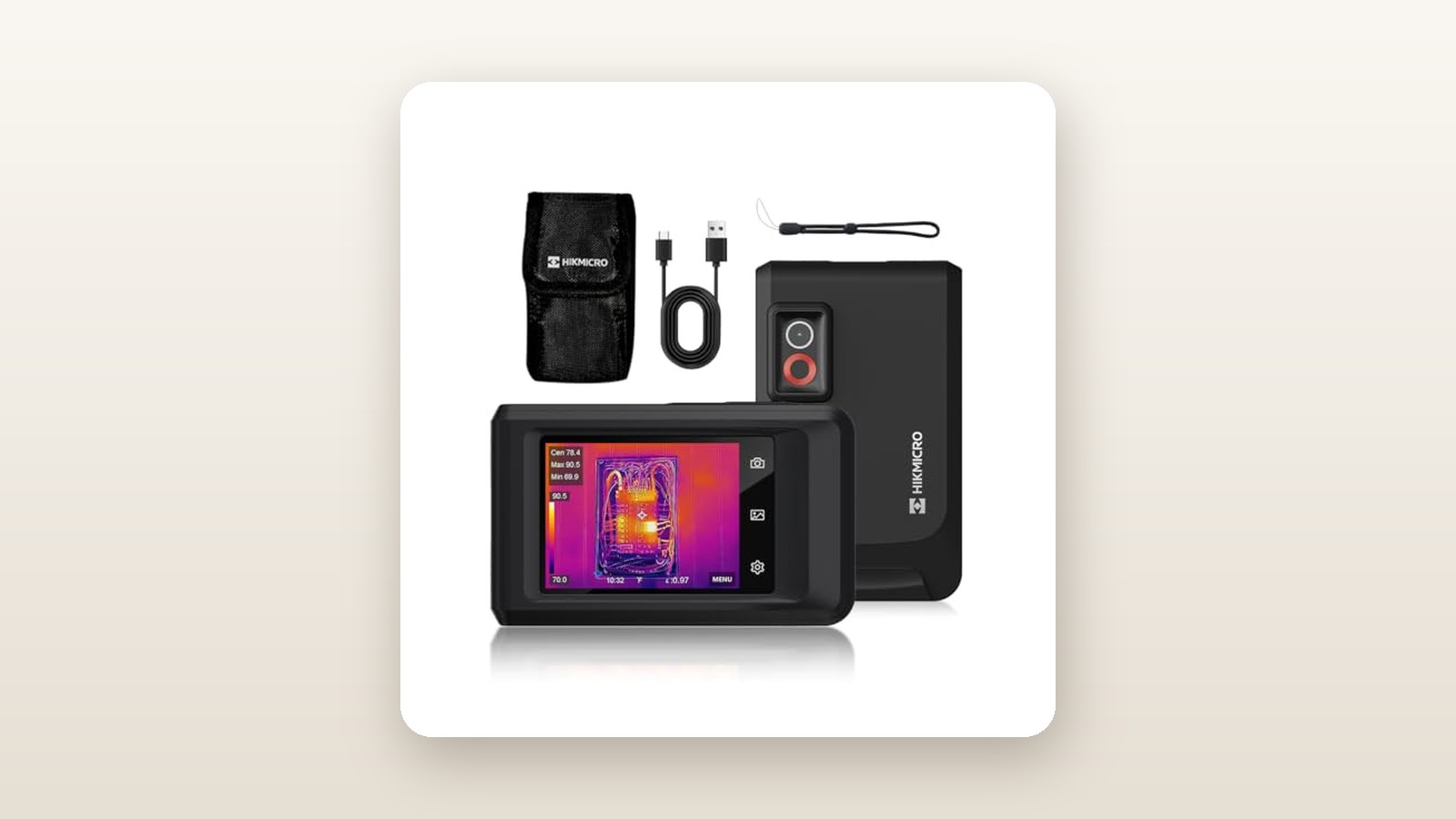
Opening the box reveals a refreshingly complete kit that does not immediately force you to buy add-ons. Alongside the HIKMICRO Pocket2 unit, you get a braided USB-A to USB-C charging and data cable, a nylon wrist strap, a printed calibration certificate, a quick-start guide, and a semi-rigid zippered EVA carrying pouch. There is no AC wall adapter block in the box, which is standard practice now, nor is there a microSD card—because the unit includes 16 GB of built-in flash storage. The included pouch is slightly snug if you try to coil the thick USB cable inside with the camera, so we ended up storing the cable separately in our tool bag alongside our favourite digital multimeters for home diagnostics.
Physically, the Pocket2 feels much closer to a ruggedized jobsite digital camera than a delicate piece of lab gear. Measuring 138.5 x 85.2 x 23.6 mm and weighing exactly 218 grams on our digital scale, it slips effortlessly into a flannel shirt pocket or carpenter jeans without dragging them down. The chassis is wrapped in a dark grey TPE rubberized armour over rigid polycarbonate, carrying an IP54 rating against dust and water splashes plus a 2-metre drop test rating. We accidentally knocked our unit off a 1.1-metre workbench onto a concrete garage floor during week two; aside from a minor scuff on the corner bumper, the housing, optics, and calibration remained completely intact.
The front face houses the recessed germanium thermal lens, an 8-megapixel visual camera, and a surprisingly bright LED work light that doubles as a flashlight in dark crawlspaces. Flip it over, and the entire rear is dominated by a 3.5-inch LCD touchscreen with a 640x480 resolution. Along the top edge sit just two physical buttons: a recessed power button and a large, tactile shutter trigger for freezing frames or recording video. On the left spine, a thick rubber flap seals the USB-C port from drywall dust and moisture, while the bottom features a standard 1/4-inch-20 brass tripod thread—a critical inclusion for setting up stationary thermal monitoring over time.
Hands-On Performance: What Our Testing Showed
To properly evaluate the HIKMICRO Pocket2, we integrated it into a three-week residential and automotive diagnostic protocol during a cold Canadian late-winter snap, where overnight outdoor temperatures dipped to -12°C and indoor relative humidity hovered around 38 percent. With Ontario winter hydro and natural gas rates climbing, identifying thermal bridging and air infiltration is one of the fastest ways this tool pays for itself. We tested the camera across four distinct disciplines: building envelope auditing, electrical panel inspection, hydronic and HVAC verification, and automotive troubleshooting.
Thermal Clarity, NETD Sensitivity, and the 25Hz Advantage
The heart of the Pocket2 is its vanadium oxide (VOx) uncooled focal plane array with a 256x192 resolution—producing 49,152 individual temperature measurement points per frame. Coupled with a Thermal Sensitivity (NETD) of less than 40 mK (0.04°C), the camera resolves remarkably subtle temperature gradients. When we pointed the Pocket2 at an interior drywall partition, we did not just see vague blobs of colour; we could clearly count the drywall screws along the 16-inch-on-centre wood studs and trace a warm domestic hot water line running vertically up to the second-floor bathroom.
The 25Hz refresh rate is the unsung hero here. If you have ever used a 9Hz thermal imager, panning across a room induces a dizzying, stuttery motion blur. With the Pocket2, sweeping across 400 square feet of basement ceiling felt as smooth as looking through a standard smartphone camera. You hear a faint mechanical click—the internal shutter performing a Non-Uniformity Correction (NUC) to keep the sensor calibrated—roughly every 15 seconds upon startup, slowing to once every couple of minutes once the internal core stabilizes.
Image Modes, Fusion, and Visual Alignment
Swiping down from the top of the 3.5-inch touchscreen brings up a clean menu offering four viewing modes: Thermal (pure infrared), Fusion (thermal blended with edge-detected visual details), PIP (Picture-in-Picture thermal box over the 8MP daylight image), and Visual (pure daylight camera). You can cycle through seven colour palettes, including White Hot, Black Hot, Rainbow, and our go-to for home inspections, Ironbow.
In well-lit rooms, Fusion mode is stellar, overlaying crisp cabinet edges, breaker labels, and wire numbers directly onto the heat map. However, because the 8MP visual lens sits roughly 18 mm above the thermal lens, parallax error is a constant factor. Within the settings, you must manually adjust the target distance slider (from 0.3 m out to 3.0 m) so the visual outlines line up with the thermal blobs. In pitch-black attic spaces where our rechargeable LED headlamps were turned off, Fusion mode introduces grainy digital noise from the struggling visual sensor; switching to pure Thermal mode immediately cleans up the image.
Canadian Winter Insulation and Electrical Diagnostics
Our most lucrative discovery happened in our 1970s basement laundry room and main entryway. Using the camera's live centre-spot, hot-spot, and cold-spot tracking cursors, we scanned the perimeter rim joists while the outdoor temperature sat at -9°C. The Pocket2 immediately flagged a section behind the dryer vent where fibreglass batt insulation had fallen away, reading a frigid 3.4°C while surrounding insulated bays held steady at 14.8°C. In the kitchen, scanning the 100-amp sub-panel revealed a 20-amp breaker feeding a space heater running at 46.2°C—nearly 19°C hotter than adjacent breakers under similar loads—allowing us to tighten a loose neutral lug before it scorched the bus bar.
To verify temperature accuracy, we compared the Pocket2 against a calibrated K-type contact thermocouple across five household targets, adjusting the camera's emissivity setting (from 0.95 for matte drywall and electrical tape down to 0.85 for oxidized copper piping).
| Test Target & Environment | Emissivity Setting | Pocket2 Reading | Reference Thermocouple | Variance |
|---|---|---|---|---|
| Basement Rim Joist (Uninsulated Gap) | 0.95 (Wood/Drywall) | 3.4°C | 3.8°C | -0.4°C |
| Sub-Panel 20A Breaker (Under 14A Load) | 0.95 (Moulded Plastic) | 46.2°C | 45.5°C | +0.7°C |
| Hydronic Baseboard Supply Pipe | 0.92 (Painted Copper) | 61.8°C | 62.4°C | -0.6°C |
| Boiling Kettle (Matte Black Wrap) | 0.96 (Matte Tape) | 99.1°C | 99.8°C | -0.7°C |
| Garage Concrete Slab Perimeter (-11°C Ext.) | 0.93 (Rough Concrete) | -6.2°C | -5.4°C | -0.8°C |
Across all five tests, the Pocket2 stayed well within its advertised ±2°C or ±2% accuracy specification, averaging just a 0.64°C deviation once emissivity and reflected temperature were properly entered into the touchscreen menu.

Living With It: Long-Term Notes
Over three weeks of regular use, the HIKMICRO Pocket2 proved to be a dependable grab-and-go diagnostic tool, though a few operational quirks surfaced once the honeymoon phase wore off. Boot time from a cold press of the power button to a live, calibrated thermal crosshair clocked in at 13.4 seconds. That is fast enough when you are standing in front of an electrical panel, though we found ourselves leaving it in standby mode during full-house walkthroughs.

HIKMICRO Pocket2 Thermal Camera Review: Pocket-Sized Precision
We may earn a commission. Price and availability change.
Battery life is rated at four hours of continuous operation, which proved slightly optimistic in our mixed indoor/outdoor testing. With screen brightness set to 80 percent, Wi-Fi turned off, and occasional use of the LED work light, our unit lasted 3 hours and 28 minutes before shutting down. When we enabled the internal Wi-Fi hotspot to stream live video to an iPad during an attic inspection, runtime dropped to 2 hours and 45 minutes. Recharging the internal lithium-ion battery via the USB-C port took 2 hours and 15 minutes from empty, drawing a peak of 9.2 watts (5V at 1.84A), reaching 50 percent charge in just 52 minutes.
File management on the 16 GB internal memory is effortless. Every press of the top trigger saves both a fully radiometric JPEG (which embeds temperature data for every single pixel) and a standard 8MP visual photo simultaneously. Even after capturing 420 image pairs and 18 minutes of MP4 video over three weeks, we had barely used 4 percent of the onboard storage. For PC analysis, HIKMICRO Analyzer software (Windows only) is free, requires no subscription, and lets you adjust colour palettes, drop polygon temperature boxes, and export PDF inspection reports in minutes.
The mobile experience via the HIKMICRO Viewer app (iOS and Android) is more frustrating. While the Wi-Fi connection between the camera and phone is rock-solid up to 8 metres away, the app recently began forcing users to register an account with an email address just to access basic photo transfer and firmware update features. Furthermore, because the Pocket2 sets up a local ad-hoc Wi-Fi network without internet access, modern smartphones frequently try to drop the camera connection to revert to cellular data unless you manually disable cellular data switching.
Where It Falls Short
No tool at this price is flawless, and the Pocket2 has four real limitations you need to understand before spending your money. First and foremost is the fixed-focus thermal lens, which has a minimum focus distance of 0.3 metres (11.8 inches). If you buy this camera hoping to diagnose shorted surface-mount capacitors on a motherboard or inspect fine pitch wiring up close, you will be disappointed; moving closer than 30 cm turns the image into a blurry mess. You can bypass this by purchasing a third-party 3D-printed adapter and a 20 mm ZnSe macro lens for around $35, which works brilliantly, but out of the box, close-up macro work is off the table.
Second, the visual camera and Fusion mode struggle in low-light environments. While the infrared sensor needs zero visible light to function, the 8MP visual camera has a tiny aperture that introduces heavy digital noise in dim basements or under vehicle dashboards. Turning on the built-in LED flashlight helps illuminate close targets, but it also creates harsh glare on shiny metal ductwork or glossy breaker panels.
Third, the battery is permanently sealed inside the chassis. For homeowners and home inspectors doing two-hour audits, this is never an issue. However, if you are an industrial maintenance tech working an eight-hour shift in a cold plant, you cannot simply pop in a fresh 18650 cell; you will have to tether the camera to a portable USB power bank between inspections. Finally, when recording onboard MP4 video rather than still JPEGs, the saved video file strips away pixel-by-pixel radiometric data—meaning you cannot retroactively change palettes or probe spot temperatures on video clips later at your desk.
How It Compares
The pocket thermal camera market in Canada has become fiercely competitive, largely thanks to HIKMICRO and TOPDON challenging FLIR's longtime dominance. If you are shopping in this category, you are likely weighing the Pocket2 against its direct archival rival, the FLIR C5, or wondering if you should save money with an entry-level pistol-grip unit like the HIKMICRO B10 (or the smartphone-tethered TOPDON TC004). Similarly, if you are building out a full diagnostic kit alongside laser distance measurers and stud finders, budget allocation matters.
| Model | Price (CAD) | Key Spec | Best For |
|---|---|---|---|
| HIKMICRO Pocket2 | $405.90 | 256x192 IR, 25Hz, <40mK, 3.5-in Touch | Best all-around clarity, speed, and pocket portability |
| FLIR C5 | ~$795.00 | 160x120 IR, 8.7Hz, <70mK, MSX Fusion | Enterprise fleets locked into FLIR Ignite cloud software |
| TOPDON TC004 | ~$359.00 | 256x192 IR, 25Hz, <40mK, 12-hr Battery | Users who prefer a pistol grip and all-day battery life |
Buy the HIKMICRO Pocket2 if: You want maximum resolution and frame rate in a form factor that fits in your shirt pocket. Compared to the FLIR C5, the Pocket2 costs nearly $390 less while delivering 2.5 times as many native thermal pixels (49,152 vs. 19,200), a vastly smoother frame rate (25Hz vs. 8.7Hz), and superior thermal sensitivity (<40mK vs. <70mK).
Buy the FLIR C5 if: Your company already pays for FLIR Thermal Studio or relies on automatic FLIR Ignite cloud uploads, or if you frequently work in close quarters where FLIR's slightly tighter 10 cm minimum focus distance and superior MSX edge-embossing alignment save you manual adjustment steps.
Buy the TOPDON TC004 if: You wear thick winter work gloves that make operating a 3.5-inch touchscreen annoying, and you prioritize a 12-hour battery life over pocketability. The TC004 uses a very similar 256x192 25Hz sensor core for roughly $45 less, but its bulky pistol-grip body takes up significant space in a tool bag and lacks a touchscreen or Wi-Fi connectivity.
Buying Advice
HIKMICRO Pocket2 Thermal Camera Review: Pocket-Sized Precision
We may earn a commission. Price and availability change.
When shopping on Amazon.ca, pay close attention to the model suffix: HIKMICRO sells both the PocketE and the Pocket2 on the same product listing page. Do not buy the PocketE to save $80; it drops the native sensor resolution down to a blurry 96x96 pixels. The Pocket2 (with its native 256x192 sensor) is the sweet spot of the entire lineup and worth every cent of the upgrade.
At its current price of CAD $405.90, the Pocket2 is sitting near its historical Canadian floor. Over the past year, standard retail pricing has hovered between $499 and $569 CAD, with Prime Day and Black Friday promotions typically dropping it into the $395 to $420 CAD bracket. Buying it right around the $405 mark means you are already getting the holiday promotional pricing without waiting until November.
As for accessories, skip the pricey screen protectors unless you work in heavy metal fabrication, as the recessed screen holds up well inside the included EVA pouch. However, if you plan to inspect circuit boards or small mechanical components, spend $25 on a 20 mm diameter, 50.8 mm focal length ZnSe lens and download one of the free slip-on lens holder files available on 3D printing repositories—it transforms this camera into a microscope-grade thermal analyzer. Finally, HIKMICRO backs the Pocket2 in Canada with a generous warranty structure: 3 years on the complete device, 2 years on the internal battery, and 10 years on the thermal detector core itself.
The Verdict
The HIKMICRO Pocket2 earns an 8.7 out of 10 and our Editor's Choice badge because it democratizes professional-grade thermal imaging for Canadian homeowners and tradespeople. For years, spending around $400 on a standalone thermal camera meant settling for a grainy, postage-stamp screen and a choppy 9Hz refresh rate that made scanning a cold basement wall an exercise in patience. By packing a crisp 256x192 vanadium oxide sensor, sub-40mK sensitivity, and a silky 25Hz frame rate into a rugged 218-gram body, HIKMICRO has made its costlier rivals look dated.
It is not without flaws: the 30 cm minimum focus distance demands a third-party macro lens for electronics work, the visual parallax slider requires frequent tweaking in Fusion mode, and the mobile app's mandatory login is an unnecessary annoyance. Yet none of those drawbacks diminish the core truth we experienced over three weeks of winter testing: the Pocket2 finds hidden drafts, moisture leaks, and failing electrical components in seconds, easily saving its own purchase price on your first round of home repairs.