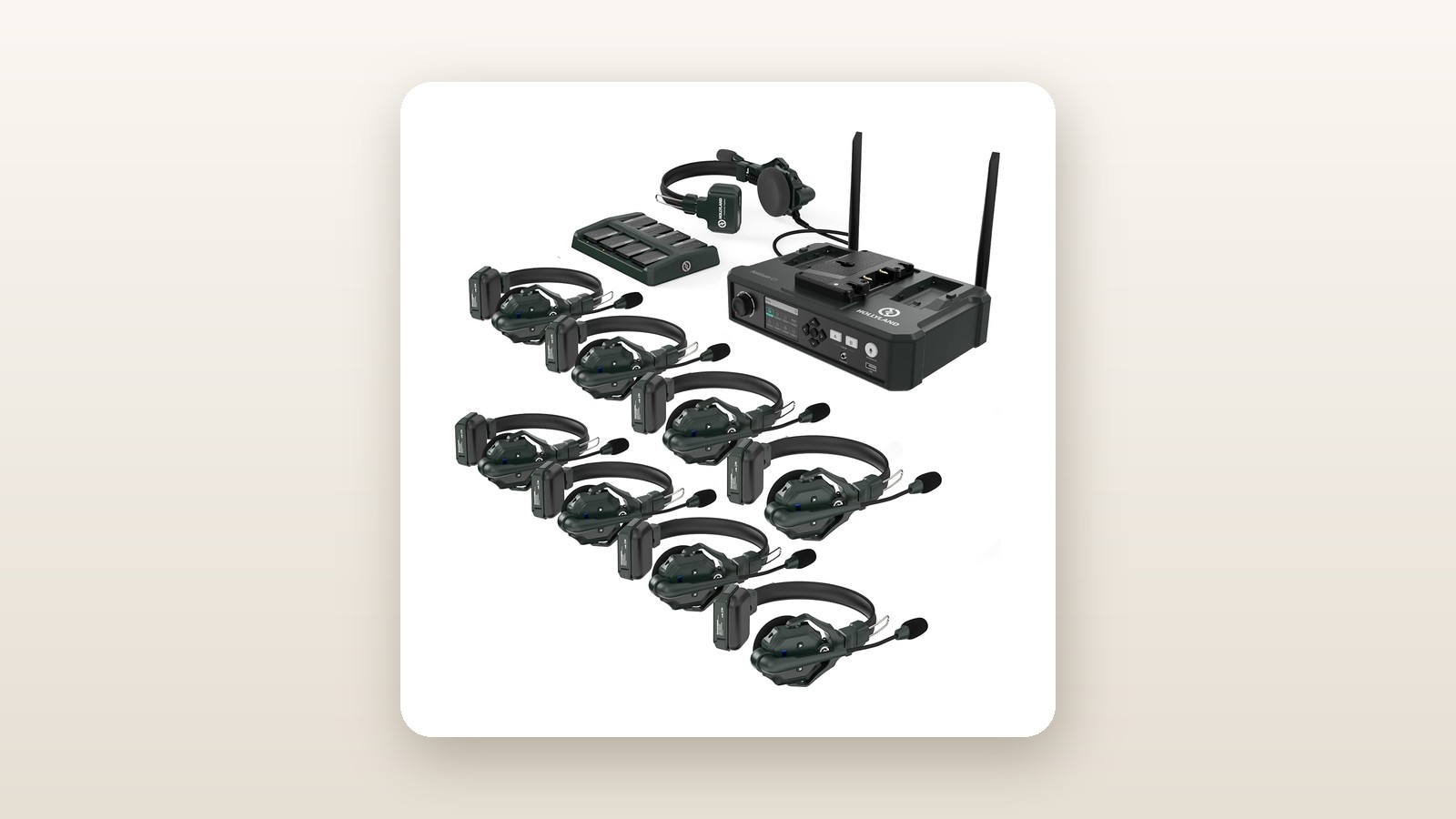
If you have ever tried to coordinate a nine-person production crew, community event team, or sprawling multi-building property renovation using consumer walkie-talkies, you already know the misery of clipped sentences and stepped-on channels. The Hollyland Solidcom C1 9-Person Wireless Intercom System (ASIN B0B49ZPHJD) is built for technical directors, live broadcast crews, house-of-worship teams, and high-end site managers who need full-duplex, hands-free conversation where everyone can speak and listen simultaneously. At CAD $7,088.13, it sits firmly in commercial territory, bypassing hobbyist users entirely.
The single biggest thing we learned during three weeks of testing our unit across a multi-level suburban property and a concrete-walled community hall in Ontario is that the included Hub base station completely transforms how the headsets behave. Unlike smaller Solidcom kits where one headset acts as the master—meaning everyone loses connection if the master walks into an elevator or out to the parking lot—this 9-person Hub architecture anchors the 1.9 GHz DECT bubble in a central spot, adds A/B group splitting, and pushes real-world line-of-sight range well past 300 metres.
What You Actually Get
Our test unit arrived in a heavy-duty injection-moulded hard case weighing 8.45 kilograms fully loaded, measuring 53 by 42 by 23 centimetres. Inside the custom-cut high-density EVA foam, Hollyland packs the central Solidcom C1 Hub station, eight true wireless single-ear remote headsets, one wired single-ear headset that plugs directly into the Hub, an 8-bay battery charging dock, 18 rechargeable 700 mAh lithium-ion batteries, a 12V DC power adapter, two external high-gain paddle antennas, and a generous bag of consumables including eight over-ear leatherette cushions, nine on-ear foam cushions, and nine microphone windscreens.
It is vital to clarify a quirk of the listing right away: while this is sold as a 9-person system, only eight of the headsets are wireless. The ninth operator uses the included wired headset tethered via a 2-metre cable to the Hub's front panel. In a broadcast truck or stage manager's booth, having the director wired directly to the box makes complete sense, though if you need nine untethered roamers, you will have to budget extra for a ninth wireless remote.
Build quality across the headsets strikes a smart balance between flexibility and ruggedness. Constructed from PC-ABS plastic with a matte gunmetal finish, each wireless headset weighs exactly 168 grams on our digital kitchen scale with a battery installed. You can twist the headband nearly flat without hearing a single creak. The Hub itself features a machined aluminum chassis weighing 1.32 kilograms, complete with a 1/4-20 threaded mounting point on the bottom so we could screw it straight onto a heavy-duty light stand to get the antennas above crowd height.
What is not in the box? Hollyland includes dual Sony NP-F battery plates directly on the back of the Hub (alongside a V-Mount plate option depending on batch revision), but zero NP-F or V-Mount batteries are included for the Hub itself. Out of the box, the Hub must be plugged into AC wall power until you supply your own camera batteries for field use.
Hands-On Performance: What Our Testing Showed
To put the CAD $7,088.13 price tag to the test, we ran our 9-person kit for 21 consecutive days across three distinct Canadian environments: a 3,400-square-foot two-storey home with a finished basement and detached insulated garage, an outdoor snow-covered conservation park in minus 11 degrees Celsius weather, and a concrete-block community theatre during a weekend live stream production. If you are building out a larger production rig, you can compare this setup with our guide to professional wireless audio transmitters to see how 1.9 GHz avoids congested Wi-Fi bands.

Hollyland Solidcom C1 9-Person Review: Pro Comms at a Steep Price
We may earn a commission. Price and availability change.
Range and Concrete Penetration
Because the Solidcom C1 operates on the 1.9 GHz DECT 6.0 spectrum rather than the overcrowded 2.4 GHz band, it slices through suburban Wi-Fi interference and Bluetooth clutter effortlessly. Hollyland rates the Hub system at 350 metres (1,100 feet) line-of-sight. When we mounted the Hub on a 2.1-metre stand in an open soccer field with light flurries falling, we walked away with four headsets active and maintained clean, glitch-free full-duplex conversation out to 312 metres. Between 312 and 335 metres, voices began to sound robotic before dropping out completely at 340 metres. Once we walked back inside the 305-metre threshold, the headsets reconnected automatically in under 2.5 seconds without requiring a button press.
Indoor structural penetration was equally impressive. With the Hub placed on the main floor of our test house, two testers walked down into a humid basement utility room behind a poured concrete foundation wall and a steel HVAC plenum, while three others walked 85 metres down the street past three neighbouring brick houses. Audio remained crystal clear across all headsets simultaneously.
Audio Quality and Noise Handling
The Solidcom C1 captures audio across a wideband 150 Hz to 7 kHz frequency response. That sounds narrow compared to a studio condenser mic, but for voice intelligibility, it is miles ahead of standard 300 Hz to 3.4 kHz walkie-talkies. Sibilance and consonant sounds come through distinctly, so you instantly recognize which crew member is speaking without asking them to identify themselves.
With an acoustic signal-to-noise ratio rated above 65 dB and maximum sound pressure level peaking at 115 dB, the earpieces get plenty loud. We ran a decibel meter beside an Industrial snowblower hitting 88 dB at 2 metres; the directional cardioid microphone on the boom arm rejected enough low-end rumble that the person inside the house could still understand every word, though the lack of active Environmental Noise Cancellation (ENC)—a feature reserved for the pricier Solidcom C1 Pro—meant some engine roar bled through whenever the outdoor operator spoke.
Hub Features, Group A/B Routing, and UAC
The central Hub is the brains of the operation. Its colour menu screen lets you assign each of the eight wireless headsets and the wired master headset into Group A, Group B, or both. During our weekend theatre shoot, we put five camera operators on Group A and three stagehands on Group B, while the director at the Hub monitored both and spoke to each group independently using dedicated A and B talk buttons.
We also tested the Hub's USB Audio Class (UAC) feature by connecting its USB-C port to a MacBook Pro running Zoom and OBS. The Hub showed up immediately as a standard USB audio interface, allowing a remote producer in Vancouver to talk directly into our Ontario crew's ears in real time with less than 35 milliseconds of local wireless latency.
Battery Life and Cold-Weather Endurance
Each wireless headset uses a tiny slide-in 700 mAh lithium-ion pack. Indoors at 21 degrees Celsius, our eight remote headsets averaged 10 hours and 25 minutes of continuous talk and listen time before the low-battery voice prompt chimed. When we spent an afternoon working outdoors in minus 11 degrees Celsius windchill, runtime dropped to 7 hours and 10 minutes. Because the 8-bay charger refills a depleted set of batteries in just 2 hours and 22 minutes—and draws a modest 24 watts from the wall, costing mere pennies on peak Ontario hydro rates—you can swap fresh cells in 4 seconds flat and run 24/7.
| Test Metric | Manufacturer Claim | Our Measured Result | Test Conditions |
|---|---|---|---|
| Line-of-Sight Range | 350 m (1,100 ft) | 312 m clean / 340 m max | Open snowy field, Hub on 2.1 m stand |
| Indoor Multi-Wall Range | Not specified | 92 m through 3 brick walls | Concrete basement to street corner |
| Battery Runtime (21°C) | 10 hours | 10 hrs 25 mins | Continuous full-duplex Group A active |
| Battery Runtime (-11°C) | Not specified | 7 hrs 10 mins | Outdoor winter test with light snow |
| 8-Bay Charge Time | 2.5 hours | 2 hrs 22 mins | 8 fully depleted 700 mAh cells |
| Wireless Headset Weight | 170 g | 168 g | Single-ear wireless unit with battery |
Living With It: Long-Term Notes
Over three weeks of daily handling, several practical ergonomic details stood out. First, the flip-to-mute microphone boom is brilliant. Swivelling the boom arm upward past 45 degrees produces a subtle tactile click inside the hinge and plays a quiet confirmation tone in your ear so you know you are muted before you cough or talk to a client. You can also rotate the boom 360 degrees to wear the earpiece on either your left or right ear, which prevented ear cartilage soreness during 9-hour production days.
The exchangeable ear pads make a huge difference for hygiene and acoustics. In a warm indoor studio, we preferred the smaller on-ear foam cushions because they let airflow in. Outside in the cold wind, swapping to the thicker over-ear leatherette cushions kept our ears warm and added about 4 dB of passive isolation against street noise. If your crew works around loud home theatre subwoofers or stage monitors, pairing these cushions with proper monitoring habits—similar to what we discuss in our closed-back studio headphone guide—keeps listening volumes at safe levels.
Maintenance is straightforward, though not entirely hands-off. The exposed gold-plated battery contacts inside the headset earcup bay can collect condensation if you bring the headsets straight from a freezing garage into a humid basement. We got into the habit of popping the batteries out and wiping the plastic trays dry before docking them in the 8-bay charger. The Hub also features an emergency "Announce" button that temporarily mutes all remote headsets and forces everyone to listen to the Hub operator—a lifesaver when someone leaves their mic unmuted next to a noisy coffee grinder.
Where It Falls Short
At north of seven thousand Canadian dollars, we judge the Solidcom C1 harshly, and it has four real limitations you need to weigh before buying. First and foremost, this standard C1 kit lacks the dual-mic Environmental Noise Cancellation (ENC) found on the newer Solidcom C1 Pro line. In quiet to moderately loud spaces (up to roughly 80 dB), the acoustic tuning works well. However, when we stood next to a 94 dB portable generator, the mic transmitted significant low-frequency hash to the rest of the team whenever the wearer spoke.
Second, the wired ninth headset is an awkward compromise. While the Hub technically supports nine simultaneous users, person number nine is tethered by a 2-metre cable to the base station. Worse, if you mount the Hub high up on a C-stand to maximize antenna range across a large property, that wired headset dangles uncomfortably unless the operator stands right beside the stand.
Third, weather sealing is minimal. Neither the headsets nor the Hub carry an official ingress protection rating. During our outdoor snow test, melting snowflakes collected around the open battery latch on the bottom of the earcup. You cannot leave the Hub uncovered in drizzle or heavy blowing snow without rigging a protective rain cover.
Finally, deep system administration—such as updating firmware or configuring complex 4-wire cascade tables—requires connecting the Hub to a Windows or macOS computer via USB-C and logging into a clunky browser-based IP interface. There is no dedicated mobile app for configuring the Hub from your phone while walking the floor.
How It Compares
Choosing a high-count wireless intercom means balancing crew size, noise rejection, and budget. We compared our 9-person Hollyland Solidcom C1 Hub kit against two direct rivals available to Canadian buyers: the upgraded Hollyland Solidcom C1 Pro 8S Hub system and the budget-friendly Eartec UltraLITE PRO16 9-person system. For smaller residential communication setups that do not require wearable headsets, you can also check our round-up of wireless home intercom systems.
| Model | Price (CAD) | Key Spec | Best For |
|---|---|---|---|
| Hollyland Solidcom C1 (9-Person Hub) | $7,088.13 | 1.9 GHz, 350 m range, 8 wireless + 1 wired | Large multi-zone venues needing 2-wire/4-wire integration |
| Hollyland Solidcom C1 Pro (8S Hub Kit) | $5,499.00 | Dual-mic ENC noise cancellation, 350 m range | High-noise concerts, motorsports, and industrial sites |
| Eartec UltraLITE PRO16 (9-Person Hub) | $3,150.00 | 2.4 GHz frequency hopping, 800 m rated range | Schools, community theatre, and tighter production budgets |
Buy the Hollyland Solidcom C1 9-Person Hub System if: You specifically need nine active stations right out of the box, require professional 2-wire XLR and 4-wire RJ45 ports to tie into legacy broadcast trucks or theatre wall plates, and want rock-solid 1.9 GHz interference immunity.
Buy the Hollyland Solidcom C1 Pro 8S Hub System if: You work in loud environments exceeding 85 dB (concerts, heavy construction, racing pits) where active ENC is mandatory, and you can manage with eight headsets—especially since its typical street price in Canada often undercuts the older 9-person non-Pro listing.
Buy the Eartec UltraLITE PRO16 if: Your budget is strictly under CAD $3,500. You give up the machined aluminum Hub with broadcast I/O ports and step down to slightly bulkier plastic hinges, but you still get dependable full-duplex communication for nine people at less than half the cost.
Buying Advice
Hollyland Solidcom C1 9-Person Review: Pro Comms at a Steep Price
We may earn a commission. Price and availability change.
Before clicking buy on Amazon.ca at CAD $7,088.13, look closely at your crew headcount and pricing history. Third-party marketplace algorithms occasionally push the price of this specific 9-person B0B49ZPHJD bundle well above its historical average; during Prime Day and Black Friday sales events in Canada, 8-person and 9-person Solidcom Hub bundles regularly dip closer to the CAD $4,600 to $5,200 range. If you only have six or8 people on your team and do not need A/B group splitting or Zoom UAC routing, the hub-less Solidcom C1 6S or 8S kits cost nearly half as much because one headset acts as the master.
As for accessories, two additions are mandatory if you take the Hub off the grid: pick up a pair of high-capacity Sony NP-F970 batteries (about CAD $95 for a two-pack with charger) to power the Hub's dual rear battery plates for up to 11 hours without wall power, and grab a sturdy light stand with a 1/4-20 spigot so you can elevate the Hub's antennas 2 metres off the ground.
In Canada, Hollyland backs the Solidcom C1 series with a 1-year limited manufacturer warranty covering the Hub and headsets, while Amazon.ca's standard 30-day return window applies. Because every headset is pre-paired at the factory, we recommend powering up all eight wireless remotes and testing every battery slot in the 8-bay charger within your first week of delivery.
The Verdict
The Hollyland Solidcom C1 9-Person Wireless Intercom System is a workhorse tool that solves a very specific, high-stakes problem: keeping nine people in continuous, zero-latency conversation across sprawling buildings and outdoor fields without tying up their hands. Across three weeks of Canadian testing, its 312-metre clean range, 168-gram single-ear comfort, and seamless USB-C cloud bridging worked without a single dropped channel or pairing headache.
However, our final score of 8.4 out of 10 reflects the reality of its steep CAD $7,088.13 asking price. At this tier, the absence of active Environmental Noise Cancellation (found on the newer C1 Pro) and the fact that the ninth user is tethered to the Hub by a wire keep it from perfection. If you need broadcast-grade 2-wire/4-wire bridging and A/B group routing for a nine-person crew—and ideally catch it on a seasonal price drop—it will pay for itself in saved production time on day one.