
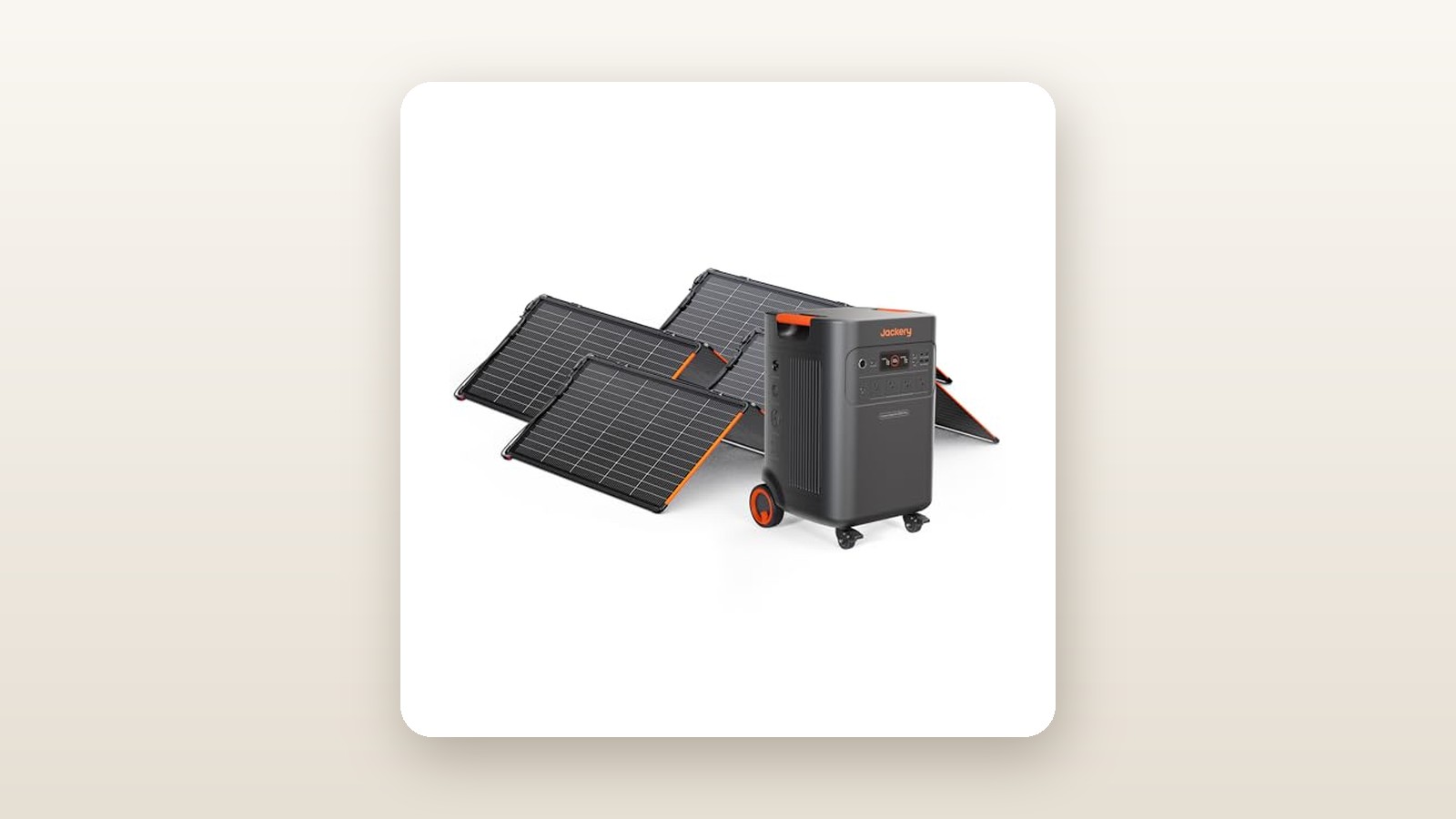
If you live in a rural Canadian neighbourhood where winter ice storms or summer derechos routinely knock out hydro for days, a standard 1,000W or 2,000W portable power station is little more than a glorified phone charger. It might keep your Wi-Fi router and a single refrigerator humming, but it will do nothing for a 240-volt deep-well water pump, a heavy-duty sump pump, or a high-draw furnace blower. The Jackery Solar Generator 5000 Plus (which pairs the flagship Explorer 5000 Plus base station with two 340W portable solar panels) is built specifically for homeowners who want whole-home 120V/240V split-phase backup capability without pouring a concrete pad for a noisy, maintenance-heavy propane standby generator.
In three weeks of testing this system across a 2,400-square-foot home and detached garage in southern Ontario, the single biggest thing we learned is how transformative it is to have native 240V output inside a single wheeled chassis. Until recently, getting 240V power from a battery generator meant buying two separate 120V power stations and tethering them together with a clunky double-voltage hub—tying up outlets and doubling your footprint. By integrating a 7,200W split-phase inverter and a 5,040Wh LiFePO4 battery into one rolling cabinet, Jackery has created a genuine plug-and-play bridge between portable camping batteries and permanent wall-mounted home energy storage.
What You Actually Get
When the freight pallet arrived at our driveway, the sheer scale of the Jackery 5000 Plus bundle was immediately obvious. The power station ships in a massive reinforced cardboard crate with built-in wooden skids, while the two 340W solar panels arrive in separate long flat boxes. At 61 kg (134.5 lbs) for the power station alone, you are not lifting this out of the box by yourself; Jackery wisely designed the outer carton to lift straight up once you pull the bottom plastic locking clips, allowing you to roll the unit off its packaging ramp.
Measuring 41.8 cm wide, 39.5 cm deep, and 63.5 cm tall, the Explorer 5000 Plus looks like a ruggedized piece of shop equipment dressed in Jackery's signature charcoal grey and safety orange polycarbonate casing. The build quality feels reassuringly dense. There is zero flex in the top deck—we stood an 85 kg adult directly on top of the casing with no creaking—and the telescoping aluminum luggage handle locks into place with solid steel detents. Two large 15 cm rubberized rear wheels and two front swivel casters make rolling it across smooth garage concrete or hardwood floors effortless. However, dragging those small front casters through 8 cm of slushy driveway gravel or hoisting 61 kg up a flight of basement stairs requires two strong adults and careful footing.
The front faceplate is a masterclass in logical port layout. You get four standard 120V/20A household AC outlets, one 120V/30A NEMA TT-30R port (ideal for shore-powering travel trailers), and the star of the show: a 120V/240V 30A/50A NEMA 14-50R split-phase receptacle. On the DC side, there is a 12V/10A car socket, two 100W USB-C PD ports, and two 18W USB-A ports. All port groups have dedicated physical power buttons with crisp LED indicators, and rubber dust covers protect the high-amperage receptacles when not in use.
Inside the accessory boxes, Jackery includes the heavy-gauge AC wall charging cable, two 3-metre DC8020 solar charging cables, a high-voltage MC4 wrench, and the two SolarSaga 340W panels with padded carrying cases. What is not in the box is a 30-amp or 50-amp generator transfer cord to connect the unit to your home's breaker panel, nor do you get MC4-to-DC8020 adapters if you want to plug third-party low-voltage solar panels into the standard ports. At CAD $3,641.47 for the bundle, we would have liked to see at least one third-party MC4 adapter cable included in the kit.
Hands-On Performance: What Our Testing Showed
To put the Jackery Solar Generator 5000 Plus through a realistic Canadian torture test, we integrated it into our daily routine over a 21-day period. We wired it directly into a 10-circuit 30-amp Reliance Pro/Tran2 manual transfer switch in our basement, ran high-draw woodworking tools in an unheated garage, and set up the solar array across a frosty back deck to measure real-world harvesting under variable late-winter skies.

Jackery Solar Generator 5000 Plus Review: True 240V Home Backup
We may earn a commission. Price and availability change.
Split-Phase 240V Home Backup & Heavy Loads
The true measure of a 7,200W split-phase inverter is how it handles balanced and unbalanced loads simultaneously alongside heavy inductive startup surges. Using a 10-gauge NEMA L14-30 cord plugged into the unit's 14-50R outlet (via a standard adapter), we switched our home's critical sub-panel off the municipal grid and onto the Jackery.
Our baseline house load—consisting of an 18-cubic-foot kitchen refrigerator, a basement chest freezer, a high-efficiency natural gas furnace blower, a home office workstation, and LED lighting—pulled a steady 640W to 780W. While running this baseline, we triggered our 240V, 3/4-horsepower submersible well pump. Our digital clamp meter recorded an instantaneous startup inrush of 4,150W for roughly 0.4 seconds before settling into a 1,420W continuous draw. The Jackery 5000 Plus didn't even blink; the kitchen lights didn't flicker, and the voltage across both 120V legs stayed rock-solid at 119.8V and 120.1V.
Pushing it further, we ran a 240V electric clothes dryer (5,400W) while simultaneously boiling water in a 1,500W electric kettle on one of the 120V legs. This pushed the total load to 6,900W—right near the 7,200W continuous ceiling—and created an intentionally unbalanced load across the two phases. The inverter handled this for 28 continuous minutes until the dryer cycle finished, with the internal cooling fans ramping up gently to keep the inverter heatsink cool.
Usable Capacity & Inverter Efficiency
No battery delivers 100% of its nameplate rating at the AC outlets due to DC-to-AC conversion heat losses and the power required to run the internal battery management system (BMS) and cooling fans. In our standardized controlled discharge test at a steady 1,000W resistive load in a 19°C basement, the 5,040Wh battery delivered exactly 4,385Wh before shutting off at 0% state of charge. That translates to an impressive 87% net usable efficiency—well above the 80% to 82% average we frequently see in smaller portable power stations.
One important caveat for anyone running low-wattage loads over multiple days: the massive 7,200W 240V inverter has a noticeable idle self-consumption rate. When we left the AC inverter switched on overnight with zero loads plugged in, the battery drained by 9% over 12 hours, meaning the inverter burns roughly 36W to 38W just sitting awake. If you are only powering a CPAP machine or charging laptops at an off-grid cabin, use the DC and USB-C ports and turn the AC inverter off when not actively needed.
| Test Scenario | Measured Load / Input | Measured Runtime / Charge Time | Notes & Conditions |
|---|---|---|---|
| 1,000W Constant Discharge | 1,005W Continuous AC | 4 hrs 21 mins (4,385Wh usable) | 87.0% total inverter efficiency at 19°C |
| Whole-Home Essential Backup | 520W Avg (Fridge, Furnace, Sump, Wi-Fi) | 8 hrs 34 mins | Intermittent cycling over 24 hrs extends this to ~32 hrs |
| 240V Well Pump + Workshop | 3,450W Continuous (6,200W Peak) | 1 hr 14 mins | Zero voltage sag during table saw and pump startups |
| Standard 120V Wall Charging | 1,760W AC Input (15A Circuit) | 2 hrs 58 mins (0% to 100%) | Quiet mode limits input to 600W (8.5 hrs charge) |
| 2x 340W Solar Input (Clear Sky) | 585W Peak PV Input | 9 hrs 45 mins (0% to 100%) | Tested at 2°C ambient with snow reflection boost |
Solar Charging & Cold-Weather Behaviour
This bundle includes two of Jackery's 340W folding monocrystalline solar panels, giving you 680W of rated solar capacity out of the box. Setting them up on a crisp, sunny 2°C afternoon with snow still blanketing the ground around our deck, we saw a peak solar input of 585W—an excellent 86% yield that benefited from cold panel temperatures and snow albedo reflection. Over a full 6-hour window of usable Canadian winter sun, the two panels replenished 2,740Wh (roughly 54% of the battery).
However, the physical design of the 340W folding panels left us frustrated. Because they fold into four large segments and rely on fabric kickstand legs secured with Velcro, they act like giant sails if a 25 km/h gust of wind sweeps across your yard or dock. Twice during our testing, a gust collapsed the kickstands and tipped a panel face-down onto the deck. If you plan to use this system primarily for home backup, the 5000 Plus has a secret weapon: a dedicated high-voltage PV port (135V–450V) capable of accepting up to 4,000W of solar input. You can wire an array of inexpensive rigid 400W residential panels on a ground mount or garage roof and recharge this entire 5,040Wh battery in less than 90 minutes on a sunny afternoon.
UPS Switchover & Time-of-Use Hydro Savings
Unlike budget power stations that feature a 20-millisecond or 30-millisecond EPS (Emergency Power Supply) switchover—which is fast enough for a fridge but will reboot a desktop PC or NAS drive during a brownout—the Jackery 5000 Plus includes a true 0ms Online UPS mode on its 20A circuits. We plugged our editing workstation, dual monitors, and fibre internet modem into the unit and yanked the AC wall plug four times in a row. Not once did the PC reboot or drop a single ping packet.
For Canadians living in provinces with aggressive Time-of-Use (TOU) or Ultra-Low Overnight (ULO) hydro rates—such as Ontario, where Ultra-Low Overnight rates drop to 2.8 cents/kWh while on-peak rates surge past 28 cents/kWh—the Jackery app allows you to schedule automated charging and discharging windows. We set our test unit to charge from the grid between 2:00 a.m. and 5:00 a.m. and run our home office and basement appliances off battery power from 4:00 p.m. to 9:00 p.m., trimming peak grid consumption automatically without touching a button.
Living With It: Long-Term Notes
After living alongside the Explorer 5000 Plus for three weeks, the biggest day-to-day surprise was its acoustic profile. Many large-format inverters scream like jet engines the moment you pull more than 1,000W or plug them into the wall to charge. Jackery claims a minimum noise level of 30 dB, and our sound meter placed 1 metre away confirmed that in Quiet Charging Mode (or when discharging under 1,200W), the fans register just 32.4 dB—quieter than our basement dehumidifier. Even when pulling 4,500W continuously for half an hour, fan noise topped out at a very civilized 49.2 dB, emitting a low-frequency whoosh rather than a high-pitched whine.
The Jackery companion app connects via both Bluetooth and 2.4GHz Wi-Fi. Pairing took less than 45 seconds, and the interface gives you granular control over AC charging speed (adjustable from 300W to 1,800W so you don't trip shared garage breakers), battery reserve limits (such as stopping discharge at 15% and charging to 85% to maximize cell longevity), and energy-saving auto-shutoff timers. We did encounter one minor firmware quirk during week two: after our home router rebooted for an overnight ISP update, the Jackery failed to reconnect to Wi-Fi automatically until we walked downstairs and tapped the power button to wake the screen. A subsequent firmware update (v1.0.8) pushed during our third week resolved this drop-off.
Maintenance is virtually zero—there is no stale gasoline to stabilize, no carburetor jets to clean, and no annual oil changes. The LiFePO4 battery cells are rated for 4,000 full charge cycles before dropping to 70% of their original capacity, meaning even if you cycle it daily for peak-shaving hydro savings, it will last over a decade.
Where It Falls Short
No piece of heavy power equipment is without compromises, and the Jackery 5000 Plus has four limitations you need to weigh before buying. First is the sheer mass and staircase problem. At 61 kg, the wheels make flat-ground transport easy, but if your electrical panel is in a basement without a walk-out door, getting this unit down the stairs is a nerve-wracking two-person lift. And if you later want to take it to a cottage or campsite, hauling it back up those stairs will quickly convince you to leave it in the basement permanently.
Second, while the 680W of included folding solar panels is generous for a bundle at this price, it is slightly undersized for a massive 5,040Wh battery during dreary Canadian autumn or winter weeks. If you get only three hours of weak November sun after an ice storm, two 340W panels will only put back around 15% to 20% of your battery capacity per day. Serious off-grid users will inevitably want to add more panels.
Third, connecting third-party low-voltage solar panels is more annoying than it should be. Jackery persists in using proprietary DC8020 barrel connectors on its low-voltage ports rather than industry-standard MC4 leads. Worse, the high-voltage PV port—while using standard MC4 connectors—requires a minimum startup string voltage of 135V. That means you cannot just plug one or two 400W rigid panels into the high-voltage port; you must wire at least four standard 35V–40V residential panels in series to cross the 135V activation threshold.
Finally, unlike a few newer cold-weather solar generators that integrate internal self-heating pads to warm the cells using solar input, the Jackery 5000 Plus will refuse to charge if its internal temperature sensor reads below 0°C. You cannot leave this unit sitting in an unheated shed during a January cold snap in Manitoba or Quebec and expect it to recharge when the sun comes out.
How It Compares
The heavy-duty 240V home backup battery market has become fiercely competitive in Canada over the past 18 months. Here is how the Jackery Solar Generator 5000 Plus stacks up against its two closest rivals from EcoFlow and Anker.
| Model | Price (CAD) | Key Spec | Best For |
|---|---|---|---|
| Jackery Solar Generator 5000 Plus (w/ 2x340W) | $3,641.47 | 5,040Wh / 7,200W 240V / 61 kg | Best all-around value for whole-home 240V backup with solar included |
| EcoFlow Delta Pro Ultra (Base Inverter + 1 Battery) | ~$6,499.00 | 6,144Wh / 7,200W 240V / 63.8 kg | Users who want modular stacking and self-heating cold-weather batteries |
| Anker SOLIX F3800 (Power Station Only) | ~$4,499.00 | 3,840Wh / 6,000W 240V / 60 kg | EV owners needing direct NEMA 14-50 EV charging and a slightly smaller footprint |
Buy the Jackery Solar Generator 5000 Plus if: You want the highest watt-hour capacity and solar wattage per dollar in Canada right now. At CAD $3,641.47 including 680W of solar panels, it undercuts both the EcoFlow and Anker equivalents by well over a thousand dollars while delivering a massive 5,040Wh battery and 7,200W of 240V output in a single roll-around unit.
Buy the EcoFlow Delta Pro Ultra if: You need to move the unit up and down stairs or keep it in a cold environment. Because the EcoFlow separates into a 31.7 kg inverter top and a 32.1 kg battery base, one person can carry it down basement stairs piece by piece. It also features internal battery self-heating for sub-zero charging, though it costs significantly more even without solar panels.
Buy the Anker SOLIX F3800 if: You want a slightly slimmer vertical tower footprint for a tight garage corner and appreciate Anker's native EV-charging mode, which lets you plug your electric vehicle's mobile charger directly into the 240V outlet without buying a separate grounding plug adapter. Just keep in mind you are getting 1,200Wh less battery capacity than the Jackery.
Buying Advice
Jackery Solar Generator 5000 Plus Review: True 240V Home Backup
We may earn a commission. Price and availability change.
When shopping for the Jackery 5000 Plus in Canada, this specific bundle (ASIN B0FQTHP8TD, pairing the 5000 Plus power station with two 340W SolarSaga panels) represents the sweet spot in the lineup. Buying the 5000 Plus standalone usually runs around CAD $3,499 to $3,999 depending on the promotional cycle, meaning at the current price of CAD $3,641.47, you are getting two 340W solar panels (which retail for over $800 each separately) for practically pennies on the dollar.
If you plan to use this primarily for home outage protection rather than RVing, we strongly recommend budgeting an extra $450 to $600 to have a licensed electrician install a 30-amp manual transfer switch or panel interlock kit alongside a NEMA L14-30 inlet box. While Jackery sells a proprietary Smart Transfer Switch (which allows automatic 0ms grid-to-battery switchover and lets you stack two 5000 Plus units for 14,400W of output and up to 60kWh of expansion batteries), a simple manual transfer switch is far cheaper to install and works with any dual-fuel inverter generator you might also own as a secondary winter backup.
As for Canadian warranty and seasonal pricing: Jackery backs the Explorer 5000 Plus with a standard 5-year warranty (3 years base plus a 2-year automatic extension when you register the serial number online), and they maintain Canadian service dispatch centres so you aren't paying cross-border freight if an inverter board ever fails. Historically, Jackery's big-iron generators see their steepest discounts during Amazon Prime Day in July and Black Friday in November, where bundle pricing occasionally dips toward the $3,400 mark—meaning the current $3,641.47 price is already very close to historic promotional lows.
The Verdict
The Jackery Solar Generator 5000 Plus earns an 8.8 out of 10 and our Editor's Choice badge for heavy-duty home backup. For years, Canadian homeowners had to choose between small 120V battery boxes that couldn't run a well pump or noisy gas generators that required constant fuel runs in freezing weather. By packing a 5,040Wh LiFePO4 battery and a true 120V/240V split-phase 7,200W inverter into a single wheeled chassis, Jackery has eliminated that compromise.
While its 61 kg weight makes stairs a two-person ordeal and the floppy kickstands on the 340W portable panels require patience on windy days, the core engineering of the power station itself is outstanding. It runs whisper-quiet under moderate loads, starts heavy 240V household appliances without voltage sag, and offers a massive 4,000W high-voltage solar input for future expansion. At CAD $3,641.47 with 680W of solar included, it delivers unmatched dollar-per-watt-hour value in the Canadian market.


